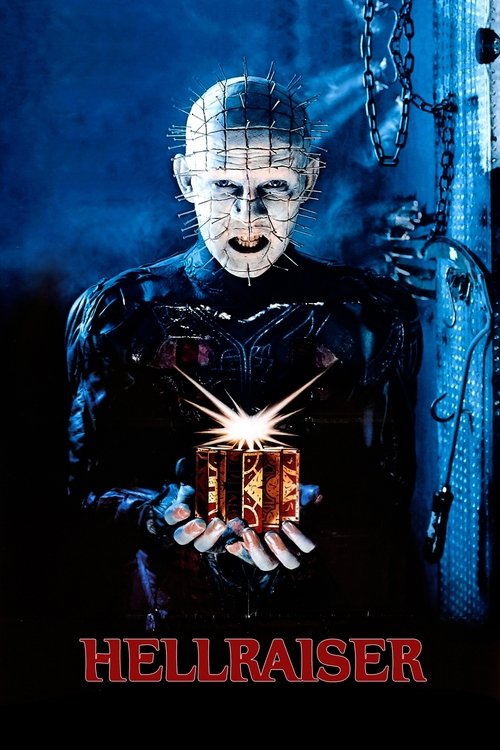
Hellraiser
1987 · Clive Barker
For when you want horror with real teeth and ideas — a late-night watch when you're in the mood to be disturbed rather than merely startled. Strictly for the strong of stomach; this is the challenge end of the genre.
What it's about
A hedonist who has exhausted every earthly pleasure solves an ornate puzzle box and summons the Cenobites — solemn, mutilated beings from a realm where pain and pleasure are the same thing. What follows unfolds in an ordinary London house: a loveless marriage, a wife with a dangerous past attachment, something regenerating under the attic floorboards, and a bargain that requires blood. It's a domestic melodrama with a door punched through to hell.
The experience
Sour, sensual, and genuinely transgressive — it moves like a gothic chamber drama and then detonates into some of the most visceral practical-effects horror of its decade. It doesn't jump-scare you; it unsettles you at a deeper, stickier level.
Performances
Clare Higgins is the film's cold engine as Julia, playing a woman's slide into monstrousness with icy conviction, and Doug Bradley's few minutes as the lead Cenobite created one of horror's most iconic figures through sheer stillness and diction.
The craft
Clive Barker, adapting his own novella as a first-time director, fuses British gothic craft with astonishing practical makeup and creature effects on a tiny budget, all lifted by a lush, unexpectedly romantic orchestral score. The Cenobite designs alone are a landmark of monster-making.
Why it matters
It launched a decades-long franchise, gave horror the icon of Pinhead, and shifted the genre's center of gravity — monsters that negotiate and seduce rather than chase, and horror rooted in desire as much as fear.
Snapshot
Hellraiser is the film in which horror's monsters stopped chasing and started negotiating. Adapting his own 1986 novella The Hellbound Heart, first-time director Clive Barker built a small, sour domestic melodrama — an unfaithful wife, a weak husband, a dead lover under the floorboards — and then punched a hole through its ceiling into a cosmology of ritualized agony. The Cenobites, the film's now-iconic leather-and-suture hierophants, occupy only a few minutes of screen time; the real horror engine is Julia Cotton picking up men in bars and hammering them to death in an empty attic so that her brother-in-law can reassemble himself out of their blood. Made in London on roughly a million dollars for New World Pictures and disguised as an American picture, it fused British gothic craft, Grand Guignol theater, Catholic martyrology and fetish iconography into something that looked like nothing else in 1987. It launched one of horror's longest-running franchises, gave the genre a monster who speaks in complete sentences about the nature of experience, and permanently expanded the vocabulary available to horror design.
Industry & production
Barker came to Hellraiser angry. He had written screenplays for two British features directed by George Pavlou — Underworld (1985) and Rawhead Rex (1986) — and was dissatisfied enough with both that directing became less an ambition than a defensive necessity. His literary reputation supplied the leverage: the Books of Blood had made him the most conspicuous new name in horror fiction, and Stephen King's much-reproduced endorsement — "I have seen the future of horror and his name is Clive Barker" — became, in effect, marketing collateral for a film by a director with no track record.
Financing came from New World Pictures, by then several years removed from Roger Corman's ownership and operating as a mid-size independent with an appetite for genre product. The budget is generally reported at around a million dollars, and the modesty of the sum is inseparable from the film's character: New World had little reason to interfere with a picture that cost less than a studio film's marketing test. Christopher Figg produced. Shooting took place in England — interiors at the Production Village complex in Cricklewood, north London, with the Cotton house exteriors found in the same general district — while the story was pitched at an unnamed, deliberately placeless America.
That transatlantic fudge produced the film's oddest production fact: several British performers were post-dubbed with American voices so the picture would read as domestic to US audiences. The seams are audible, and they contribute to the film's slightly denatured, dreamlike sense of place. Barker has also described the title as an imposition — his working title derived from the novella — with Hellraiser arriving from the distributor's side.
Censorship shaped the finished object. Trims were required to secure an R rating in the United States, and the film arrived in a British climate still conditioned by the "video nasty" panic and the Video Recordings Act 1984. Released in the autumn of 1987, it was a substantial commercial success in proportion to its cost — reported North American grosses in the region of fourteen million dollars — enough to make a sequel immediate and a franchise inevitable.
Technology
Hellraiser is a monument of the late analog era: 35mm photography, spherical lenses matted to 1.85:1, and effects achieved almost entirely in front of the camera or in the optical printer. There is no digital compositing in it, and its enduring tactility is a direct consequence.
The centerpiece is Frank's resurrection — a sequence assembled from foam-latex bladder rigs, articulated puppets, viscera built from butcher's supply and food-grade slime, and, crucially, camera trickery: reverse photography and undercranking used to make matter appear to gather rather than disperse. The chains that erupt to hook their victims were largely practical, frequently shot in reverse so that a chain pulled away on set reads as a chain flying toward the lens. The Cenobites' arrival is signaled by hard shafts of light, atmospheric haze, and optically added beams — a cheap effect executed with unusual discipline, since Barker's staging withholds rather than displays.
Two artifacts carry disproportionate design weight. The Lament Configuration — Lemarchand's box — was realized by Simon Sayce as a lacquered puzzle-box that reads simultaneously as toy, reliquary and instrument; its mechanical clicks and unfolding faces are shot in loving macro. The Cenobite makeups came from Bob Keen's Image Animation, working from Barker's own drawings, with costumes by Jane Wildgoose. The final "engineer" creature is a stop-motion and puppet construction whose brevity is a budgetary tell as much as an aesthetic choice.
The record on specific camera packages and lab processes is thin; what is well documented is the method — practical first, optical second, nothing solved in post that could be solved on the floor.
Technique
Cinematography
Robin Vidgeon, who came up through the British camera department on large productions before becoming a director of photography, gives the film a polish its budget does not explain. The scheme is bluntly bifurcated: downstairs is naturalistic, warm-neutral, unremarkable — beige walls, packing cases, the visual register of a couple moving into a house they cannot quite afford. Upstairs, the attic is a chamber of hard slats and shafts, dust in the beam, deep shadow, and a rising blue that intensifies as Frank re-forms. The Cenobite scenes push further into expressionist blue-white with heavy backlight and haze.
Vidgeon's camera is patient. Where the contemporaneous American slasher relied on prowling subjective movement, Hellraiser favours slow dollies, locked frontal compositions and an almost devotional stillness when the Cenobites appear — they are presented, not discovered. That frontality is the film's most distinctive photographic gesture: it treats the monsters as altarpieces.
Editing
Richard Marden, a veteran of mainstream British features rather than genre, cuts the domestic material with unfussy classical continuity — which is precisely what makes the ruptures land. The horror set-pieces are built differently: the resurrection is a mosaic of macro inserts, each shot short enough to imply more than it shows, accumulating into a body. Kirsty's hospital nightmare and the hospital-corridor pursuit use abrupt shock cutting of a kind the rest of the film refuses.
By most accounts New World's post-production executive Tony Randel — who would go on to direct Hellbound: Hellraiser II — supervised the finish, and the film's brisk, slightly compressed final shape reflects both censorship trims and a distributor's instinct for length. Some connective tissue is clearly missing; the cosmology is delivered in fragments, which turns out to be the film's greatest asset.
Mise-en-scène / staging
The house at 55 Lodovico Street — a name that nods, as the novella does, toward the Ludovico Technique of A Clockwork Orange — is the whole film in miniature: a banal domestic shell with an unspeakable upper room. Barker's staging is architectural. Ascent equals transgression; the attic is reached by ladder, the way one reaches a hayloft or a gallows.
Costume does the ideological work. Julia is dressed in tailored blues and mustards, hair immaculate, a woman performing a marriage. The Cenobites are the inverse: Wildgoose's designs hybridize surgical dress, ecclesiastical vestment and fetish leather, with wounds treated as ornament — pins driven in a lattice, a throat opened and dressed, flesh clamped and pinned as though tailored. Nothing about them is accidental or diseased; every mutilation is designed. That single decision separates Hellraiser from the rot-and-slime idiom of its contemporaries and is the reason its imagery outlived its plot.
Sound
Barker commissioned a score from the industrial group Coil; New World rejected it, and the material later circulated independently. In its place, Christopher Young — fresh from A Nightmare on Elm Street 2: Freddy's Revenge — wrote a full orchestral and choral score in an unabashed gothic-romantic idiom, its main theme a slow, music-box waltz. The choice is counterintuitive and decisive: instead of scoring the film as transgression, Young scores it as tragedy and ceremony, lending grandeur to material that could easily have played as squalid.
Sound design supplies the other half: the wet, granular foley of tissue reassembling, the precise mechanical tick of the box's rotating faces, a tolling bell announcing the Cenobites, the drag and clatter of chain. The dubbed American dialogue floats slightly free of the images — an accident, but one that adds to the film's sense of a place that does not quite exist.
Performance
Clare Higgins gives the film its spine. A stage actress with no investment in genre condescension, she plays Julia as a woman bored to the point of violence, and her progression from revulsion to complicity to appetite is the most carefully graded arc in the picture. Andrew Robinson — indelibly the Scorpio Killer in Dirty Harry — plays Larry as deliberately soft and unassertive, then, in the final act, cuts loose as Frank wearing his brother's skin. Ashley Laurence's Kirsty is an unusually active heroine for the period: she does not merely survive, she negotiates, trading information for her life and then reneging.
Frank is split between Sean Chapman (in flesh) and Oliver Smith (skinless), an unusual division that keeps the character's charisma and his abjection in separate bodies. Doug Bradley, Barker's friend and collaborator since their Liverpool school days and their Dog Company theater work, plays the Lead Cenobite — credited as such; "Pinhead" was a crew nickname that the marketplace subsequently made canonical. Bradley's performance is the anti-slasher: motionless, unhurried, sonorously articulate, more senior clergy than killer. He does not lunge. He explains.
Narrative & dramatic mode
Structurally, Hellraiser is a noir with a supernatural third act. Strip out the box and the first hour is James M. Cain: a wife, a lover, a dull husband, a corpse in the house, and a series of murders committed to preserve an affair. The Cenobites appear at the beginning and then withdraw for most of the running time, functioning less as antagonists than as a legal system that will eventually arrive to enforce a contract.
The film is organized around two bargains — Julia's with Frank, Kirsty's with the Cenobites — and its climax turns on the fact that both parties to a bargain are bound. That contractual logic replaces the moral logic of the slasher, where death is punishment for transgression. Here death is procedure.
Barker withholds explanation almost completely. Where the box came from, what the Cenobites are, what Hell means in this scheme: none of it is dramatized, only gestured at through the merchant who traffics the box and the circulating artifact of the final scene. The result is an unusually adult refusal of exposition, and it is why the film's world felt inexhaustible enough to sustain sequels, comics and novels.
Genre & cycle
1987 was late in the American slasher cycle and deep into the video boom; A Nightmare on Elm Street 3 and Evil Dead II were that year's most visible horror releases, both of them extroverted and, in Raimi's case, comic. Hellraiser is conspicuously humorless, and that sobriety is a positioning statement.
It belongs more properly to two other cycles. One is the mid-'80s golden age of practical body horror — The Thing, Videodrome, Re-Animator, From Beyond, The Fly — where the transformation of flesh is the primary spectacle. The other is erotic gothic: Cat People, The Hunger, the strain of horror that treats desire rather than terror as its subject. Hellraiser welds the two, and its innovation is to make the monsters objects of fascination rather than disgust. It also, almost incidentally, contributed to the era's shift from anonymous killers to branded, personality-bearing monsters — the very commercial logic that would flatten the Cenobites into a franchise mascot within five years.
Authorship & method
Barker is the rare horror auteur who arrived complete as a designer. A painter, illustrator, playwright and novelist before he was a filmmaker, he storyboarded and drew extensively, and the Cenobites exist on paper in his hand before they exist in latex. His authorship is conceptual and iconographic rather than grammatical: the film's cutting and coverage are competent-conventional, the work of a first-timer learning on the floor, while its production design and its ideas are fully realized.
The key collaborators map onto that division of labor. Robin Vidgeon supplied the professional image. Richard Marden supplied classical construction. Christopher Young supplied the tragic register that the script alone does not earn. Bob Keen's Image Animation, Jane Wildgoose's costumes and Simon Sayce's box realized Barker's drawings. Producer Christopher Figg held the budget together. Doug Bradley, Simon Bamford and Nicholas Vince — all from Barker's theater circle — brought a stage discipline to performances delivered almost entirely through posture.
Movement / national cinema
Hellraiser is a British film pretending not to be one, and that pretense is a symptom of its industrial moment. The Hammer and Amicus traditions had collapsed a decade earlier; the mid-'80s brought the end of the Eady levy, the unraveling of Goldcrest, and a British production sector in which genre films were largely made with American money for American audiences. The picture's American setting, its dubbed accents and its US distributor are all consequences.
What survives of the national tradition is craft and temperament: theater-trained actors, a Home Counties suburban gothic imported into a nominally American house, a taste for the ecclesiastical and the mortuary, and an unembarrassed literary streak. Barker would repeat the arrangement on Nightbreed (1990), also shot in England for American release, and the Hellraiser sequels stayed British-made for a further installment before decamping.
Era / period
The film sits at the intersection of Thatcher-Reagan domestic ideology and the AIDS crisis, and criticism has read it through both. The Cotton household is aspirational property with nothing inside it; the horror comes up through the floor of a house being renovated. More pointedly, Hellraiser arrived at a moment when contaminated flesh, penetration and desire had acquired a terrible public charge, and its imagery — bodies opened, pleasure and injury made indistinguishable, a lover reconstituted from other men's blood — was inevitably legible in that light.
Barker, a gay writer working in a genre then notorious for punishing sexuality, complicated the reading rather than confirming it: the Cenobites are not moralists and the film does not present appetite as sin. What it presents is appetite as a transaction with terms the buyer has not read.
Themes
The film's governing proposition is announced in the marketing and honored in the text: pleasure and pain are not opposites but a single continuum, and the Cenobites are its specialists. Their name is taken from cenobitic monasticism — monks living in disciplined community — and Barker's design pushes the analogy hard, with vestment, tonsure-like mutilation, ritual and vow all present. They are the film's only characters with a settled ethics.
Around that sits a set of profane appetites. Frank consumes; Julia feeds him; the family is a hunting ground, with an adulterous affair between a wife and her husband's brother, Frank's assault on his niece, and the horror of a father returning home wearing the wrong soul. Knowledge is figured as trespass — the box is a Faustian instrument, an inquiry that answers. And the whole is bound by the theme of the contract: everything in Hellraiser is bought, and every purchase is honored to the letter.
Reception, canon & influence
Contemporary reviews split predictably. Genre press received the film as a landmark and Barker as a major arrival; a number of mainstream American critics were repelled, treating the sadomasochistic iconography as gratuitous and the plot as thin. Its reputation has risen steadily since, and it now sits securely in the canon of 1980s horror, with sustained academic attention — queer horror scholarship such as Harry Benshoff's Monsters in the Closet and dedicated studies including Paul Kane's book-length account of the films and their legacy.
Looking backward, the influences are unusually legible. Grand Guignol and Barker's own physical theater supply the staging. Catholic martyrology — Sebastian, the flagellants, the ecstatic wound — supplies the iconography, crossed with the leather and S/M subcultures of the period. Bataille and Sade underwrite the thesis about pleasure. Lovecraft supplies the forbidden-knowledge structure without the purple prose; Cocteau, whom Barker has repeatedly cited, supplies the conviction that the fantastic can be beautiful. The plot machinery is Cain-via-noir, and the resurrection-by-blood recalls the Hammer Frankenstein cycle. The wish-granting artifact belongs to a lineage running from Faust to "The Monkey's Paw."
Forward, the influence is broad. The immediate legacy is the franchise: Hellbound: Hellraiser II (1988), Hell on Earth (1992), Bloodline (1996), a long direct-to-video tail — several entries built from unrelated scripts retrofitted with Cenobites — and David Bruckner's 2022 reimagining with Jamie Clayton as the Priest. Epic Comics' Clive Barker's Hellraiser anthology (1989–93) proved the mythology could hold other authors' stories.
Beyond the series, the design language propagated widely. Event Horizon (1997) is routinely described as Hellraiser in space. The film's ceremonial-mutilation aesthetic informed industrial and goth visual culture and, through it, music video. Critics have persistently traced Silent Hill's executioner figures and a strain of video-game monster design back to Wildgoose and Keen's Cenobites. Most durably, Hellraiser established that a horror monster could be articulate, doctrinal and unhurried — a figure who arrives not to chase you but to collect. Nearly every subsequent horror antagonist who negotiates rather than pursues is working in the space this film opened.
Reception
In 1987 it landed as a shocking, divisive debut — critics were split on the gore, but horror fans knew instantly something new had arrived. Nearly forty years on it's settled comfortably into the canon as one of the defining British horror films of the decade, its standing only burnished by every sequel that failed to match it.
How Hellraiser was received, from release to now →
How to watch Hellraiser: what to notice on a first viewing
- Notice how differently downstairs and the attic are lit. Vidgeon shoots the house in warm, unremarkable domestic light below, then switches the attic to hard shafts, dust, and a rising blue that gets stronger as the story goes on. The house is quietly split into two different films, one ordinary and one occult, by lighting alone.
- Watch how still and frontal the camera holds on the Cenobites. Where slasher films of the era prowl with a restless camera, Barker and Vidgeon present the Cenobites in locked, symmetrical shots, almost like a painting being unveiled rather than a monster jumping out. You are made to regard them, not just be scared by them, the way you would look at a religious image.
- Look at how deliberately designed each Cenobite wound looks. Pins sit in neat lattices, a throat is opened and dressed, flesh is clamped as if tailored. Nothing on their bodies reads as accidental or diseased. Their mutilation is presented as craftsmanship, which is exactly what makes them fascinating instead of simply repulsive.
- Listen for a gentle, music-box waltz under the horror. Christopher Young scores the film with full orchestra and choir in a romantic, almost tragic register, instead of harsh or dissonant music you might expect from this material. The score treats the horror as ceremony and grief rather than shock, which makes it feel stranger, not safer.
- Track how you always reach the attic by ladder. Barker stages the house so that going up always means going somewhere forbidden, the ladder itself doing the work a locked door might in another film. Height in this house is not neutral. Going up always costs something.
The whole guide to watching Hellraiser, with the keys for a rewatch →
Influences: the films it descends from and the films it influenced
- Orphée (1950) — Cocteau's in-camera conjuring — reversed footage and the mirror shot as a physical membrane — is the exact grammar of Frank's resurrection, where blood, sinew and skin reassemble by running the decomposition backwards through the optical printer rather than by cutaway.
- Double Indemnity (1944) — Supplies the Cain armature Barker bolts under the front half: a wife and her lover running a domestic murder scheme as a procedure, with Julia's attic pickups staged as the femme fatale's methodical, repeatable transaction rather than as horror set pieces.
- The Curse of Frankenstein (1957) — Hammer's blood-as-reagent resurrection staged in a bourgeois house's upper room, and Fisher's discipline of holding wet viscera in saturated color on a British stage floor, is the template for the attic's regeneration sequences.
- Repulsion (1965) — Establishes the flat itself as antagonist — walls that give way to hands, domestic space photographed with wide lenses until its geometry turns hostile — which Hellraiser inherits as the Lodovico Street house rather than a castle or crypt.
- Inferno (1980) — The house-as-machine built on vertical staging (stairwells, attics, hidden lower rooms) with its mythology released only through a found text and never explained by a character, the same withheld-exposition contract Hellraiser signs with the box.
- The Thing (1982) — Rob Bottin's articulated flesh puppets held on screen in full light, cut as a mosaic of macro inserts on cable-pulled details, is the shot-list logic Bob Keen's Image Animation reproduces for the hooks, the flayed body and the box's opening.
- Videodrome (1983) — Rick Baker's latex bladder work makes the wound an aperture — a slit that receives rather than bleeds — establishing the body as a device with openings, which is precisely the Cenobites' engineering premise.
- The Hunger (1983) — Fuses commercial-gloss photography with fetish vestment (leather, tailoring, the ankh worn as both jewelry and blade) so that an artifact of predation is designed like couture — the design ethic behind Jane Wildgoose's Cenobite costuming and Simon Sayce's box.
- Lifeforce (1985) — British-crewed erotic gothic that runs desiccation and reconstitution through reverse photography and optical compositing, proving the Pinewood-adjacent effects pipeline Barker would use could sell a body being unmade and remade on a genre budget.
- Hellbound: Hellraiser II (1988) — Scales Barker's drawings into architecture, building the Labyrinth as a literal vertical set of shifting corridors and reusing the same latex process for skinless Julia, while Christopher Young expands his tragic themes into full choral statement.
- Nightbreed (1990) — Industrializes the designer-auteur method: Image Animation manufactures an entire tribe of creatures directly from Barker's paper drawings, with performance again delivered through posture and prosthetic silhouette rather than facial acting.
- Candyman (1992) — Takes Hellraiser's central invention — the courteous, unhurried monster who arrives only when a summoning rule is correctly performed — and pairs it with a liturgical organ-and-choir score doing exactly the elevating work Young's did for the Cenobites.
- Event Horizon (1997) — Transplants the iconography wholesale: a gothic-industrial set dressed as a cathedral of spikes and grilles, a gravity drive built as a rotating puzzle mechanism, and flayed bodies revealed in the same macro-insert vocabulary.
- Saw (2004) — Extends contractual logic into machinery — an apparatus that requires the victim's active consent and appetite to operate — and an antagonist who states terms rather than pursues, the negotiating monster Hellraiser licensed.
- Silent Hill (2006) — Its executioner and nurse figures are direct descendants of Wildgoose's vestment design and Keen's build — bound, hooded, surgically dressed bodies moving with stage-trained slowness through rust-and-flesh architecture.
- Martyrs (2008) — Literalises the Catholic martyrology Barker sublimated: flaying performed as a clinical, documented protocol toward ecstasy, shot with clean continuity coverage so the procedure reads as doctrine rather than as spectacle.
- Hellraiser (2022) — Reimagines the box as a legible mechanism — each configuration a physically motivated blade deployment — and rebuilds the vestments as prosthetics sculpted flush to skin, replacing latex-over-costume with pinned, sutured surface.
- The Cabin in the Woods (2012) — The Cenobite design and summoned-pain-god iconography are directly echoed in 'Fornicus, Lord of Bondage and Pain,' one of the taxonomy's marquee monsters.
- Prince of Darkness (1987) — Released within weeks, it makes evil doctrinal and object-bound — a sealed vessel with rules, attended by a liturgical score running almost continuously — the same substitution of theology and apparatus for a chasing killer that Barker makes with the Lament Configuration.
- Re-Animator (1985) — Barker builds on the same two-part structure — a body reassembling itself in an upstairs room while a straight-faced accomplice lures victims to feed it — and shares the refusal to hide resurrection effects behind concealing cuts.
- A Nightmare on Elm Street 3: Dream Warriors (1987) — Released the same year and solving the same commercial problem the same way: Bob Keen's latex-and-appliance monster designed as a brand-legible face, an unironic orchestral score (Christopher Young) against a slasher marketplace, and mythology-as-rulebook engineered so sequels have machinery to run on.
Similar films
- Saw (2004) — influence & lineage
- Halloween (1978) — shared sensibility
- Suspiria (1977) — shared sensibility
- Insidious (2011) — shared sensibility
- Eraserhead (1977) — shared sensibility
- House (1977) — shared sensibility
- Evil Dead Burn (2026) — shared sensibility
- Obsession (2026) — shared sensibility