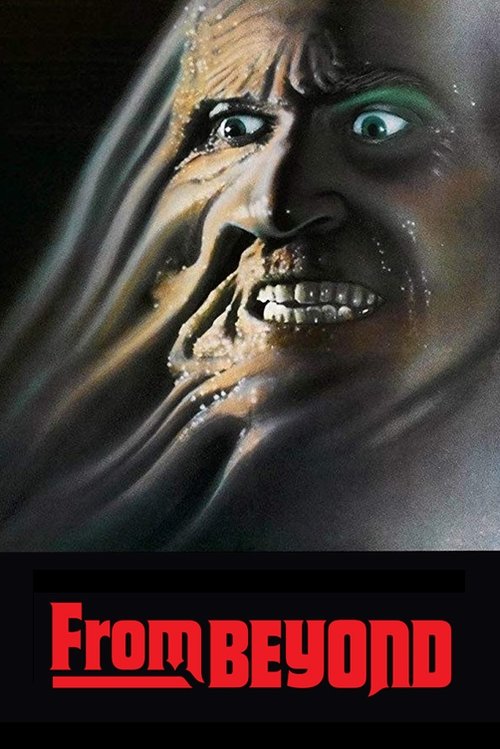
From Beyond
1986 · Stuart Gordon
For when you want practical-effects body horror at full throttle — a midnight movie to make you squirm and laugh, best with a strong stomach and ideally an audience. Decidedly a thrill-seeker's pick, not a gentle one.
What it's about
A scientist builds the Resonator, a machine that stimulates the brain's 'third eye' and opens perception to a predatory dimension overlapping our own — and it kills him. His traumatized assistant is pulled from a psychiatric ward by an ambitious psychiatrist who insists on restarting the experiment, and with each activation the boundary thins: the creatures see them, the machine changes them, and appetite starts flowing both ways.
The experience
Feverish, slimy and gleefully excessive — a short, intense ride through glowing purple light, melting bodies and escalating derangement. It's grotesque and funny in equal measure, with a strain of frank, unnerving eroticism that keeps you off balance.
Performances
Jeffrey Combs is magnetic as the haunted assistant, flipping between terror, pathos and transformation, and Barbara Crampton gives the psychiatrist a dangerous curiosity that makes her corruption by the machine genuinely disturbing.
The craft
Stuart Gordon turns a brief Lovecraft story into a showcase of pre-digital creature effects — writhing, dripping, hand-built monstrosities bathed in lurid pink and violet light. The production design makes one attic laboratory feel like a doorway to an entire hostile universe, and the practical gore has a tactile punch no computer imagery matches.
Why it matters
The follow-up to Re-Animator by the same core team, it cemented Gordon, Combs and Crampton as the defining names of screen Lovecraft and became a touchstone for fans of 80s practical-effects horror.
Snapshot
From Beyond is Stuart Gordon's second feature and his second adaptation of H. P. Lovecraft, made a year after Re-Animator (1985) with most of the same team. It takes a short Lovecraft story and turns it into a feature-length film about sex, sensory overload and bodies changing into something else. Dr. Edward Pretorius (Ted Sorel) and his assistant Crawford Tillinghast (Jeffrey Combs) build the Resonator, a machine that stimulates the pineal gland, the small structure in the brain long nicknamed the "third eye." It opens human perception to a dimension that overlaps our own and is full of predatory creatures. Pretorius is killed, apparently decapitated, and Tillinghast is committed to a psychiatric hospital. Dr. Katherine McMichaels (Barbara Crampton), an ambitious psychiatrist, takes him back to the house to rebuild the experiment. Police detective Bubba Brownlee (Ken Foree) goes with them. Pretorius returns from beyond as a shapeless, sexually predatory mass of flesh, and the Resonator starts changing everyone it touches.
The film sits where 1980s practical-effects body horror, the Lovecraft revival and the low-budget direct-to-video economy of Charles Band's Empire Pictures meet. It is generally regarded as Gordon's most visually extravagant early work. It also departs further from its source than Re-Animator does, and is more openly about erotic transgression.
Industry & production
The film was made by Empire Pictures, Charles Band's independent company. Empire was a prolific producer of genre films for theatrical release and, increasingly, for the home-video market that was growing fast in the mid-1980s. Brian Yuzna, who had produced Re-Animator, produced again; Band was executive producer. The script is credited to Dennis Paoli, from an adaptation by Yuzna, Paoli and Gordon. Paoli was a childhood friend of Gordon's and an academic.
Empire shot the film in Italy, at the studio complex outside Rome that Dino De Laurentiis had built as Dinocittà and that Band had acquired. Gordon made Dolls (released 1987) for Empire at the same facility around the same time. Shooting in Italy gave a modest budget access to large sets and Italian craftspeople. The art department was led by production designer Giovanni Natalucci.
The film is set in an American city, but its interiors were built on Italian stages: the Pretorius house, its attic laboratory, the hospital. That gives them a slightly heightened, theatrical scale.
The film ran into trouble with the MPAA, which reportedly threatened an X rating over its gore and sexual content. Cuts were made to get an R. In the mid-2000s MGM, which by then controlled much of the Empire library, found the trimmed footage. A restored, unrated version was released on DVD in 2007, and that version has become the standard text for home viewing. The film opened theatrically in the United States in October 1986. Reliable box-office figures are hard to verify. It is usually described as a modest performer whose reputation grew mainly through home video.
Technology
The film is a showcase of mid-1980s practical effects, made before digital imaging. Several effects teams worked on it, notably John Carl Buechler's Mechanical and Makeup Imageries and makeup artist Mark Shostrom, along with other specialists. The work divided between them included:
- Prosthetic transformation: Tillinghast's pineal gland grows out of his forehead as a quivering stalk, and the final mutations follow from it.
- Pretorius's reconstituted body: a mass of shifting tissue, sprouting appendages and distorted features, built with foam latex, mechanical puppetry and cable-operated parts.
- The creatures from beyond: eel-like and insect-like forms, achieved with puppetry and some miniature and optical work.
The Resonator itself is a key piece of production design: tuning forks and electrical coils that throb with light. It also works as a lighting device. Its glow justifies the film's colored light schemes, so a piece of technology inside the story becomes a tool of the cinematography. The effects follow the "rubber reality" tradition of Rob Bottin's work on The Thing (1982) and Rick Baker's on Videodrome (1983). The value of the image lies in tactile, handmade flesh that is visibly wet and visibly physical.
Technique
Cinematography
Mac Ahlberg, the Swedish cinematographer who had also shot Re-Animator, photographed the film. His most distinctive contribution is the Resonator lighting. Whenever the machine runs, scenes are flooded with saturated magenta, violet and pink, a color scheme that has become the film's visual signature. The palette marks a clear shift from ordinary perception to heightened perception: the hospital and police scenes look flat and institutional, and the Resonator scenes look lurid and dreamlike. Ahlberg's work here can be compared with the colored lighting of Italian horror, Mario Bava and Dario Argento in particular. That link is fitting given where the film was made, though no specific debt is documented. The camera generally serves the effects. It is framed and lit so the prosthetic work can be read clearly instead of hidden in shadow.
Editing
Lee Percy, who had cut Re-Animator, edited the film. The cutting is economical and moves quickly: the film runs well under ninety minutes. The prologue gets to the inciting catastrophe almost at once, and the rest of the film moves between three things: investigation at the hospital, experiments at the house, and set pieces of attack and transformation. Percy's rhythm, like Gordon's direction, often lets a grotesque moment run a beat longer than expected, then cuts sharply away. The film tips between horror and black comedy, and the editing manages that balance.
Mise-en-scène / staging
Gordon came to film from experimental theater, and the staging shows it. Most of the action takes place in a few heavily dressed sets that work almost like stages: the attic laboratory, Pretorius's private chamber of bondage gear and leather, the hospital ward. Pretorius's hidden room of sadomasochistic equipment is crucial. It makes his sexual appetites a physical place in the house, and Katherine's exploration of the room maps her growing fascination. Costume carries meaning in the same way. Katherine moves from clinical, buttoned-up professional clothes to the leather outfit she finds in Pretorius's collection, and the change charts the Resonator's effect on her.
Sound
Richard Band, Charles Band's brother, composed the score. He had also scored Re-Animator. His music for From Beyond is less bluntly pastiche than the earlier score, which famously echoed Bernard Herrmann's Psycho theme. It mixes orchestral textures with electronic elements that suit the machinery and the dimension it opens. Sound design matters just as much. The Resonator's hum and its electrical buzz and crackle become the cue that perception is about to warp, and the squelch and suction of the creature effects are pushed up to make the body horror more tactile. Detailed published accounts of the sound team's methods are scarce.
Performance
The cast is a key part of the film's identity. Jeffrey Combs, already a cult figure from playing Herbert West, plays Tillinghast very differently: nervous, frightened, pushed into an addiction he never wanted. His transformation into a brain-hungry mutant is one of his most physically demanding performances. Barbara Crampton takes the more active lead role. She plays Katherine's arc from professional ambition to erotic abandon without condescending to the character, and many critics have counted this among her strongest work. Ken Foree, best known for Dawn of the Dead (1978), brings warmth and humor as Bubba Brownlee. He is the film's grounded, skeptical center and something of its moral anchor. Ted Sorel's Pretorius, all leering appetite, is played as a sexual predator who gets more blatant the less human he looks. Carolyn Purdy-Gordon, Stuart Gordon's wife, appears as Dr. Bloch, Katherine's skeptical superior. She was a recurring presence in his films.
Narrative & dramatic mode
Lovecraft's 1920 story (published in 1934) is short. An unnamed narrator watches his friend Crawford Tillinghast demonstrate a machine that reveals unseen beings, ending with a hint that Tillinghast's former servants have been devoured. The film keeps the premise, the machine and Tillinghast's name. Almost everything else is invented: the psychiatrist protagonist, the policeman, Pretorius as a returning monster, and above all the sexual element.
The structure is a classic overreacher plot, the line that runs from Frankenstein through the mad-scientist film. The twist is that the main overreacher is a woman doctor whose professional ambition and personal curiosity are hard to tell apart. The tone mixes horror, melodrama and grotesque comedy, the dark camp Gordon had developed in Re-Animator. The film takes its horrors seriously enough to frighten, and it also signals that it knows how outrageous they are. The ending pushes toward hysteria and does not tidy up its characters' psychological states.
Genre & cycle
The film belongs to several overlapping groups:
- 1980s body horror, alongside David Cronenberg's Videodrome (1983) and The Fly (1986), John Carpenter's The Thing, and later Clive Barker's Hellraiser (1987). The body as a site of transformation, technological breach and desire links it to all of them, and to Videodrome in particular: both films involve a technology that opens new perception through the flesh and stirs sexual hungers.
- The mad-scientist film, a lineage the film names outright. "Pretorius" is a widely noted nod to Ernest Thesiger's Doctor Pretorius in James Whale's Bride of Frankenstein (1935).
- The Lovecraft adaptation, a small but persistent genre that Gordon and Yuzna's films did much to revive in the 1980s.
- Empire Pictures' output, the mid-1980s home-video genre economy, where films like this were made to be marketed on their effects and premise.
Authorship & method
Stuart Gordon (1947–2020) co-founded Chicago's Organic Theater Company, which produced original and adapted work in a physical, often confrontational style. The company premiered David Mamet's Sexual Perversity in Chicago and created the science-fiction serial Warp! Gordon's theater training shows in his films' close work with actors, his preference for confined dramatic spaces, and his readiness to push audiences toward discomfort. He returned to Lovecraft again and again: Castle Freak (1995), Dagon (2001) and "Dreams in the Witch House" (2005, for the Masters of Horror series).
Brian Yuzna, producer and co-adapter, was central to the Lovecraft cycle and later directed Bride of Re-Animator (1990), Society (1989) and other body-horror films. Society in particular extends the fleshly transformations of From Beyond.
Dennis Paoli, screenwriter, co-wrote many of Gordon's Lovecraft adaptations. His scripts are known for expanding Lovecraft's spare, often dialogue-free stories into character-driven drama.
Mac Ahlberg (cinematography), Lee Percy (editing) and Richard Band (music) all came back from Re-Animator. That gives the two films a shared craft identity, and they are best seen as a pair made by a stable creative unit.
The effects teams, led by John Carl Buechler and Mark Shostrom among others, can fairly be called co-authors of the film's look. Its appeal is inseparable from their work.
Movement / national cinema
The film is an American independent production made partly in Italy, and it belongs to no national movement in the art-cinema sense. It is best placed within 1980s American independent genre film, the world of producer-entrepreneurs like Charles Band, Roger Corman's New World Pictures and Lloyd Kaufman's Troma, who made low-budget horror and science fiction for theatrical and video markets.
The Italian production adds a transnational footnote. Empire's use of Dinocittà, Italian technicians and Italian production design connects the film to the infrastructure of Italian genre cinema, then declining. The colored lighting invites comparison with that tradition, though the film's sensibility is plainly American.
Era / period
The film is a product of the mid-1980s in several ways:
- Home video was turning horror production into a market where premise, effects and box art drove sales, and Empire was built for that market.
- Practical effects were at a peak of ambition and invention, before computer imaging took over.
- Ratings conflicts grew in the period as the MPAA cracked down on gore in horror, and those battles shaped what audiences saw until restored cuts became available.
- The cultural context of the AIDS crisis and Reagan-era conservatism around sexuality gives the film's mix of sexual desire, contagion and bodily transformation extra charge. Critics have read 1980s body horror against this background, though how far Gordon and his collaborators meant such readings is unclear.
Themes
- Perception and its dangers. The Resonator literalizes a Lovecraftian idea: reality as we know it is a narrow band of what exists, and seeing more is catastrophic. The film adds that seeing more is also addictive.
- Sex and appetite. The sexual subtext is barely subtext. Stimulating the pineal gland awakens desire as much as vision, and Pretorius's sadomasochism turns into a monstrous will to consume. Katherine's attraction to the machine raises questions about repression and liberation, and about the line between curiosity and compulsion. The film neither simply condemns nor simply celebrates them.
- Ambition and scientific hubris. Katherine's wish to make her name, along with her ethical lapses, places her in the overreacher tradition.
- Madness and institutions. The psychiatric framing, with Tillinghast's commitment and Katherine's research into schizophrenia, raises the question of who decides what counts as sanity when ordinary perception is shown to be incomplete.
- Flesh and transformation. The body grows, merges and consumes. The self, the film suggests, is only as stable as the flesh that holds it.
Reception, canon & influence
Critical reception. Contemporary reviews were mixed to positive. Critics often compared the film with Re-Animator. Some found it less tightly built and less consistently witty. Others praised its effects, its performances (Crampton's especially) and its willingness to follow the premise to its most excessive conclusions. Reliable documentation of festival honors is thin. It has been reported to have won awards on the European fantasy-film festival circuit, but the specifics need checking. Its reputation has risen steadily since. The 2007 restored release and later Blu-ray editions brought it a new audience and fresh critical attention.
Influences on the film. The clearest sources are:
- Lovecraft's story, which supplies the premise.
- Bride of Frankenstein, which supplies Pretorius's name and some of the mad-scientist template.
- The wider 1980s body-horror cycle, especially Cronenberg's Videodrome, with which it shares a preoccupation with technology, perception and sexuality.
- Re-Animator, which set the tone, the team and the house style that this film continues.
Legacy. The film confirmed the Gordon–Yuzna–Paoli–Combs–Crampton group as a lasting brand of Lovecraft adaptation and helped make Lovecraft a viable source for genre film. That influence can be traced through Gordon's own later adaptations and into later independent Lovecraftian cinema, such as Richard Stanley's Color Out of Space (2019). Some critics have noted parallels with Hellraiser (1987), which appeared the following year with its own mix of sadomasochism and otherworldly horror. The two films appear to have been made independently, and no direct line of influence is documented.
The film is also a key part of Crampton's and Combs's lasting cult stardom, which supported their later careers in independent horror. Its magenta-lit look and its creature effects are now standard reference points in discussions of 1980s practical effects. In a modest but real way, its restoration history shows how ratings cuts and home-video recovery shaped the canon of 1980s horror.
Influences: the films it descends from and the films it influenced
- Bride of Frankenstein (1935) — Gives the film Dr. Pretorius by name and the Whale laboratory model: a mad-science set full of crackling apparatus where the machine's light and noise stage the transgression.
- X: The Man with the X-Ray Eyes (1963) — Sets the template for a scientist whose machine-widened perception overloads him, with distorted, colour-shifted POV shots and an ending that fixates on the eye.
- Suspiria (1977) — Shows how far saturated primary gels can go in horror; the Resonator's magenta wash pushes this unnatural, mood-driven colour lighting into a single signature hue.
- Altered States (1980) — Its scientist's experiment in widening perception is rendered through Dick Smith's air-bladder prosthetics, with skin bulging and buckling on camera; Crawford Tillinghast's pulsing, tumorous head sits directly in that line.
- The Thing (1982) — Rob Bottin's 'rubber reality' creature work, with whole bodies opening, stretching and recombining in full view, set the practical-effects standard that Buechler and Shostrom's melting Pretorius was built to compete with.
- Videodrome (1983) — Its machine that alters perception and wakes a dormant brain organ (the pineal gland here, a growth Rick Baker's prosthetics make visible in Max Renn's body) is paired with a sadomasochistic sexual awakening; Crampton's turn into a leather-clad dominatrix restages the Nicki Brand arc.
- Re-Animator (1985) — Made by the same unit (Gordon, Yuzna, Paoli, Ahlberg, Percy, Band, Combs, Crampton), it set the house method this film continues: deadpan theatrical performance, a grotesque practical-effects beat followed by a quick cut, and a loose, expanded take on Lovecraft.
- Society (1989) — Yuzna has Screaming Mad George push the film's fleshly fusions into the 'shunting' climax, with bodies melting into one another as an extended practical-effects set piece.
- Bride of Re-Animator (1990) — Carries the Bride of Frankenstein homage further with the same Combs-and-Yuzna creative unit, building a stitched-together bride from a patchwork of practical prosthetics.
- Castle Freak (1995) — Gordon reunites Combs, Crampton and screenwriter Paoli for a Lovecraft-derived chamber piece set in one Italian castle, keeping the theatrical confinement and the long-held prosthetic-monster reveals.
- Dagon (2001) — Paoli again expands sparse Lovecraft material (mainly 'The Shadow over Innsmouth') into character-driven drama, with practical-effects transformations of half-human, fish-like bodies.
- Dreams in the Witch House (2005) — Gordon and Paoli's Masters of Horror episode returns to the student-scientist whose mathematics opens other dimensions, staged inside one cramped boarding house.
- Beyond the Black Rainbow (2010) — Reworks the eighties scientific experiment in perception as pure saturated-gel lighting, with synth drones playing the role of the Resonator's hum.
- The Void (2016) — A crowdfunded throwback built as a direct tribute to Gordon-era practical effects: Lovecraftian monstrosities made from fused flesh inside a single besieged hospital.
- Color Out of Space (2019) — Its magenta, Lovecraftian otherworldly glow is treated as an onscreen light source that warps bodies, ending in a fused-flesh creature that recalls Pretorius, with Nicolas Cage's escalating performance standing in for the Combs and Crampton mania.
- You're Next (2013) — Barbara Crampton's genre persona in Gordon's Lovecraft cycle is what the film's casting deliberately calls on, turning her into a knowing meta-presence who is dispatched early as the matriarch.
- Dolls (1987) — Shot back to back for Empire Pictures with Mac Ahlberg as cinematographer, it uses the same confined, single-house stage setting and the same stylized coloured lighting on Charles Band's home-video budget.
- Hellraiser (1987) — Developed separately, it reaches the same formula a year later: a device that opens onto another dimension, sadomasochistic leather imagery and Bob Keen's practical gore, where the effects team effectively shares authorship of a low-budget British-American shocker.
Similar films
- Re-Animator (1985) — influence & lineage
- Altered States (1980) — influence & lineage
- Hellraiser (1987) — influence & lineage
- Videodrome (1983) — influence & lineage
- The Thing (1982) — influence & lineage
- The Beyond (1981) — shared sensibility
- The Fly (1986) — shared sensibility
- Scanners (1981) — shared sensibility