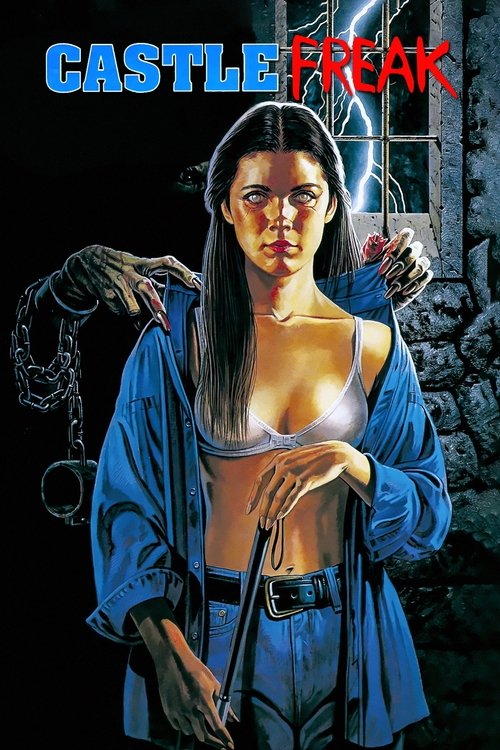
Castle Freak
1996 · Stuart Gordon
For when you want horror that hurts — a dark, mean, old-school creature feature with actual grief under the gore, not a fun party watch. Reach for it on a night you're ready to be bummed out and disturbed in equal measure.
What it's about
A recovering alcoholic inherits a crumbling castle in Italy and moves in with his estranged wife and blind teenage daughter, hoping the fresh start might repair a family shattered by a car crash he caused. But the castle isn't empty: something starved and brutal has been kept chained in its depths for decades, and it's loose. A monster movie wrapped around a marriage in ruins, where the horrors inside the walls and inside the family keep bleeding into each other.
The experience
Grim, sorrowful, and genuinely nasty — this plays its gothic setup straight, with almost no comic relief, and the violence lands hard when it comes. The sadness of the family story gives the dread real weight, so it feels heavier and crueler than its direct-to-video origins suggest.
Performances
Jeffrey Combs plays painfully against type as a guilt-wrecked father rather than a manic eccentric, and Barbara Crampton matches him as the wife who can't forgive — their scenes together give the film its bruised heart.
The craft
Stuart Gordon shoots a real Italian castle and wrings everything out of its stone corridors and candlelit cellars, giving a low-budget production genuine gothic atmosphere. The creature work is practical and pitiable — a monster designed to be as tragic as it is repulsive — and the film commits to a somber tone most cheap horror of its era wouldn't dare.
Why it matters
The last full reunion of the Re-Animator team — Gordon, Combs, Crampton, writer Dennis Paoli — and proof that direct-to-video horror could be serious and personal; it's since become a cult touchstone and earned a later remake.
Snapshot
Castle Freak is a low-budget, direct-to-video horror film made for Charles Band's Full Moon Entertainment. Stuart Gordon directed it in Italy, in a castle that Band himself owned. It brought back the central creative team of Re-Animator (1985) and From Beyond (1986): Gordon, actors Jeffrey Combs and Barbara Crampton, screenwriter Dennis Paoli and composer Richard Band. It was their last full collaboration in that configuration, and it is a noticeably different film from the earlier two. Where Re-Animator worked as black comedy and From Beyond as baroque erotic delirium, Castle Freak is a sombre, mostly humourless domestic tragedy with a monster at its centre.
John Reilly (Combs) is a recovering alcoholic. A drunk-driving crash he caused killed his young son and blinded his teenage daughter Rebecca (Jessica Dollarhide). He inherits a castle in Italy from a duchess he never met and travels there with Rebecca and his estranged wife Susan (Crampton). Locked in the castle's depths is Giorgio (Jonathan Fuller), the duchess's son. He has been chained and tortured for decades, and he turns out to be John's half-brother. When Giorgio escapes, the family's unspoken guilt takes on a literal, violent body.
The film was loosely inspired by H. P. Lovecraft's story "The Outsider." It has a lasting cult reputation and is often named among Full Moon's strongest productions. It also anticipates the more openly melancholic register of Gordon's later work.
Release dating varies. Many references give 1995 for the original U.S. video release, while this atlas lists 1996.
Industry & production
The film came out of the direct-to-video economy that Charles Band built, first with Empire Pictures in the 1980s and then with Full Moon Entertainment from the late 1980s on. Full Moon's model was tight budgets, short schedules, and recognisable horror "brands" (Puppet Master, Subspecies, Trancers) aimed at rental shelves. A key cost-saver was shooting in Europe, especially Romania and Italy, where crews, locations and period architecture were cheap.
Band owned a castle in Umbria, the Castello di Giove near Terni, and used it repeatedly as a location for his productions. Castle Freak is the clearest case of a film built around that asset. Accounts of the production say the project started from a title and a location, as was common with Band, and that the story was developed to fit them. The screenplay is credited to Dennis Paoli from a story by Charles Band.
Gordon had already made The Pit and the Pendulum (1991) for Full Moon in Italy, so he knew both the company's methods and its Italian production base. Casting Combs and Crampton together again was a deliberate act of reunion that the film's marketing could use, given the standing of Re-Animator among horror audiences.
Like much of Full Moon's output, the film circulated in different versions. An unrated cut contained its most notorious violence, chiefly the murder of a prostitute. The record does not document detailed production figures such as budget or shooting days in a form reliable enough to repeat here.
Technology
Castle Freak is a 35mm film with no particular technical innovation. Its technology belongs to mid-1990s practical effects work, made just before digital effects became common in low-budget horror.
The creature is a prosthetic makeup design worn by Jonathan Fuller, who is credited as Giorgio. It was produced by a specialist effects house; Optic Nerve Studios is commonly credited. The design is deliberately unspectacular. It shows malnutrition, scarring, self-mutilation and deformity, not a fantastic anatomy. In effect it is a wounded human body rather than a creature, and that choice sets the film's tone.
The real castle replaced constructed sets almost entirely, which saved money and gave the film its look. Practical candlelight and torchlight motivate much of the night lighting, along with the limits of the castle's electrical supply, which is also a story point.
Technique
Cinematography
The Italian cinematographer Mario Vulpiani photographs the castle as a series of cramped, stone-bound spaces: spiral stairs, cellars, narrow corridors, and a cell at the bottom of the building. The day exteriors use the soft, washed light of the Umbrian countryside and the stone of the town below. These scenes show the outside world as indifferent, and on occasion hostile, through the townspeople and the police. The night interiors are low-key and sharply pooled, so most of the castle stays in darkness.
The camera often holds back from showing Giorgio directly. It frames him in partial shadow, at the edge of the frame, or as an unseen presence registered by Rebecca's heightened hearing. The full reveal of his face is held back for a long time, in keeping with the "Outsider" source idea of a being horrified by its own reflection.
Editing
The editing is economical and functional, in keeping with Full Moon's house style. Its most effective device is cross-cutting between Giorgio moving through the castle and the family's ordinary activities, which builds suspense out of the house's hidden geography.
The film's most notorious sequence is Giorgio's attack on Sylvana (Raffaella Offidani), the prostitute John brings back to the castle. It is cut to linger rather than to elide, and that choice is the main reason the film was released in an unrated version.
Mise-en-scène / staging
The castle is the film's governing image. Its staging contrasts the inherited, decaying grandeur of the upper rooms with the subterranean cell where Giorgio has been chained. Paintings, family portraits, a crucifix-bearing chapel and the whip used by Giorgio's mother all fill the space with signs of aristocratic and religious authority turned sadistic.
Gordon stages the family's estrangement spatially. Susan sleeps apart from John. Rebecca explores the house by touch and sound. John moves between the castle and the town's bars, where his sobriety is tested.
The climax uses the castle's vertical axis, ending on the battlements and tower. This brings to a peak the movement up from the dungeon that runs through the whole film.
Sound
Richard Band's score uses Gothic and orchestral idioms, often realised on synthesizers because of the budget. It is more restrained and elegiac than his propulsive, Herrmann-indebted Re-Animator score.
Sound design does a lot of narrative work, because Rebecca is blind. Footsteps, breathing, the scrape of chains and the creaks of an old building become her way of perceiving, and the audience's too. Giorgio has no articulate language, so his vocal performance consists of moans, cries and inarticulate sounds.
Performance
Combs, best known for the manic Herbert West, gives one of his most restrained and inward performances as John Reilly. The role is a guilt-ridden man trying to hold himself together. Critics who admire the film often single it out as evidence of his range beyond eccentric character work.
Crampton plays Susan as cold and grieving, which inverts the sexualised victim roles of her earlier Gordon films. Dollarhide's Rebecca is the film's moral centre.
Jonathan Fuller's Giorgio is a physically demanding, nearly wordless performance under heavy prosthetics. It builds pathos out of posture and movement: a body so abused that cruelty is the only thing it knows how to repeat.
Narrative & dramatic mode
The film is a family melodrama with a horror engine. Its central situation, a fractured family isolated in an inherited house that holds a buried secret, is a standard Gothic setup, but Paoli's script ties the supernatural-seeming threat closely to the human one.
There is no supernatural agency in the film. The "freak" is a human being produced by maternal sadism and paternal abandonment. He is also John's blood relative: the duchess had a child by John's father, who later left her. The castle's horror is therefore John's own family history coming back to him, and the parallel with John's guilt over his son's death is explicit.
Suspicion is a secondary plot strand. The Italian police, led by an inspector, increasingly suspect John of the killings and disappearances. His drinking history makes their suspicion plausible to the audience as well, which gives the film a brief mystery or thriller element.
The resolution is sacrificial. John wraps the chain around himself and Giorgio, falls with him from the tower, and dies to save his daughter and redeem himself. The film's emotional key is tragic rather than triumphant.
Genre & cycle
Castle Freak combines several traditions:
- The Gothic "old dark house" narrative, especially its European castle variant.
- The "monster in the attic or cellar" subgenre, in which a hidden, abused family member becomes a figure of terror. Its literary roots run through Jane Eyre and later Gothic fiction.
- Lovecraft adaptation, which Gordon helped popularise in film. Here the debt is thematic rather than literal: "The Outsider" gives the idea of a creature that does not know it is monstrous until it sees itself.
- 1990s direct-to-video horror, a market where gore, nudity and franchise recognition were selling points, and where Castle Freak stands out for its seriousness.
Within Full Moon's catalogue, the film sits apart from the company's puppet- and gimmick-driven franchises. It is closer to Gordon's own The Pit and the Pendulum, an adult, European-set Gothic piece.
Authorship & method
Stuart Gordon (1947–2020) came to film from Chicago theatre, where he founded the Organic Theater Company. His screen career was shaped by his association with Charles Band, beginning with Empire's Re-Animator.
Gordon's method combined theatrical attention to actors and ensemble with a readiness to push transgressive physical content further than mainstream horror allowed. Taken across his career, his recurring interests are:
- the body as a site of transformation and violation;
- abusive family and institutional authority;
- the adaptation of Lovecraft and Poe as vehicles for psychological, not just supernatural, terror.
Castle Freak is a turn toward grief and moral responsibility. That turn continues in Dagon (2001), King of the Ants (2003), Edmond (2005) and Stuck (2007).
Dennis Paoli, Gordon's long-time writing partner, co-wrote Re-Animator, From Beyond and The Pit and the Pendulum, and later Dagon. His script for Castle Freak builds the domestic drama carefully enough that the film's horror rests on character.
Charles Band, producer and story originator, provided the title, the castle and the production framework.
Richard Band, Charles's brother, composed the score. He had scored Re-Animator and From Beyond and wrote extensively for Empire and Full Moon.
Mario Vulpiani, an Italian cinematographer, brought local professional experience to the photography.
The editing credit belongs to Full Moon's regular post-production personnel. The record of individual contributions there is thinner than for the principal creative team.
Movement / national cinema
Castle Freak is an American production shot in Italy. It belongs to a long tradition of American genre filmmaking that used European, and especially Italian and Eastern European, locations to give Gothic stories real antiquity at low cost.
It is not part of the Italian horror tradition in authorship. Still, its setting and some of its crew connect it to the long Italian-American exchange in Gothic horror, which runs back to Roger Corman's Poe films and to the Italian Gothics of the 1960s. Gordon's own Poe adaptation, The Pit and the Pendulum, sits explicitly in that lineage.
The Italian townspeople and police are drawn broadly, as outsiders to the American family's experience. This reflects the film's American point of view rather than any engagement with Italian life as such.
Era / period
The film belongs to the mid-1990s, a low point in the theatrical fortunes of horror before Scream (1996) revived the studio slasher. During these years much inventive and transgressive horror went straight to video. Full Moon was one of the main producers in that market, and the video store was the main venue for figures like Gordon, whose transgressive sensibility kept them on the margins of studio filmmaking.
Castle Freak also reflects the era's interest in addiction and recovery, as well as family dysfunction and abuse, themes that 1990s popular culture discussed more openly than before. John's sobriety, with its references to AA and its temptations, is treated with unusual seriousness for a genre film of its budget.
Themes
- Guilt and responsibility. John's drunk-driving crash is the film's original sin. The castle forces him to face it again, in a monstrous form.
- Inherited sin. The inheritance is literal: the castle and its property come with the consequences of John's father's abandonment and the duchess's revenge. The sins of parents become the burden of children.
- Abuse producing monstrosity. Giorgio is not born a monster. He has been made into one by decades of torture, whipping and confinement. The film asks the audience to pity him even as it shows his violence in detail, which marks its Lovecraftian "Outsider" heritage.
- Blindness and perception. Rebecca's blindness is the film's figure for knowledge that does not depend on sight. She senses the creature before anyone believes her.
- The doubled family. John and Giorgio are half-brothers and mirror images, both damaged and both capable of destruction. The film plays out John's struggle with his own capacity for harm through the creature.
- Redemption by sacrifice. The ending gives John the only redemption the film thinks possible: self-destruction in another's service.
Reception, canon & influence
Critical reception. As a direct-to-video release, Castle Freak was reviewed little in mainstream outlets on first release. Its reputation was built mainly through genre magazines, fan communities and later reassessment.
Over time it has become widely regarded as one of Full Moon's best films and a significant work in Gordon's filmography. Admirers point to:
- Combs's restrained, dramatic performance;
- the seriousness of the family drama;
- the use of a real castle;
- the pathos of the creature.
Critics have also noted its graphic and misogynistic violence, especially the Sylvana sequence. That scene remains the most discussed and most contested part of the film, and it is a large part of why its reputation is mixed outside committed horror audiences. Several later home-video releases, including restored editions, have kept it in circulation and contributed to its reappraisal.
Influences on the film (backward):
- H. P. Lovecraft's "The Outsider" (1926), the acknowledged loose inspiration.
- The Gothic novel tradition of the hidden, imprisoned family member.
- The Poe-Corman cycle and Italian Gothic cinema, which established the decaying European castle as a cinematic space for family horror.
- Gordon's own Re-Animator and From Beyond, whose cast and creative team it brings back, deliberately inverting their tone.
Legacy (forward): Castle Freak is a turning point in Gordon's career, away from the transgressive comedy of his Lovecraft films and toward the darker, character-centred work of his last decade. Dagon, shot in Spain, extends its pattern of a Lovecraft-derived horror story set in a European locale.
The film also helped cement the Combs-Crampton pairing as a recurring element in genre fandom. In 2020 it was remade as Castle Freak, directed by Tate Steinsiek, with Barbara Crampton among the producers. The remake reflects both the original's lasting cult standing and the 2010s revival of interest in 1980s and 1990s practical-effects horror.
Within the history of direct-to-video horror, Castle Freak is often cited as evidence that the format could support serious authorial work. Its specific influence on later filmmakers is harder to document than its cult standing, and claims beyond that standing should be treated with caution.
Influences: the films it descends from and the films it influenced
- The Old Dark House (1932) — Its secret family member shut away on an upper floor of a remote house, kept off screen for most of the film before a late, pitiable reveal, is the structure Castle Freak moves down into a dungeon.
- Frankenstein (1931) — Karloff's wordless creature, built from heavy prosthetics and played as a wounded child rather than a predator, is the model for Jonathan Fuller's mute, abused Giorgio.
- Black Sunday (1960) — Bava's Italian Gothic set the language of crypt-to-hall castle geography lit with isolated pools of light in surrounding blackness, which Mario Vulpiani carries into a real Umbrian castle.
- House of Usher (1960) — The Poe-Corman template of a cursed bloodline tied to a decaying ancestral house, whose vaults hide a family member, gives Castle Freak its inheritance-as-curse engine.
- Don't Look Now (1973) — An estranged couple in Italy, broken by guilt over a child's death, with the horror built from their grief, is the family-melodrama spine that Paoli's script gives John and Susan Reilly.
- The Elephant Man (1980) — It treats a deformed, abused body hidden from the world as a subject of pathos, with prosthetic makeup that serves performance more than shock, the register Castle Freak aims for with its creature.
- Basket Case (1982) — A disfigured sibling kept hidden by family shame who erupts into sexual violence sets the low-budget video-horror precedent for Giorgio as the family's buried secret.
- Re-Animator (1985) — The Gordon–Paoli–Band–Combs–Crampton unit forms here, and Castle Freak reassembles the same team deliberately to invert its gleeful transgressive comedy into grief.
- From Beyond (1986) — The Combs-Crampton pairing and Richard Band's scoring first go up against a body horrifically transformed by a family-like authority, which Castle Freak replays without From Beyond's camp.
- The People Under the Stairs (1991) — Its children mutilated and locked inside the walls and cellar by an abusive parent figure, with the hidden spaces of the house cross-cut against the family above, prefigures Castle Freak's cellar-to-tower geography.
- Dagon (2001) — It extends Castle Freak's pattern of Paoli's Lovecraft adaptation moved to a real European location (Galicia), with an American protagonist who discovers his own monstrous lineage and an ending of sacrifice and acceptance.
- King of the Ants (2003) — It carries on the post-Castle Freak turn toward bleak character-centred horror, with violence played for moral weight instead of comic transgression.
- The Others (2001) — A grief-stricken family in an isolated European house, with an unseen presence detected through sound and darkness rather than shown, follows Castle Freak's blind-perspective, withheld-reveal method.
- We Are Still Here (2015) — Barbara Crampton plays a grieving mother whose dead son's absence drives the horror of an old house with something in the basement, a conscious revival of Castle Freak's grief-plus-cellar formula with practical gore.
- Castle Freak (2020) — The Crampton-produced remake keeps the inherited European castle, the chained prosthetic creature and the family-guilt engine, and puts them in the service of the 2010s revival of practical-effects horror.
- The Pit and the Pendulum (1991) — Gordon's earlier Full Moon/Band-produced Italian location shoot (Paoli script, Combs, Richard Band score) made real European stone architecture the production asset that Castle Freak builds on.
- Subspecies (1991) — Full Moon shot it in real Romanian castles and ruins, the same direct-to-video economy of cheap Eastern/Southern European locations standing in for expensive Gothic sets.
Similar films
- From Beyond (1986) — influence & lineage
- Re-Animator (1985) — influence & lineage
- Frankenstein (1931) — influence & lineage
- Don't Look Now (1973) — influence & lineage
- The Brood (1979) — shared sensibility
- Nosferatu (1922) — shared sensibility
- House (1985) — shared sensibility
- Hereditary (2018) — shared sensibility