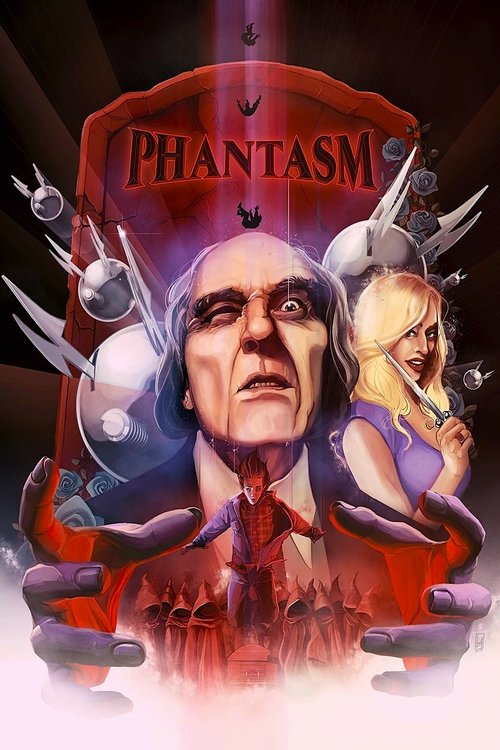
Phantasm
1979 · Don Coscarelli
For a late night when you want horror with imagination — weird and homemade rather than polished, scary in a way that's more uncanny than brutal. Perfect when you're nostalgic for the video-store deep cut you discovered too young.
What it's about
A thirteen-year-old boy, newly orphaned and terrified his older brother will leave town without him, starts spying on the local mortuary after seeing its gaunt undertaker lift a loaded coffin single-handed. What he uncovers at Morningside Cemetery is far stranger than grave robbing: the dead are being put to use, and a towering figure known only as the Tall Man presides over it all, guarded by a flying silver sphere with lethal intentions.
The experience
It runs on dream logic — scenes slide from sleepy suburban afternoons into full nightmare without warning, and the rules keep shifting under your feet. Scrappy, eerie, and genuinely strange, it's the rare horror film that feels like something you half-remember from childhood.
Performances
Angus Scrimm's Tall Man is an all-timer of physical menace — a glower, a stride, and two words ('Boy!') that carried a whole franchise.
The craft
Don Coscarelli wrote, directed, shot, and edited it himself on family money with a cast of friends, and the resourcefulness shows as personality rather than cheapness. The flying sphere is one of horror's great practical gadgets, and the droning synth theme burrows in like Tubular Bells' stranger cousin. Watch it loud, in the dark.
Why it matters
One of the defining American independent horror films of the late seventies, it proved a kid with a camera and an idea could build a mythology — four sequels and a devoted cult followed.
Snapshot
Phantasm is one of the defining American independent horror films of the late 1970s. It was made almost entirely outside the studio system by a young writer-director, Don Coscarelli, working with family money, a small group of regular collaborators and friends, and a cast mostly drawn from his earlier pictures. On the surface it tells a simple story. Thirteen-year-old Mike, recently orphaned and afraid that his older brother Jody will leave him, sees the gaunt mortician of Morningside Cemetery lift a full coffin on his own. Mike starts spying and uncovers a scheme: the dead are being crushed down into hooded, dwarf-like slaves and sent through a dimensional gateway to another world.
The film is remembered less for its plot than for how it feels. It follows the logic of a dream, it drifts between suburban realism and outright surreal invention, and it gave horror some lasting images: Angus Scrimm's towering "Tall Man," the flying silver sphere that drills into a victim's skull, and the marble-lined corridors of the mausoleum. It began a franchise that ran to four sequels over nearly four decades. It also became a touchstone for horror that treats nightmare as a structure rather than a framing device. Under the genre machinery is a film about grief, and about a child's fear that death will take away everyone he has left.
Industry & production
Phantasm was a private, family-financed production. Coscarelli was still in his early twenties. He had already made two low-budget features, Jim, the World's Greatest (1976, co-directed with Craig Mitchell) and Kenny & Company (1976). Both were coming-of-age dramas, and Kenny & Company had won some notice. His father, D.A. (Dac) Coscarelli, produced and helped fund Phantasm, as he had his son's earlier films. The budget is usually reported as a few hundred thousand dollars; the figure most often repeated is about $300,000. The record isn't precise enough to state an exact amount.
The shoot was long and piecemeal. Coscarelli has described it as stretching over more than a year, done mostly on weekends and whenever cast and crew were free, and many of the cast were not professional actors. Most of the film was shot in Southern California. The exterior of Morningside mortuary was the Dunsmuir House, a historic mansion in Oakland in the San Francisco Bay Area. Its Neoclassical portico gives the film's main location a stately, funereal look that the budget could never have built.
AVCO Embassy Pictures acquired the film and released it in 1979. AVCO Embassy was then a leading distributor of genre pictures (it would release John Carpenter's The Fog and Escape from New York). The film did well commercially relative to its cost and found a large audience in drive-ins and second-run theaters, but reliable gross figures aren't documented well enough to cite here. Accounts say the MPAA objected at first to the gore, especially the sphere attack, before the film was cleared with an R rating. The details of that negotiation are mostly known from later recollections, not from documents.
Technology
The film's technology is that of a resourceful 1970s independent: 35mm photography, practical effects, and a lot of improvised in-camera solutions. The silver sphere is its signature effect, and it was made with very simple tools. For the shots of the sphere flying down the mausoleum corridor, the filmmakers used methods Coscarelli has described in interviews and commentaries: they threw or swung a physical prop, sometimes photographed a prop pulled away from the target and ran the shot backwards, and placed the camera carefully. The goal was to keep the sphere's movement smooth and its gleam convincing. The blood that pumps from the drill wound out the back of the sphere was a practical rig.
Other effects are just as handmade. The Tall Man's severed finger keeps twitching and bleeds yellow ichor. A bug-like creature grows out of it and flies around the house. The dimensional gateway, the "space gate" in the mortuary's back room, is two upright metal posts with a shimmering field between them, done with light and simple optical work. The red desert planet on the other side is a brief, high-contrast location shot. The hooded dwarfs were played by small performers in brown robes. Their look was sometimes compared, then and since, to the Jawas of Star Wars (1977).
The score was produced on synthesizers, which tied the film to the electronic and progressive-rock textures then entering genre cinema.
Technique
Cinematography
Coscarelli shot the film himself and is credited as director of photography. The look moves between two registers. Daytime scenes in town (the brothers' house, the antique shop, the open road, Reggie's ice cream truck) are lit and framed with flat, everyday realism. Night scenes and interiors in the mausoleum use deep shadow, saturated color, and strong frontal light on gleaming surfaces. The mausoleum's white marble halls are shot with long, symmetrical perspectives down the corridor. The sphere's attack depends on that geometry, which makes the building feel infinite and clinical, like a hospital for the dead.
The camera often takes Mike's viewpoint. It peers from behind gravestones, through windows, and from his hiding places, which ties what we see to a child's partial, frightened understanding. Low angles make the Tall Man, already very tall, look even bigger. Several of his appearances are staged as sudden entries into a frame that a moment earlier was empty.
Editing
Coscarelli also edited the film. The cutting serves the dream logic. Scenes sometimes break off abruptly, and transitions between waking and dreaming are left unmarked or are deliberately misleading. At one point we see Mike in bed, the "Lady in Lavender" appears, and the film offers no clear boundary between event and nightmare. The ending piles up reversals. A sequence that seems to reveal everything as a dream is followed by one more shock that cancels the comfort of waking. The effect is less a twist than a refusal to settle what is real.
Some of the episodic, occasionally lurching rhythm also comes from the long, discontinuous shoot and from material cut in the edit. Footage removed from the original version later surfaced and was partly reused in Phantasm: Oblivion (1998).
Mise-en-scène / staging
The production's visual identity rests on contrast. Morningside's interior combines the hush of a funeral parlor with something faintly technological: glossy marble, rows of crypt drawers, embalming rooms, and a back room full of canisters and machinery. Outside are the open, sunbaked spaces of a small American town. The film shoots that ordinary world (the house, the garage, the black 1971 Plymouth 'Cuda Jody drives, Reggie's truck) with affection, so the cemetery's intrusion feels like a violation of home.
The Tall Man's costume is a dark, severely cut undertaker's suit. With Scrimm's height and the angles used to film him, it makes him look both Victorian and alien. Small objects carry weight: the sphere, the finger in the box, the tuning fork that briefly opens a window onto the other world. A fortune-teller's test, in which Mike must keep his hand in a black box despite pain, is staged as a ritual initiation into fear.
Sound
The score is by Fred Myrow and Malcolm Seagrave. It is built on a repeated, pulsing synthesizer and keyboard motif, a minor-key arpeggio that is now one of the most recognizable themes in American horror. It has often been compared to Goblin's work for Dario Argento, especially Suspiria (1977), in its blend of rock instrumentation, organ-like tones, and electronic repetition. The theme sits beside some rawer sound effects: the sphere's whirring hum, the clang of the mausoleum's doors, and the Tall Man's few, heavily delivered lines.
The soundtrack also uses folk-rock warmth as a counterweight. A scene of Jody and Reggie playing guitar together on the porch is one of the film's most quoted human moments, a pause in which music marks friendship and normal life against the encroaching dead.
Performance
The performances range from the naturalistic to the iconic, and the film uses that range on purpose. Michael Baldwin, a veteran of Coscarelli's earlier films, plays Mike with a mix of determination, curiosity, and buried grief that keeps the film anchored. Bill Thornbury gives Jody an easy, slightly weary charm. Reggie Bannister plays Reggie, the ponytailed ice-cream man, with good humor. The character became so popular that he moved closer to the center of the sequels. Kathy Lester plays the Lady in Lavender, a seductive figure who is one of the Tall Man's disguises.
The film belongs above all to Angus Scrimm, the stage name of Lawrence Rory Guy, who had appeared in Jim, the World's Greatest. Scrimm was very tall, and his costume and lifts made him taller. He plays the Tall Man with few words and enormous presence: a slow, stiff walk, a fixed stare, and a voice that turns the single word "Boy!" into a threat. His performance borrows from silent-cinema villainy and Gothic theater. It is the main reason the character became a horror icon.
Narrative & dramatic mode
The story is framed as a mystery seen through a child's eyes. Mike investigates the cemetery, gathers evidence, and tries to convince Jody and Reggie. Each discovery escalates the threat: the lifted coffin, the severed finger, the dwarfs, the sphere, the gateway.
The film's mode, though, is oneiric rather than procedural. Causality is loose. Some events go unexplained, while others are explained in surprisingly literal science-fiction terms, such as Mike's discovery that the corpses are compressed for a world with heavier gravity. The film never fully decides whether its world is supernatural, extraterrestrial, or simply the fantasy of a bereaved boy. The final movement plays on this. One scene seems to reframe the events as Mike's grief-driven nightmare after Jody's death, and the comforting reframing is then violently overturned.
The emotional throughline is Mike's fear of abandonment. He has lost his parents, and Jody is thinking about leaving town. The Tall Man takes the dead away, and the film links that horror directly to Mike's private terror of being left alone.
Genre & cycle
Phantasm sits where several late-1970s cycles meet. It belongs to the wave of low-budget American independent horror in the decade after Night of the Living Dead (1968) and The Texas Chain Saw Massacre (1974). In that wave, regional and self-financed productions competed with, and often outperformed, studio genre films. It came out a year after Halloween (1978) and shares that film's suburban setting and adolescent protagonists, but it has none of the slasher formula's structure.
It also belongs to the post-Star Wars boom in science fiction. Its interdimensional gate, its alien world, and its industrial processing of human bodies bring sci-fi ideas into a Gothic cemetery horror story. The result is a hybrid that genre writers have often described as unclassifiable: part haunted-house tale, part alien-invasion story, part dark fairy tale, part teen adventure.
Authorship & method
Phantasm is unusually personal for a horror film because Coscarelli wrote, directed, photographed, and edited it, and also co-produced it with his father. Coscarelli has said the film grew partly from a dream about being chased through marble corridors by a flying sphere. He has also named Ray Bradbury's Something Wicked This Way Comes (1962) as a major influence. The novel's theme of two boys facing a sinister, supernatural showman in a small town, and its mix of autumnal nostalgia and fear, clearly shaped the film's design.
Coscarelli's method was artisanal and collaborative. He relied on a recurring company of performers, especially Baldwin, Thornbury, Bannister, and Scrimm, who would return across the franchise. Composers Fred Myrow and Malcolm Seagrave gave the film its musical identity. Myrow, a classically trained composer who had scored studio films such as Soylent Green (1973), returned with Christopher L. Stone for the sequels.
Coscarelli's later career kept the same independent, genre-mixing sensibility: The Beastmaster (1982), the four Phantasm sequels he directed, Bubba Ho-Tep (2002), and John Dies at the End (2012). The fifth film, Phantasm: Ravager (2016), was directed by David Hartman and co-written with Coscarelli.
Movement / national cinema
The film is a product of American independent filmmaking in the 1970s. That cinema was enabled by cheaper production methods, the drive-in and grindhouse markets, and genre distributors willing to buy finished films from outsiders. Phantasm fits into an informal movement of young horror directors working outside Hollywood in this period, including George A. Romero, Tobe Hooper, John Carpenter, Wes Craven, and later Sam Raimi. Their films defined American horror for the next generation.
Its debts also reach beyond America. Commentators routinely point to the stylized color and synth-rock sound of Italian horror, especially Argento. The film was well received at European fantasy festivals and won a Special Jury Prize at the Avoriaz International Fantastic Film Festival in France in 1979, an early sign that its surrealism appealed to audiences used to continental fantastique.
Era / period
Phantasm belongs to the end of the 1970s, when American horror was moving from the political nihilism of the early decade toward the commercial horror boom of the 1980s. Its setting is recognizably late-'70s suburban and small-town America: muscle cars, rock music, an ice cream truck, empty streets. It treats this world nostalgically and uneasily at once.
The film's concern with funeral homes and the commercialization of death fits a broader cultural moment. Jessica Mitford's The American Way of Death (1963) had made the funeral industry a subject of satire and suspicion, though no direct link to the film is documented. Its blend of horror with outer-space science fiction reflects the decade's wider fascination with aliens and other dimensions.
Themes
Death and grief. The film is about death in its most domestic form: losing parents, funerals, embalming, caring for corpses. Mike's investigation of the Tall Man is also his way of dealing with a loss he can't otherwise face. The ambiguous ending suggests the whole story may be a grieving mind's attempt to explain why the dead go away.
Abandonment and brotherhood. Mike and Jody's relationship is the emotional center. Mike's fear that Jody will leave matches the Tall Man's theft of the dead, and the film's warmest scenes are those of family and friendship holding against isolation.
The violation of the body. The film turns the dead into labor. Corpses are crushed and remade into slaves for another world. That idea pushes the funeral industry's handling of bodies into cosmic horror and anticipates later body horror in its focus on the body's physical transformation.
Coming of age. Mike's ordeal, including the fortune-teller's black-box test, has the shape of an initiation. In a classic adolescent-horror pattern, adults don't believe the child, and the child has to find his own courage.
The instability of reality. The film repeatedly unsettles the line between waking and dreaming, and so denies its characters and its audience any secure footing. That uncertainty is less a narrative trick than a statement that fear, like grief, cannot be resolved.
Reception, canon & influence
Critical reception. Mainstream critics were divided when the film came out. Many acknowledged its inventiveness and atmosphere but found it incoherent or amateurish. Genre audiences and the fantasy-festival circuit were more enthusiastic, and the Avoriaz prize gave it early standing abroad. Its reputation grew steadily on home video, television, and revival screenings, and it is now widely considered a cult classic and a key American horror film of its decade. The dream logic once criticized as incoherence is now usually read as its main strength.
Influences on the film (backward). Coscarelli has acknowledged Bradbury's Something Wicked This Way Comes as an inspiration. The film's music and color are often linked to Italian horror, especially Argento's Suspiria. Its creatures and space gate reflect the science-fiction moment after Star Wars. Its small-town investigation, with a child as the protagonist and adults who don't believe him, recalls an older lineage of American genre cinema, including Invaders from Mars (1953), which commentators have cited as a precedent for its child's-eye view of an alien threat. The Tall Man draws on the long Gothic tradition of the sinister undertaker and on silent-film villainy.
Legacy (forward). The film launched a franchise: Phantasm II (1988, released by Universal), Phantasm III: Lord of the Dead (1994), Phantasm IV: Oblivion (1998), and Phantasm: Ravager (2016). Across them, the original cast aged with their roles, a rare kind of continuity in horror. The Tall Man and the sphere entered horror's iconography, and Scrimm became one of the genre's best-known figures until his death in 2016.
Critics have often cited the film's merging of nightmare and reality as an antecedent to A Nightmare on Elm Street (1984) and to the wider trend of dream-logic horror. Its mix of the uncanny and the cosmic in ordinary places is a precursor to later horror on film and television. A 4K restoration, Phantasm: Remastered, was completed in 2016 with help from J.J. Abrams's company Bad Robot, confirming the film's place in the canon of American independent horror. It is now widely recognized as a work in which an independent filmmaker, with very few resources, made a coherent and deeply personal vision out of fear, loss, and imagination.
Influences: the films it descends from and the films it influenced
- Invaders from Mars (1953) — Menzies's child's-eye production design, with forced-perspective sets, elongated corridors and a boy whose warnings adults wave away, is the template for Mike's point of view and the Tall Man's oversized white mortuary halls.
- Suspiria (1977) — Goblin's pulsing progressive-rock synth ostinato built around a nursery-like hook sets the model for the Myrow/Seagrave keyboard theme, and Argento's set-piece structure, where plot logic gives way to architecture and sound, licenses Phantasm's dream-logic sequencing.
- The Night of the Hunter (1955) — A towering, soft-spoken adult predator shot from below and pursuing children who can't get adults to believe them, with expressionist low angles that turn one tall man into a silhouette, prefigures how Scrimm is framed and blocked.
- Nosferatu (1922) — Max Schreck's rigid, gaunt, elongated body, gliding entrances and stiff-armed stillness are the silent-film vocabulary Scrimm draws on for the Tall Man's movement and his sudden appearances in the frame.
- Carnival of Souls (1962) — A regional, self-financed production that uses real locations, a pale ghoul figure and an ending that undoes the story's reality is the American independent precedent for Phantasm's dream structure on a tiny budget and its 'it was all real after all' twist.
- The Texas Chain Saw Massacre (1974) — It proved that a regional, crew-of-friends feature with a handheld, documentary feel could reach national distribution, the production model Coscarelli followed in shooting, editing and co-producing Phantasm with family and a stock company.
- Star Wars (1977) — Its popularization of practical miniatures and dimensional-gate imagery shapes Phantasm's in-camera space-gate tuning fork, its red-planet matte vista and its hooded dwarf 'Jawa' figures, as the film grafts post-1977 science fiction onto Gothic horror.
- A Nightmare on Elm Street (1984) — Craven extends Phantasm's unmarked slides between waking and dreaming and its final false-awakening shock (the villain bursting through a mirror or door to grab the teen) into a franchise structure built around a single iconic boogeyman.
- Phantasm II (1988) — Coscarelli scales the sphere effects up with studio money (the multiple-blade and drill 'gold sphere' rigs) and adds a road-movie structure, while keeping the original's closing false-awakening and Scrimm's choreography.
- Phantasm: Ravager (2016) — It turns the series' dream-logic ambiguity into a formal principle, cutting between incompatible realities (dementia ward, apocalyptic wasteland), and pays off the founding cast's thirty-seven years of aging in their roles.
- Hellraiser (1987) — An otherworldly undertaker figure with mechanical torture devices (the puzzle box and hooks, against the sphere and drill) and a cosmic dimension behind a domestic door continue Phantasm's fusion of mortuary Gothic with otherworldly technology.
- Bubba Ho-Tep (2002) — Coscarelli brings Phantasm's soul-harvesting mummy-ghoul and its grief-and-aging core to a nursing home, using the same low-budget practical-effects method and the same deadpan mix of genres.
- It Follows (2014) — Disasterpeace's synth score, a symmetrical suburban widescreen frame, adults who are absent or can't see the threat, and a slow-walking pursuer with dream-uncertain rules all revive the Phantasm-era model of American independent horror.
- Stranger Things (2016) — Its synth-pulse theme (by S U R V I V E), kids on bikes investigating while adults disbelieve, a portal to another dimension and an extradimensional entity reproduce Phantasm's mix of small-town boys' adventure and interdimensional horror (a series, included as a direct craft heir).
- The Lords of Salem (2012) — Long symmetrical corridors, dream sequences that can't be told apart from waking life, and a droning, ritual score follow Phantasm's oneiric staging inside clinical, institutional spaces.
- Terrifier 2 (2022) — Coscarelli built a cosmology retroactively across sequels out of a first film that explained nothing — the same sequel-as-mythology-engine that produces the Little Pale Girl and the amulet apparatus here.
- Something Wicked This Way Comes (1983) — Both adapt the same Bradbury blueprint, two boys in an autumnal small town facing a tall, courtly showman who harvests the dead and the grieving; Coscarelli's version came first, and Clayton's film stages the source he drew on.
- Halloween (1978) — A contemporary independent hit built on a self-composed, repeating minimalist synth motif and a near-mute, implacable boogeyman framed in widescreen depth; the two films defined the late-1970s template of keyboard score plus iconic villain.
- Lost River (2014) — A teenage protagonist in a decaying American town, a carnival of death run by a tall, stylized showman, and an atmosphere of synth and neon dream logic draw openly on the Phantasm/Bradbury/Argento triangle.
Similar films
- The Texas Chain Saw Massacre (1974) — influence & lineage
- Carnival of Souls (1962) — influence & lineage
- Halloween (1978) — influence & lineage
- Skinamarink (2023) — shared sensibility
- Ghost Stories (2018) — shared sensibility
- Backrooms (2026) — shared sensibility
- Cobweb (2023) — shared sensibility
- Insidious (2011) — shared sensibility