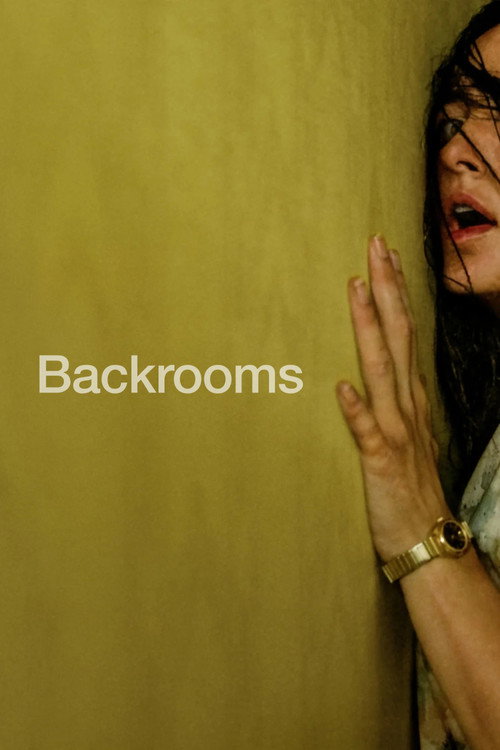
Backrooms
2026 · Kane Parsons
For when you're craving a real scare of the eerie, existential kind — lights off, headphones or good speakers, no phone. Challenge viewing, not comfort viewing: it wants to disorient you and mostly succeeds.
What it's about
In 1990s California, a strange doorway appears in the basement of a furniture showroom — an opening into an endless, fluorescent-lit elsewhere that shouldn't exist. Told through recovered footage, it follows the people drawn into those humming yellow corridors, where the architecture repeats forever and something else may be moving through it. Underneath the mystery run very human wounds: childhood trauma, addiction, and the things people can't walk away from.
The experience
Slow-crawling, hypnotic dread — the fear of empty rooms and wrong geometry rather than jump-a-minute shocks. It's the kind of horror that gets under your skin through atmosphere and sound, leaving you uneasy about ordinary hallways for days.
The craft
Director Kane Parsons created the Backrooms as a viral web series while still a teenager, and the film scales up his signature: camcorder-era found footage, oppressive fluorescent hums, and impossibly vast liminal spaces rendered with uncanny conviction. The sound design and production design do the heavy lifting — this is a film about spaces, and it rewards the biggest, loudest presentation you can give it.
Why it matters
A landmark case of internet-native horror crossing into cinema — a creepypasta aesthetic born on YouTube handed a feature canvas, with one of the youngest directors ever trusted with a studio-backed film.
Horror · Found footage · Cosmic horror · Psychological horror. Camcorder found footage lost in endless fluorescent corridors: slow-burn liminal dread built from hum, wrong geometry and empty rooms.
Snapshot
Backrooms is the feature-length adaptation of the internet horror phenomenon that Kane Parsons, who works online as "Kane Pixels," began building on YouTube in January 2022. A24 produced and distributed it. The film turns a piece of crowd-authored creepypasta into a studio feature directed by the creator who gave that mythology its moving-image form. The premise starts in an ordinary place: a furniture-store owner and his therapist find that the store's basement opens onto an extradimensional labyrinth of liminal spaces. That labyrinth is the endless, fluorescent-lit maze of dated, beige-yellow rooms the internet calls "the Backrooms." Chiwetel Ejiofor and Renate Reinsve lead the cast. The film premiered at the Aero Theatre in Santa Monica on May 7, 2026, and A24 released it wide in late May.
Its significance is partly formal and partly historical. Formally, the film combines found-footage sequences with conventionally shot drama, and on 30,000-plus square feet of practical sets it builds the space Parsons had modeled digitally for years. Historically, it marks the point where a fully internet-native, collaboratively imagined horror mythology entered the theatrical mainstream and succeeded there commercially. It was made for a reported $10 million and grossed about $402.5 million worldwide, with reports calling it A24's biggest opening. Critics were more divided than audiences. Most praised the craft, especially the found footage, the sound, and the production design. They argued more over whether the story could sustain feature length.
Industry & production
The industrial story here doubles as a discovery story. The Backrooms began as an anonymous May 2019 post on 4chan's /x/ board. It paired one grainy photograph of an empty office interior with yellow wallpaper and a short caption warning that if you "noclip" out of reality in the wrong place, you end up in rooms that go on forever. The image and its liminal-space mood spread across Reddit, wikis, and YouTube. Parsons gave the concept a moving-image grammar. His short "The Backrooms (Found Footage)" presented the phenomenon as recovered 1990s camcorder footage. It reached a very large audience, and its sequels built it into a serialized mythology.
A24 acquired the property and attached Parsons to direct, a deal widely reported in the trade press in 2023. The finished film's production model is part of its interest: a viral creator, a boutique-prestige distributor known for auteur horror (Hereditary, The Witch, Talk to Me), and a source text with no single author. The cast pairs established screen actors with younger performers: Chiwetel Ejiofor as Clark, Renate Reinsve as Dr. Mary Kline, Mark Duplass as Phil, Finn Bennett as Bobby, Lukita Maxwell as Kat, and Avan Jogia as Naren Warne.
The production was modest by studio standards: a reported $10 million budget and a shoot in Vancouver, British Columbia, in July and August 2025. Much of that money went into building the space itself. More than 30,000 square feet of practical sets were constructed, a choice that shapes the film's whole texture. The commercial result changed the film's standing: its worldwide gross of about $402.5 million (roughly $197.5 million of it domestic) is many times its budget, and it was widely reported as A24's biggest opening. For a distributor whose identity rests on mid-budget, director-driven horror, Backrooms became a breakout of a different order. It showed that a platform-born property could draw a mass theatrical audience.
Technology
As a visual idea, the Backrooms is tied to one technological register: degraded consumer video. Parsons's online work rests on the look of the camcorder and the VHS transfer: chroma smear, interlacing artifacts, autofocus hunting, and the low dynamic range of 1990s tape. The feature keeps that register for its found-footage sequences. Reviewers singled out the camcorder material, grainy, shaky, and deeply uncomfortable, as the most frightening thing in the film. Its genealogy runs through analog-horror predecessors such as Local 58 and Marble Hornets and through the found-footage tradition proper (The Blair Witch Project, Paranormal Activity).
The main photography takes a more deliberate technical path. Cinematographer Jeremy Cox shot on the Sony Venice 2 with Zeiss Supreme prime lenses, mostly at apertures between T2.8 and T4. Lens choice separates the two worlds. Inside the Backrooms the camera works at 18mm or wider, which stretches the repeating rooms toward their vanishing points. Outside, in the everyday world, it moves to 25–28mm and longer. For the tightest tunnel spaces the crew used a compact "toothpick" rig with a Libra stabilizing head. Night sequences used the Venice 2's 3200 base ISO, so small LED units on the ground would not overpower the practical fixtures in the sets.
The production side also continues Parsons's method in a new form. His online videos combined location footage with digital 3D environments he built himself in Blender, and he had modeled the Backrooms in that software for years before any set existed. On the feature, he taught Cox the basics of Blender so the two could tune the virtual environment to the planned shots before construction began. The digital model became previsualization for a physical build. In this way the production kept the authorship of the space in the director's hands while turning it into a professional pipeline.
Technique
Cinematography
The Backrooms' signature image is a wide-angle, deep-focus corridor: identical doorways receding to a vanishing point, institutional walls, and drop-ceiling fluorescents that flatten every shadow. The feature's ultra-wide lensing inside the maze builds that image directly into the camera's optics. Cox has said that he and Parsons did not want the film to feel glossy or conventionally "cinematic." On the grade, he observed that restoring contrast to the image quickly makes it dense, which suggests why the film keeps its pale, washed-out flatness rather than pushing toward deep blacks. The result is a horror of legibility. Everything is lit evenly and harshly, so dread comes not from darkness but from the impossibility of finding an edge, an exit, or a horizon.
The conventionally shot passages favor slow pans through empty corridors. One reviewer noted that these pans pull attention to threats outside the frame and keep the viewer scanning the margins. The found-footage material works in the opposite register: handheld, searching, and governed by a person filming their own disorientation. Reviewers found its shaky movement and heavy breathing on the soundtrack still effective at producing unease. Even critics who disliked the story praised the strength of the visual composition.
Editing
Greg Ng edited the film. Its basic editorial strategy is to cut between found-footage sequences and conventionally photographed drama, alternating the documentary-artifact rhythm of analog horror with scene-based storytelling. The overall shape is two-part. Several critics judged the first half stronger, and some felt the second loses force as the film moves from suggestion toward explanation. The sharpest version of this complaint came from Film Stories, whose reviewer argued that the film is at heart a short stretched to feature length. Others felt the found footage was handled with enough conviction that it never reads as a gimmick.
Mise-en-scène / staging
Production design, by Danny Vermette, is the film's central craft, because the Backrooms is a set: a space rather than a plot. The feature builds that space physically, across more than 30,000 square feet of practical construction. Reviewers repeatedly said this tangibility makes the dread concrete, and one argued that the sets hold the film up when the story falters. NME's review described the rooms as bland, dated, and beige, enlivened by small off-kilter details that give them the feel of a half-remembered dream. The same review compared the overall look to a cross between an Escher drawing and a glitching science-fiction horror game.
The furniture store is a shrewd anchor. A furniture showroom is already a liminal, maze-like consumer environment of staged fake rooms, so the slide from store to Backrooms is a slide between two versions of the same uncanny commercial architecture. Parsons has described stepping onto the finished set as deeply strange: he knew a place that did not exist, and then it did. That remark captures the film's staging logic, in which human figures are dwarfed by repetition inside a space that feels both familiar and impossible.
Sound
Sound carries much of the weight in liminal-space horror. The canonical Backrooms soundscape is the buzz of fluorescent lights at full intensity, written into the original 4chan caption: an electrical drone layered with room tone and distant noises from no visible source. The score is by Edo Van Breemen and Kane Parsons himself, so the director's hand reaches into the music as it did in his solo online work. Critics praised the sound design, and one review called it exceptional. Along with the heavy breathing of the found-footage passages, it sustains a horror of the ambient: the fear that nothing is happening, held until something does.
Performance
The online series was built around anonymous or lightly sketched found-footage subjects. The feature gives the material named actors and dramatic psychology. Ejiofor's performance moves between rage and fascination. Reinsve, in the view of Film Stories, is underused in the first half and carries the second. NME credited the two leads with giving the film real dramatic weight. Not everyone agreed. Awards Radar found the acting uneven, judged Mark Duplass underused, and felt the dialogue too plainly serves the plot. Across the reviews, the actors ground the conventionally shot drama, while the found footage keeps the faceless, first-person dread of the source.
Narrative & dramatic mode
The Backrooms began essentially plotless: a place and a warning, not a story. Parsons's real authorial act online was to graft a narrative onto the space. His series added a fictional research organization (the Async Research Institute), a period setting, an investigation into the phenomenon, and an entity with intentions. The feature keeps the investigative impulse and moves it into a present-day frame. A furniture-store owner and his therapist discover the passage in the store's basement, and the first act follows their entry into a labyrinth that will not be mapped.
The film's dramatic mode is hybrid. The found-footage passages deliver the mythology in fragments, as recovered documentation. The conventional scenes supply character, relationships, and psychological stakes. The two-part structure organizes this material, and critics broadly preferred the first part, where ambiguity and spatial dread dominate. People's Movies compared the film to Barbarian: compelling while it withholds, less so once it starts to explain. Critics also noticed a vein of self-aware humor beside the horror. The core narrative tension carries over from the source: a wiki-like, fragmentary mythos is fitted to a single dramatic through-line, and the film's craft holds that fit together more firmly than its plotting does.
Genre & cycle
Backrooms sits where several currents meet: found-footage horror; "analog horror," the YouTube cycle of faux-vintage broadcast dread; and "liminal space" aesthetics, the wider cultural fascination with empty transitional environments such as malls, pools, and corridors. The noclip, alternate-dimension premise gives it its science-fiction side. This is less a supernatural haunting than a breach in the physics of space. It sits closer to the weird-fiction tradition of unstable geometry (the impossible interiors of House of Leaves, the reality-slippage of Annihilation) than to the haunted house.
The film's commercial scale gives the genre claim more weight. The Blair Witch Project consolidated found footage as a theatrical form in 1999. Backrooms has done something similar for internet-born horror: it took a subgenre that lived in YouTube uploads and wiki entries and proved it could fill multiplexes. Its mix of found footage and conventional drama is itself a cycle marker. The film does not pretend to be wholly recovered footage. It treats the found-footage mode as one register inside a larger cinematic structure.
Authorship & method
The authorship story is genuinely new. Parsons is an auteur made by the platform economy. He developed a personal style, an audience, and a mythology entirely on YouTube before the industry approached him, reversing the usual route from film school to features. His online method was famously near-solo, with direction, 3D environments, effects, editing, and sound often his own work. The feature shows how much of that sensibility survived the move into a collaborative production.
A good deal did. The Backrooms that Cox photographed and Vermette's team built began as Parsons's Blender models, refined over years. The director then used those models to plan shots with his cinematographer before construction. Parsons also co-composed the score with Edo Van Breemen. His influences, as he has described them, come mainly from his own earlier shorts and their fascination with unsettling liminal spaces. The film's key collaborators, Cox (cinematography), Greg Ng (editing), and Danny Vermette (production design), extended his design rather than replacing it.
The source text still has diffuse authorship: an anonymous 4chan poster, a wiki community, and Parsons as adapter. That makes a clean auteur reading harder. Still, the feature confirms that the version of the Backrooms most people now picture is substantially his.
Movement / national cinema
The film belongs less to a national cinema than to a placeless, platform-native movement: internet horror. Its lineage is the English-language, globally circulated YouTube and creepypasta ecosystem (Slender Man, Marble Hornets, Local 58, the analog-horror wave), a body of work with no fixed geography and a shared grammar of degraded media and institutional dread. As an industrial object it is an American independent-distributor production, made by A24 and shot in Vancouver.
Critics placed it in the YouTube-to-features pipeline, citing it as further evidence that the platform has become a training ground for horror directors. Its scale makes it a landmark in that pipeline. It is the clearest case so far of web horror created collectively and published online moving into legacy cinema without losing its audience.
Era / period
Two period registers are in play. The first is inherited: the mythology is steeped in the 1990s, with camcorder footage, VHS textures, and pre-digital corporate architecture, and it uses analog obsolescence to produce unease. The feature's found-footage sequences keep that texture, and its bland, dated rooms keep the sense of a built environment left over from an earlier decade.
Industrially, the film belongs to the mid-2020s. That moment is defined by liminal-space internet aesthetics, mature routes from online creator to studio director, and A24's brand of elevated horror. The film looks backward, through nostalgic analog dread and the half-remembered office interior, while being very much of its own moment, the point at which the internet finally reached the multiplex at scale.
Themes
The Backrooms gets its thematic charge from the horror of the non-place, anthropologist Marc Augé's term for the transient, characterless spaces of late capitalism (airports, corridors, showrooms) that belong to no one. The film literalizes the anxiety of being lost inside infrastructure: architecture with no exit, light that brings no comfort, a built environment scaled for no human purpose. The furniture-store opening sharpens a consumerist reading. The Backrooms becomes the nightmare underside of the staged, aspirational retail interior.
Critics found further themes in the characters' drama. Reviewers identified psychological loops and existential dread as the film's emotional core, and Awards Radar read it as a story about memory and trauma. That reading fits the premise, in which the labyrinth opens at the meeting of a man and his therapist. The found-footage conceit adds a theme of the archive: reality treated as recoverable, corrupted data, where the most frightening material is the footage someone left behind. Underneath all of these runs a distinctly contemporary dread of liminality itself, the fear of being stuck permanently in transition.
Reception, canon & influence
The film's backward influences are clear and traceable: the 2019 4chan image and its noclip mythology; the found-footage tradition from The Blair Witch Project onward; the analog-horror YouTube cycle (Marble Hornets, Local 58); and weird-fiction traditions of impossible space. Parsons's own viral series is the immediate source and the reason the feature exists.
Critics were mixed but respectful, and nearly unanimous about the craft. NME admired the dreamlike production design, the unease of the handheld footage, and the weight Ejiofor and Reinsve bring. It preferred the first half of the two-part structure and noted a strain of self-aware humor. Film Stories called the found footage the film's strongest asset and credited the practical sets with carrying it through weaker stretches, but argued that it remains a short film stretched to feature length. People's Movies praised the camerawork and the sound design, and compared the film to Barbarian in feeling that its power fades as mystery gives way to explanation. Awards Radar was the coolest of these reviews. It granted the film abundant atmosphere and striking visuals but faulted an underdeveloped story, uneven acting, and functional dialogue.
Audiences were less divided. Against a reported $10 million budget, the worldwide gross of about $402.5 million and the reports of A24's biggest opening make Backrooms one of the most commercially successful horror debuts of its era. They also make it a landmark in its distributor's history.
The film's historical significance is structural. It shows that horror created collectively online can be adapted into theatrical cinema at scale, and that a creator discovered on YouTube can direct a studio feature built from his own designs. Its most immediate influence is as a precedent. Its success strengthens the case for the creator-to-director route and makes internet-native horror mythologies attractive properties for studios. Its craft offers a model too: digital previsualization by the creator, large practical sets, and alternation between found footage and conventional drama.
A Deleuzian reading
Start with the doorway.
The full Deleuzian reading of Backrooms →
Reception
Pre-release, the snark was 'a 16-year-old's YouTube short stretched to two hours?' — then it opened to 87% on Rotten Tomatoes and an $81.5M weekend, more than tripling A24's previous best debut (Civil War), and became the studio's highest-grossing film ever.
How Backrooms was received, from release to now →
How to watch Backrooms: what to notice on a first viewing
- Notice that the fluorescent light leaves no shadows to hide in. Cox keeps the image pale, flat and evenly lit, refusing deep blacks. Every corner of the beige rooms is visible, and still nothing tells you which way is out. The fear does not come from darkness. It comes from seeing everything and finding no edge, no exit and no horizon.
- Look down the corridors at the doorways repeating to a vanishing point. Ultra-wide lenses and deep focus stretch each hallway into identical doorways. Ejiofor and Reinsve shrink inside the repetition, small figures in a space built for no one. The camera's optics make the maze feel endless, so the size of the place becomes the threat.
- Listen for the fluorescent buzz under every scene in the maze. The electrical drone sits under room tone and distant noises from no visible source. Parsons co-wrote the score with Edo Van Breemen, and it often gives way to the hum. Nothing happens, and the hum keeps telling you nothing is happening. The waiting becomes the scare.
- Track the switches between shaky handheld footage and steady drama scenes. Ng cuts between found footage, where someone films their own disorientation with heavy breathing on the track, and conventionally shot scenes with slow pans through empty corridors. The handheld passages put you inside the panic. The steady pans make you scan the edges of the frame for what is out there.
- Look at the furniture showroom's staged fake rooms before the basement. The store is already a maze of model living rooms nobody lives in. Vermette's Backrooms sets, 30,000 square feet built for real, carry the same beige blandness with small details slightly off. The basement doorway does not lead somewhere new. It leads to a stranger version of the commercial space you started in.
The whole guide to watching Backrooms, with the keys for a rewatch →
Influences: the films it descends from and the films it influenced
- The Backrooms (Found Footage) (2022) — The feature's direct source text: it fixes the VHS-degraded found-footage grammar, the yellow fluorescent maze, and the drifting 'noclip' camera the film adapts wholesale.
- The Blair Witch Project (1999) — Codifies the diegetic handheld camera as the sole light source and witness, wringing terror from off-frame space and the impossibility of navigating out of a maze.
- Cannibal Holocaust (1980) — Originates the 'recovered footage' framing device that presents the horror as an authenticated document rather than a staged fiction.
- Paranormal Activity (2007) — Establishes the locked-off camera that holds on empty architecture until duration itself becomes the threat, a micro-budget minimalism the film inherits.
- Marble Hornets (2009) — Model for YouTube-native serialized analog horror in which image static and signal corruption become the index of an unseen entity's presence.
- Local 58 (2015) — Supplies the analog-horror texture of VHS artifacting and broadcast decay used as the very medium through which dread is transmitted.
- Cube (1997) — Turns architecture itself into the antagonist by repeating a single modular set to imply an infinite, rule-governed maze on a minimal budget.
- The Shining (1980) — Steadicam gliding through the Overlook's non-Euclidean floor plan and endless carpeted corridors is the template for the Backrooms' spatial wrongness.
- Stalker (1979) — The Zone as a space governed by hidden, shifting rules and traversed in long takes, where the environment rather than a monster is the source of dread.
- Eraserhead (1977) — Pioneers the unbroken low-frequency industrial drone as a bed of continuous dread, making sound design the primary horror instrument (cf. the fluorescent hum).
- Pulse (Kairo) (2001) — Mines horror from depopulated, empty architecture and a low-fi digital image, treating the liminal void as itself a haunting.
- Enter the Void (2009) — Its untethered floating POV that drifts through and clips past solid architecture directly prefigures the 'noclip' roaming camera.
- Skinamarink (2022) — The closest kin: a micro-budget liminal-space horror by a YouTube creator that crossed to theaters using grain, darkness, and empty domestic geometry as analog dread.
- We're All Going to the World's Fair (2021) — Internet-native, screen-mediated horror whose aesthetic and authorship emerge directly from online creepypasta culture, paralleling the crowd-authored source.
- Host (2020) — Screenlife found-footage born of and distributed through internet platforms, proving platform-native horror can scale to a theatrical feature.
- The Outwaters (2022) — Extends found-footage into cosmic horror by dissolving legible space into disorienting, near-abstract darkness pierced only by the camera's own light.
Similar films
- The Shining (1980) — influence & lineage
- Silent Hill (2006) — influence & lineage · same viewing thread
- The Blair Witch Project (1999) — influence & lineage · same viewing thread
- Gonjiam: Haunted Asylum (2018) — same viewing thread
- undertone (2026) — same viewing thread
- [REC] (2007) — same viewing thread
- Phantasm (1979) — same viewing thread
- Sinister (2012) — same viewing thread
All the films related to Backrooms →
Watch it with: curated runs of related films
- Trapped in the Dark — Watch these as a run of survival horror where the place itself — a chained-shut bathroom, a cabin cellar, a lightless cave, an endless fluorescent nowhere, an emptied city — turns into the thing hunting you.
- The Camera Kept Rolling — A run of found-footage and fake-documentary horror. Every film rhymes on the same dread: someone points a camera at the dark, insists on filming, and leaves us the recording. It moves from the Maryland woods to Barcelona stairwells, Seoul asylums, Taiwanese curses and Thai shamans.
- Doorways Into Cosmic Dread — A run of films where someone opens a door they shouldn't (a star map, a shimmer, a mist, a machine, a basement wall), and what's on the other side doesn't care about human sense or human bodies; watched together, they map how horror tries to picture the unknowable.