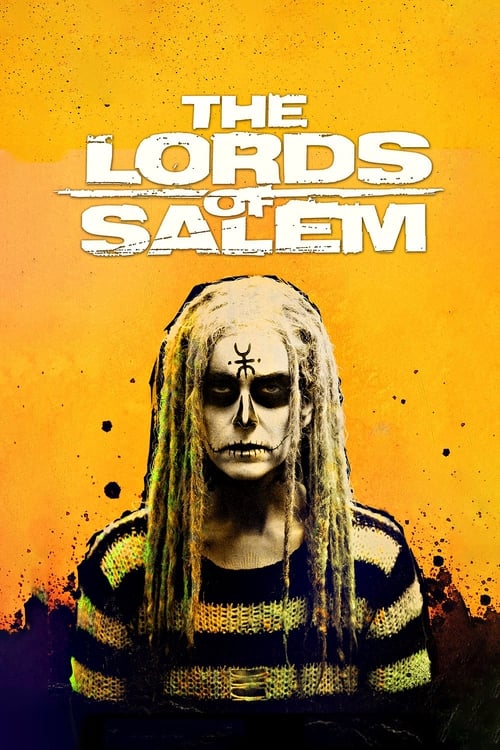
The Lords of Salem
2013 · Rob Zombie
For when you want horror as a trance — something strange, arty, and genuinely disturbing to sink into alone, not a crowd-pleaser. Firmly a challenge watch, best for viewers who like their occult films slow and sincere.
What it's about
Heidi, a recovering addict working as a late-night radio DJ in Salem, Massachusetts, receives a mysterious record — a 'gift from the Lords.' When she plays it on air, its droning sound stirs visions of the town's violent past, and a coven of witches executed centuries ago begins reaching across time to claim her. Whether Heidi is losing her mind or being chosen becomes the film's slow, sinking question.
The experience
Hypnotic and oppressive rather than jumpy — a slow descent built from droning sound, ritual imagery, and rooms that feel wrong. It gets under your skin and stays there; expect to feel dirtied rather than startled.
Performances
Sheri Moon Zombie gives her most vulnerable, lived-in performance as Heidi — the film rests on her fraying, haunted presence, and she carries it.
The craft
Rob Zombie abandons his grindhouse mayhem for 1970s European art-horror textures: symmetrical corridors, lurid ritual tableaux, and a sound design where a single droning melody becomes an instrument of possession. It's his most visually composed film and rewards a dark room and good speakers.
Why it matters
Divisive and commercially ignored on release, it has since built a strong cult following as the film where Zombie proved he could do dread instead of carnage — many now call it his best.
Snapshot
The Lords of Salem is Rob Zombie's fifth feature and the first he wrote from scratch after his two Halloween films (2007, 2009). A recovering addict who works as a radio DJ in Salem, Massachusetts, plays a strange record on air. The record wakes a coven of witches executed in the town's past, and they set out to use her as the vessel for their revenge on the descendants of their persecutors. The film is slow and atmospheric, and it is far more abstract than the redneck grindhouse brutality of House of 1000 Corpses (2003) and The Devil's Rejects (2005). It leans less on plot than on dread, ritual imagery and its central performance. It borrows openly from 1970s European art-horror, Kubrick, Polanski and Ken Russell. Critics were sharply divided on release and it earned little money, but it has since gained a strong cult reputation. Many of Zombie's admirers now consider it his most personal and formally daring film.
Industry & production
The film came out of the low-budget production model that Jason Blum and Oren Peli built after Paranormal Activity (2007). Their label, often called Haunted Movies, produced genre films cheaply and gave the director creative control, including final cut, in return for a small budget. Blum, Peli, Steven Schneider and Andy Gould (Zombie's longtime manager) were among the producers. Alliance Films was involved in financing and international release, and Anchor Bay Films distributed it in the United States. Exact budget figures vary between accounts and are not fully documented. It was a very small sum compared with Zombie's studio-backed Halloween films.
That arrangement mattered to Zombie. He had said publicly that Halloween II was a difficult experience under the Weinstein Company, and Lords gave him the creative independence he had been missing. The project grew from his own music: "The Lords of Salem" is a track on his 2006 album Educated Horses. The film premiered in the Midnight Madness section of the Toronto International Film Festival in September 2012. It opened on a limited U.S. release in April 2013 and went to home video soon after.
Most of the film was shot in Los Angeles, with some location work in Salem itself. Several familiar genre actors filmed scenes that were cut from the release. Reports name, among others, Richard Lynch, Sid Haig, Michael Berryman, Udo Kier and Clint Howard. Accounts differ on how much each of them shot, and the details are not consistently documented. Zombie co-wrote a novelization with B. K. Evenson, published in 2012, which keeps material and backstory that the film drops or leaves vague.
Technology
Nothing about the film's technology was new; its interest lies in how it uses modest means. It is framed in anamorphic widescreen (2.35:1). Brandon Trost, who also shot Halloween II, gave it a cleaner, more composed look than Zombie's earlier grainy, handheld work. Sources disagree in detail about the capture format, so this dossier does not commit to one. The visual effects are deliberately sparing and often practical: prosthetic witch make-up, puppetry and creature work for the monstrous "Lord" figures, and in-camera lighting effects such as neon and coloured gels. Digital work does not dominate. The low budget pushed the film toward suggestion, controlled settings and theatrical tableaux rather than large set-pieces, and the result looks deliberately old-fashioned.
Technique
Cinematography
Trost and Zombie build much of the film from static, often symmetrical wide shots: long apartment hallways, centred doorways, figures set small in empty rooms. The effect recalls Kubrick's The Shining (1980) and, in its patient stillness, Polanski's Rosemary's Baby (1968) and The Tenant (1976). The look of Heidi's daily life (her loft, the radio station, Salem's grey streets) is muted and wintry. The visionary scenes break into saturated colour: red-lit corridors, glowing neon crosses and smoky, backlit ritual spaces. The camera rarely lurches. Dread comes from holding the frame and letting the viewer search it. In the hallucinations the camera turns frontal and close to iconic, and the flashbacks to the 17th-century coven are shot as firelit, low-angle tableaux.
Editing
Glenn Garland, Zombie's regular editor, cuts the film to a slow rhythm. The story is divided by title cards for the days of the week, counting down to a final act that turns into hallucinatory montage. Long stretches of everyday routine are interrupted by short visionary inserts, and the inserts get longer and more frequent as Heidi's grip on reality weakens. The final reel gives up continuity almost entirely. It strings together tableaux, a concert where the audience falls into trance, and grotesque religious imagery, ending on news-report narration rather than a clean resolution. Critics divided sharply over this ending: some saw a bold surrender of narrative logic, others a loss of control.
Mise-en-scène / staging
Production designer Jennifer Spence and Zombie's art department fill the film with sharply contrasting spaces. Heidi's loft is cluttered with vintage posters and bohemian objects. Lacy Doyle's building has a perpetually "vacant" Apartment 5 that becomes a portal. The 17th-century coven gathers in a forest clearing. The visions borrow from Catholic and Satanic iconography: inverted crosses, defiled clergy, goat imagery, enthroned figures. They are staged with the stylised sacrilege of Ken Russell's The Devils (1971) and the occult tableaux of Jodorowsky and 1970s Euro-horror. The coven's witches are played by older women whose bodies are shown without glamour, and this is central to the film's look. It refuses the "sexy witch" convention in favour of something earthier and more unsettling.
Sound
Sound sits at the centre of the plot, since the curse spreads through a record played on the radio. The droning, repetitive theme of the Lords is the film's key sonic motif. It is built from scraping strings and a hypnotic, almost primitive pulse, and it works on the characters and the audience alike. John 5, Zombie's guitarist, and Griffin Boice are credited with the score. The film also draws on existing music, including pieces by the Velvet Underground and classical choral repertoire. The pairing of art-rock and sacred music fits its blend of counterculture and liturgy. The radio-station setting also supports a running theme about broadcast: once the music is on the air, nobody in the town can avoid it.
Performance
Sheri Moon Zombie, who appears in all of her husband's features, plays Heidi Hawthorne in a quiet, internal register. The part differs sharply from her manic Baby Firefly in the earlier films. Heidi's relapse into addiction and her gradual possession play out mostly through withdrawal, exhaustion and silence. Critics disagreed about whether the performance could carry the film; some found it too blank, while others found its passivity fitting for a woman being emptied out. The supporting cast is deliberately stocked with genre and cult veterans. Judy Geeson, Dee Wallace and Patricia Quinn play a trio of sisters whose kindness slowly turns sinister. Meg Foster gives a ferocious performance as the coven leader Margaret Morgan. Bruce Davison plays Francis Matthias, an author whose research uncovers the curse. Jeff Daniel Phillips and Ken Foree play Heidi's co-hosts, and Andrew Prine plays the ancestral witch-hunter Reverend Jonathan Hawthorne. Casting performers best known from 1970s and 1980s cinema works as a kind of genre memory.
Narrative & dramatic mode
The narrative is simple and nearly linear: an inherited curse closes in on its chosen vessel over a single week. The film is less a mystery than a slow drift toward a fate fixed from the start. The audience is told early what the Lords want, so the suspense lies in how far Heidi will slide, not in what is happening. Two strands run in parallel: Heidi's experiences, and Matthias's research into the coven's 17th-century persecution. The investigator strand follows a familiar occult-horror pattern in which a scholar pieces together the past too late to save anyone.
The dramatic mode is closer to dream or liturgy than to classical suspense. Scenes work through repetition, ritual and atmosphere, and the day-of-the-week structure gives the film the feel of a countdown or a calendar of rites. Heidi's history of addiction gives her possession a psychological reading, as relapse, surrender and the pull of a destructive habit. The film never settles whether we are watching madness or the supernatural, though the ending points firmly toward the latter.
Genre & cycle
The Lords of Salem belongs to occult and witchcraft horror, a line running through Häxan (1922), Black Sunday (1960), Witchfinder General (1968), Rosemary's Baby, The Devils, Suspiria (1977) and Inferno (1980). It also connects to the "Satanic conspiracy among neighbours" plot that Polanski established. In 2013 it stood apart from the dominant American horror cycles: found footage, the haunted-house and possession films of the Blumhouse and Insidious/Conjuring mould, and the tail end of the remake boom that Zombie had helped drive. It moves slowly and works by image and mood, which put it at odds with the jump-scare model of those cycles. In hindsight it looks like an early example of the turn toward art-house, folk and occult horror that grew over the rest of the decade.
Authorship & method
Zombie wrote and directed the film. It is often read as a deliberate break with the image formed by his earlier features: Texan grindhouse violence, profane and loud characters, and heavy use of 1970s exploitation styles. Lords keeps his devotion to cult cinema and his habit of casting genre veterans, but turns from American drive-in culture toward European and art-house models. It brings his music career into the film more directly than before. The story began as one of his songs, the curse travels through a record, and his guitarist co-composed the score.
His key collaborators are mostly longstanding ones:
- Sheri Moon Zombie, lead actress and his constant on-screen presence.
- Brandon Trost, cinematographer, whose more composed framing here differs from his rougher handheld work on Halloween II.
- Glenn Garland, editor, who has cut most of Zombie's features.
- John 5 and Griffin Boice, composers.
- Producers Jason Blum and Oren Peli, whose budget model gave Zombie his autonomy.
Zombie spoke in interviews about wanting a European, art-film approach to horror, and named Ken Russell, Kubrick and Polanski among his touchstones. The film's look bears those influences out, but any exact quotation should be checked against the source interviews before it is cited.
Movement / national cinema
The film is American independent genre filmmaking, made inside the then-new micro-budget, director-controlled model that Blumhouse made commercially important in the 2010s. It does not belong to any formal movement. Its style draws heavily on non-American traditions: Italian gothic and supernatural horror (Bava, Argento, Fulci), British occult and religious-transgression cinema (Russell, Witchfinder General, Hammer's late period) and the surrealism of Jodorowsky. Its setting carries its own American meaning. Salem and the witch trials of the 1690s are the founding American story of persecution and mass hysteria. The film turns the usual moral reading around: the persecuted witches really were diabolical, and their revenge falls on a town that now trades on its own history.
Era / period
The film was made at a turning point for American horror. In the early 2010s the remake wave of the 2000s (Zombie's own Halloween among them) was fading, and the found-footage and supernatural-franchise boom launched by Paranormal Activity and Insidious (2010) was at its height. Blumhouse was turning into a studio-scale brand on the strength of cheap, profitable films. Lords was an outlier within that system: an auteur's personal project, financed on the same model but uninterested in its commercial formula. It came just before the wave of distinctive, slow, often female-centred occult horror that would include The Witch (2015) and Hereditary (2018). That later context shaped how the film was reassessed.
Inside the story, the period setting is split. The contemporary scenes are given a timeless, slightly retro feel through vinyl records, analogue radio and vintage décor. They are set against flashbacks to the late 17th century, which give the coven's persecution a precise historical setting different from the famous 1692 trials.
Themes
- Inheritance and ancestral guilt. Heidi is chosen because she descends from the witch-hunter Hawthorne. The sins of the persecutors pass down to their descendants, a familiar gothic idea set here against America's founding myths.
- Addiction and relapse. Heidi's slide into possession tracks her return to drug use. The film links dependency, isolation and the pull of self-destruction to its supernatural plot.
- Broadcast, music and contagion. The curse spreads through a record played on the radio. Music becomes something that spreads irresistibly, and the film is drawing on its maker's own world of rock performance and fandom.
- Female bodies, ageing and power. The coven's older women, the sisterhood of landladies and Heidi's forced role as mother of the Antichrist all put women's bodies at the centre. Readings differ on whether the film celebrates their power or turns them into monsters. It also reworks the forced-pregnancy horror of Rosemary's Baby.
- Religion and sacrilege. Catholic imagery is repeatedly defiled. The film treats institutional religion and Satanism as mirror-image systems of ritual and spectacle, much as Ken Russell did.
- Persecution and revenge. The film turns the liberal reading of the witch trials upside down, and it leaves deliberately open whether its sympathy lies with the hunted or the hunters.
Reception, canon & influence
Critical reception. Reviews in 2013 were sharply split, and aggregate scores sat in the "mixed" range. Some critics praised the film's ambition, its look, its patience and its break from Zombie's earlier habits. Detractors found it incoherent, slow or self-indulgent, criticised its final act as uncontrolled and doubted that the lead performance could carry it. It made very little at the box office on a limited release, which was in line with the low-budget model and its small marketing push.
Backward influences. The film's sources are unusually visible: Rosemary's Baby and The Tenant (neighbours who are not what they seem, a woman's mind and body taken over); The Shining (symmetrical hallways and a building as a site of possession); The Devils (operatic sacrilege); Argento's Suspiria and Inferno (saturated colour, covens hidden behind ordinary façades); Häxan and Witchfinder General (the history of witch persecution); and Jodorowsky's surreal religious imagery. Casting Geeson, Wallace, Quinn, Foster and Davison adds a further layer of homage to 1970s and 1980s genre cinema.
Forward legacy. Its reputation has grown steadily on home video and in genre criticism. It is now often cited as Zombie's most mature or most underrated film, and it turns up in reassessments of 2010s horror. Its slow occult dread and focus on a woman's possession by an ancestral coven are often mentioned alongside later films such as The Witch and Hereditary. These comparisons are critical hindsight; there is no documented direct influence on those films, so Lords is better described as an early example of that sensibility than as its source. Zombie's next features, 31 (2016) and 3 from Hell (2019), went back to the grindhouse register of his earlier work. That makes The Lords of Salem the most clearly European-minded experiment in his filmography so far.
Influences: the films it descends from and the films it influenced
- Rosemary's Baby (1968) — Its central device is a coven of fussy, kindly elderly neighbours who take over a young woman's body to bring forth Satan's child, and Lords reuses it directly in the three tea-serving sisters who groom Heidi toward a satanic birth.
- The Tenant (1976) — Polanski shows a tenant's identity being worn away by neighbours in one apartment building through stairwell and corridor geography, and Lords uses that geography to stage Heidi's decline toward the 'empty' Apartment 5.
- The Shining (1980) — Lords takes two things from Kubrick: day-of-the-week title cards that count down to the possession, and symmetrical one-point-perspective wides of corridors that make the building itself feel possessed.
- The Devils (1971) — Russell's operatic, sexualised sacrilege (writhing clergy and desecrated altars shown in stark designed tableaux) is the template for Lords' grotesque priest imagery and its blasphemous set pieces.
- Suspiria (1977) — Argento hides a coven behind a respectable institution and floods the frame with saturated primary-colour gels, and Lords borrows both the hidden-coven structure and the coloured-light hallucinations.
- Inferno (1980) — Its apartment building is literally a witch's lair (Mater Tenebrarum's dwelling), with bold colour washes over the architecture, and Lords' Apartment 5 is built on the same idea.
- Häxan (1922) — Christensen restages witches' sabbaths as tableaux of naked old women around fires, which is the model for Lords' 1696 flashbacks of Meg Foster's coven.
- Witchfinder General (1968) — Reeves treats Puritan witch persecution as the real atrocity, and Lords' Reverend Hathorne trial-and-burning prologue follows that approach, with the bloodline guilt it creates driving the plot.
- The Holy Mountain (1973) — Jodorowsky's frontal, surreal religious tableaux (distorted clergy, ritual costume, symbolic beasts) set out the visual grammar of Lords' hallucinatory finale montage.
- City of the Dead (1960) — It established the plot of a Massachusetts witch burned in the 17th century whose coven survives into the present and claims a modern young woman, which Lords transposes to Salem.
- Black Sunday (1960) — Bava opens with a witch's execution and her curse on her executioners' descendants, and Lords copies that structure, with the vengeance falling on Heidi as Hathorne's heir.
- The Sentinel (1977) — A young woman's brownstone contains a supposedly vacant apartment that turns out to be a gateway to hell, and its strange elderly residents are cast with ageing veteran actors; Lords repeats both the apartment and the casting.
- The Witch (2015) — Eggers' slow-burn New England witchcraft film uses unglamorous naked witches in firelit forest rites, very close to Lords' Puritan-era coven imagery (a parallel in critical hindsight, not a documented debt).
- Hereditary (2018) — Its ending, with naked elderly cultists bowing before a possessed heir crowned on a throne, echoes Lords' climax of Heidi enthroned before an aged coven (critical comparison, not documented influence).
- Suspiria (2018) — Guadagnino turns Argento's witches into ageing, physically grotesque bodies, prosthetic Markos included, and ends in a sabbath bloodbath, extending Lords' unglamorous-coven revision of Argento.
- Sinister (2012) — It was made under the same Blumhouse micro-budget, director-autonomy model in the same period, and it also uses found recorded media (Super 8 reels) as the diegetic channel through which an ancient entity arrives.
- Mandy (2018) — It brings together a metal-musician sensibility, saturated single-colour washes and an occult-cult plot told in dreamlike tableaux, the same crossover of music and art-horror that Lords began.
Similar films
- Häxan (1922) — influence & lineage
- Suspiria (2018) — influence & lineage
- Suspiria (1977) — influence & lineage
- The Devils (1971) — influence & lineage
- Mandy (2018) — influence & lineage
- House of 1000 Corpses (2003) — shared sensibility
- The Witch (2016) — shared sensibility
- Saint Maud (2020) — shared sensibility