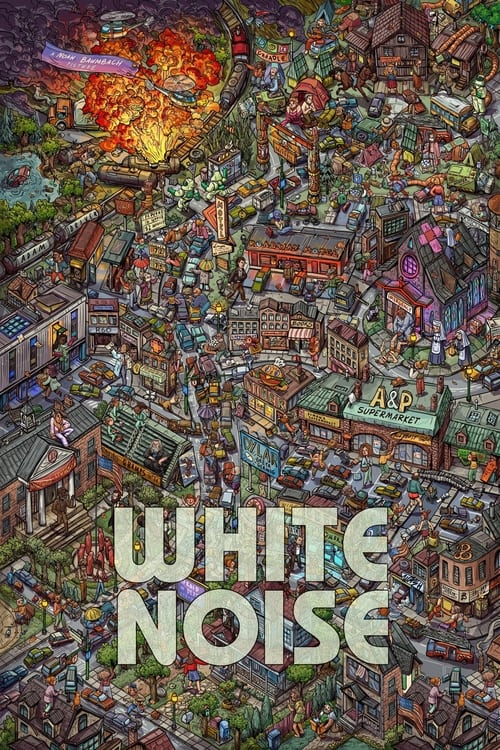
White Noise
2022 · Noah Baumbach
For when you're in the mood for something weird and talky to argue about afterward — an acquired taste, not a crowd-pleaser. Reach for it when you want ambition and ideas over easy laughs.
What it's about
Jack Gladney is a celebrated professor of Hitler studies at a leafy liberal-arts college — never mind that he can't speak German — presiding over a blended family of four kids where everyone talks at once. His wife Babette has a secret involving an experimental pill, and Jack has a terror he can't name: his own death. Then a rail-car chemical spill sends a toxic cloud over town, and the whole family joins a panicked highway evacuation that drags his fear out into the open.
The experience
Deliberately artificial and strange — screwball-fast overlapping dialogue, sudden swerves from campus satire into disaster spectacle into something like dread. It's funny in an arch, off-kilter way that keeps you at a slight remove, and it leaves a hum of unease about consumerism, media chatter, and mortality.
Performances
Adam Driver disappears into paunchy, pontificating Jack, and Greta Gerwig gives Babette's frazzled warmth a current of real sadness underneath.
The craft
Noah Baumbach takes on Don DeLillo's famously 'unfilmable' 1985 novel at full studio scale, keeping the book's stylized, essayistic dialogue and staging the evacuation with genuine widescreen disaster-movie sweep. The production design is a saturated 1980s supermarket dream, and it looks terrific on a big screen.
Why it matters
Baumbach's biggest, riskiest swing — a rare big-budget attempt to film a cornerstone of American postmodern literature, and a lightning rod that split critics on whether the book can be filmed at all.
Snapshot
Noah Baumbach's adaptation of Don DeLillo's 1985 novel is the strangest object in his filmography: a $80-million-scale Netflix production, built around a book long treated as unfilmable, that converts one of American postmodernism's foundational texts into a widescreen disaster-comedy about the fear of death. Jack Gladney (Adam Driver) is the inventor of Hitler studies at a small Midwestern college who cannot speak German; his wife Babette (Greta Gerwig) is secretly taking an experimental drug, Dylar, that promises to erase the fear of dying. Between them sit four children from prior marriages, a household in which everyone talks at once and no one listens. Midway through, a derailed tank car releases a chemical plume over the town, and the family joins a highway evacuation that the film stages with genuine Spielbergian awe.
The film keeps DeLillo's tripartite structure — "Waves and Radiation," "The Airborne Toxic Event," "Dylarama" — and much of his dialogue verbatim, which is both its method and the source of most objections to it. It opened the 79th Venice Film Festival in August 2022, played the New York Film Festival, received a brief theatrical release in November, and arrived on Netflix on December 30, 2022. Reviews divided sharply. It won no major awards. Its reputation since has been shaped less by consensus than by the peculiar afterlife of its central image.
Industry & production
White Noise sits at the high-water mark of Netflix's auteur-patronage period — the run of expensive, personal, awards-facing films that included Alfonso Cuarón's Roma, Martin Scorsese's The Irishman, Baumbach's own Marriage Story, and, in the same 2022 slate, Andrew Dominik's Blonde and Alejandro González Iñárritu's Bardo. Baumbach had made The Meyerowitz Stories and Marriage Story for the company; White Noise was the film that tested how far the arrangement would stretch. Reported budgets vary across trade accounts, generally in the $80–100 million range — an order of magnitude above anything Baumbach had previously directed, and a figure impossible to justify by any theatrical logic, since Netflix released the film to a small number of cinemas as a qualifying and prestige gesture and does not report grosses.
Baumbach has described writing the screenplay during the first COVID lockdown, having returned to a novel he had known since college. That timing matters: an airborne contaminant, a state-mandated evacuation, an official vocabulary invented in real time to describe an emergency nobody understands. The novel supplied all of this in 1985; 2020 simply made it legible again.
Production ran through 2021, largely in northeast Ohio — Cleveland and surrounding towns, standing in for the fictional college town of Blacksmith. The film's most-discussed logistical feat was the supermarket: rather than dress an existing store, the production built a complete, fully stocked 1984 A&P inside a vacant department-store space at a Cleveland-area mall, down to period-correct packaging and the plain white generic-brand labels that DeLillo made emblematic. It functioned as a standing set across the shoot and became the film's cathedral. Producers included David Heyman and Uri Singer alongside Baumbach.
Technology
For a director whose reputation rested on rooms, conversation, and available light, White Noise represents a wholesale change of toolkit. It is Baumbach's first film built around visual effects of any consequence: the derailment itself, the toxic plume, aerial and highway-scale evacuation imagery, and a set of skyscapes that the film treats as apocalyptic weather. The approach blends practical elements — real vehicles, real crowds, real smoke — with digital extension, and the seams are deliberately soft rather than photoreal-slick, keeping the disaster closer to the texture of an early-eighties studio picture than to contemporary blockbuster compositing.
The photography was captured on 35mm, consistent with Baumbach's practice since Marriage Story, and the choice is legible on screen: grain, halation around fluorescents, and a color response in the reds and yellows that digital capture tends to clean up. The period is registered as much through emulsion behavior as through props.
Technique
Cinematography
Lol Crawley — the British cinematographer of Ballast, 45 Years, The Childhood of a Leader, and Vox Lux, who would go on to win the Academy Award for The Brutalist (2024) — is the single most consequential hire. Crawley's prior work is marked by long, deliberate camera movement and an unusual willingness to hold on architecture. Here he gives Baumbach a vocabulary the director had never used: crane moves that lift off a family kitchen into an omniscient survey, sustained lateral tracking down supermarket aisles, and a widescreen frame organized around symmetry and product-shelf geometry rather than the loose, reactive handheld of Frances Ha or The Squid and the Whale.
The palette is a period argument. Domestic interiors run warm and cluttered; the campus is autumnal; the supermarket is a hard white-and-primary environment lit to look like an advertisement for itself. The toxic-event sequences push into an almost Spielbergian register — headlights in fog, faces upturned toward a sky doing something inexplicable — with the crucial difference that the wonder is unearned and the object of awe is poison.
Editing
Matthew Hannam replaced Jennifer Lame, Baumbach's longtime editor, who had by then moved into Christopher Nolan's orbit. The change is audible. Hannam's cutting holds DeLillo's dialogue at full length — the film is unusually willing to let a paragraph play — while accelerating hard through the middle act, where the evacuation is assembled from short, incident-dense fragments. The three-part structure is preserved as structure: each section has a distinct tempo, and the film accepts the resulting unevenness rather than smoothing it. The closing supermarket dance, a choreographed sequence set to LCD Soundsystem over the end credits, is the one passage where cutting yields entirely to sustained movement.
Mise-en-scène / staging
Production designer Jess Gonchor — a frequent Coen brothers collaborator — builds a 1984 that is neither nostalgic nor ironic but taxonomic: an America cataloged through packaging, appliances, wood paneling, and the specific beige of institutional carpet. Ann Roth's costumes do comparable work, aging Driver into tweed, academic robes and heavy dark glasses, and giving Gerwig a halo of pale curls that reads as both period-accurate and faintly celestial.
Staging is the film's most distinctive formal gambit. Baumbach blocks the Gladney household as an ensemble in constant simultaneous motion, dialogue overlapping in the Altman manner, with the camera choosing arbitrarily among competing conversations. The lecture-hall duet in which Jack and Murray Siskind (Don Cheadle) improvise a comparative aria on Hitler and Elvis, circling each other while students accumulate around them, is the film's set piece of pure staging — a theatrical two-hander shot as spectacle.
Sound
The title is a design brief. Sound is where the film's thesis lives: television and radio voices bleeding under domestic scenes, appliance hum, supermarket muzak, the intercom, the announcer. Information arrives constantly and is never quite addressed to anyone. The evacuation's crucial joke is auditory — the event acquires its official name, "the airborne toxic event," from the radio, and the family adopts the phrase immediately.
Danny Elfman's score, his first for Baumbach, is a genuine oddity: it moves between wide-eyed orchestral gesture in the disaster passages and a needling, pulse-driven anxiety elsewhere, functioning less as emotional underlining than as another layer of ambient signal. The closing credits carry "new body rhumba," written for the film by James Murphy and marking LCD Soundsystem's return to new material after several years — a piece of music that recasts the supermarket as a dance floor and the whole preceding two hours as choreography nobody realized they were performing.
Performance
Driver plays Jack as a man wearing an authority he assembled himself: padded, stooped, deliberately unhandsome, his voice pitched at lectern volume even at breakfast. Gerwig's Babette is the film's most difficult performance, required to be radiantly capable in public and hollowed out in private, and to deliver the Dylar confession as something between confession and recitation. Cheadle's Murray is the film's engine of theory, delivering DeLillo's aphorisms with the pleasure of a man who has found his subject. The children — Raffey Cassidy as Denise, Sam Nivola as Heinrich, May Nivola as Steffie, with the toddler Wilder as a mute barometer — are directed to speak in adult cadences without adult understanding, which is precisely the novel's joke about media-raised children.
The European casting is pointed. Lars Eidinger, of Berlin's Schaubühne, plays the ruined Mr. Grey; Barbara Sukowa, veteran of Fassbinder's Berlin Alexanderplatz and Lola and of Margarethe von Trotta's Rosa Luxemburg and Hannah Arendt, appears late as a nun who explains that she does not believe and that her non-belief is a service she performs for others. Casting a New German Cinema icon to deliver the film's final theological turn, in a story about a man who has built a career on German history he cannot read, is not incidental. André Benjamin appears as Jack's colleague Elliot Lasher and Jodie Turner-Smith as the neurochemist Winnie Richards.
Narrative & dramatic mode
The film is structurally a triptych and tonally a hybrid: campus satire, then disaster picture, then noirish marital thriller, each mode played straight within its own section. What holds it together is not plot but a single obsessive question — who is more afraid of death, Jack or Babette — which is posed as a marital negotiation and resolved as a farce of violence in a motel room.
Baumbach resists the standard adaptive move of naturalizing DeLillo's speech. Characters talk in essays. Nobody in the film speaks the way people speak. This is a deliberate formal commitment: the flatness and the aphoristic density are the point, since the novel argues that Americans have been colonized by the language of institutions, advertising and broadcast. Detractors read the result as arch and airless; on its own terms it is a coherent anti-realist decision, closer to Whit Stillman's or Wes Anderson's stylized diction than to the naturalism of Marriage Story.
Genre & cycle
White Noise is a satire that keeps borrowing whole genres and returning them slightly damaged: the academic comedy of Lucky Jim and its screen descendants; the seventies-eighties disaster movie; the paranoid conspiracy picture; the domestic melodrama. Its clearest cyclical placement, though, is industrial. It belongs to a 2022 cluster of expensive, maximalist, personal films by established auteurs — Babylon, Blonde, Bardo, Empire of Light, The Fabelmans — nearly all of which struggled commercially or critically, and whose collective reception marked the end of a brief period in which studios and streamers underwrote director-driven spectacle at that scale.
Authorship & method
Baumbach had never adapted another novelist's work as a director; his prior adaptive credits were collaborations in animation, including Fantastic Mr. Fox with Wes Anderson. The shift from autobiographical miniaturism to literary maximalism is the central authorial fact of the film. What survives from earlier Baumbach is the family as an acoustic problem — overlapping, competitive, affectionate, incapable of a single shared conversation — a device running back to The Squid and the Whale.
The collaborator roster is almost entirely new: Crawley in place of Robbie Ryan, Hannam in place of Lame, Elfman where Baumbach had generally used Randy Newman or Georges Delerue needle-drops, Gonchor and Roth bringing studio-scale craft. Gerwig, Baumbach's partner and co-writer, is here purely as an actor; the two co-wrote Barbie immediately afterward, and the artificial, product-saturated, primary-coloured world-building of White Noise reads in retrospect as a rehearsal for it.
Movement / national cinema
The film is a late document of American independent cinema's absorption into streaming capital — an intimate-scale sensibility given blockbuster resources by a company with no theatrical stake in the outcome. Culturally it sits in the New York literary-cinematic lineage that runs from Woody Allen through Stillman to Baumbach, applied for once to the Midwest rather than Manhattan. The German casting, and the film's preoccupation with a European catastrophe endlessly re-broadcast as American academic content, gives it a second, transatlantic axis.
Era / period
The setting is 1984, and the period is not decorative. DeLillo's novel was published in January 1985, weeks after the Bhopal disaster killed thousands in India — an accident of timing that made the airborne toxic event look prophetic on arrival, and that followed Three Mile Island and Love Canal in a decade when chemical and nuclear accident had become an ambient American expectation. The film restores that context: Reagan-era abundance, cable news, the mall, the supermarket as civic center, and beneath it a low continuous dread with no available object.
Themes
Death is the subject; everything else is displacement activity. The Gladneys manage mortality through consumption (the supermarket as sacrament), through academic mastery of atrocity (Hitler studies as a way of standing next to death without dying), through pharmacology (Dylar), through media (disaster as televised entertainment), and through family noise. The film's sharpest satirical invention, retained from DeLillo, is SIMUVAC — the emergency agency using a real evacuation as a rehearsal for its simulated ones, having found the real thing a useful opportunity to improve the model. DeLillo's most-quoted set piece, the most photographed barn in America, has become shorthand for his theory of the image; Baumbach locates the same idea in the supermarket, where the film both begins its argument and ends its dance.
Reception, canon & influence
Backward. The film's inheritance is double. From literature: DeLillo's novel, winner of the 1985 National Book Award, and the broader postmodern account of simulation associated with Baudrillard that the novel anticipated and absorbed. Screen precedent for DeLillo is thin — David Cronenberg's Cosmopolis (2012) is the significant prior adaptation, with Benoît Jacquot's Never Ever (2016), from The Body Artist, a marginal second — and the "unfilmable" label attached to White Noise for nearly four decades. From cinema: Altman's overlapping ensembles, Spielberg's suburban astonishment, the seventies disaster cycle, and the deadpan academic comedy tradition.
Critical reception. Venice audiences and critics split on opening night and never converged. Admirers praised the sheer ambition, Crawley's images, the evacuation sequence, and the final dance; detractors found the film an over-faithful transcription that mistook reciting DeLillo for dramatizing him, and that left Driver and Gerwig performing sentences rather than people. Awards recognition was minimal — no Academy Award nominations, including for the original song submitted from the closing credits. Netflix's non-reporting makes commercial assessment impossible, but nothing in the company's subsequent behavior suggests satisfaction.
Forward. Two afterlives dominate. The first is industrial: White Noise, alongside Blonde and Bardo, marked the closing of Netflix's blank-cheque auteur window; Baumbach's next feature, Jay Kelly (2025), remained with the company but returned to human scale. The second is uncanny. In February 2023, six weeks after the film reached Netflix, a Norfolk Southern freight train derailed at East Palestine, Ohio, releasing hazardous chemicals and forcing an evacuation — in the same state where the film had shot, with reports that some residents affected had worked as background extras on it. The coincidence circulated far beyond the film's own audience and effectively rewrote its reputation: a picture received as an arch period exercise was retroactively read as documentary. Whatever the film's standing as an adaptation, that is now the primary way it is remembered, and it is an oddly DeLillian fate — a work about the collapse of the distinction between event and simulation, overtaken by the event.
A Deleuzian reading
The radio says it first.
The full Deleuzian reading of White Noise →
Reception
Opened Venice 2022 to a shrug-and-a-half — critics split, audiences baffled, and Netflix's ~$100M gamble got filed under 'noble folly.' The reappraisal came from real life: after the 2023 East Palestine train disaster, the film suddenly read as eerily prophetic, and its defenders got louder.
How White Noise was received, from release to now →
How to watch White Noise: what to notice on a first viewing
- Watch the camera crane up and out of a crowded room. Crawley lifts off the Gladney kitchen into a wide, omniscient view, a move Baumbach had never used in his earlier, tighter films. The camera keeps arguing that this family is part of a bigger system, not just a household.
- Listen for a television or radio playing under a conversation. Broadcast voices bleed constantly beneath the family's talk, alongside appliance hum and supermarket muzak, so information never stops arriving. Nobody in the house is quite listening to any one source. Everyone is just receiving.
- Notice how many people talk at once in a scene. Baumbach blocks the household as a constant ensemble, dialogue overlapping while the camera picks arbitrarily among competing conversations. No single voice gets to be the center, which is exactly how information works in this family.
- Listen for the family adopt a phrase from the radio. A radio voice names the chemical cloud 'the airborne toxic event,' and within seconds the whole family is repeating the phrase as if it were knowledge. The name becomes a substitute for information nobody in the car actually has.
- Watch the supermarket's hard white and primary-color light. The store is lit to look like an advertisement for itself, a sharp contrast to the warm clutter of the family's home and the autumnal campus. The brightest, most reassuring space in the film is also its most artificial one.
The whole guide to watching White Noise, with the keys for a rewatch →
Influences: the films it descends from and the films it influenced
- Nashville (1975) — The multi-track radio-mic method that lets an ensemble talk simultaneously and be balanced in the mix rather than staged in turns is exactly the technique behind the Gladney kitchen and dinner-table scenes, where competing lines are laid over each other and no single conversation is privileged.
- Close Encounters of the Third Kind (1977) — The grammar of suburban astonishment — upturned faces lit by an off-screen event, cut against the family station wagon fleeing an official evacuation, with the phenomenon rendered by in-camera light and smoke rather than described — is the direct template for the Airborne Toxic Event sequence.
- Poltergeist (1982) — Establishes the television as a lighting and sound source that contaminates the domestic frame — an always-on broadcast murmur bleeding under family dialogue — the precise device Baumbach's sound design uses to keep media chatter audible beneath every scene.
- The Andromeda Strain (1971) — Codifies the containment procedural as a visual idiom — anonymous figures in hazmat suits, decontamination corridors, readouts and clipboards shot with clinical flatness — which White Noise reproduces and satirizes in the SIMUVAC and quarantine-barracks passages.
- Playtime (1967) — Builds a consumer-modern environment as a full practical set and stages comedy as dispersed choreography inside it, gags occurring at the edges of a deep-focus frame — the operating principle of the supermarket, whose aisles function as a stage grid rather than a location.
- The Young Girls of Rochefort (1967) — Stages a full musical number in a working commercial space with non-dancer principals, choreography arranged as a social diagram of the crowd — the structural model for the LCD Soundsystem supermarket dance that resolves the film in movement rather than dialogue.
- Cosmopolis (2012) — The only serious prior solution to filming DeLillo: keep the declamatory, unspeakable syntax verbatim and direct actors to recite it frontally as text rather than psychologise it — the anti-naturalist diction Driver and Gerwig are asked to sustain.
- Lola (1981) — Source of Barbara Sukowa's Brechtian frontal address and of the gel-saturated, artificially colored interior; casting her as Sister Hermann Marie imports New German Cinema's alienation-effect performance directly into the hospital scene's confrontation about belief.
- A Serious Man (2009) — Jess Gonchor's production design method — a period suburb built as an anti-nostalgic diagram, every object placed for graphic legibility rather than lived-in texture — carries straight into the Gladney house and the College-on-the-Hill campus, alongside the same deadpan academic dread.
- The Squid and the Whale (2005) — Establishes Baumbach's signature treatment of the family as an acoustic problem: four people talking past each other in one room, affection expressed as interruption — the one authorial technique that survives intact into a film otherwise made with an entirely new crew.
- Safe (1995) — Renders environmental toxicity entirely through production design and framing — wide, held, unhelpfully distant compositions of consumer interiors that make the suburb itself the pathogen — the formal precedent for treating the supermarket and split-level home as the film's real subject.
- Edward Scissorhands (1990) — The canonical pairing of Danny Elfman's choral wonder-with-menace idiom against a pastel, anti-naturalist suburb built as a set — precisely the tonal contract Baumbach hired Elfman to supply in place of his usual Newman or Delerue needle-drops.
- Barbie (2023) — Extends the practical-build hyperreality rehearsed here — primary-coloured product-saturated environments constructed rather than rendered, with a mass choreographed dance deployed as structural release — written by Gerwig and Baumbach immediately after this shoot.
- Asteroid City (2023) — Pushes the same anti-naturalist recitation further: atomic-age Americana staged on a constructed desert town set, a containment event played as deadpan tableau, and nested framing that makes the story's artifice explicit rather than concealed.
- The Brutalist (2024) — Crawley's large-format architectural craning and lateral tracking, organized as an overture-plus-parts structure with an epilogue set to a needle-drop — the fullest development of the camera and structural methods he tested on White Noise.
- Magnolia (1999) — The maximalist ensemble built in movements and closed by a supernatural catastrophe, with a pop songwriter's needle-drops carrying structural weight the score cannot — the same wager White Noise makes on its tonal triptych and its closing-credits song.
- Enemy (2013) — Matthew Hannam's editorial signature — holding shots past the point of comfort so that dread accumulates in duration rather than in cuts, and letting tonal registers switch without a transitional beat — is the mechanism by which White Noise's three movements are joined.
- Vox Lux (2018) — Lol Crawley's anamorphic craning and long lateral tracks over a chaptered, narrated structure that opens on public catastrophe and closes on a performance number — the same camera vocabulary and architecture Crawley brings to White Noise.
Similar films
- The Squid and the Whale (2005) — influence & lineage
- The Brutalist (2024) — influence & lineage
- Nashville (1975) — influence & lineage · often watched together
- PlayTime (1967) — influence & lineage · often watched together
- The Big Lebowski (1998) — often watched together
- Annihilation (2018) — often watched together
- Beau Is Afraid (2023) — shared sensibility
- Nouvelle Vague (2025) — shared sensibility