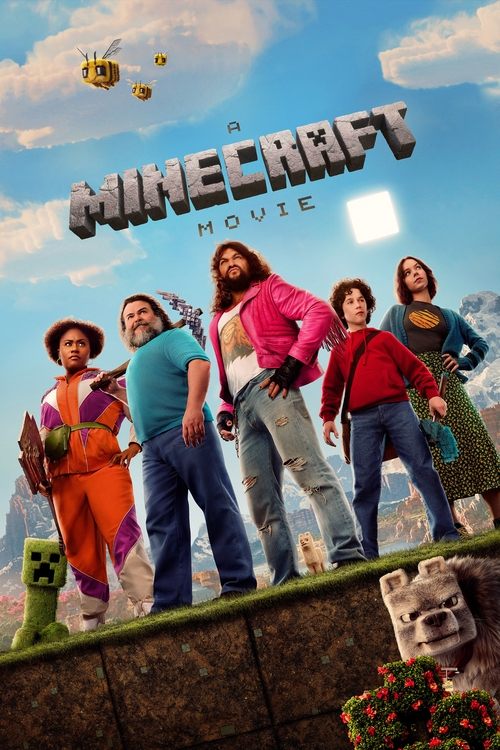
A Minecraft Movie
2025 · Jared Hess
Gen Alpha's first theatrical riot: TikTok-coordinated screaming, thrown popcorn, and police calls at screenings — the phenomenon that launched "is disruptive moviegoing the future of moviegoing" think-pieces.
For a rowdy family night or a so-in-on-the-bit hangout with friends — when you want to switch your brain off, quote lines at the screen, and laugh at blocky nonsense. Pure comfort, zero challenge.
What it's about
Four misfits with ordinary, stuck lives get yanked through a portal into the Overworld — a cubic wonderland where everything can be mined, stacked, and built. To get home they team up with Steve, a gleefully expert crafter who's been living there for years, and set off on a quest through a landscape where imagination is literally the raw material — and where something hostile wants to snuff that imagination out.
The experience
Loud, silly, candy-colored, and completely unembarrassed about it — the jokes come fast, the set pieces are big, and Jared Hess's deadpan-weirdo humor keeps sneaking through the studio machinery. It's a party movie more than a story movie, and it plays best with a crowd that's in on the joke.
Performances
Jack Black goes all-in as Steve, treating every line about crafting and lava like it's an aria — his total commitment to the bit is the engine of the whole film.
The craft
The real trick is visual: translating a game made of flat-shaded cubes into a tactile, sunlit world that still feels unmistakably like Minecraft, with creatures and landscapes rebuilt block by block. It's bright, busy, and made for a big screen full of kids.
Why it matters
A middling critical reception didn't matter — it opened enormous, became one of the biggest video game adaptations ever, and spawned a genuine participatory phenomenon, with young audiences turning screenings into rowdy call-and-response events that became their own news story.
Snapshot
A Minecraft Movie is the first theatrical feature adapted from Mojang Studios' Minecraft (2009/2011), the best-selling video game of all time. Directed by Jared Hess and released by Warner Bros. Pictures in partnership with Legendary Entertainment, Vertigo Entertainment, and Mojang, it arrived in April 2025 after more than a decade of stalled development. The film transposes the game's open-ended, block-built sandbox into a conventional portal-fantasy quest: four contemporary misfits are pulled into the cubic "Overworld," where they are guided home by an eccentric master crafter named Steve (Jack Black) while contending with a villain bent on extinguishing creativity. Its most durable cultural footprint was not its critical standing, which was middling, but its extraordinary commercial performance and the participatory, meme-driven theatrical rowdiness — the "Chicken Jockey" phenomenon — that turned screenings into events. As an object of study it sits at the intersection of the mid-2020s video-game-adaptation boom, brand-IP blockbuster logic, and the social-media-amplified theatrical experience.
Industry & production
The project's defining industrial fact is its protracted gestation. A Minecraft feature was announced in the mid-2010s, when the game's cultural ubiquity and Microsoft's 2014 acquisition of Mojang (a deal reported at roughly $2.5 billion) made a screen adaptation an obvious asset. Development passed through multiple creative regimes and attached filmmakers over the years before Jared Hess was set as director and the film consolidated at Warner Bros. with Legendary as a lead production and financing partner. The long turnover of writers and directors is characteristic of "unfilmable" sandbox IP: unlike a narrative game, Minecraft offers a world, a look, and a set of verbs (mine, craft, build, survive) but no protagonist or plot, so the central production problem was inventing a story the brand did not supply.
Production was mounted as a large transnational studio undertaking, with principal photography carried out substantially in New Zealand, whose facilities and crews have become a standard base for effects-heavy Hollywood fantasy. The casting strategy paired a marquee action star, Jason Momoa, with a comedy anchor, Jack Black, and surrounded them with a younger ensemble (Emma Myers, Sebastian Hansen, Danielle Brooks) plus comic character players including Kate McKinnon and Jennifer Coolidge — a familiar four-quadrant configuration meant to reach children, teens, nostalgic adult players, and general family audiences simultaneously.
Commercially, the film was one of the standout successes of 2025. It opened to figures widely reported as a record for a video-game adaptation and became a major global earner, decisively recouping a large blockbuster budget. Precise box-office totals should be confirmed against trade tallies rather than asserted here, but the qualitative record is unambiguous: the film substantially over-performed pre-release critical expectations and functioned as a tentpole win for Warner Bros. in a period when the studio needed one.
Technology
The film is a hybrid live-action/computer-animation production, and its core technological challenge was translating Minecraft's voxel aesthetic — a world built from meter-scale cubes and low-resolution textures — into a photographed feature without either abandoning the look or rendering it unwatchably austere. The solution was a heavily CG-constructed Overworld populated by digitally created creatures ("mobs" such as creepers, zombies, skeletons, and the piglins) into which live actors were composited. This required extensive virtual production and environment work, blue/green-screen and set-extension pipelines, and creature animation that preserved the game's blocky silhouettes while adding cinematic texture, weight, and lighting.
That very act of "texturing up" the cubes proved contentious. Marketing materials and early footage drew notable fan pushback for making Steve, the mobs, and the landscape look more detailed and organic than the clean, flat-shaded geometry players associate with the game, provoking an "uncanny" response. The finished film is thus a useful case study in a recurring adaptation dilemma: how much of a game's deliberately abstract, low-fidelity visual language survives contact with photorealistic filmmaking technology, and what is lost when it does not.
Technique
Cinematography
The photography serves a fantasy-comedy register: bright, high-key exposure in the Overworld to sell it as a "wonderland," with the saturated primaries and clean daylight typical of contemporary family blockbusters, set against a more mundane palette for the framing scenes in the ordinary world. Because so much of the frame is digitally built, the camera's job is largely to integrate live performers convincingly into synthetic space and to keep the geometry legible during action. The specific cinematographer credit and the extent of virtual-camera versus practical shooting are details better verified against the film's official credits than characterized from memory here; the dominant visual strategy, however, is plainly one of clean, bright legibility over expressive or naturalistic image-making.
Editing
The cutting follows mainstream family-adventure rhythm: brisk, gag-forward, and structured around set pieces and quest beats, with comedic timing (especially Black's and Momoa's) foregrounded. As with the cinematography, the individual editor credit is best confirmed from the film's titles rather than asserted; what is analytically clear is that the film is edited for pace and for the delivery of quotable comic moments rather than for sustained tonal immersion.
Mise-en-scène / staging
The staging is organized around the productive contrast between blocky, rule-bound geometry and the improvisational human bodies moving through it. The Overworld's design leans into recognizable Minecraft iconography — cubic trees, ore-veined caverns, crafting tables, the diamond-armor visual grammar — so that the frame reads as authentic to players. Steve is staged as the world's fluent native, effortlessly "crafting" objects into existence, while the human newcomers are staged as clumsy tourists, a physical-comedy dynamic that carries much of the film's humor and its theme of learning to build.
Sound
Sound design translates the game's famously spare, iconic audio cues — the hiss of a creeper before it detonates, block-breaking and placing sounds, mob noises — into a fuller cinematic mix, trading on player recognition. The music is a conventional adventure-comedy score supplemented by comic songs, most notably Jack Black's brief, deliberately silly musical number that became a viral clip in its own right; the film's use of Black as an in-diegesis performer extends a strategy his casting has long invited. Specific score-composer attribution should be checked against the credits before being stated as fact.
Performance
Performance is the film's primary pleasure and its primary critical fault line. Jack Black plays Steve in his fully unleashed, mugging, high-energy mode, and Jason Momoa plays against his action persona as a washed-up, self-mythologizing former gaming champion — a comic vanity role. The two big performances are broad by design, pitched to children and to the meme economy; the younger ensemble and the supporting comedians (McKinnon, Coolidge) work in a more grounded or eccentric register around them. The looseness of the comic playing is what audiences seized on, for better and worse.
Narrative & dramatic mode
The screenplay resolves the "no-story game" problem by defaulting to the portal-fantasy template: ordinary people from our world are transported into a magical realm, must complete a quest to return, and are changed by the experience. This is the Wizard of Oz / Jumanji / Narnia lineage, chosen precisely because Minecraft itself supplies world but not narrative. The dramatic mode is comic adventure with a clear moral arc about creativity and belonging; conflict is externalized through a threat to the Overworld's imaginative order and internalized through characters who are stuck, failing, or out of place in their ordinary lives. The structure is episodic and quest-driven, a natural fit for a game about traversal and building, and it privileges gag and spectacle over psychological depth — an appropriate, if unambitious, choice for the property and the audience.
Genre & cycle
A Minecraft Movie belongs squarely to the resurgent video-game-adaptation cycle that redefined the form in the late 2010s and 2020s. After a long earlier era in which game adaptations were synonymous with critical disaster, the Detective Pikachu (2019), Sonic the Hedgehog franchise, and above all The Super Mario Bros. Movie (2023) demonstrated that faithful, family-oriented, brand-forward adaptations could be enormous commercial successes. A Minecraft Movie is a direct beneficiary and continuation of that cycle, and it also participates in the broader toy-and-sandbox-IP strand exemplified by The LEGO Movie (2014) and Barbie (2023), films built from open-ended play systems that thematize creativity itself. Generically it is a family fantasy-adventure comedy; industrially it is a piece of brand cinema whose first obligation is fidelity to a beloved property.
Authorship & method
The most interesting authorship question is the collision between an idiosyncratic comic director and an impersonal mega-brand. Jared Hess emerged from indie comedy with Napoleon Dynamite (2004) and Nacho Libre (2006, also with Jack Black), followed by Gentlemen Broncos (2009), Don Verdean (2015), and Masterminds (2016). His authorial signature is deadpan absurdism, affection for social outsiders and dweebs, awkward comic rhythms, and a peculiar Americana. Reuniting with Black is the clearest through-line from his earlier work, and traces of his taste for the deliberately goofy survive in the film's comic pitch — but the demands of a nine-figure franchise vehicle inevitably submerge much of that sensibility beneath spectacle and brand management.
The screenplay carries multiple credited writers, reflecting the project's long development churn — a familiar pattern for adaptations assembled over many years and creative regimes. The specific writing, cinematography, editing, and composing credits should be verified against the film's official titles before being cited individually; the honest scholarly position is that the film is best understood as a heavily collaborative, studio-shaped work in which no single below-the-line author dominates, with Hess and his lead performers supplying its most legible voice.
Movement / national cinema
The film is an American studio blockbuster in the fullest sense — Hollywood IP capital, global distribution, four-quadrant targeting — but like most contemporary tentpoles it is transnational in execution, produced with substantial work in New Zealand and drawing on globally distributed visual-effects labor. It is less an expression of any national cinema than of "platform" or "brand" cinema: a mode in which the governing identity is the intellectual property (Minecraft, itself Swedish in origin via Mojang and now owned by Microsoft) rather than a country or a studio house style. Its natural audience is worldwide and heavily youth-skewing, matching the game's global, cross-cultural player base.
Era / period
A Minecraft Movie is a document of mid-2020s Hollywood, defined by three forces. First, the dominance of pre-sold IP: studios de-risk by adapting properties with enormous existing fan bases, and few properties are larger than Minecraft. Second, the post-pandemic effort to reassert theatrical exhibition as an "event," where a film's value lies partly in its being experienced communally and shared online. Third, and most vividly here, the fusion of moviegoing with social-media participation. The film's release became inseparable from the audience's own performance of it: crowds erupting, chanting, and throwing popcorn at specific triggers (the "Chicken Jockey" line above all), a phenomenon that spread through short-form video, drew news coverage, prompted some theaters to warn or eject patrons, and arguably fueled the box office. It is a near-perfect illustration of how, in this period, the meme lifecycle and the theatrical release have become mutually constitutive.
Themes
The film's thematic spine is inherited directly from the game: creativity, imagination, and the value of making things. The Overworld is explicitly a place that "thrives on imagination," and the plot's central threat is the suppression of that creative freedom — a tidy allegory for the sandbox ethos that made Minecraft culturally significant. Around this sit the reliable family-adventure themes: misfits and failures finding purpose and belonging, the passage from stuck ordinariness to agency, and collaboration over isolation. The recurring motif of building — turning raw material into something by hand and mind — carries the film's argument that play and creation are how the lost find their footing. These themes are earnestly stated rather than deeply interrogated, consistent with the film's family-comedy address.
Reception, canon & influence
Critically, the film was received as mediocre-to-negative, with reviewers broadly faulting a thin, generic story, an aesthetic that could feel busy or uncanny, and comedy pitched at the broadest possible register — while audience response, especially among younger and player audiences, ran far warmer. Exact aggregate scores should be checked against Rotten Tomatoes and Metacritic rather than quoted from memory, but the divergence between a lukewarm critical verdict and an exuberant popular one is the defining feature of its reception and, in a sense, its central lesson about the period.
Looking backward, the film's influences are unusually legible. Its primary source is the game itself — Markus "Notch" Persson's original creation, developed and released by Mojang around 2009–2011, later owned by Microsoft — whose open-world, procedurally generated, block-based sandbox supplies the entire visual and conceptual vocabulary. Structurally it draws on the portal-fantasy tradition (The Wizard of Oz, Jumanji, the Narnia films) and on the sandbox/toy-movie template pioneered by The LEGO Movie. Commercially and strategically, it follows the playbook validated by The Super Mario Bros. Movie and the Sonic films.
Looking forward, its most immediate legacy is commercial and behavioral rather than artistic. Its box-office scale reinforced the studio conviction that faithful, family-oriented game adaptations are among the safest bets in the market, all but guaranteeing further Minecraft screen projects and continued mining of comparable IP. Its most distinctive contribution to film culture, however, may be the "Chicken Jockey" episode itself: a landmark example of audiences co-authoring a film's meaning and marketing through disruptive, joyful, camera-ready participation — a case future accounts of 2020s exhibition and fandom will likely cite when tracing how the theatrical event and the meme became the same thing. As of this writing the film is too recent for its longer-term artistic influence to be assessed, and that judgment should be left open.
A Deleuzian reading
A green thing the shape of a fire hydrant walks toward you and starts to hiss.
The full Deleuzian reading of A Minecraft Movie →
Reception
Critics shrugged (mid-40s on Rotten Tomatoes), but audiences turned it into 2025's first true event movie — it blew past every video-game adaptation before it and became a genuine theatrical phenomenon within a week of opening.
How A Minecraft Movie was received, from release to now →
How to watch A Minecraft Movie: what to notice on a first viewing
- Listen for the creeper's hiss and the block-breaking sounds. The mix lifts the game's spare audio cues straight into the theater. Players react before they have finished thinking. Anyone who has never played hears a sound effect rather than an instruction. Half of what the film tells you arrives as recognition. The soundtrack counts on what your hands already know.
- Watch the hands. Steve's never stop and everyone else's stall. Jack Black plays Steve as fluency with no pause at all, crafting objects into being mid-sentence. The four newcomers fumble and misjudge distances. Jason Momoa's former champion is all boast and no hands. Every gag in the film is finally the same gag. A body that hesitates, dropped into a world that does not.
- Notice how drab the real world looks beside the Overworld. The ordinary scenes are muted and plain. The Overworld runs high key, saturated and primary, lit clean so the geometry stays readable in every direction. You can tell which world the film thinks is alive just by looking at it. The Wizard of Oz made the same move in Technicolor.
- Watch human bodies trying to move through square geometry. Everything in the Overworld is cubic and rule-bound. The actors are not. Hess stages the comedy in that mismatch, with clumsy newcomers bumping through a place built from meter-wide blocks. The joke and the technical problem are one thing. Photographed people have to share space with drawn cubes.
- Look at the crafting table and what happens on it. Raw material goes in and a made thing comes out. The film keeps returning to that surface, and the threat driving the plot is aimed precisely at the freedom to make things. One object holds the whole argument. Building is what this movie thinks people are for.
The whole guide to watching A Minecraft Movie, with the keys for a rewatch →
Influences: the films it descends from and the films it influenced
- The Wizard of Oz (1939) — Supplies the portal-fantasy blueprint of ordinary protagonists swept into a saturated, high-key fantasy realm on a quest home, the exact tonal and structural template Minecraft reuses for the overworld transition.
- Jumanji (1995) — Establishes the 'game rules literally invade physical reality' engine and the compositing grammar of live actors reacting to CG game-hazards stampeding through real space.
- Tron (1982) — First literalizes 'inside the videogame' as an inhabitable geometric place characters step into, the diegetic conceit Minecraft's blocky world extends.
- Who Framed Roger Rabbit (1988) — Codifies the technical problem of humans sharing eyelines, contact, and shadow with non-photoreal characters — the blocky-vs-human staging challenge Hess's film inherits wholesale.
- The LEGO Movie (2014) — Pioneers the toy-sandbox template: a world rendered entirely from one proprietary modular unit, with building and creativity as the literal plot engine rather than set dressing.
- The Super Mario Bros. Movie (2023) — Validates the commercial playbook of the reverent, easter-egg-dense, family-pitched game adaptation that Minecraft directly follows as strategy.
- Sonic the Hedgehog (2020) — Models the live-action-human-world plus CG-game-character hybrid and the fan-feedback-driven design pipeline that shapes how these adaptations court player audiences.
- Napoleon Dynamite (2004) — Source of Hess's authorial signature — deadpan absurdist timing, awkward comic rhythms, and affection for dweeby outsiders — that survives beneath the franchise spectacle.
- Nacho Libre (2006) — Establishes the Hess/Jack Black partnership and Black's broad, committed physical mugging that the film leans on for its comic pitch.
- Space Jam (1996) — Prototype of the brand-crossover event film dropping a live star into a cartoon-logic playfield governed by IP rather than physics.
- Detective Pikachu (2019) — Solves the same integration puzzle of stylized game creatures rendered with tactile fur/texture inside live-action frames, negotiating the uncanny-vs-human staging line.
- Ready Player One (2018) — Deploys virtual-production and volumetric stagecraft to shoot actors inside a digital game-world mashup, the toolchain Minecraft's virtual production descends from.
- Barbie (2023) — Contemporaneous toy-IP-to-live-action built on constructed-world stagecraft and against-type star casting, sharing the 'impersonal mega-brand meets idiosyncratic auteur' authorship collision.
- Five Nights at Freddy's (2023) — Game-to-screen adaptation whose theatrical success was driven by co-authoring fandom turning the screening into a participatory event — the same mechanism as the 'Chicken Jockey' phenomenon.
- Borderlands (2024) — Contemporaneous CG-saturated game adaptation relying on virtual-production world-building and stunt-cast comic leads working against type.
- The Angry Birds Movie (2016) — Early instance of translating a mechanics-thin mobile game into a quest-structured family comedy padded with gag-forward pacing and celebrity vocal mugging.
Similar films
- The Super Mario Bros. Movie (2023) — influence & lineage · same viewing thread
- Five Nights at Freddy's (2023) — influence & lineage
- The Lego Movie (2014) — influence & lineage
- Ready Player One (2018) — influence & lineage
- Minions & Monsters (2026) — same viewing thread
- The Lego Batman Movie (2017) — shared sensibility
- Toy Story 5 (2026) — shared sensibility
- Jurassic World (2015) — shared sensibility
All the films related to A Minecraft Movie →
Watch it with: curated runs of related films
- Candy-Colored Other Worlds — A run of maximalist, all-ages spectacles where stuck ordinary lives tumble through into a wholly built, saturated wonderland — watch these back to back when you want production design to do the dreaming for you.