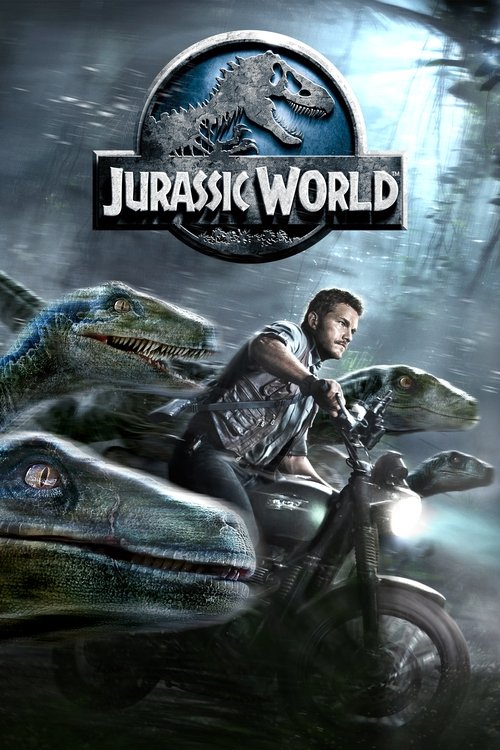
Jurassic World
2015 · Colin Trevorrow
For a popcorn night when you want scale, chaos, and dinosaurs eating things — comfort-food spectacle you can watch with the whole couch. Reach for it when nostalgia and adrenaline sound better than subtlety.
What it's about
Twenty-two years after the original park failed, Isla Nublar is open for business as a polished dinosaur theme park — and attendance is slipping, because visitors have gotten used to living wonders. The lab's answer is a bigger, smarter, genetically engineered hybrid, and when it gets loose the park's raptor trainer and its buttoned-up operations manager have to contain the disaster with thousands of guests still on the island. Two visiting kids, nephews of the manager, are caught in the middle.
The experience
A fast, glossy thrill ride that alternates rollercoaster set pieces with old-fashioned monster-movie dread — jump scares, chases, and a knowing wink at its own blockbuster machinery. It's tense in bursts but never punishing; the tone stays fun even when the teeth come out.
The craft
The park itself is the star: a fully imagined resort of monorails, petting zoos, and sea-monster splash shows, rendered with effects money and staged for maximum crowd panic. The action geography is clean, the sound design is built for a subwoofer, and the film constantly plays new spectacle against affectionate echoes of the 1993 original. This one genuinely rewards the biggest screen and loudest speakers you can find.
Why it matters
It restarted a dormant franchise into a new trilogy and posted one of the biggest opening weekends ever recorded, proving legacy properties could be revived at record-breaking scale. Its self-aware premise — audiences bored of wonders demanding a bigger monster — became a talking point about blockbuster culture itself.
Snapshot
Jurassic World is the fourth film in the Jurassic Park franchise and the first in fourteen years, a legacy-sequel that reopened Steven Spielberg's 1993 property as a fully operational theme park and, in the same gesture, as a fully operational corporate spectacle. Directed by Colin Trevorrow on the strength of a single low-budget feature, produced under Spielberg's executive supervision, and built around Chris Pratt and Bryce Dallas Howard, it became one of the highest-grossing films in history and, by widely reported accounts, the first picture to cross half a billion dollars worldwide in a single opening weekend. Its dramatic engine — a genetically engineered "wow factor" hybrid called the Indominus rex, manufactured because real dinosaurs no longer thrill jaded audiences — made the film unusually self-aware about the blockbuster economy it both critiqued and exemplified. Jurassic World matters less for formal innovation than for what it demonstrates about the 2010s studio system: the franchise revival as a dominant industrial logic, nostalgia engineered as a feature, and the spectacle film commenting on its own appetite while feeding it.
Industry & production
The film's production history is essentially a story of a stalled property restarted. After Jurassic Park III (2001), Universal spent more than a decade developing a fourth installment through multiple writers and false starts before the project crystallized around a new conceptual premise — the park finally open and running — credited principally to screenwriters Rick Jaffa and Amanda Silver, whose script was then reworked by Trevorrow and his collaborator Derek Connolly. Trevorrow's hiring was itself a notable industrial signal: he had directed only Safety Not Guaranteed (2012), a Sundance comedy made for a fraction of a single Jurassic World visual-effects sequence, and his elevation to a tentpole reflected the decade's pattern of recruiting indie directors for franchise duty under heavy producer oversight. Spielberg, the original's director, served as executive producer and an active creative presence, and the production was mounted by Universal in partnership with Spielberg's Amblin Entertainment and Frank Marshall's Kennedy/Marshall lineage of producers.
Principal photography took place largely in Louisiana, with the NOLA/Big Easy studio infrastructure and surrounding locations standing in for park interiors and infrastructure, and on Hawaii — Oahu and Kauai — supplying the lush island exteriors that had grounded the 1993 film's sense of place. The release strategy was global and saturating: a June 2015 launch positioned squarely in the summer corridor, with the marketing leaning hard on franchise memory. Commercially the result reset expectations for what a revived property could earn, and its performance is generally credited with confirming the "legacy sequel" as a reliable studio instrument for the remainder of the decade.
Technology
Jurassic World sits at a hinge in dinosaur-effects technology, twenty-two years after the original film helped inaugurate the photorealistic-CGI era. The creatures are overwhelmingly digital, executed primarily by Industrial Light & Magic, the same house that built the 1993 animals — a continuity the production treated as a point of pride and benchmark. The film blends those digital dinosaurs with practical animatronics and creature effects from the Legacy Effects shop (the successor to Stan Winston's studio, Winston having built the original's animatronics), most memorably in the scene of a dying Apatosaurus rendered as a large-scale physical puppet so the actors could touch and grieve over a tangible body. Trevorrow publicly framed this hybrid practical/digital approach as a deliberate inheritance of Spielberg's method, where a physical presence anchors the digital extension.
The film also reflects a transitional moment in capture and exhibition technology. Cinematographer John Schwartzman, a noted advocate for photochemical capture, shot the picture on a combination of film and digital formats — the record here is best summarized as a mixed-format production rather than a purely digital one — partly to echo the grain and warmth of the original. It was released in 3D and large-format presentations, and the underwater Mosasaurus set-pieces and the climactic multi-creature melee were engineered as the kind of scale-and-spectacle showcases that premium formats were built to sell.
Technique
Cinematography
Schwartzman's photography is glossy, bright, and consciously continuous with Dean Cundey's work on the 1993 film. The early park sequences are flooded with daylight and clean wide compositions that present Jurassic World as a functioning, sun-struck resort — the cinematography sells the place as plausible before it sells the danger. Schwartzman repeatedly quotes the original's visual grammar: the slow reveal of awe-struck faces, the reflective surfaces and lens flares, the use of vehicles and glass as framing devices. As the film darkens, the palette cools and the staging tightens, but the dominant register is the high-key, legible spectacle photography of mainstream studio filmmaking rather than anything expressionistic.
Editing
Edited by Kevin Stitt, the film follows the contemporary blockbuster rhythm — patient world-building in the first act giving way to accelerating crosscut action. The cutting is built to manage multiple simultaneous threads during the climax (the two boys, Howard's and Pratt's characters, the control room, the converging creatures) and to deliver clean, readable geography in the large set-pieces, a legibility that distinguishes the Jurassic action style from the more fragmented cutting of some peers. The pacing's deliberate front-loaded calm — letting the audience tour the park before the system fails — is itself an editorial inheritance from Spielberg's original structure.
Mise-en-scène / staging
The production design is the film's richest layer. Jurassic World is staged as a credible theme park: monorails, a Main Street of branded retail, a Sea World–style aquatic stadium, a petting zoo of baby dinosaurs, gyroscopic ride vehicles. This designed environment carries much of the film's argument — the staging of consumer leisure atop barely contained nature is the theme made physical. Trevorrow stages the Indominus reveals with classical withholding, and the famous I. rex roar and the final-act arrival of the original film's Tyrannosaurus are blocked as nostalgic spectacle, framed for recognition and applause.
Sound
The sound design extends the franchise's signature creature vocabulary while introducing the Indominus as a new sonic signature, and the mix exploits the low-frequency, theater-shaking register that has defined the series since the original T. rex footstep. Michael Giacchino's score (see below) is integral to the soundtrack's emotional cueing, and the film deliberately deploys John Williams's original theme as a sonic memory-trigger at key beats.
Performance
The casting reorganizes the franchise around two archetypes. Chris Pratt, fresh from Guardians of the Galaxy (2014), plays Owen Grady as a rugged, wry raptor handler — a deliberate movie-star turn pitched between action hero and comedian. Bryce Dallas Howard plays Claire Dearing, the park's operations executive, whose arc from corporate control to embodied courage the film foregrounds (and which drew contemporary debate about the character's writing and gendered framing). The supporting ensemble — including the young brothers as the audience-surrogate children, and actors playing the park's scientists, security contractors, and owner — fills out the franchise's familiar role-types. The performances are calibrated to the spectacle: efficient, charismatic, and subordinate to the creatures, which remain the film's true stars.
Narrative & dramatic mode
The film operates in the disaster-adventure mode the franchise established: a controlled environment, a hubristic violation of limits, a systems failure, and a survival ordeal that culminates in monstrous combat. Its dramatic innovation is reflexivity. The park's need for a "bigger, louder, more teeth" attraction to revive flagging attendance is an explicit allegory for the sequel itself, and characters voice the logic of escalation aloud. The narrative threads a corporate-thriller subplot (a security contractor's scheme to weaponize the trained raptors) through the survival spine, gesturing at a militarized future the later films would pursue. Emotionally, the film runs on nostalgia and family reconciliation — estranged brothers, a career-focused aunt rediscovering care — well-worn Spielbergian machinery deployed with knowing efficiency rather than fresh feeling.
Genre & cycle
Jurassic World belongs to several overlapping cycles. It is a creature-feature and a science-fiction adventure, but its defining cycle membership is the 2010s legacy sequel — films that revive a dormant franchise a generation later by foregrounding continuity with an original (returning iconography, locations, music, sometimes characters) while installing new leads. Alongside roughly contemporaneous revivals across other franchises, it helped define that cycle's commercial template. It is also a paradigmatic example of the franchise-revival blockbuster that dominated the decade's tentpole economy, and its self-conscious commentary on spectacle escalation makes it a useful text for studying the genre's late-cycle self-awareness.
Authorship & method
Authorship here is genuinely diffuse, which is itself characteristic of the contemporary tentpole. Colin Trevorrow is the credited director and co-writer, but the film is shaped decisively by Steven Spielberg's executive producership and the gravitational pull of the original he directed; Trevorrow has described his role partly as a steward of Spielberg's tone. The screenplay is credited to Rick Jaffa, Amanda Silver, Derek Connolly, and Trevorrow, layering franchise-revival specialists over Trevorrow and Connolly's character voice. Cinematographer John Schwartzman brought a film-advocate's sensibility and a mandate to honor Dean Cundey's original look. Editor Kevin Stitt managed the multi-thread action architecture. The score is by Michael Giacchino, who built new themes while quoting John Williams's foundational music — a scoring strategy that mirrors the film's whole method of new material braided with inherited motifs. The result reads less as a single author's vision than as a coordinated act of franchise stewardship, with Trevorrow as its on-set executor.
Movement / national cinema
The film is a product of the mainstream American studio system — Hollywood's globalized tentpole apparatus — and belongs to no art-cinema movement. Its most relevant "national cinema" context is the financialized, globally-oriented Hollywood of the 2010s, in which production decisions, casting, and spectacle design were calibrated for international (and particularly East Asian) markets as much as domestic ones. Its enormous worldwide gross relative to its domestic share is itself evidence of that transnational orientation. Stylistically it is heir to the Spielberg-Lucas blockbuster tradition that American cinema institutionalized from the late 1970s onward.
Era / period
Jurassic World is firmly of the mid-2010s, the high-water period of franchise consolidation when studios increasingly concentrated resources in revivable intellectual property and shared universes. Its existence answers an industrial question of its moment — how to monetize a beloved dormant property — and its success accelerated the strategy across the business. The film's anxieties (engineered novelty, audiences numbed to spectacle, corporate control of wonder) are period-appropriate reflections of an entertainment economy contending with escalation and saturation, and read almost as the blockbuster's commentary on its own historical condition.
Themes
The film's central theme is the commodification of wonder — the conversion of awe into a product, with corporate sponsorship, branded attractions, and a perpetual demand for novelty. From this flow its other concerns: scientific hubris and the ethics of genetic engineering (the Indominus as a creature designed by committee for marketability rather than by nature); the limits of human control over living systems; consumerism and spectacle fatigue; and the militarization of biotechnology hinted at in the raptor-weaponization subplot. A quieter thread concerns care versus management — the recurring contrast between treating animals (and children) as assets to be controlled and as beings to be related to, dramatized through both the raptor-training relationship and Claire's arc. The film's reflexive joke — that audiences, like park guests, always want something bigger — folds all of these into a critique the film cannot fully escape, since it satisfies the very appetite it diagnoses.
Reception, canon & influence
Critical reception was mixed-to-positive and notably split between admiration for the spectacle and reservations about the screenplay. Many reviewers praised the scale, the nostalgic charge, and Pratt's star presence while faulting thin characterization, and a substantial strand of contemporary criticism scrutinized the film's gender politics, particularly the writing of Claire Dearing and a recurring visual emphasis the film drew comment for. Commercially the response was historic: the film became one of the highest-grossing of all time and, by widely reported accounts, set the record for the largest global opening weekend then achieved, confirming enormous latent demand for the franchise.
The influences on the film are explicit and central: Spielberg's Jurassic Park (1993) above all — its structure, set-pieces, iconography, and John Williams score are quoted throughout — alongside the broader Spielberg-Lucas adventure tradition and the creature-feature lineage. The film's reflexive premise also engages, knowingly, with the discourse about sequel escalation and blockbuster excess.
Its influence forward is primarily industrial and franchise-internal. Jurassic World's success spawned a new trilogy — Fallen Kingdom (2018), which Trevorrow co-wrote, and Dominion (2022), which he returned to direct — extending the series into eco-thriller and biotech-conspiracy territory the first film had only gestured toward. More broadly, its performance reinforced the legacy-sequel as a durable studio strategy and made Trevorrow, briefly, a hot property — he was attached to direct a Star Wars sequel-trilogy installment before departing the project, an episode that underscores how a single tentpole success could reshape a director's industrial standing. Whether Jurassic World enters a durable critical canon is doubtful; its lasting significance is as a case study — in franchise revival, in spectacle economics, and in the blockbuster's capacity to narrate its own commercial logic even as it obeys it.
A Deleuzian reading
Claire kneels in the grass beside a dying Apatosaurus and puts her hand on its flank.
The full Deleuzian reading of Jurassic World →
Reception
A record-shattering monster hit in 2015 — the first film ever to open past $500M worldwide — but the glow faded fast: what once felt like triumphant nostalgia now reads to many as the template for the hollow legacy sequel, and the reviled follow-ups dragged its reputation down with them.
How Jurassic World was received, from release to now →
Influences: the films it descends from and the films it influenced
- Jurassic Park (1993) — The literal source text Jurassic World restages — Stan Winston animatronics intercut with ILM CGI to sell a 'complete creature,' and Dean Cundey's high-key daylight reveals that Schwartzman was mandated to honor.
- Jaws (1975) — Establishes the withhold-then-reveal suspense grammar and Williams's two-note low-register ostinato that Giacchino reuses as a creature-menace signature over a resort-under-threat setting.
- Westworld (1973) — Crichton's own template — an engineered theme-park attraction that turns lethally on its paying guests — is the structural DNA Jurassic World literalizes by finally building the functioning park.
- King Kong (1933) — Willis O'Brien's blueprint of the captured spectacle-monster displayed as a paid attraction that escapes its enclosure — the commodified-wonder staging Jurassic World makes its explicit theme.
- Close Encounters of the Third Kind (1977) — Source of the Spielbergian 'wonder reaction shot' — upturned faces lit by an off-screen marvel — which Jurassic World deploys verbatim at the Mosasaurus tank and gyrosphere valley.
- Aliens (1986) — Provides the corporate-greed-weaponizes-the-organism plot engine (InGen's militarization subplot) and the siege-and-pursuit action set-piece architecture Stitt's crosscutting inherits.
- The Lost World: Jurassic Park (1997) — The franchise's own escalation precedent and Spielberg's multi-animal herd/stampede choreography that Jurassic World scales up into the aviary and raptor-pack sequences.
- Star Trek (2009) — Applies the post-Trek franchise-reboot structure — new cast inheriting established mythology, nostalgic callbacks woven into an origin narrative, compressed action prologue establishing emotional stakes before the title card — codifying the 2009 template as the dominant mode of studio franchise continuation.
- Jurassic Park III (2001) — Revives the dormant franchise drawing directly on JP3's conception of intelligent, trainable/weaponizable raptors and its expanded predator bestiary.
- Jurassic World: Fallen Kingdom (2018) — Extends Jurassic World's bioengineered-dinosaur-as-weapon premise into gothic haunted-house staging, swapping high-key park spectacle for chiaroscuro creature horror Trevorrow co-wrote.
- Jurassic World Dominion (2022) — Trevorrow returns to push the biotech-conspiracy thread Jurassic World only gestured toward, while doubling down on the legacy-cast reunion as nostalgia mechanism.
- Godzilla (2014) — Shares the withhold-the-monster discipline and human-scale-foreground lensing of a giant creature, plus seismic sub-bass roar design from the same low-frequency creature-vocabulary toolkit.
- Pacific Rim (2013) — Contemporaneous kaiju feature built on weight-conveying sound design and sub-bass creature vocalizations, the audio grammar Jurassic World uses to make its hybrid read as massive.
- Kong: Skull Island (2017) — MonsterVerse creature-feature conveying scale through the same human-figure-in-foreground compositional trick and digital-creature-in-natural-daylight integration.
- Star Wars: The Force Awakens (2015) — Defines the same-year legacy-sequel method: mirror the original's beat structure while quoting the founding Williams cues as nostalgia triggers — the 'new material braided with inherited motifs' strategy.
- Creed (2015) — Parallel 2015 legacy-sequel using a torch-passing structure — a new lead deferring to inherited iconography and theme music — to reactivate a dormant franchise without a straight remake.
- Rogue One: A Star Wars Story (2016) — Michael Giacchino applies the identical scoring approach he used here — original themes interwoven with direct Williams quotations — making the franchise-stewardship score a shared method.
- Ready Player One (2018) — Spielberg's own reflexive blockbuster about the commodification of nostalgia and spectacle-fatigue, narrating the same self-aware franchise economics Jurassic World embeds in its 'Verizon Indominus' satire.
- Jurassic World Rebirth (2025) — Introduces the engineered-hybrid dinosaur (Indominus rex) as frankenstein design overreach — the specific genetic-tampering premise Rebirth inherits and reworks into mutant creatures.
Similar films
- Jurassic Park (1993) — influence & lineage
- The Lost World: Jurassic Park (1997) — influence & lineage
- Star Wars: The Force Awakens (2015) — influence & lineage
- Godzilla (2014) — influence & lineage
- Pacific Rim (2013) — influence & lineage
- Jaws (1975) — influence & lineage
- Jurassic World Rebirth (2025) — shared sensibility
- Jurassic Park III (2001) — shared sensibility