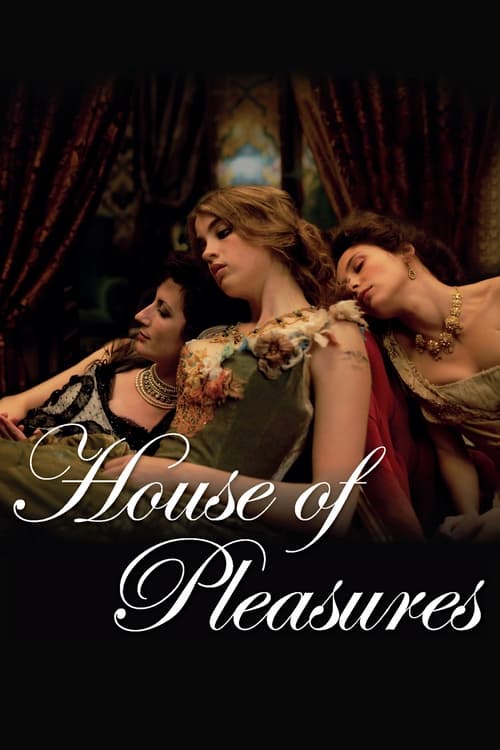
House of Pleasures
2011 · Bertrand Bonello
For when you want to sink into atmosphere — something gorgeous, adult, and melancholy to get lost in on a late night, more a spell than a story, and emotionally heavier than its beauty suggests.
What it's about
Paris, the turn of the twentieth century: L'Apollonide, a luxurious legal brothel, is living out its final years as rents rise and the trade drifts to the streets. There's no single heroine and barely a plot — instead the film follows a dozen women through the house's daily rituals of bathing, dressing, waiting, and performing, as some clients fall in love, others turn cruel, and the women share their debts, fears, and small joys inside a world that's closing around them.
The experience
Languid, opulent, and quietly devastating — it drifts like an opium dream but keeps a ledger's cold eye on what everything costs. The mood is velvet on the surface and bruise underneath, and it stays with you.
The craft
Bertrand Bonello composes the house in candlelit tableaux — split screens, mirrored salons, fabrics and skin rendered with painterly care — then jolts the period frame with deliberately anachronistic music that lands like a message from the future. It's rigorous ensemble filmmaking disguised as sensual drift, and it glows on a big screen.
Why it matters
One of the most formally controlled French films of its decade, it cemented Bonello as a major stylist and became a touchstone for period films that treat the past with modern, unsentimental eyes.
Snapshot
Bertrand Bonello's L'Apollonide: Souvenirs de la maison close — released in Britain as House of Tolerance and in the United States, misleadingly, as House of Pleasures — is a chamber film about the last two years of a legal Parisian brothel, roughly 1899 to 1900. It has no protagonist and almost no plot in the conventional sense. What it has instead is a building, a dozen women, a ledger, and a deadline: the landlord is raising the rent, the trade is migrating to the streets and the cafés, and the maison close is running out of time. Bonello films this as an ensemble ritual — bathing, dressing, waiting, performing, being examined by a doctor, being paid for, going into debt — rather than as a story with rising action. The result is one of the most formally controlled French films of its decade and, more quietly, one of the most rigorous screen accounts of sex work as labor under a debt system, which is the point its English-language title most thoroughly betrays. Premiered in Competition at Cannes in 2011, it left without a prize but with a durable critical afterlife, and it functions as the hinge between Bonello's early provocations and the major late work — Saint Laurent, Nocturama, The Beast — that followed.
Industry & production
L'Apollonide is a French production of the ordinary art-house kind: assembled through the standard national financing stack of CNC support, pay-television pre-purchases and co-production equity, produced by Kristina Larsen's Les Films du Lendemain alongside Bonello's own company, My New Picture. Its budget was modest by period-film standards — the film's single-location strategy is as much an economic solution as an aesthetic one — and it never sought or found a commercial breakout. I would rather not attach numbers to its budget or gross than repeat figures I cannot verify; the public record on both is thin and inconsistently reported.
The Cannes Competition slot was the film's decisive industrial event. It came in Bonello's second appearance in Competition, after Tiresia (2003), and confirmed him as a festival-system auteur rather than a provocateur with a cult. The 2011 Competition was a strong one (Malick's The Tree of Life took the Palme), and L'Apollonide was overshadowed; but Cannes secured the international sales that put it into art-house release across Europe and, via IFC Films, into the United States. It went on to collect a substantial slate of César nominations at the 2012 ceremony, weighted heavily toward craft — cinematography, costume, production design, sound — and converted none of them, in a year swept by The Artist. That distribution of recognition is itself diagnostic: the industry saw the film's surfaces first, which is both a compliment and a misreading.
Technology
The film's most interesting technological argument is internal rather than industrial: it is set precisely at the moment when the light changes. The Apollonide is lit by oil and gas and candle, and electricity arrives in the film as an intrusion — a harder, flatter, less forgiving illumination that exposes what lamplight flattered. Bonello treats the coming of electric light the way other filmmakers treat the coming of sound: as a technology that makes an entire mode of performance obsolete. The women's faces were built for a light that is being switched off.
Bonello also uses two techniques whose effect depends on their being anachronistic to the world depicted. The first is split-screen: late in the film, the frame divides into simultaneous panels so that several women's parallel routines run at once, converting narrative into inventory and making the house legible as a system of interchangeable labor. The second is the soundtrack (below). Both are devices from the film's own century, not its subject's, and both are deployed to keep the period from sealing over.
On the shoot's origination format, lens package and post-production chain, the accessible documentation is thinner than for Bonello's later, better-covered films, and I will flag that rather than guess. What can be said from the image is that the film's color work — amber, oxblood, gold, with skin held warm against deep shadow — is graded with a precision that reads as a deliberately controlled, closed palette rather than a naturalistic one.
Technique
Cinematography
Josée Deshaies, Bonello's long-standing director of photography, shoots almost the entire film in interiors, motivated by practical lamps. The camera moves slowly and laterally, drifting through the salon and along corridors, frequently entering a room after an event has begun and leaving before it resolves. Faces are held in close-up at length, often while the woman is doing nothing but waiting — the film's most repeated action. Depth is shallow and the background dissolves into a warm blur, so the house registers as atmosphere rather than architecture.
Against this, one sequence breaks out: an excursion to the countryside, shot in bright hazy daylight with a diffusion that quotes Impressionist painting outright — Renoir's boating parties, filtered through his son's cinema. It is the only sustained air in the film, and its function is comparative. Having seen these women in sunlight, we know exactly what the house costs them.
Editing
Fabrice Rouaud cuts the film against chronology. Date cards mark the passage from 1899 into 1900, but events recur, are revisited from other vantages, and occasionally precede their own premonitions — most disturbingly in the strand concerning Madeleine, whose dream of a client who binds her and cuts her mouth into a permanent smile arrives braided with the event itself, so that cause and prophecy cannot be separated. The average shot is long, but the film is not a long-take film in the Hungarian or Taiwanese sense; Rouaud dissolves between scenes as often as he cuts, giving the whole a soft, opiated continuity that matches what the women are smoking.
The final cut is the film's most famous gesture: a leap forward roughly a century to contemporary Paris, women waiting for cars on a modern street. It is not an epilogue but a rhyme, and it retroactively converts everything before it from period reconstruction into ongoing condition.
Mise-en-scène / staging
The house is the film's only real character. Bonello stages it as a total environment — salon, bedrooms, bath, kitchen, the madam's office where the accounts are kept — and the accounts matter as much as the beds. The women are charged for their rooms, their gowns, their meals, their medical inspections; they arrive owing and they stay owing. Marie-France, the madam played by the filmmaker Noémie Lvovsky, is neither monster nor rescuer but a middle manager squeezed by a landlord, and Bonello's decision to make the house's economics visible in ledgers and conversations about rent is the film's central act of demystification.
Staging within the salon is choreographic: women arranged on divans in tableaux for the arriving clients, then dispersing, then re-forming. Costume (Anaïs Romand) and production design (Alain Guffroy) build a world of extravagant surface that the camera keeps looking behind — corsets unlaced, makeup removed, a nightgown in a plain room. The film's erotic imagery is consistently interrupted by the sight of work: the fantasy is staged, and we watch the staging.
Sound
Bonello, a trained musician, composes his own scores, and here he combines original material with an anachronistic selection of 1960s American soul and pop — most audibly The Moody Blues' "Nights in White Satin," which underscores a slow dance, and Lee Moses's raw, grinding soul, which drops into the brothel like a foreign object. The device has an obvious precedent in Sofia Coppola's Marie Antoinette (2006), but Bonello inverts its use: where Coppola's needle-drops confer youth and buoyancy, his confer melancholy and dislocation, insisting that the emotion in the room is not historical and does not stay in 1900.
Equally important is what surrounds the music: the hum of the house, murmured conversation half-heard through walls, silence in the bedrooms. Jean-Pierre Laforce's mix keeps the aural space enclosed, so that the eventual arrival of street noise in the coda lands as a physical shock.
Performance
The ensemble — Hafsia Herzi, Céline Sallette, Jasmine Trinca, Adèle Haenel, Alice Barnole, Iliana Zabeth, with Lvovsky as the madam — plays at a deliberately low temperature. Bonello asks for a doubled register: the performed vivacity the women give clients, and the flat exhaustion they give each other. The gap between the two is the film's real subject and its acting is built entirely around making it visible. Barnole's work as Madeleine, whose face is fixed into a rictus that the house then re-markets as an attraction, is the extreme case — a performer required to act through a mask of imposed pleasure, which is what every other character is doing metaphorically.
Narrative & dramatic mode
The film is choral and cyclical rather than causal. Its dramaturgy is that of the closing institution — the deadline structure of Chekhov's estates — but Bonello withholds the catharsis such structures usually promise. Threads that melodrama would resolve are left open: a syphilis diagnosis, a disfigurement, a girl of sixteen arriving to sign on at the beginning. Nobody escapes; nobody is punished in any morally legible way. Events happen to the women, and the film records the accounting rather than the arc.
This is why the film resists both the brothel-as-bordello-comedy tradition and the redemption narrative. There is no rescue plot and no client who is secretly good. The one recurring figure who seems to offer tenderness is simply another transaction with better manners.
Genre & cycle
L'Apollonide belongs to a specific and distinguished cycle: the brothel film as a study of enclosure. Its ancestors include Maupassant's "La Maison Tellier" and Max Ophüls' adaptation of it in Le Plaisir (1952); Mizoguchi's The Life of Oharu (1952) and Street of Shame (1956), the latter also a film about a house facing legislative extinction; Louis Malle's Pretty Baby (1978), with its Storyville interiors derived from Bellocq's photographs; and, most proximately, Hou Hsiao-hsien's Flowers of Shanghai (1998), whose lamplit, exterior-free, ritual-bound courtesan houses are the formal template critics reached for immediately and correctly.
It also touches the heritage film only to refuse it. Where heritage cinema uses period detail as reassurance, Bonello uses it as evidence. And there is a genre undertow — the dream logic, the slashed smile invoking Hugo's L'Homme qui rit, a surreal shot of a woman weeping milk-white tears — that pulls the film toward horror without letting it arrive.
Authorship & method
Bonello came to L'Apollonide from Le Pornographe (2001) and Tiresia (2003), films that had earned him a place in the loose grouping James Quandt polemically named the "New French Extremity," and which Tim Palmer more usefully theorized as a cinéma du corps. His consistent subject is the body priced, displayed and instrumentalised, and L'Apollonide is the film where that subject finally found a form adequate to it: not confrontation, but observation of a system.
His core collaborators are essential to that shift. Josée Deshaies has shot nearly all his features, and the enclosed, lamp-warm image here is a joint authorship. Fabrice Rouaud's editing gives the film its dissolving, recursive time. Anaïs Romand's costumes carry the film's argument about surface, and would do so again on Saint Laurent. Bonello writes and scores his own films, which is unusual enough to matter: the music is not commentary added afterward but part of the conception, which is why the anachronism feels structural rather than decorative.
Movement / national cinema
The film sits in the post-nouvelle-vague French auteur tradition as it stood around 2010 — a cinema of directors (Denis, Breillat, Dumont, Noé, Grandrieux, Bonello) formed by the funding and festival architecture of the CNC and Cannes, working at the intersection of the body film and the art film. Its French specificity is also historical: the maisons closes were a state-regulated institution, licensed and policed under a nineteenth-century réglementariste system that registered prostitutes and subjected them to compulsory medical inspection, and were only abolished by the loi Marthe Richard in 1946. Bonello films the regulation as much as the sex — the doctor's rounds are shot with the same attention as the salon — and this makes the film unmistakably a French national reckoning rather than a generic period piece.
Era / period
The setting is the Belle Époque at its most self-congratulatory: Paris on the eve of the 1900 Exposition Universelle, the city advertising itself to the world as the capital of pleasure while the pleasure industry is being industrialized out from under its practitioners. Bonello's chosen years let him hold two things at once — the aesthetic apex of a milieu (the Toulouse-Lautrec and Degas iconography the film knows it is quoting) and the moment its economic basis collapses. Electricity, rising rents, changing tastes, the shift of the trade outward to the boulevards: the film is about obsolescence arriving inside a golden room.
Themes
Debt is the organizing theme. The women are not enslaved by law but by ledger, and Bonello's insistence on this is his sharpest intervention in a subject usually handled through either titillation or pity. Around it cluster: contagion, and the way syphilis converts a body from asset to liability; the face as instrument, and what happens when it is damaged; solidarity among women that is real but cannot alter the arithmetic; and the client as a category rather than a set of individuals — men pass through, some sentimental, some cruel, all paying.
Beneath these runs a meta-theme about looking. The film is beautiful, knows it is beautiful, and repeatedly implicates its own beauty — staging an image of desire and then holding on it long enough for the labor beneath to surface. The coda finishes the argument: the century's clothes were the only thing that changed.
Reception, canon & influence
Reception at Cannes was admiring but divided, with the split falling predictably between critics who read the film's opulence as complicity and those who read it as indictment. It found its firmest support in the French critical establishment, where Bonello had long-standing champions, and its reputation has strengthened steadily since — helped considerably by the retrospective clarity of Bonello's subsequent career. Anglophone reception was warm and comparatively narrow in circulation; the American retitling to House of Pleasures did the film no favours in framing.
Its backward debts are legible and mostly avowed: Ophüls and Maupassant for the brothel-as-community; Mizoguchi for the institutional critique; Hou for the enclosed, lamplit form; Renoir for the one afternoon of sunlight; Buñuel's Belle de Jour (1967) for the dream-structure of bourgeois fantasy; Visconti for the register of decadence with a death sentence attached; and the painters — Lautrec, Degas, Manet — whose brothel images the film restages from the labourers' side.
Forward, its clearest legacy is Bonello's own. Saint Laurent (2014) is L'Apollonide's direct successor: another closed luxury world running on invisible labor, again with split-screen, again with anachronistic music, again with Deshaies, Rouaud and Romand. The Beast (2023) returns to a Belle Époque Paris and to the film's deepest structural idea — that a woman's experience recurs across centuries with the costumes swapped out. Externally, the film was an important early credit for a cohort of French actors, most conspicuously Adèle Haenel and Céline Sallette, who became central figures in the decade's French cinema. And it stands as a proximate precedent — an affinity more than a documented influence, and worth marking as such — for the subsequent wave of French period films built around enclosed female worlds and the ethics of looking, of which Céline Sciamma's Portrait of a Lady on Fire (2019) is the best-known. What L'Apollonide contributed to that conversation was not the gaze critique itself, which was long established, but the ledger: the insistence that the question of who is looking is inseparable from the question of who is being charged for the room.
A Deleuzian reading
Electricity arrives at the Apollonide like weather.
The full Deleuzian reading of House of Pleasures →
Reception
It premiered in competition at Cannes 2011 and left empty-handed, with critics split between rapture and discomfort; as Bonello's stock rose through Saint Laurent, Nocturama and The Beast, it got steadily reappraised and now regularly tops 'best Bonello' conversations.
How House of Pleasures was received, from release to now →
How to watch House of Pleasures: what to notice on a first viewing
- Notice how warm and amber every face looks in lamplight. Josee Deshaies lights almost the entire film with oil, gas, and candle, holding skin warm against deep shadow so every face reads as honey-colored and soft. The light itself is part of the house's product, flattering faces the way the business needs them flattered.
- Watch how often a scene starts after something has already begun. The camera drifts laterally through the salon and corridors, arriving mid-event and leaving before it resolves, with the background dissolving into a shallow, warm blur behind each face. You are always catching the house mid-motion, never quite at the start or the end of anything.
- Count how the women rearrange themselves when a client arrives. Bonello stages the salon like a choreography, women arranged on divans in a tableau, then dispersing, then re-forming into a new arrangement for the next arrival. The staging itself shows you a business running on repeated poses, not on individual encounters.
- Listen for 1960s soul or pop music playing in this 1900 house. Bonello drops period-wrong songs like The Moody Blues into the score, a choice that has nothing to do with historical accuracy and everything to do with mood. The music insists the feeling in this room isn't locked in 1900. It's still current.
- Watch a woman's face change the second a client leaves the room. The ensemble plays two registers at once, performed vivacity for the men paying and flat exhaustion for each other, and the gap between the two is always visible. You are watching two different women in the same body, and the film wants you to see both.
The whole guide to watching House of Pleasures, with the keys for a rewatch →
Influences: the films it descends from and the films it influenced
- Flowers of Shanghai (1998) — The governing formal template: a brothel filmed entirely in interiors with no exterior shot at all, lit by practical oil lamps to a warm amber falloff, built from slowly drifting long takes that circle the room and are separated by fades to black rather than cuts.
- Le Plaisir (1952) — The "Maison Tellier" episode supplies both the brothel-as-household-economy ensemble and the single excursion out of the house into daylight, plus Ophüls's practice of keeping the camera outside windows and doorways so the viewer is positioned as a paying visitor rather than an intimate.
- Street of Shame (1956) — The institutional ledger: each woman's individual debt, advance and family remittance tracked as plot mechanics, the madam's accounting scenes given the same weight as the erotic ones, and a closing image of a new girl arriving to restart the cycle.
- A Day in the Country (1936) — The impressionist countryside interlude is shot in Renoir's idiom — dappled riverside light, camera loose among grass and water, faces overexposed by real sun — so the film's one reel of exteriors is stylistically foreign to the lamplit rest.
- Belle de Jour (1967) — Buñuel's method of cutting between brothel room and fantasy with no marker whatsoever — no dissolve, no music cue, identical lighting — is what licenses the film's dream inserts and the recurring image of the woman whose body is handled as an object.
- Barry Lyndon (1975) — Exposing period interiors on practical candle and lamplight alone, and composing them as painting-derived frontal tableaux, established the technical grammar Josée Deshaies works in here with faster stock and a shallower plane.
- The Damned (1969) — A closed luxury household filmed in ember reds and gold, where the ensemble's decadence is already staged as terminal — Visconti's costume-and-decor-first mise-en-scène treating surface as the argument, which Anaïs Romand's work extends.
- Chelsea Girls (1966) — Split-screen as a way to render simultaneity inside one building — two rooms of the same house running at once, durational and plotless, the panels surveying inhabitants rather than advancing a story.
- Marie Antoinette (2006) — Established the anachronistic needle-drop as a structural rather than ironic device: contemporary pop scored across a hermetically sealed period luxury world to collapse the historical distance the costumes create.
- Le Pornographe (2001) — Bonello's own precedent for filming the priced body as labor — the shot held on the crew, the waiting, the setup rather than the act — and for writing his own score, so that music arrives as part of the conception.
- Saint Laurent (2014) — The direct successor, made with Deshaies, Rouaud and Romand: another sealed luxury world running on invisible labor, again structured by split-screen simultaneity and anachronistic music, with time again folded rather than advanced.
- Nocturama (2016) — Transposes the single-location chamber to a department store after hours — a choral, near-plotless ensemble trapped in a luxury interior, its first half built on achronological recursion through the same hours from different bodies, its second on needle-drops in an enclosed mix.
- The Beast (2023) — Takes the film's deepest structural idea — one woman's experience recurring across eras with the costumes swapped — and makes it the whole architecture, returning to Belle Époque Paris and to the contemporary coda as a formal rhyme rather than an epilogue.
- Portrait of a Lady on Fire (2019) — Restages painting from the model's side of the easel within an enclosed female household, filmed almost entirely in practical firelight and candlelight — an affinity rather than a documented debt, but the same insistence that the act of looking is a transaction with terms.
- Corsage (2022) — Runs the anachronism program on a single displayed woman: contemporary songs and deliberate modern objects planted in period frames, with the corset and the daily measuring ritual filmed as the machinery that prices the body.
- The Duke of Burgundy (2014) — Single-location chamber film built on interrupted, rehearsed eroticism — scenes broken off at the moment of consummation and replayed with variation — inside a dense enclosed interior mix where the house's own sounds carry the tension.
- The Favourite (2018) — A closed court shot in candlelit wides with an ensemble of women arranged by service hierarchy, and a deliberately non-period sound and music strategy used to make the enclosure feel present-tense.
Similar films
- Belle de Jour (1967) — influence & lineage
- Le Plaisir (1952) — influence & lineage
- Flowers of Shanghai (1998) — influence & lineage
- Portrait of a Lady on Fire (2019) — influence & lineage
- Last Tango in Paris (1972) — shared sensibility
- The Night Porter (1974) — shared sensibility
- Salò, or the 120 Days of Sodom (1976) — shared sensibility
- La Cérémonie (1995) — shared sensibility