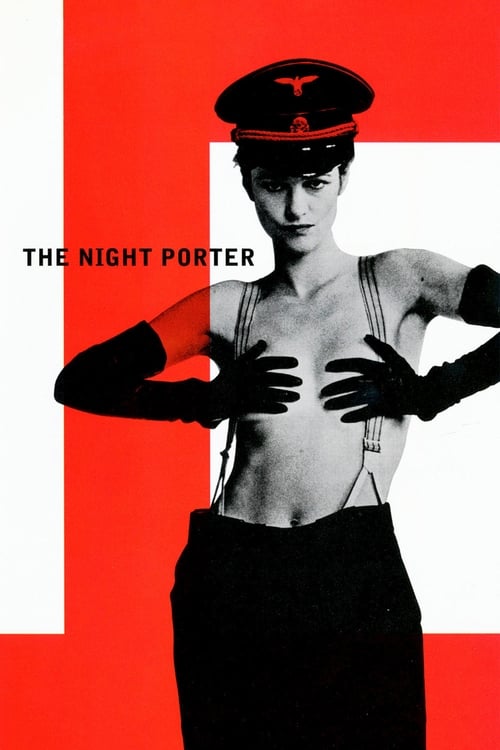
The Night Porter
1974 · Liliana Cavani
Strictly for when you want to be challenged, not comforted — a film to sit with, squirm through, and debate afterward. Not a casual watch, and not a date movie despite the word 'romance' on the label.
What it's about
Vienna, 1957. A concentration camp survivor checks into a grand hotel and recognizes the night porter: the SS officer who tormented — and sexually possessed — her as a teenage prisoner. Instead of denouncing him, she stays, and the two slip back into their old bond while his former comrades, men with pasts to bury, begin to circle.
The experience
Claustrophobic, hushed, and deeply unsettling — a chamber piece that trades shocks for a slow moral vertigo. It leaves you queasy and arguing with yourself, which is exactly its intent.
Performances
Dirk Bogarde is all brittle, fastidious control as the porter hiding in plain sight, and Charlotte Rampling matches him with a watchful, unreadable intensity — the whole film lives in the charged space between their faces.
The craft
Liliana Cavani shoots it in muted, twilit hotel interiors that feel like a trap slowly closing, letting silence and glances carry what dialogue won't say. The flashback structure keeps past and present bleeding into each other without ever letting you settle.
Why it matters
One of the great scandals of 1970s European cinema — denounced and defended in equal measure — and a landmark of a woman director forcing an audience to look at fascism's psychological afterlife without flinching.
Snapshot
The Night Porter (Il portiere di notte) is Liliana Cavani's incendiary chamber drama about the reunion, in 1957 Vienna, of a former SS officer now working nights at a grand hotel and the woman he tormented—and sexually possessed—as a teenage prisoner in a concentration camp. Reduced to its premise it sounds like provocation, and much of its reception treated it as exactly that. But the film is more disciplined and stranger than its scandal: a closed, claustrophobic study of a folie à deux in which victim and perpetrator, recognizing one another across a hotel lobby, choose to re-enter their wartime bond rather than testify against it. Built almost entirely from two performances—Dirk Bogarde's brittle, fastidious Max and Charlotte Rampling's watchful Lucia—and shot in muted, twilit interiors, it remains one of the most disputed films of the 1970s European art cinema's confrontation with fascism, simultaneously condemned as aestheticized kitsch and defended as a serious anatomy of trauma, complicity, and desire. Its single most reproduced image—Rampling bare-chested in SS cap, braces, and gloves, performing a Weimar cabaret song before an audience of officers—has long outlived arguments about the film itself, migrating into fashion, pop iconography, and the broader cultural shorthand for "Nazi chic."
Industry & production
The film was an Italian production made at the high tide of a national art cinema that was both internationally financed and unusually willing to court censorship. Cavani had come up through RAI television documentary, and The Night Porter was conceived as a feature after years of nonfiction work on the Third Reich and on the psychology of survivors; she has said in interviews that the story crystallized around encounters with women who had survived the camps, including the recurring figure of a survivor compelled to return to the site of her imprisonment. That documentary lineage matters to how the project was pitched and financed: it was sold as a serious historical reckoning rather than exploitation, even as its sexual content guaranteed controversy.
Casting was the production's decisive act. Bogarde, by 1974, had remade himself from British matinee idol into the emblematic actor of European auteur cinema, above all through Luchino Visconti's The Damned (1969) and Death in Venice (1971); his presence imported the iconography of Viscontian Nazi decadence directly into Cavani's film. Rampling, then in her twenties, became indelibly identified with the role. The supporting cast assembled a familiar roster of European character players—among them Gabriele Ferzetti and Philippe Leroy as members of the surviving SS cabal that meets to stage mock "trials" and erase living witnesses to its crimes.
The film provoked the censorship trouble its makers might have anticipated: it ran into seizure and prosecution in Italy on obscenity grounds, the kind of legal harassment that also dogged Pasolini and Bertolucci in the same years. In the United States it was handled by Joseph E. Levine's Avco Embassy, and—against the expectations created by its hostile reviews—it found a substantial art-house audience. I won't cite specific box-office figures, as I can't verify reliable numbers, but the consensus of the historical record is that it was a notable commercial success relative to its scale, and that its notoriety drove its distribution.
Technology
The Night Porter is a conventional 35mm color production of its moment, and its technology is deliberately self-effacing. There is no formal experimentation at the level of stock, gauge, or process; the interest lies in restraint. The color is desaturated and tilted toward browns, ambers, and shadow—a palette that reads as both period (the dun tones of a postwar Mitteleuropa) and psychological (the embalmed quality of two people living inside their own memory). The film leans on available-light naturalism in its hotel and apartment interiors and on the textures of real Viennese locations, reserving its few stylized images for the camp flashbacks. In short, the technological choices are subordinated entirely to mood and to the actors; the film's "effects" are performance, framing, and editing rather than any apparatus.
Technique
Cinematography
The photography, by Alfio Contini—whose credits include Antonioni's Zabriskie Point—is the film's quietest and most effective instrument. Contini works in low, even, often sourceless light, favoring interiors that feel sealed off from daylight and history alike: the night shift of the hotel, the shuttered apartment where Max and Lucia barricade themselves. Compositions are tight and frontal, pressing the two principals into a confined visual world that mirrors the psychological enclosure of their relationship. The flashbacks are handled with a colder, harder light and a more clinical, near-documentary framing—an aesthetic discontinuity that keeps "then" and "now" legible even as the film's logic insists they have collapsed into one another. Crucially, Contini refuses the obvious move of glamorizing the camp; the most notorious images derive their charge less from lighting than from the shock of the body and the costume.
Editing
Editing is arguably the film's true authorship. The cutter was Franco "Kim" Arcalli, the most important Italian editor of the era—collaborator on Bertolucci's The Conformist and Last Tango in Paris and on Antonioni's The Passenger. Arcalli's signature was associative, memory-driven montage, and The Night Porter is structured as a braid of present-tense Vienna and intrusive wartime fragments that arrive without conventional cueing, as flashes of compulsion rather than orderly recollection. The film's argument—that trauma is not remembered but relived—is carried by the cutting more than by any line of dialogue. The notorious cabaret scene and the "Salome" gift of a severed head function as memory-images surfacing into the narrative, and the editing deliberately blurs whose memory we are inhabiting.
Mise-en-scène / staging
Cavani stages the film as theater of confinement. The dominant spaces are the grand hotel (its lobby and corridors a world of surveilling glances and discreet service) and the increasingly squalid apartment where the lovers immure themselves, ceasing to eat, refusing to leave, regressing into the private order of camp and master. Props and costume do heavy symbolic work—the porter's uniform that rhymes with the SS uniform, the chains, the broken glass strewn so Lucia cannot walk. The most analyzed staging is the cabaret flashback, in which Lucia performs Weimar decadence for the camp's officers in a man's SS cap and braces; the image is calibrated to be at once seductive and appalling, and the controversy over the film is essentially a controversy over whether that calibration is critique or complicity.
Sound
The score, by Daniele Paris, is sparing; the film is not driven by music so much as by silence, ambient hotel sound, and a few charged diegetic interventions. The decisive musical moment is diegetic: Lucia's cabaret number, a Weimar-era song associated with Marlene Dietrich and the Friedrich Hollaender songbook, which fuses the film's themes of performance, eroticism, and historical pastiche into a single sequence. Otherwise the soundscape is hushed and interiorized, matching the visual claustrophobia.
Performance
Everything rests on Bogarde and Rampling. Bogarde plays Max as a creature of nerves and ritual—courtly, self-loathing, addicted to a power he no longer holds in the world but can still exercise in the bedroom. Rampling's Lucia is the film's enigma and its lightning rod: she gives almost nothing away, and the performance withholds the reassurance of a clearly legible "victim," which is precisely what made critics uneasy. The two performances refuse psychological exposition; they enact a bond rather than explain it, and the film's power and its moral hazard both flow from that refusal.
Narrative & dramatic mode
The dramatic mode is tragic and closed rather than investigative. The plot has the bones of a thriller—a hunted couple, a conspiracy of ex-Nazis determined to silence a witness—but Cavani drains the thriller of suspense and converts it into fatalism. The lovers' reunion sets in motion not an escape but a withdrawal from the world, and the narrative's forward motion is really a spiral inward and backward. Flashbacks are not explanatory inserts but the very substance of the present. The film's controlling idea—closer to Freudian repetition compulsion and to a Sadean logic of master and victim than to conventional melodrama—is that the relationship is a sealed system that can end only in shared destruction. The result is a film with the shape of a chamber tragedy: two people who cannot live inside their bond and cannot live outside it.
Genre & cycle
The Night Porter belongs unmistakably to the early-1970s European cycle that fused the imagery of Nazism with the analysis (and spectacle) of sexuality. Its immediate kin are Visconti's The Damned (1969) and Bertolucci's The Conformist (1970), with their reading of fascism as eroticized decadence; its near-contemporaries Pasolini's Salò (1975) and Lina Wertmüller's Seven Beauties (1975) extended the same fraught territory. Cavani's film sits at the respectable, art-cinema end of a spectrum whose debased other end was the outright "Naziploitation" exploitation genre (Ilsa, She Wolf of the SS, 1975, and its imitators). One of the durable critical problems of The Night Porter is precisely its position on that spectrum: its imagery is adjacent to exploitation even as its intentions are tragic, and the film has never fully escaped that ambiguity.
Authorship & method
Cavani is the film's author in the fullest sense, and her method is rooted in her documentary apprenticeship. Her RAI work on the Third Reich, on Nazism's psychological appeal, and on resistance and collaboration gave her a research-driven approach to material that she then pushed toward myth and psychodrama. She is also the central figure in a thematic trilogy of films probing power, transgression, and the body, of which The Night Porter is the most famous installment. Her key collaborators shaped the result decisively: the screenplay was developed by Cavani with Italo Moscati (with contributions credited to Barbara Alberti and Amedeo Pagani, though the precise division of writing labor is not something I can verify in detail); Contini's photography set the muted register; Paris's restrained score held the silences; and above all Arcalli's editing translated Cavani's conception of memory-as-compulsion into form. The casting of Bogarde was itself an authorial gesture, importing the meaning of Visconti's cinema into Cavani's.
Movement / national cinema
The film is a product of Italian cinema in its last great auteurist phase, when directors like Pasolini, Bertolucci, Wertmüller, the Tavianis, and Cavani worked within an internationally financed industry that still prized the personal film. Cavani's documentary origins tie her additionally to the strong Italian nonfiction tradition channeled through state television. Yet The Night Porter is also conspicuously transnational: English-language, set in Austria, anchored by a British star, and addressed to a European and American art-house market. It exemplifies how "national" Italian cinema in the 1970s was in practice a cosmopolitan enterprise, circulating its reckonings with European fascism to an international audience.
Era / period
The film is doubly periodized. Diegetically it is set in 1957, a Vienna of postwar amnesia in which former perpetrators have reorganized themselves into a discreet bourgeois society dedicated to forgetting—an environment Cavani treats as the true horror, the smooth surface over unpunished crime. Made in 1974, it also belongs to a specific historical moment in which a generation that had not fought the war was reopening the question of fascism, complicity, and the libidinal sources of authoritarianism, often through the lens of post-1968 sexual politics and a popularized Freudo-Marxism (the influence of thinkers concerned with the "mass psychology of fascism" hovers over the whole cycle). The film's provocations are inseparable from that early-'70s impulse to read history through the body.
Themes
At its center is the question of complicity: the film's scandal is that it denies the audience a clean separation between victim and oppressor, staging instead a bond in which Lucia is neither simply coerced nor simply free. Around that core cluster its other concerns: repetition compulsion and the persistence of trauma; the eroticization of power and the Sadean dialectic of master and slave; postwar impunity and the social machinery of forgetting; memory as a force that abolishes ordinary time. The film also probes the dangerous proximity of fascism and spectacle—the way uniforms, ritual, and performance carry an aesthetic charge that the film both exploits and, in its defenders' reading, interrogates. Whether the film masters that danger or succumbs to it is the central interpretive crux of its entire reception.
Reception, canon & influence
Contemporary reception was sharply divided and, among major Anglo-American critics, frequently hostile; the film was widely accused of trivializing the Holocaust and of aestheticizing atrocity for erotic effect. It became a central exhibit in the broader early-1970s debate about the fetishization of fascist imagery that Susan Sontag crystallized in her 1975 essay "Fascinating Fascism," and it drew condemnation from those who saw it as turning the camps into a backdrop for sadomasochistic fantasy. Defenders—then and increasingly since—argued the opposite: that the film refuses consolation precisely in order to expose the entanglement of desire and power, and that its discomfort is the point.
The influences running into the film are legible: Visconti's The Damned and the Viscontian Bogarde persona; the broader Italian art-cinema reckoning with fascism; a Freudian and Sadean intellectual frame; and the iconography of Weimar cabaret and the Salome myth (the gift of a severed head explicitly invokes it). Cavani's own documentary research on Nazism and on survivors is the deepest source.
Its legacy has been more cultural than strictly cinematic. The film's reputation has steadily rehabilitated through feminist and queer scholarship and through prestige reissue—it has been canonized as a serious, if irreducibly troubling, work rather than dismissed as exploitation. Its most concrete influence is iconographic: the "night porter look," Rampling's cabaret image, became a recurring reference point in fashion editorial, photography, and pop styling, and the film stands as a key node in the long, uneasy afterlife of fascist chic in Western visual culture. Within film history it remains the most-cited example of the 1970s collision of Holocaust memory and eroticized spectacle—a film whose permanent controversy is, in a sense, its canonical status.
A Deleuzian reading
A man behind a hotel desk looks up into the night shift.
The full Deleuzian reading of The Night Porter →
Reception
Savaged on release — Roger Ebert called it "despicable," and it scandalised critics on both sides of the Atlantic — it has since been reappraised as a serious, if still unnerving, art film about trauma and complicity, complete with a Criterion Collection canonization.
How The Night Porter was received, from release to now →
Influences: the films it descends from and the films it influenced
- The Damned (1969) — Supplies the template of Nazism rendered as decadent operatic tableau — desaturated interiors, sourceless low light, and the family rotting from within — that Cavani strips down and chambers.
- Death in Venice (1971) — Fixed Dirk Bogarde's withheld, interiorized performance of forbidden desire — minimal gesture, eyes doing the work — which Cavani imports wholesale as the porter's affect (an explicitly authorial casting gesture).
- The Blue Angel (1930) — Originated the cabaret as arena of erotic degradation and reversed power; Rampling's androgynous topless-in-suspenders number directly restages Dietrich's Lola-Lola.
- The Conformist (1970) — Modeled Italian art cinema's psychoanalytic anatomy of fascist complicity, and introduced Franco Arcalli's elliptical past/present cutting that Cavani reuses on the same editing table.
- Hiroshima mon amour (1959) — Established the associative flash-cut montage that braids wartime trauma into present-tense erotic obsession — the exact grammar behind Cavani's memory-as-repetition-compulsion structure.
- The Pawnbroker (1964) — Pioneered subliminal flash-frame intrusions of concentration-camp memory into the present, the editing device Cavani's associative montage extends into a love story.
- Cabaret (1972) — Demonstrated diegetic Weimar cabaret as the stage where eroticism and rising fascism fuse into spectacle, the sound-world Cavani echoes in her camp 'performances.'
- The Servant (1963) — Cavani recruits Bogarde to reprise his register of menacing servility, building a whole film on the sexualized inversion of master and subordinate that his Barrett pioneered.
- Salon Kitty (1976) — The most direct commercial extension of the eroticized-fascism cycle Cavani's film triggered — the Reich rebuilt as brothel, nazi-chic iconography foregrounded as spectacle.
- The Serpent's Egg (1977) — Carries forward the Weimar-decay chamber dread — sourceless low light, cabaret milieu, paranoia — as proto-fascist atmosphere rendered in muted interiors.
- Lili Marleen (1981) — Builds on the cabaret-chanteuse-as-collaborator figure, using diegetic song as the medium of complicity with Nazi power, extending the fascism-and-spectacle theme.
- Mephisto (1981) — Extends the performer's-complicity strain — the theater artist who thrives under Nazism — through a withheld, self-deceiving central performance in the Bogarde register.
- The Reader (2008) — Inherits the eroticized perpetrator/victim entanglement across time — withheld victimhood, Holocaust complicity rendered through an intimate two-hander rather than spectacle.
- Pillion (2025) — Pioneers the eroticized power-and-tenderness dyad in which dominance is administered as care, the charge Pillion transposes from trauma into courtship.
- Ripley's Game (2002) — Cavani's own career-defining grammar of domination, complicity, and the erotic moral entanglement of corrupter and victim — the authorial signature she imports wholesale into the Ripley–Jonathan bond.
- Last Tango in Paris (1972) — The confined sadomasochistic two-hander sealed inside a single apartment, sharing Arcalli's editing and the same year's appetite for power enacted through sex in a sealed room.
- Salò, or the 120 Days of Sodom (1975) — Pushes the 'theater of confinement' to its limit, treating fascism as a closed Sadean system of bodies and ritual — the same Freudian/Sadean frame, staged as chamber atrocity.
- Seven Beauties (1975) — Italian art cinema staging camp survival as a grotesque erotic transaction with a Nazi captor (the female commandant), sharing the complicity-of-the-victim provocation.
- The Skin (1981) — Cavani's own continuation of postwar bodies-as-currency, occupied-Naples degradation staged with the same desaturated, complicity-soaked gaze.
- A Special Day (1977) — Contemporary confined two-hander that binds a private, transgressive intimacy to Fascist history within enclosed rooms, staging the era through one charged relationship.
Similar films
- Last Tango in Paris (1972) — influence & lineage
- Seven Beauties (1975) — influence & lineage
- Death in Venice (1971) — influence & lineage
- The Blue Angel (1930) — influence & lineage
- Cabaret (1972) — influence & lineage · often watched together
- In the Realm of the Senses (1976) — often watched together
- The Bitter Tears of Petra von Kant (1972) — often watched together
- Pandora's Box (1929) — often watched together
All the films related to The Night Porter →