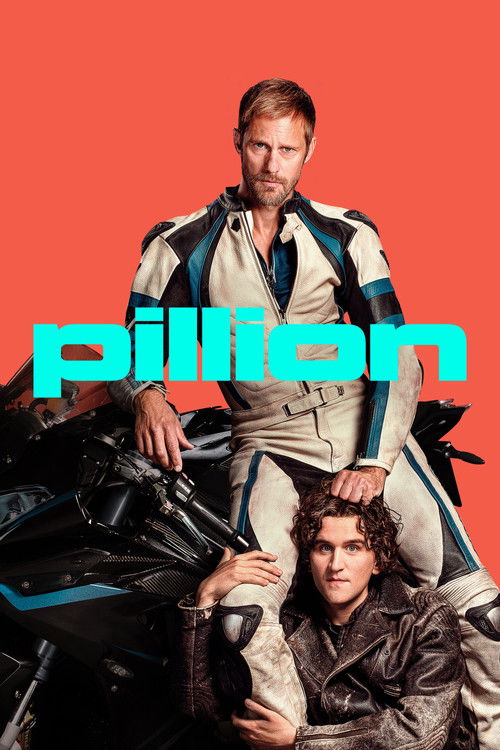
Pillion
2025 · Harry Lighton
For a night when you want a love story with teeth — something bold, funny, and frank that still leaves you a little melted. A date-night pick for the adventurous; a comfort watch for anyone tired of timid romances.
What it's about
Colin is a timid parking attendant still half-living in his parents' shadow when Ray — an impossibly handsome, quietly commanding biker who leads a queer motorcycle club — takes him on as his live-in submissive. What follows is a genuine romance told through the rules and rituals of dominance and devotion, as Colin discovers what he actually wants versus what he's been handed. It's kinky, yes, but it's really about learning to be wanted.
The experience
Far funnier and sweeter than the premise suggests — a dark comedy with a big, sincere heart, frank about sex and disarmingly tender about need. It keeps surprising you: you brace for lurid and get laugh-out-loud, then quietly moving.
Performances
Harry Melling is extraordinary as Colin, turning meekness into a full inner life, and Alexander Skarsgård plays Ray with a magnetic, unreadable stillness — the two together make an unlikely chemistry feel inevitable.
The craft
Harry Lighton's screenplay, adapted from Adam Mars-Jones's novella Box Hill, won the Un Certain Regard writing prize at Cannes, and you can hear why: it threads explicit material, deadpan comedy, and real emotional stakes without a wobble. The direction treats the biker-club world with affection and specificity rather than shock value.
Why it matters
One of the most acclaimed British debuts of its year, it announced Lighton as a major new voice and pushed queer kink into mainstream romantic filmmaking on its own warm, unapologetic terms.
Snapshot
Pillion is the feature debut of British writer-director Harry Lighton, a romance told in the grammar of submission. Colin (Harry Melling), a diffident parking attendant still living in the orbit of his parents, is drawn into the world of Ray (Alexander Skarsgård), the laconic, magnetic leader of a queer motorcycle club, who installs him as his live-in submissive. What could have been a lurid premise is instead handled as a tender, frequently funny study of how a person learns to want, and to be wanted on terms not their own. Adapted from Adam Mars-Jones's 2020 novella Box Hill, the film premiered in Un Certain Regard at the 78th Cannes Film Festival on 18 May 2025, where it won the section's Best Screenplay prize (and a Palm Dog for the club's rottweiler). It emerged as one of the most acclaimed British debuts of its year, sweeping major categories at the British Independent Film Awards and earning Lighton a Gotham Award for Best Adapted Screenplay. The achievement is one of register: an explicit BDSM picture that treats kink not as transgression to be punished or pathology to be cured, but as a vocabulary of intimacy.
Industry & production
Pillion is a UK–Ireland production from Element Pictures, the Dublin/London company whose recent output (The Favourite, Poor Things, The Lobster, Normal People, Aftersun) has made it the pre-eminent supplier of distinctive auteur-driven work in the British-Irish space. It was produced by Emma Norton with Element principals Ed Guiney and Andrew Lowe, alongside Lee Groombridge, and co-financed by BBC Film and the British Film Institute on a reported budget of roughly £814,000 — a genuinely modest sum that conditioned many of the film's creative choices. Skarsgård, a substantial draw in his own right, also served as an executive producer, signaling personal investment in material that asks considerable vulnerability of its leads.
Principal photography ran from late July through early September 2024 across London and southeast England, with locations in Bromley, Sevenoaks, and Lullingstone Castle in Kent. The compressed schedule and regional shooting were partly economic, partly tonal: the suburban, unglamorous English backdrop is essential to the film's contrast between domestic ordinariness and erotic self-invention. Lighton's research was unusually grounded — he consulted members of the gay bikers' community as advisors, and the production worked with intimacy coordinators throughout, a practice the cast discussed publicly as central to making the explicit scenes safe and precise rather than improvised.
A24 acquired US distribution rights, releasing the film theatrically in early 2026; in the UK it was handled through Picturehouse/Warner Bros. for a late-2025 release. International sales activity following the Cannes premiere was brisk, the festival reception (a multi-minute standing ovation widely reported in the trade press) converting quickly into global deals.
Technology
Cinematographer Nick Morris has described testing roughly nine camera systems before settling on the ARRI Alexa 35, valued for reliability and latitude, paired with Canon K35 vintage lenses chosen for their soft, romantic bokeh and gentle rendering of skin — a deliberately sensual optical signature that resists clinical sharpness. For tight interiors and the film's more athletic sequences, the production supplemented with a RED Komodo X on a DJI Ronin RS4 Pro gimbal, which Morris operated remotely to stay physically close to the performers during a wrestling scene. Notably, the team avoided Steadicam, preferring dolly, tripod, and gimbal — a choice that keeps the camera composed and observational rather than restlessly subjective. Motorcycle work used a Bickers banking rig and a small Technocrane in place of conventional low-loader setups, lending the riding footage a credible sense of lean and weight. Finishing was completed digitally with colorist Toby Tomkins at Harbor. These are the tools of contemporary mid-budget art cinema deployed with discipline rather than spectacle; the technology serves intimacy.
Technique
Cinematography
Morris's images are restrained and considered, cited by him against the grain of overt romanticism. He has named photographer Nick Waplington's documentation of subculture and Alfonso Cuarón's Roma as touchstones — references that point toward an observational, texturally rich naturalism rather than glossy eroticism. A governing strategy is the play of light sources: Morris embraced the harsh overhead spots of Ray's apartment rather than softening them, letting their clinical glare characterize that space, and set it against the warmer, lower-key domesticity of Colin's parents' home. The K35 glass softens flesh and bleeds highlights just enough to keep the explicit material tender. The result is a film that looks at submission with curiosity and steadiness, neither leering nor flinching.
Editing
Gareth C. Scales cuts for observation and comic timing in equal measure. The film's tonal achievement — sustaining genuine eroticism, real emotional stakes, and dry humor often within the same scene — depends heavily on editorial patience: holding on Colin's face as he calibrates a reaction, letting silences sit, allowing the audience to register the absurd and the moving simultaneously. The rhythm is unhurried, trusting the performances and the precision of the staging.
Mise-en-scène / staging
Production designer Francesca Massariol and costume designer Grace Snell (the latter recognized at the BIFAs) build the film's meaning through environment and dress. The leather-and-chrome iconography of the motorcycle club is rendered specifically rather than generically — a lived-in subculture with its own etiquette and uniforms — and set against the chintz and clutter of suburban family life. Costume does heavy narrative work: Colin's transformation is legible in what he is given, and permitted, to wear. The contrast of spaces — institutional flat versus parental home, garage versus countryside — externalizes the negotiation between the self Colin performs and the one he is discovering.
Sound
Oliver Coates's score is a defining element. A cellist and electronic composer associated with Mica Levi, Jonny Greenwood, and Radiohead, and the composer behind Aftersun, Coates works in textures that are ambiguous and interior — neither conventionally romantic nor ironic — a sonic equivalent of the film's refusal to tell us exactly how to feel. The music holds the same delicate position the film does: between ache and absurdity, intimacy and unease.
Performance
The film rests on its two leads and the chemistry of their power exchange. Harry Melling, long since past his child-actor origins, gives Colin a watchful, internalized quality — much of the performance is reaction, micro-adjustment, the slow accrual of self-knowledge — work that won him Best Actor at the Stockholm and Valladolid festivals. Skarsgård plays Ray as control rendered almost gentle: dominance expressed through stillness and economy rather than menace, which makes the dynamic legible as care as much as command. Supporting turns from Douglas Hodge, Lesley Sharp, and Scissor Sisters' Jake Shears flesh out the worlds Colin moves between.
Narrative & dramatic mode
The dramatic mode is the coming-into-being story refracted through submission: a Bildungsroman in which growth is measured not by independence but by the capacity to surrender and to articulate desire. Mars-Jones's novella is narrated in Colin's reticent, self-deprecating first person, and the film translates that interiority into a close, restrained third person anchored to his point of view. The arc resists the genre's usual moralizing shape — there is no punishment, no rescue, no conversion back to "normal" intimacy. Instead the question is whether a relationship structured around inequality can also be a site of genuine tenderness and growth, and what Colin keeps for himself within it. The tone braids romance, drama, and a persistent dry comedy, the humor functioning as a release valve and as a marker of the characters' humanity.
Genre & cycle
Pillion sits within the contemporary queer romance and a longer, fraught lineage of BDSM on screen. Where earlier films often coded kink as danger or perversion — Pasolini's Salò, the moral panic of William Friedkin's Cruising (1980), the gothic dread of The Night Porter — Pillion belongs to a more recent, normalizing turn that treats kink as a legitimate erotic and emotional language, closer in spirit to Steven Shainberg's Secretary (2002) in its comic-romantic framing of dominance and submission. Within queer British cinema it extends the intimate, landscape-grounded realism of Andrew Haigh's Weekend and Francis Lee's God's Own Country, while pushing further into explicitness. It also participates in the broader Element Pictures cycle of formally controlled, off-kilter character studies. The pairing of a major Hollywood-adjacent star with frank queer content marks it within a wider 2020s movement of explicit, awards-courting queer films.
Authorship & method
Pillion is a true authorial debut: Lighton both wrote and directed, and the screenplay — the element most decorated, with prizes at Cannes and the Gothams — is the clearest signature. His method is fidelity to a literary source married to deep ethnographic research (time spent with the gay bikers' community) and a commitment to safety-as-craft via intimacy coordination. The collaborators are notably aligned: Morris's restrained, source-light photography; Coates's ambiguous score; Scales's patient cutting; Snell and Massariol's expressive design. The decisive authorial achievement is tonal calibration — holding eroticism, comedy, and pathos in suspension without any one collapsing the others. Lighton's prior short work (including the BAFTA-nominated Wren Boys) anticipated this interest in male intimacy and constrained worlds; Pillion realizes it at feature scale.
Movement / national cinema
The film is a flagship of contemporary British independent cinema in its publicly funded, internationally minded mode — BBC Film and BFI money channeled through Element Pictures and amplified by a US art-house distributor (A24) and a name lead. It belongs to a recognizable strand of British art cinema that grafts social-realist specificity (suburban England, regional locations, ordinary domestic texture) onto art-house formal control and adult subject matter. Its festival pathway — Un Certain Regard to BIFA dominance to transatlantic release — is the now-standard route for ambitious British auteur debuts.
Era / period
Pillion is a film of the mid-2020s, and bears that moment's marks: the institutionalization of intimacy coordination as standard practice for explicit content; the post-#MeToo seriousness about consent reframed here, pointedly, around a relationship built on negotiated power; and a film culture in which a mainstream star can headline frank queer material as a prestige proposition. It reflects a period in which queer cinema has moved from arguing for its subjects' legitimacy toward exploring the textures and difficulties of queer lives as a given.
Themes
Its central theme is desire as something learned rather than innate — the education of a timid man into the articulation of what he wants, even when that want takes the shape of submission. Around this cluster: the paradox of power and tenderness, the possibility that an unequal structure can house genuine care; self-esteem and self-erasure (Mars-Jones subtitled the source novella A Story of Low Self-Esteem); the negotiation between performed and authentic selves; the relation of the queer subculture to the suburban family; and the body as a site of both vulnerability and agency. The film insists that surrender can be a form of growth, refusing the equation of submission with degradation.
Reception, canon & influence
Critical reception was strongly positive — the film registered near-unanimous approval on the aggregators and drew particular praise for the assurance of Lighton's direction, the calibration of tone, and the leads' performances; reviewers in the trade and general press repeatedly noted how little the work betrayed a first-timer's hand. Its awards run was substantial: the Un Certain Regard screenplay prize and Palm Dog at Cannes, Best British Independent Film and multiple craft awards at the BIFAs, the Gotham for Best Adapted Screenplay, festival acting prizes for Melling, and a cluster of BAFTA nominations.
Looking backward, the film's influences are legible: Mars-Jones's novella as direct source; the queer-realist intimacy of Haigh and Lee; the comic-romantic reframing of kink pioneered by Secretary; and, by Morris's own account, the visual restraint of Cuarón and Waplington. Looking forward, the record is necessarily thin given the film's recency — its long-term legacy cannot yet be assessed honestly. What can be said is that it consolidates a model: explicit queer material handled with care-as-craft, anchored by a star willing to be vulnerable, and pitched at the festival-prestige tier rather than the niche. Its most concrete forward effect is the launch of Harry Lighton as a major directorial voice and a further validation of Element Pictures' house authorship. Whether Pillion becomes a touchstone for how mainstream cinema depicts kink and consent, as Secretary was for its generation, will be clearer with time.
Sources consulted for production and reception detail: Wikipedia), British Cinematographer, Variety, Festival de Cannes.
A Deleuzian reading
The camera holds on Colin's face longer than you'd expect.
The full Deleuzian reading of Pillion →
Reception
It arrived at Cannes 2025 sounding like a provocation — 'the Skarsgård BDSM biker movie' — and within months had flipped into something nobody expected: a beloved, crowd-pleasing romance, Certified Fresh at 99% and embraced as one of the year's warmest films.
How Pillion was received, from release to now →
How to watch Pillion: what to notice on a first viewing
- Watch the camera stay on Colin's face after something happens, not on the event. The film repeatedly holds on Colin instead of cutting to whatever Ray has said or done, letting you watch him work out what he is allowed to feel. Deleuze calls a feeling registered on a face before it turns into action the affection-image, and the film is built almost entirely from that gap.
- Notice how harsh the light is in Ray's apartment compared to Colin's parents' home. Ray's flat is lit with unsoftened overhead spots, while Colin's family home stays warmer and lower-key by comparison. The two lighting registers mark which world is clinical and which is familiar before Colin has to explain the difference himself.
- Watch what Colin is given, and allowed, to wear. Costume tracks Colin's transformation directly, with his clothing changing as his position within the relationship changes. His growth is legible in fabric and permission before it ever shows up in dialogue.
- Notice how specifically the motorcycle club's spaces and rituals are rendered. The leather-and-chrome world of Ray's club is staged with its own etiquette and uniforms, set against the chintz and clutter of suburban family life. Treating the subculture with the same specificity as the suburb refuses to make either one exotic or shameful.
- Listen for a score that never tells you whether to feel comfortable or unsettled. Oliver Coates's music stays textured and ambiguous rather than swelling toward romance or curdling into irony. The score matches the film's refusal to hand you a fixed verdict on what you are watching.
The whole guide to watching Pillion, with the keys for a rewatch →
Influences: the films it descends from and the films it influenced
- Secretary (2002) — Establishes the template Pillion inherits — the dom/sub contract restaged as a romantic-comic bildungsroman in which submission is filmed as a route to selfhood rather than pathology.
- The Night Porter (1974) — Pioneers the eroticized power-and-tenderness dyad in which dominance is administered as care, the charge Pillion transposes from trauma into courtship.
- Scorpio Rising (1963) — Codifies the leather-and-chrome biker as queer fetish icon through fetishistic montage of polished machinery and bodies, the iconographic grammar behind Pillion's leather-vs-chintz staging.
- Querelle (1982) — Stylizes male submission and desire as ritual within a hermetic homoerotic-fetish world, the staging tradition Pillion naturalizes into observational realism.
- Cruising (1980) — Friedkin's immersive, costume-and-code-accurate ethnography of the leather subculture prefigures Lighton's research-led insider depiction of the gay-biker community.
- The Servant (1963) — Stages dominance and submission as choreographed power-inversion within charged domestic interiors, the blocking grammar underlying Pillion's leather/suburban-chintz mise-en-scène.
- Brokeham Mountain (2005) — Melling's internalized-reaction performance descends from Lee's direction of male repression, desire carried by withheld micro-expression rather than dialogue.
- Weekend (2011) — Haigh's naturalistic queer two-hander — long, source-lit scenes of intimacy negotiated in real time — is the realist register Pillion adopts wholesale.
- God's Own Country (2017) — Lee's British rural queer realism — tender, near-wordless physical intimacy between men shot in available light — is the immediate native tradition Pillion extends.
- Roma (2018) — Cinematographer Nick Morris cites Cuarón's restraint directly: available-light naturalism and a static, observational camera (no Steadicam) favored over busy coverage.
- Aftersun (2022) — Shares composer Oliver Coates, whose ambiguous, dread-tinged strings score both; both are assured British debuts built on internalized reaction and held tonal suspension.
- Sanctuary (2022) — Wigon's dom/sub chamber two-hander reframes a power-exchange relationship as a verbal comedy of control, the contemporary kink-comedy register Pillion shares.
- Passages (2023) — Pitches graphic queer desire at the prestige-arthouse tier with coordinated intimacy as craft, the mid-2020s model Pillion consolidates.
- All of Us Strangers (2023) — Haigh's later Element-tier queer feature handles explicit gay intimacy through intimacy coordination as craft, the same care-as-method authorship Pillion practices.
- The Bikeriders (2023) — Nichols' ethnographic biker-subculture staging — leather, chrome, the machine as character — runs parallel to Pillion's, both built from inside the community's codes.
Similar films
- The Night Porter (1974) — influence & lineage
- Aftersun (2022) — influence & lineage · same viewing thread
- Queer (2024) — same viewing thread · often watched together
- Strange Darling (2024) — shared sensibility
- Babygirl (2024) — shared sensibility
- Urchin (2025) — shared sensibility
- Joyland (2022) — shared sensibility
- The Power of the Dog (2021) — shared sensibility
All the films related to Pillion →
Watch it with: curated runs of related films
- Desire on Uneven Ground — A run of tender, lopsided intimacies — an outsider fixed on someone just out of reach — that keep slipping from realism into dream, myth, or memory.