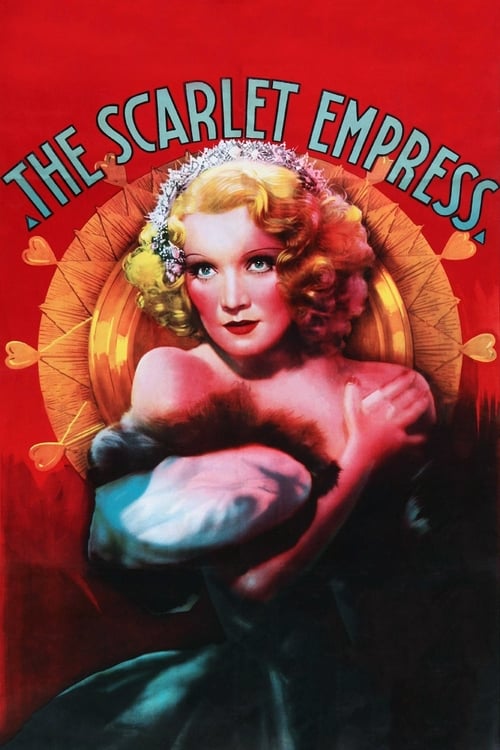
The Scarlet Empress
1934 · Josef von Sternberg
For when you want pure spectacle with a transgressive edge — a night of gawking at one of the strangest, most gorgeous things the studio era ever produced. Best approached as a visual feast, not a history lesson.
What it's about
A sheltered German princess is shipped off to eighteenth-century Russia to marry the heir to the throne — who turns out to be a grinning, half-mad man-child in a court ruled by intrigue and appetite. Trapped in a loveless marriage, she learns the game faster than anyone expected. It's the rise of Catherine the Great told as fever dream: a naive girl's education in power, desire, and survival.
The experience
Delirious is the word — every frame is crammed with grotesque statues, guttering candles, and veils of gauze until the Russian court feels like a haunted house. It's wicked, sly, and visually overwhelming, moving at the pace of a dark fairy tale.
Performances
Marlene Dietrich, in her sixth film with Josef von Sternberg, transforms before your eyes from wide-eyed innocent to icon of imperial cunning — one of the great star performances built almost entirely out of light and gesture.
The craft
Sternberg treats the sets, costumes, and lighting as the real story: a phantasmagoric Russia of nightmare iconography and candlelit shadow that no actual palace ever resembled. Made just before Hollywood's censorship code clamped down, it gets away with a frankness about sex and cruelty that vanished from American screens for decades. It looks like nothing else — the images alone justify the watch.
Why it matters
A commercial flop in 1934 that time has vindicated completely — it's now regarded as one of the most extreme and beautiful achievements of studio-era Hollywood, and the pinnacle of the Dietrich–Sternberg collaboration.
Snapshot
The Scarlet Empress is Josef von Sternberg's delirious, hothouse account of the rise of Catherine the Great, and the sixth of the seven features he made with Marlene Dietrich at Paramount. It traces Sophia Frederica's journey from a sheltered German princess to the empress who seizes the Russian throne, but narrative is almost beside the point: the film is a sustained essay in décor, light, and texture, in which a half-mad Russian court becomes a phantasmagoria of grotesque statuary, guttering candles, and gauze. Released in 1934 just as the Production Code began to bite, it baffled contemporary audiences and underperformed commercially, overshadowed in part by a competing British Catherine picture released the same year. Time has been far kinder: it is now widely regarded as one of the most extreme and beautiful demonstrations of pure mise-en-scène in studio-era Hollywood, and a key document of Sternberg's conviction that cinema is, before all else, an art of arranged light and surface.
Industry & production
The film was produced by Paramount, the studio that had imported Sternberg and Dietrich after the German success of The Blue Angel (1930) and built an entire prestige line around their partnership — Morocco, Dishonored, Shanghai Express, Blonde Venus, and The Scarlet Empress. By 1934 that cycle was nearing exhaustion, both commercially and personally; the films had grown more rarefied and less profitable, and The Scarlet Empress represents the partnership at its most uncompromisingly stylized, just before the final collaboration, The Devil Is a Woman (1935), after which the two separated professionally.
The production is best understood as an art-direction enterprise as much as a dramatic one. Paramount's design resources, overseen by supervising art director Hans Dreier, were marshaled to build a court of monstrous icons, oversized doors, and contorted sculpted figures that function as furniture, throne, and chorus at once. The expressionist sculptures — gargoyles, skeletal saints, and writhing wooden bodies — are among the most discussed physical elements of any 1930s American film. Sternberg, exacting and autocratic on set, supervised this world down to the smallest reflection.
The film's commercial fate was shaped by timing. It arrived amid a brief vogue for Catherine the Great subjects: Alexander Korda's British production Catherine the Great (1934), directed by Paul Czinner with Elisabeth Bergner, reached screens at roughly the same moment, splitting attention and inviting comparison. More consequentially, The Scarlet Empress opened as the newly enforced Production Code constrained exactly the kind of erotic suggestion the Sternberg–Dietrich films had traded in; its candid treatment of Catherine's appetites sits awkwardly against that tightening. The picture is generally recorded as a box-office disappointment, though precise figures should be treated cautiously rather than asserted.
Technology
The Scarlet Empress is a black-and-white sound film made with the standard 35mm technology of the mid-1930s, by which point optical sound-on-film recording and panchromatic stock were mature. What distinguishes it technologically is not novelty of apparatus but the extremity with which conventional tools were pushed. The lighting demanded enormous control over highlight and shadow, including extensive backlight through veils, smoke, nets, and translucent materials — effects that depended on the sensitivity and contrast range of contemporary panchromatic emulsions and on banks of arc and incandescent units arranged with unusual precision. The film also draws on archival-style and montage technique in its compressed historical passages. In broad terms, though, the picture's "technology" is inseparable from its craft: it is a demonstration of how far the ordinary instruments of the sound-era studio could be bent toward a single, obsessive visual sensibility.
Technique
Cinematography
The photography, credited to Bert Glennon, is the film's reason for being. Sternberg — himself a cinematographer by instinct who routinely intervened in the lighting of his pictures — pursued a near-continuous veiling of the image: faces glimpsed through lace, smoke, hanging nets, candle flame, and fur. Light is rarely flat or merely illustrative; it isolates Dietrich's face as a luminous mask within darkness, models the grotesque sculptures into active presences, and turns surfaces — gauze, bell ropes, ice, candle wax — into the true subjects of the shot. The camera favors dense, layered compositions in which foreground objects partially occlude the action, so that the viewer seems always to be peering into the court rather than placed within it. This deliberate obstruction of sightlines is itself a thesis about looking, desire, and concealment. Few Hollywood films of the period are so thoroughly committed to the image as an end in itself.
Editing
Editing in a Sternberg film is subordinate to composition and duration; cutting tends to preserve and prolong the pictorial tableau rather than drive momentum. The Scarlet Empress alternates between languorous held compositions — the long wedding sequence, the banquet under the gargoyles — and bursts of rapid, near-abstract montage that compress dynastic history and violence into impressionistic flurries (bells, galloping riders, instruments of torture). The contrast between stasis and frenzy is one of the film's structural signatures. The specific editor's credit is not something I can attribute with confidence, and I won't guess; what is clear is that the rhythm answers to Sternberg's pictorial priorities rather than to conventional continuity pacing.
Mise-en-scène / staging
This is the category the film exists to dominate. The Russian court is conceived as a single oppressive organism of carved wood and warped iconography: doors so massive they require several women to push them open, a dining table flanked by skeletal sculpted figures, thrones shaped like screaming idols, and a private chamber dense with religious grotesques. Staging continually dwarfs the human figure against these objects, then suddenly grants Dietrich command of them. Costuming and props — furs, veils, a riding uniform, candles held to the face — are blocked as compositional elements rather than naturalistic detail. The famous image of Catherine ascending the palace stairs on horseback in the climactic coup fuses performance, costume, set, and movement into a single emblematic gesture. Sternberg's claim that the film was "a relentless excursion into style" is, for once, plain description.
Sound
The soundtrack leans heavily on music and orchestral underscoring rather than naturalistic ambience or extended dialogue, in keeping with the film's pageant-like, near-operatic mode. The score is built largely from adaptations of nineteenth-century classical music — Russian and German romantic repertoire, including material associated with Tchaikovsky, Wagner, and Mendelssohn — woven over the action to heighten its emotional and ceremonial register. The precise arranger credits within Paramount's music department I cannot specify reliably and will not invent. Dialogue is comparatively sparse and stylized, and Dietrich's voice, used sparingly, becomes one more controlled instrument in a largely visual and musical design.
Performance
Dietrich's performance is a study in transformation managed through stillness. She begins as a wide-eyed, almost naïve girl and hardens, gesture by gesture, into a sovereign whose power is expressed through poise, calculated glances, and the wearing of costume as armor. Sternberg directs her as an object of light first and a psychological agent second, yet the arc from innocence to mastery registers clearly. Around her, performance is pitched toward the grotesque: Sam Jaffe, in his film debut, plays the Grand Duke Peter as a giggling, vacant near-imbecile, a deliberately repellent caricature; Louise Dresser delivers the Empress Elizabeth in a blunt, earthy, almost anachronistically American register that cuts against the surrounding stylization; and John Lodge supplies brooding romantic weight as Count Alexei. Dietrich's own daughter, Maria Sieber, appears as Sophia as a child, a touch of biographical intimacy inside the artifice.
Narrative & dramatic mode
The film adapts the early life and ascent of Catherine the Great, drawing in part on the empress's own writings, but it treats history as raw material for spectacle and irony rather than as chronicle. The dramatic mode is closer to fable, pageant, and dark fairy tale than to realist biography: a princess is delivered to a monstrous court, married to a fool, schooled in cruelty and desire, and finally turns the court's own instruments of power against it. Causality is loose and elliptical; long ceremonial set-pieces alternate with compressed montage, and psychology is externalized into décor and lighting. The tone is mordantly ironic — the machinery of empire is shown as grotesque theater — yet the film also takes seriously its arc of a woman learning to convert imposed powerlessness into command. It is melodrama abstracted almost to the level of ritual.
Genre & cycle
Nominally a historical romance and costume drama, The Scarlet Empress belongs more truly to the prestige historical-spectacle cycle of the early-to-mid 1930s, when studios mounted lavish biographical and period pictures around star personalities. Within that field it is an extreme outlier: where the cycle generally aimed at legible heroism and middlebrow uplift, Sternberg produced something closer to expressionist erotic grotesque. It is also the culmination of the specific Sternberg–Dietrich cycle, a series of films built around Dietrich's image as an enigma to be lit, costumed, and contemplated. The film's near-simultaneous release alongside the British Catherine the Great marks it as part of a brief, transnational micro-cycle of Catherine films, against which Sternberg's version looks the least conventional and the most aesthetically radical.
Authorship & method
The Scarlet Empress is among the strongest cases for treating a studio film as the work of a single controlling sensibility. Josef von Sternberg conceived the film as an exercise in style and exercised authority over photography, design, and the modeling of Dietrich's image to an unusual degree, frequently shaping the lighting himself. His method subordinated narrative clarity and actorly naturalism to pictorial composition, treating the human face and body as elements within an arranged field of light and texture. His central collaborator-as-subject was Dietrich, whose persona the partnership had constructed across five prior films and who here gives her last great Sternberg performance but one. Cinematographer Bert Glennon executed and shared in the film's extraordinary lighting. Supervising art director Hans Dreier and the sculptors and craftsmen who built the court's grotesque statuary were essential to its physical world. The screenplay derives from Catherine's own diaries and is credited as an adaptation by Manuel Komroff, though under Sternberg the script functioned largely as scaffolding for spectacle. Editor and music-department credits I leave unstated rather than risk inaccuracy.
Movement / national cinema
The film is a Hollywood studio production, but its sensibility is transplanted European, specifically a late flowering of German Expressionism inside American industrial cinema. Sternberg, Austrian-American and steeped in the visual culture that produced The Blue Angel, imports the expressionist vocabulary of distorted décor, dramatic chiaroscuro, and psychologized space, and grafts it onto Paramount's resources and Dietrich's star image. It thus sits at a hinge between European art cinema and the American studio system, and stands as one of the most thoroughgoing expressionist works produced within 1930s Hollywood — closer in spirit to Weimar design than to the prevailing realist or theatrical norms of its home industry.
Era / period
The Scarlet Empress is a quintessential product of the early sound era's transitional moment, and specifically of the boundary between the permissive "pre-Code" years and the enforcement of the Production Code in mid-1934. Its frank treatment of sexuality, cruelty, and power belongs to the pre-Code sensibility, even as it arrived just as that latitude was being curtailed — a tension that helps explain both its strangeness and its commercial difficulty. It also reflects an industry confident enough in its technical command of light and sound to indulge a director's purely aesthetic ambitions, a confidence that the more standardized, content-policed later 1930s would rein in.
Themes
The film's governing themes are power and its theatricality: the court is staged as a grotesque machine that grinds innocence into ruthlessness, and Catherine's education is the discovery that survival requires becoming a performer and manipulator within that machine. Sexuality and politics are inseparable — desire is a currency, the bedchamber a site of statecraft, and the empress's body a locus of both vulnerability and conquest. Looking, veiling, and concealment recur visually as themes in their own right: the persistent obstruction of the image makes voyeurism and the limits of seeing a subject of the film. Underlying all of this is a bleak vision of empire as madness dressed in ceremony, in which religious iconography and dynastic ritual are rendered as monstrous spectacle.
Reception, canon & influence
On release, The Scarlet Empress was met with confusion and limited commercial success; its extravagance struck many contemporaries as excessive or cold, and it failed to recover the audience the early Sternberg–Dietrich films had enjoyed, a decline hastened by the competing Catherine production and the chilling effect of the new Code. The partnership ended soon after with The Devil Is a Woman.
The film's influences run backward to German Expressionism, to the operatic and pageant traditions of historical spectacle, and to the constructed Dietrich persona of the preceding Paramount films, all of which it pushes toward an extreme. Its forward legacy is largely one of aesthetic example rather than direct imitation, since few films dared its degree of stylization. Critical reappraisal, especially within auteurist criticism, elevated it from curio to canonical demonstration of mise-en-scène and of Sternberg's authorship; it became a touchstone for arguments that a film's meaning can reside primarily in its visual surface. Its imprint can be felt in later filmmakers drawn to lavish, anti-realist period décor and to the image of the female sovereign as both spectacle and force, and it endures as a reference point for the idea of cinema as, in Sternberg's own terms, an excursion into style. Where specific lines of direct influence on named later films are concerned, the record is more a matter of shared sensibility than documented homage, and is best described as such rather than overstated.
A Deleuzian reading
Start with the veil.
The full Deleuzian reading of The Scarlet Empress →
Reception
A notorious flop in 1934 — audiences and critics found its delirium baffling, and it fed the slide toward Dietrich's 'box office poison' label — it's now canonized as the wildest peak of the Sternberg–Dietrich cycle and one of Hollywood's great feats of pure style.
How The Scarlet Empress was received, from release to now →
Influences: the films it descends from and the films it influenced
- The Cabinet of Dr. Caligari (1920) — Establishes the Expressionist principle Sternberg inherits — built, distorted décor functioning as psychological state rather than place, the set as an active expressive surface instead of neutral backdrop.
- Die Nibelungen (1924) — Hieratic, frieze-like tableau staging amid monumental architecture and statuary anticipates the Empress court's grotesque sculptures and the freezing of action into pictorial composition.
- Faust (1926) — Murnau's modeling of figures with directional chiaroscuro through smoke and shaft-light is the lighting grammar Sternberg and Glennon push to extremes on Dietrich's face.
- Foolish Wives (1922) — Obsessive, decadent set-dressing and European-court excess as a controlling authorial signature — the studio-as-total-environment that Sternberg's 'excursion into style' extends.
- Intolerance (1916) — The Babylonian pageant supplies the historical-spectacle scale and the impulse to subordinate narrative to vast decorative set-pieces.
- Napoléon (1927) — Layered, cluttered frames and superimposition that crowd foreground objects between camera and subject prefigure Sternberg's veiling of the image through intervening textures.
- The Blue Angel (1930) — First construction of the Dietrich persona as an object of arranged light — the collaborator-as-subject method that The Scarlet Empress inherits and intensifies.
- Shanghai Express (1932) — Glennon's foreground veils — nets, gauze, smoke, shadow-lattices laid between lens and Dietrich — is the literal 'veiled image' technique the Empress carries into its candle-and-veil close-ups.
- Dishonored (1931) — Carries Dishonored's pictorial maximalism to its extreme — narrative-as-clothesline-for-images, the frame choked with grotesque statuary and veiling, Dietrich as sovereign masked construct.
- Ivan the Terrible (1944) — Operatic court of grotesque profiles, looming shadows and power-as-theater, oscillating between montage and held tableau — the same tension between cutting and frozen pictorial spectacle.
- Beauty and the Beast (1946) — Living statuary — caryatid arms, watching faces in the décor — turns Sternberg's grotesque court sculptures into an animate mise-en-scène of enchantment.
- Black Narcissus (1947) — Cardiff's wholly studio-built, anti-realist hothouse — painted backings and emotionally keyed light standing in for a real place — is the postwar heir to Sternberg's décor-as-feeling.
- Citizen Kane (1941) — Toland's deep-focus layered compositions and low-key chiaroscuro, staging meaning across cluttered foreground-to-background planes, extend Sternberg's crowded, sculpted frame.
- Lola Montès (1955) — A woman's life staged as circus pageant behind veils, drapes and framing devices — the female sovereign as both spectacle and force, rendered through layered, obstructed compositions.
- The Conformist (1970) — Storaro veils faces and rooms through slatted light, gauze and intervening objects, reviving Sternberg's chiaroscuro of partial concealment as psychological surface.
- Barry Lyndon (1975) — Painterly held tableaux and an anti-realist, candle-lit period surface assert that the film's meaning resides in its composed image — Sternberg's mise-en-scène-as-end in 18th-century dress.
- Marie Antoinette (2006) — The female monarch rendered as pure decorative spectacle, court life staged as surface and pageant over historical narrative — Sternberg's image of the sovereign-as-theater.
- The Devil Is a Woman (1935) — The final Sternberg–Dietrich film carries the carnival of intervening veils, streamers and screens to its furthest point, closing the cycle's looking-and-veiling project.
- The Saga of Anatahan (1953) — Sternberg's late studio-built jungle, narrated and wholly artificial, is the purest restatement of his thesis that meaning lives in a constructed visual surface, not in realism.
Similar films
- Shanghai Express (1932) — influence & lineage
- The Blue Angel (1930) — influence & lineage
- Barry Lyndon (1975) — influence & lineage
- Marie Antoinette (2006) — influence & lineage
- Faust (1926) — influence & lineage
- Dishonored (1931) — shared sensibility
- Gertrud (1964) — shared sensibility
- Marketa Lazarová (1967) — shared sensibility