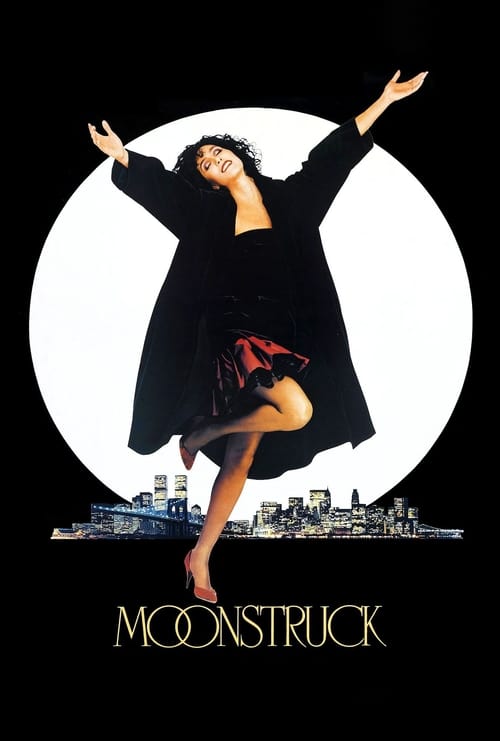
Moonstruck
1987 · Norman Jewison
For a cozy night in when you want to fall in love — comfort viewing with real intelligence behind it, the kind of romance you put on when you need the world to feel generous again.
What it's about
Loretta Castorini, a 37-year-old Italian-American widow in Brooklyn, is convinced she's cursed in love, so she says yes to a safe marriage proposal from a man she doesn't love. Then she meets his estranged younger brother Ronny — a wounded, volcanic baker who blames his brother for ruining his life — and everything she's arranged for herself starts to come apart. Around them orbits a whole family of parents, uncles, and neighbors, each wrestling with their own version of the same question: why do people who know better still fall in love?
The experience
Warm, funny, and full-hearted, with the timing of a stage farce and the swoon of grand opera underneath. It's talky in the best way — every scene is people arguing about love over food — and it builds to a payoff that feels both inevitable and delicious.
Performances
Cher won the Oscar for a performance of perfect deadpan pragmatism slowly melting into abandon, and Olympia Dukakis won one too as her mother, delivering hard-earned wisdom in a bathrobe. Nicolas Cage plays Ronny at full operatic boil, and the gamble pays off.
The craft
John Patrick Shanley's Oscar-winning screenplay is the star of the show — dense with quotable, aria-like speeches, compressing a whole family's reckoning into about three days and resolving everything at one kitchen table. Norman Jewison directs with unhurried classical warmth, letting the ensemble and the moonlit Brooklyn streets do the work, with opera itself woven through the story and the soundtrack.
Why it matters
An improbable smash — a modestly budgeted adult romantic comedy that became a major hit and awards success in an era of high-concept spectacle, and the gold standard people still reach for when they talk about grown-up romantic comedy.
Snapshot
Moonstruck is an Italian-American family comedy built with the precision of a stage farce and the emotional register of grand opera. John Patrick Shanley's screenplay compresses a Brooklyn widow's engagement, betrayal, and reversal into roughly three days, then resolves every thread at a single kitchen table. Norman Jewison — a Canadian directing a Manhattan-and-Brooklyn milieu he did not come from, working with a British cinematographer — shot it as warm, unhurried, classically covered comedy, trusting the writing and the ensemble rather than visual invention.
The film became one of the more improbable commercial and awards successes of its moment: a modestly budgeted adult romantic comedy with no stars under thirty in the leads, released into a marketplace increasingly organized around high-concept spectacle. It earned six Academy Award nominations, winning three: Best Actress (Cher), Best Supporting Actress (Olympia Dukakis), and Best Original Screenplay (Shanley). Vincent Gardenia was nominated for Supporting Actor; Jewison for Director; the film for Best Picture, losing to The Last Emperor. Nearly four decades later it survives as the reference point for a kind of American film — the ensemble ethnic romantic comedy for grown-ups — that Hollywood has largely stopped making.
Industry & production
Moonstruck was produced by Patrick Palmer and Jewison, the producing partnership that had already carried A Soldier's Story (1984) and Agnes of God (1985), and released through MGM/UA — a studio then in prolonged corporate instability. The picture's economics were the point: a contained, dialogue-driven film with location work in Brooklyn Heights, Carroll Gardens, Greenwich Village, and at Lincoln Center, with interiors reportedly completed in Toronto, where Jewison habitually based production. It opened on a platform pattern in December 1987 and widened in early 1988, the classic awards-season release shape, and it substantially outperformed its cost — a sleeper by any reasonable definition. Precise budget and gross figures vary across sources and are worth treating with caution; what is not in doubt is that the film was a durable, word-of-mouth hit rather than an opening-weekend one.
Shanley's script came out of the New York theater rather than the studio development system. He was, in 1987, known chiefly as a playwright — Danny and the Deep Blue Sea, Savage in Limbo — and the screenplay reportedly circulated under an earlier title, The Bride and the Wolf, before Jewison took it. That provenance matters: the film's structure, its density of dialogue, and its willingness to let scenes run on talk are theatrical inheritances, not Hollywood ones.
Casting was the commercial risk. Cher had built a serious acting career across Silkwood, Mask, and, in 1987 alone, Suspect and The Witches of Eastwick, but she was not a conventional romantic lead for a middle-aged bookkeeper in Brooklyn. Nicolas Cage, coming off Peggy Sue Got Married and the same year's Raising Arizona, was an unpredictable young actor with no romantic-lead track record. The supporting bench was drawn heavily from New York stage and character work: Dukakis, Gardenia, Danny Aiello, John Mahoney, Julie Bovasso — a downtown playwright and director of real standing, best known to film audiences as Travolta's mother in Saturday Night Fever — and Feodor Chaliapin Jr., son of the Russian bass, as the grandfather.
Technology
Technologically the film is deliberately unremarkable, and that is a choice with aesthetic consequences. It was shot on 35mm in spherical 1.85:1 and released in Dolby Stereo — a standard late-1980s package, no anamorphic scope, no format novelty. Nothing in the image announces its own machinery.
The one visible effect is the enormous low moon that hangs over Brooklyn and gives the film its title and its cosmology. This predates practical digital compositing in narrative features by several years; the moon was achieved by the optical and in-camera means available in 1987 — plate elements and optical printing — and the surviving technical record on exactly how it was executed is thin enough that any more specific account would be speculation. What is worth noting is the artistic result: the moon reads as slightly too large and slightly too present, a deliberate fairy-tale exaggeration rather than an attempt at photographic realism.
Technique
Cinematography
David Watkin, an Oscar winner two years earlier for Out of Africa, brought a lighting philosophy developed across his work with Richard Lester and Ken Russell: heavy use of bounced and reflected light, few hard sources, an even soft ambience that lets actors move freely without hitting marks for light. In Moonstruck this produces the film's defining warmth. The Castorini kitchen and dining room are lit as a hearth — amber, low-contrast, faces modeled but never carved. Against this, the night exteriors run cool and blue, lit by that impossible moon. The film's emotional geography is simply the temperature of the light: inside is family, obligation, food, and the small daily death of routine; outside is the moon, appetite, and risk.
Watkin's camera is largely static or gently mobile. There is little showy movement, no long-take bravura. The compositions favor the two-shot and the full-table group, keeping the ensemble legible — a decision that treats the frame as a proscenium.
Editing
Lou Lombardo, whose credits include The Wild Bunch, McCabe & Mrs. Miller, and The Long Goodbye, cut Moonstruck with almost none of the rhythmic aggression those films are famous for. The cutting is invisible and comic: it holds for reactions, lets pauses land, and resists the temptation to punch up jokes with editorial emphasis. Lombardo's real structural work is the braiding. The film runs four romances in parallel — Loretta and Ronny, Rose and the philandering professor Perry, Cosmo and Mona, and the grandfather's stubborn communion with his dogs — and the cross-cutting on the night of the full moon draws them into a single simultaneous action without ever labeling the parallel.
Mise-en-scène / staging
Philip Rosenberg's production design makes the Castorini brownstone a vertical stage: kitchen, stairs, front stoop, bedrooms above, each level assigned to a different kind of scene. Characters are constantly arriving at or leaving that stoop, and the front door functions as a farce door in the French sense — the mechanism by which the wrong people meet at the wrong moment.
The two central non-domestic spaces are opposed with almost allegorical clarity. Ronny's basement bakery is a hell-mouth: fire, ovens, flour dust, a man who lost his hand to a machine and has organized his whole life around the grievance. The Metropolitan Opera is its opposite — marble, chandeliers, red velvet, an institution devoted to formalizing exactly the passions Ronny cannot control. Loretta travels from one to the other, and the film marks the passage with a transformation sequence — hair, gown, shoes — that is unembarrassed Cinderella iconography. Theoni V. Aldredge's costumes track the same arc: dowdy dark layers, then the red dress.
Sound
The soundtrack is the film's most operatic instrument. Dick Hyman — the jazz pianist and arranger whose scoring work includes several Woody Allen pictures of the same decade — supplies a score built substantially around Puccini, above all La Bohème, and around Italian-American popular song. Dean Martin's "That's Amore" opens the picture; Vikki Carr's "It Must Be Him" recurs at moments of romantic derangement. Puccini's melodies migrate freely between diegetic and non-diegetic space — a record in the bakery, the opera itself, the underscore — so that by the time Loretta weeps at the Met, the film has already trained the audience to hear opera as the language its characters would speak if they could.
Dialogue recording favors overlap and density in the family scenes, the plausible acoustics of too many people in one room. The howling dogs on the moonlit street are the film's one piece of pure sonic whimsy.
Performance
The acting registers are wildly different and deliberately unreconciled. Cher plays Loretta close to the vest — flat affect, deadpan delivery, a woman who has decided that feeling is a luxury she can't afford — which makes her eventual collapse into feeling structurally satisfying. Cage plays Ronny in a broad, near-expressionist mode: hurled furniture, operatic self-pity, the wooden hand brandished as evidence. Contemporary and later commentary has often noted this stylistic mismatch; the film converts it into content, since the plot is precisely about a self-controlled woman being detonated by an uncontrolled man.
Dukakis and Gardenia work in a third mode entirely — dry, worn, naturalistic, playing a long marriage in shorthand. Dukakis's Rose is the film's moral intelligence, and her repeated question to various men about why men chase women is the mechanism by which the comedy states its thesis: they do it because they fear death.
Narrative & dramatic mode
The structure is a well-made play. Unity of time is close to absolute — the action turns over a handful of days — and unity of place is nearly so. Every plot line is planted early and pays off in a single convergent final scene, in which the entire cast assembles in one kitchen and all secrets surface at once. That is the classical comic resolution, descended through Molière and French farce, and it is executed here without irony.
Layered over it is a folk-tale grammar: a wolf (Ronny gnaws at his own captivity; Shanley's working title made the animal explicit), a moon that acts as an agent rather than a symbol, a transformation, a curse of bad luck to be broken. The film's characters believe in luck, curses, and lunar influence, and the film declines to correct them. That refusal is what keeps it from being merely a romantic comedy with local color.
The comedy's engine is the collision of two value systems — Catholic-familial obligation versus appetite — with death as the third term. Cosmo's affair, the grandfather's proximity to the grave, and the funeral-adjacent atmosphere of the family's talk keep mortality continuously in play beneath the jokes.
Genre & cycle
Moonstruck sits at the intersection of two American traditions. The first is screwball and the Hollywood comedy of remarriage: a couple wrong on paper, an engagement to the wrong man, verbal combat as courtship, and a final reordering that reaffirms marriage as an institution. The second is the Italian-American family picture, whose comic-domestic branch runs back through Chayefsky and Delbert Mann's Marty (1955) — another film about a lonely, unglamorous ethnic adult given permission to want something — and whose dramatic branch runs through The Godfather and Mean Streets.
In the cycle of its own decade it is an outlier. The mid-eighties romantic comedy was largely youth-facing; Moonstruck's protagonist is thirty-seven, widowed, and lives with her parents. Its success demonstrated an adult audience that the industry had been undercounting, and it belongs with Broadcast News and Fatal Attraction in a 1987 cluster of grown-up, dialogue-forward studio films about desire and its costs.
Authorship & method
Jewison's authorship is a matter of tone management rather than signature style. His career — In the Heat of the Night, Fiddler on the Roof, Jesus Christ Superstar, A Soldier's Story — divides between social-problem dramas and musicals, and Moonstruck draws on the musical side: the confidence to let Puccini carry a scene, the sense of an ensemble as a chorus, the willingness to stage emotion at a scale that would be embarrassing if the film blinked. He was nominated three times for Best Director (In the Heat of the Night, Fiddler, Moonstruck) and never won a competitive Oscar, receiving the Thalberg award in 1999. He founded the Canadian Film Centre in 1988 and died in January 2024.
Shanley is the film's dominant author. The dialogue's rhythm — declarative, aphoristic, characters announcing their philosophies aloud — is a playwright's rhythm, and he returned to the same milieu immediately afterward in the stage play Italian American Reconciliation (1988). His later trajectory, through Joe Versus the Volcano (which he directed) and eventually Doubt, confirms the preoccupations visible here: Catholicism, certainty and its collapse, people arguing about the nature of love in kitchens.
Watkin, Lombardo, and Hyman each brought careers of considerable range to a film that asked them for restraint. It is a notable feature of Moonstruck's method that three major craftspeople all chose to disappear.
Movement / national cinema
The film is American studio cinema, but its Italianness is constructed by outsiders — a Canadian director, an English cinematographer, an Irish-American playwright of the Bronx. This has been read both ways. Sympathetically, the outsider position produces affection without self-mythology, and the film's Italian-American world is specific in its details (the bakery name Cammareri belonged to a real Carroll Gardens bakery; the Greenwich Village restaurant is a real one) while remaining legible to audiences with no connection to it. Less sympathetically, it can be read as ethnic pastiche, a warm consumable version of a community. Both readings have currency; the film's persistent popularity among Italian-American audiences complicates the second.
Its Puccini spine also makes it, in a limited sense, a film about European high culture arriving in Brooklyn — opera as the emotional vocabulary of immigrants and their children, not as elite ornament.
Era / period
1987–88 was a transitional moment: the blockbuster logic of the decade was consolidating, MGM/UA was in decline, and the specialty-release awards campaign was becoming a reliable studio tactic. Moonstruck succeeded by being unfashionable — no effects, no franchise potential, an ensemble of stage actors, a middle-aged love story. Its Oscar haul arrived in a year dominated by The Last Emperor's nine wins, and Dukakis's Supporting Actress victory coincided with her cousin Michael Dukakis's presidential campaign, a coincidence she acknowledged from the stage and which gave the win an unusual public afterlife.
Themes
Death is the film's substrate. Rose's investigation into male infidelity concludes that men chase women because they fear dying; Cosmo's affair is a mortality panic; the grandfather is openly rehearsing his exit; Loretta's first husband was killed by a bus, which she has interpreted as a curse. Against this, the film proposes that love is not a reward for good behavior but a wound one consents to — Ronny's missing hand is the literalization, and Loretta's slap and her instruction to snap out of it is the film's most quoted refusal of self-pity.
Secondary themes: superstition as a functioning epistemology; the difference between the marriage you choose for safety and the one you choose for hunger; confession, both sacramental and secular, as the film's recurring structural device; and family as the institution that both suppresses and finally ratifies desire.
Reception, canon & influence
Critical reception in 1987–88 was broadly and unusually warm, with particular praise for Shanley's writing and for Dukakis; Roger Ebert was among the film's most visible champions, placing it among the year's best. The three Oscars sealed a consensus that has held. The film subsequently entered popular canon lists of great American comedies and screen romances, and its lines and set pieces — the slap, the moon, the final table — have had a long second life in circulation detached from the film.
Backward. Its debts are legible: Puccini's La Bohème (structurally as well as musically, in its treatment of love as a doomed, glorious excess); the comedy of remarriage tradition of the 1930s and '40s; Marty and the Chayefsky line of unglamorous ethnic realism; commedia all'italiana in its comfort with mixing farce and mortality; and the New York theater of the early 1980s from which Shanley emerged.
Forward. Moonstruck became the template for the ensemble ethnic-family romantic comedy — the clearest descendant being My Big Fat Greek Wedding (2002), which reproduces its structure of a repressed adult daughter, a chaotic loving family, and a romance that reorganizes the household. It contributed to the late-1980s and 1990s revival of the adult romantic comedy that runs through When Harry Met Sally... and the Nora Ephron cycle, and it demonstrated to studios that a middle-aged female protagonist could open a picture. For Cage it established the expressionist romantic register he would return to for decades; for Cher it produced the performance that ended any argument about whether she was an actor. Jewison himself returned to the mode with Only You (1994), with less success — evidence that the film's balance of farce, opera, and mortality was harder to reproduce than it looks.
A Deleuzian reading
She goes down a flight of stairs to deliver a wedding invitation and walks into an oven room.
The full Deleuzian reading of Moonstruck →
Reception
A genuine hit in 1987 — three Oscars, including Cher for Best Actress — it was received as a charming crowd-pleaser, but decades on it's been upgraded to something closer to the great American romantic comedy, a 'they don't make them like this anymore' touchstone. Nicolas Cage's operatic performance, which struck some 1987 viewers as bizarre, now reads as early proof of concept for everything people love about him.
How Moonstruck was received, from release to now →
How to watch Moonstruck: what to notice on a first viewing
- Compare the light in the kitchen with the light outside. David Watkin bounces soft amber through the Castorini kitchen with almost no hard sources, so faces are modeled and never carved. The night streets run cool and blue under an enormous low moon. The film's map is a temperature. Inside is family, food and routine. Outside is appetite and risk.
- Compare Cher's face with Cage's in the same scene. Cher plays Loretta flat and deadpan, a woman who decided years ago that feeling was a luxury. Cage plays Ronny at opera volume, hurling furniture and raising the wooden hand as evidence. The mismatch is the plot. A woman who controls everything is being detonated by a man who controls nothing.
- Watch who arrives at the front door and when. Philip Rosenberg makes the brownstone a vertical stage: kitchen, stairs, stoop, bedrooms above, each level holding a different kind of scene. The door keeps admitting the wrong person at the wrong moment. A scene gets relabeled halfway through because of who just walked in on it.
- Listen for Puccini moving between a record and the score. Dick Hyman builds the music around La Boheme, and the melodies cross freely from a record playing in a room to the underscore to the opera house itself. Dean Martin opens the film and Vikki Carr returns at the wildest moments. By the time anyone reaches the Met you already hear opera as the language these people would speak if they could.
- Count how often someone acts before knowing what's happening. A wedding invitation delivered down a flight of stairs turns into something else entirely. Rose asking a stranger in a restaurant why men chase women is idle talk and an audit of her own marriage at the same time. Nobody in this film knows what scene they are in, and that is the engine of the comedy.
The whole guide to watching Moonstruck, with the keys for a rewatch →
Influences: the films it descends from and the films it influenced
- Marty (1955) — Chayefsky's method of building a romance out of ordinary kitchen-table speech among working-class ethnic New Yorkers — the unglamorous Bronx/Brooklyn apartment interior as the primary dramatic arena, with the mother and aunt as a resident chorus commenting on the son's marriageability — is the direct model for the Castorini household scenes and Rose's interrogations.
- The Awful Truth (1937) — The comedy-of-remarriage grammar Moonstruck runs on: the couple must be broken apart and re-educated before they can be legitimately joined, with the farce-door timing of bedroom and apartment entrances (McCarey's doors, Jewison's brownstone stoop and bedroom) supplying the mechanical rhythm underneath the romantic argument.
- The Philadelphia Story (1940) — Cukor's transposition of a well-made stage play to film by trusting the proscenium two-shot and letting actors deliver aphoristic, declarative dialogue in sustained wides — the same anti-coverage discipline Watkin and Jewison apply to the Loretta/Ronny kitchen and the final breakfast-table assembly.
- Divorce Italian Style (1961) — Commedia all'italiana's license to run farce and mortality in the same register — operatic Sicilian family honor played for laughs without softening the death and betrayal underneath — which is the tonal permission Moonstruck needs to put a funeral, an amputated hand, and a slap in the same comic frame.
- Big Deal on Madonna Street (1958) — The ensemble-as-chorus construction where every supporting player gets a self-declared philosophy and a comic aria, and the group scene is blocked so overlapping voices layer rather than compete — the structural template for the Castorini dinner table and Rose's restaurant scenes.
- Fiddler on the Roof (1971) — Jewison's own apprenticeship in letting a score carry narrative weight and treating an ethnic community as a singing chorus; the confidence to stage a daughter's marriage as a communal moral crisis at unembarrassed emotional scale carries straight into Puccini's function in Moonstruck.
- Chariots of Fire (1981) — David Watkin's signature bounced-and-diffused source light — the practice of firing units into white surfaces to build a soft ambient wash with warm practicals inside it — is the exact lighting method he brings to the Castorini kitchen's amber interiors against the cold blue moonlit street.
- McCabe & Mrs. Miller (1971) — Lou Lombardo's editing of overlapping, half-audible ensemble dialogue — cutting on speech overlap rather than on clean line ends, so a group scene reads as a room rather than a series of turns — is the technique he redeploys in the Castorini household's talk-over-talk sequences.
- The Godfather (1972) — Established the cross-cut between a sacramental/operatic performance and the domestic action it comments on (baptism against the murders) as an American formal device; Moonstruck inverts the polarity, cross-cutting La Bohème's Café Momus against the bakery and the Grand Ticino.
- Alice Doesn't Live Here Anymore (1974) — Proved that a middle-aged woman's romantic reawakening could be built from long, loosely-staged kitchen and diner two-shots with a working-class vernacular soundtrack — the commercial and formal precedent for Cher's Loretta carrying a picture at 41.
- Joe Versus the Volcano (1990) — Shanley directing his own script makes explicit the Moonstruck method: characters declaring philosophies aloud in aphorism, a giant moon as literal narrative agent, and an unapologetically stagey, fable-grammar structure where sets read as painted theatrical flats.
- When Harry Met Sally... (1989) — Adopts Moonstruck's proof that adults arguing about the nature of love in declarative, essayistic dialogue can carry a romantic comedy, and pairs it with a standards-based soundtrack (Harry Connick Jr. for Dean Martin) used as period-neutral emotional chorus.
- Only You (1994) — Jewison's own attempted repetition of the formula — fated-love folk-tale logic, Italian settings, operatic scoring, a heroine's engagement broken by a stranger — whose failure isolates what Moonstruck's balance of farce and mortality actually depended on.
- My Big Fat Greek Wedding (2002) — Reproduces the structural template wholesale: repressed adult daughter in a family business, a patriarch with a fixed obsession, a chaotic multigenerational household staged in one vertical family home, and a suitor whose arrival reorganizes the family in a final ensemble table scene.
- Moonlight Mile (2002) — Carries forward the Shanley/Jewison device of running grief and courtship in the same scene at the same volume, with family dinner-table blocking where mortality and comic bickering are cut together rather than segregated by tone.
- Silver Linings Playbook (2012) — Extends the mismatched-register performance strategy and the shouting-ethnic-household staging — an over-pitched male lead against a flatter, harder female one, a superstitious father whose ritual obsession drives plot, and dialogue scenes cut on overlap in cramped domestic interiors.
- Saving Face (2004) — The ethnic screwball comedy that runs a middle-aged widowed parent's romance in counterpoint to the young lovers, powered by an overbearing family's marriage expectations — the same dual-romance engine Wu borrows.
- Big Night (1996) — Proved that an Italian-American ensemble comedy could be blocked around the family kitchen and the restaurant table with no crime plot at all, and that food preparation could carry the comic beats rather than decorate them.
- Prizzi's Honor (1985) — The deliberate mismatch of acting registers within one frame — Nicholson's broad Brooklyn caricature against Turner's cool naturalism — as a comic engine, the same collision Jewison stages between Cage's expressionist operatic pitch and Cher's deadpan flatness.
- Broadway Danny Rose (1984) — Italian-American New York rendered as folk-tale: the story framed and narrated in a comedians' round table, characters speaking in aphorism, and a fable structure with a moral — the same 'told story' grammar Moonstruck uses in its moon-as-agent causality.
- Married to the Mob (1988) — Uses saturated, near-theatrical production design and pop-standard needle-drops to key an ethnic-community comedy, letting jukebox songs function as chorus commentary rather than score — the same use Jewison makes of Dean Martin and Vikki Carr standards.
- Enchanted April (1991) — Extends the well-made-play adaptation model of repressed adults released by relocation and moonlight, holding actors in composed proscenium groupings and trusting Watkin-style soft natural light to do the emotional shift rather than editing.
- Crossing Delancey (1988) — The other 1987–89 romantic comedy built from a playwright's self-consciously heightened dialogue (Shanley) held in long takes inside a densely specific ethnic family system, where the neighborhood functions as a chorus adjudicating the heroine's choice.
Similar films
- The Philadelphia Story (1940) — influence & lineage · often watched together
- The Awful Truth (1937) — influence & lineage
- Divorce Italian Style (1961) — influence & lineage
- When Harry Met Sally... (1989) — influence & lineage
- Annie Hall (1977) — shared sensibility
- Cinema Paradiso (1988) — shared sensibility
- Some Like It Hot (1959) — shared sensibility
- All That Heaven Allows (1955) — shared sensibility