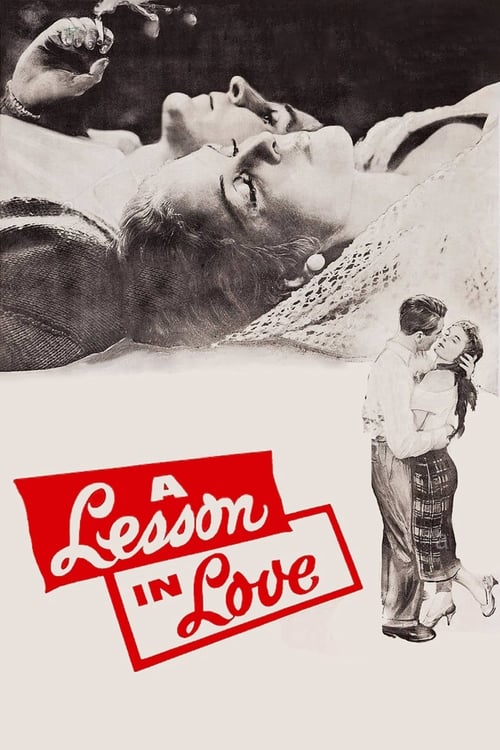
A Lesson in Love
1954 · Ingmar Bergman
For a cozy night in when you want grown-up romance — a witty, comfortable watch about whether two people who know each other's worst can fall back in love. Comfort viewing with a brain.
What it's about
A successful gynecologist and his wife have spent fifteen years being unfaithful to each other, and their marriage is all but over. Then a train journey to Copenhagen throws them back together, and the trip turns into a running battle of wits, grudges, and old memories — a couple flirting with divorce and, awkwardly, with each other. It's Bergman doing marital comedy: barbed on the surface, tender underneath.
The experience
Light, talky, and slyly funny, with a bittersweet undertow — the sparring is playful but the wounds are real. It moves briskly and leaves you smiling with a small ache attached.
Performances
Gunnar Björnstrand and Eva Dahlbeck spar beautifully as the married pair — she regal and quick, he wry and wrong-footed — a screen partnership with the timing of a great double act.
The craft
Bergman structures the film around the train journey, folding in flashbacks so the marriage's whole history unspools mid-argument, and writes dialogue that crackles like the best stage comedy. It's elegant, economical black-and-white filmmaking where the wit is in the construction.
Why it matters
One of the sophisticated marital comedies from Bergman's early 1950s run, it shows the lighter register of a director the world would soon know for much darker things — and it's a key to understanding his lifelong subject: marriage.
Snapshot
A Lesson in Love (Swedish: En lektion i kärlek) is a romantic comedy of remarriage in the continental tradition, directed by Ingmar Bergman and released by Svensk Filmindustri in the autumn of 1954. Set largely aboard a train bound for Copenhagen, the film follows gynecologist David Erneman and his wife Marianne as years of infidelity, boredom, and suppressed feeling are dragged into the open over the course of a single absurd journey. It belongs to a cluster of sophisticated marital comedies Bergman produced in the early 1950s — lighter in register than the work for which he would become internationally known, yet unmistakably shaped by his particular interest in the erotic dynamics of power, memory, and self-deception. The film stars Gunnar Björnstrand and Eva Dahlbeck, a pairing Bergman returned to repeatedly across this decade, and it is best understood as the immediate precursor to Smiles of a Summer Night (1955), the film that announced Bergman to European art-cinema audiences. Compared with that later triumph, A Lesson in Love remains underexamined — but it is no mere warm-up exercise. It is a genuinely funny, formally agile picture, and its candor about bourgeois marriage anticipates the harsher marital anatomy of Scenes from a Marriage (1973) by nearly two decades.
Industry & production
By 1954 Bergman was a prolific but not yet fully autonomous figure within Svensk Filmindustri (SF), the dominant Swedish production and distribution company. SF operated on a studio model that encouraged relatively fast, commercially oriented production alongside the occasional prestige project. Bergman had spent much of the early 1950s delivering a mix of popular entertainments and more personal work: Summer Interlude (1951), Waiting Women (1952), Summer with Monika (1953), and Sawdust and Tinsel (1953) all appeared within a compressed span, and the commercial comedies were partly a concession to SF's appetite for reliable returns. A Lesson in Love was written and directed by Bergman on a modest budget appropriate to its largely interior settings — train compartments, a Copenhagen hotel, a country house rendered in the controlled conditions of SF's Råsunda Studios in Solna. The film's relatively contained production design reflects both budgetary pragmatism and a deliberate stylistic choice: the studio-bound quality gives the farce a theatrical airiness, keeping attention on dialogue and performance rather than landscape. The screenplay was Bergman's own — he adapted no prior source — which was consistent with his increasing insistence on controlling the narrative material he directed.
Technology
A Lesson in Love was shot in 35mm black-and-white using standard professional equipment available within the SF infrastructure of the period. The aspect ratio is the Academy standard 1.37:1 prevalent in European studio production before the widespread adoption of widescreen formats. Sweden was somewhat slower than Hollywood to retrofit its studio pipelines for CinemaScope and its variants, so the squarish frame Bergman worked with here remained the norm for another year or two. The lighting setup draws on high-key conventions associated with classic Hollywood comedy — soft fill, controlled shadows — rather than the expressionist chiaroscuro Bergman deployed in more somber work. The train-set sequences required the familiar combination of back-projection, partial set construction, and practical prop rigging common across European studio productions of the era; no evidence in the public record suggests the production used any technically unusual approach. Sound was recorded and mixed using the mono optical-track method standard to the period.
Technique
Cinematography
The cinematographer for A Lesson in Love was Martin Bodin, one of several Swedish directors of photography Bergman worked with during his busy early-1950s output. (Gunnar Fischer, Bergman's primary visual collaborator for the decade's major works — Smiles of a Summer Night, The Seventh Seal, Wild Strawberries — was not involved here, a distinction worth noting when assessing the film's visual character.) Bodin's work on the film is competent and economical: the framing favors medium shots and close two-shots that emphasize the comic interplay between Björnstrand and Dahlbeck's faces, and there is little of the restless, probing camera that would come to characterize Bergman's mature style. The flashback sequences — rendering earlier chapters of the Ernemans' courtship — are distinguished from the present-tense narrative primarily through editing and performance register rather than through any marked shift in photographic treatment. Bodin keeps the light clean and the compositions legible, subordinating his own signature to the demands of an actor-driven comedy.
Editing
The editing is notable for its management of the film's temporal structure. A Lesson in Love interleaves its present-day train journey with embedded recollections of the couple's courtship and early marriage, and the cuts between these registers are handled with a fluency that avoids the laboriousness many flashback-heavy comedies of the period could not escape. The rhythm of the present-tense scenes tends toward the brisk — entrances and exits choreographed with a near-theatrical snappiness — while the memory sequences breathe a little more slowly, giving Dahlbeck and Björnstrand room to play a different, more tentative emotional key. The editor's role in the film's overall comic timing is significant, though detailed primary documentation on the editing process is not widely available in the English-language scholarship.
Mise-en-scène / staging
Bergman stages the bulk of A Lesson in Love in restrictive spaces — train compartments, corridor berths, the shared geography of a couple who cannot easily escape each other — and this spatial compression is the film's central dramaturgical device. The staging makes productive use of doorways and thresholds: characters enter, overhear, retreat, re-enter. Bergman's theater background is visible in his use of the single room as a pressure cooker, and the blocking frequently draws on vaudeville conventions of missed encounters and deliberate eavesdropping. The country house flashback sequences open the space somewhat, but the film returns always to enclosure as the condition of marriage — the witty implication being that the couple's inability to escape each other on the train is not a trap so much as a revelation of what they have always been: two people unable to leave.
Sound
The dialogue — swift, literate, occasionally barbed — is the film's primary sonic texture. Dag Wirén, a Swedish composer associated with neoclassical leanings, provided the score, which operates in a light orchestral register appropriate to high comedy: brisk string figures, the occasional ironic counterpoint beneath a sentimental scene. The music does not foreground itself; it functions as a tonal signal rather than an interpretive commentary. No ambient location recording was used — the film's soundscape is purely the studio-constructed world of the interiors — and this contributes to the slightly hermetic quality that distinguishes its fictional universe from the Swedish landscapes Bergman had recently filmed in Summer with Monika.
Performance
The performances are the film's crown. Gunnar Björnstrand plays Dr. David Erneman with the combination of worldly self-assurance and helpless susceptibility to his own emotions that made him Bergman's ideal vehicle for a certain kind of middle-class male vanity. His comedy is never mugging: Björnstrand plays intelligence with intelligence, letting the humor arrive from the gap between what David thinks he controls and what is visibly controlling him. Eva Dahlbeck, as Marianne, is if anything the more commanding presence — she plays a woman fully aware of the situation's absurdity and only intermittently willing to concede that she still cares. Dahlbeck's timing is formidable; she can modulate within a single line from cool irony to something rawer, and this mutability is exactly what the film requires. The supporting cast includes Harriet Andersson, then recently prominent from Summer with Monika, in a minor role that reinforces the sense of an SF ensemble operating with shared professional ease.
Narrative & dramatic mode
The narrative is built around the Hollywood comedy of remarriage as theorized most usefully by Stanley Cavell — a structure in which a separated or divorcing couple must undergo a process of re-education before earning the right to reunite. The couple's journey to Copenhagen functions as the space of this education: removed from the domestic routines that have calcified their relationship, David and Marianne are forced to encounter each other freshly, and the film's flashbacks serve not as nostalgic ornamentation but as counter-evidence that complicates both characters' self-justifying narratives. Bergman does not resolve the film through sentiment: the reconciliation that arrives is provisional, clear-eyed, and slightly rueful. The dramatic mode alternates between farce — misunderstandings, competing love interests, comic reversals — and a more wry, reflective tone that prevents the farce from becoming merely mechanical. Several scenes pivot quickly from laughter to an uncomfortable candor about desire and disappointment, and it is in these pivots that Bergman's individual sensibility leaves its clearest mark.
Genre & cycle
A Lesson in Love belongs to the sophisticated marital comedy, a genre with deep roots in the American screwball films of the 1930s and their European precursors. The nearest formal models are probably the work of Ernst Lubitsch — particularly The Marriage Circle (1924), Trouble in Paradise (1932), and the Lubitsch-influenced comedies of the early sound era — along with the Cukor and Hawks films that Bergman is known to have admired. The film also participates in a specifically Swedish cycle of postwar domestic comedies that SF was producing in the late 1940s and early 1950s, though Bergman's version is distinguishable from less personal SF product by its psychological sharpness. Within Bergman's own filmography, it forms a sequence with Waiting Women (1952), which uses a similar flashback-and-frame structure to examine marriage through multiple perspectives, and Smiles of a Summer Night (1955), which expands the marital comedy into a fully orchestrated ensemble piece. A Lesson in Love sits between these two, inheriting the structural experiment of the earlier film and anticipating the tonal mastery of the later one.
Authorship & method
Bergman is the film's sole author in the relevant senses: he wrote the original screenplay, directed all phases of production, and collaborated closely with his actors on the psychological nuance of individual scenes. His method in the early 1950s was already marked by long rehearsal periods and an unusual degree of trust placed in his principal performers — he repeatedly said that his scripts were proposals rather than blueprints, that the actors had to find the life in the scenes themselves, and this creative latitude is visible in the ease with which Björnstrand and Dahlbeck inhabit their characters. Bergman's theater work at Malmö City Theatre (where he was a resident director throughout much of the 1950s) directly inflected his film practice: the emphasis on ensemble, on blocking that reveals psychological relationship, and on the scene as a complete unit of dramatic action all reflect a theatrical intelligence adapting itself to cinema rather than suppressing it.
Martin Bodin's cinematographic contribution has been discussed above. Dag Wirén's score operates efficiently within its brief. The editorial structure — managing the film's temporal layering — was a collaborative achievement whose precise attribution is not fully documented in available scholarship.
Movement / national cinema
The film belongs to Swedish cinema's postwar modernization, a period in which Svensk Filmindustri was attempting to balance commercial viability with the emerging international prestige of directors like Bergman and Alf Sjöberg. Swedish cinema had been internationally prominent in the silent era — Victor Sjöström and Mauritz Stiller established its global reputation in the 1910s and 1920s — and the postwar years represented a partial recovery of that standing after a period of relative insularity. A Lesson in Love is not a particularly nationalistic film: its milieu is the educated, cosmopolitan Swedish bourgeoisie, its generic references are European and American, and its journey to Copenhagen gestures toward a broader Scandinavian geography. The film's relation to specifically Swedish cultural traditions is most visible in its attitude toward class — the gynecologist's professional standing is quietly but persistently important to the comedy's social texture — and in certain qualities of emotional restraint and self-deprecating wit that Bergman's Swedish critics recognized as distinctively local.
Era / period
The mid-1950s were a period of consolidation in European art cinema before the nouvelle vague ruptures of the late 1950s and early 1960s. The prestige of the Italian neorealists and the emergence of a self-conscious auteur culture were beginning to reshape the critical conversation, but the dominant commercial models — the literary adaptation, the star-driven studio comedy, the genre picture — still provided the basic industrial framework within which directors like Bergman worked. A Lesson in Love is in several respects a period-typical product: studio-shot, generically legible, built around recognized performers. What distinguishes it is the degree to which its director's sensibility reshapes those conventions from within rather than breaking from them — a characteristic strategy of the transitional moment before auteurism fully reorganized the relationship between commerce and art in European cinema.
Themes
The film's central preoccupation is the epistemology of love within long-term partnership: what is the difference between habit and genuine feeling, between the performance of affection and its substance? David Erneman believes himself to have outgrown his marriage — to have become, through professional success and the attractions of a younger woman, someone who has moved beyond the need for what Marianne represents. The film methodically dismantles this self-assessment. Through the flashbacks, the viewer watches David and Marianne in earlier configurations — tentative, genuinely surprised by each other — and the comedy of the present action consists in part of David's confrontation with the evidence that his self-knowledge is deeply unreliable.
A secondary theme concerns the different experiences of marriage for men and women in mid-century bourgeois Europe. Marianne is not, in the film's framing, simply a wronged wife awaiting rescue; she is an actor in the situation with her own infidelities, her own strategies, her own ambiguous investment in the marriage's continuation. Bergman gives both characters culpability and both characters dignity, and the film's refusal to moralize — its willingness to find the same comedy and the same pathos in both positions — is among its more quietly radical qualities.
Memory and its distortions also run through the film: the flashbacks are not objective reconstructions but colored by the consciousness recalling them, and the film leaves productively open the question of whose memory is operating and how faithfully. This interest in the unreliability of retrospection connects A Lesson in Love to a broader strand of Bergman's work — most obviously to Wild Strawberries (1957), where the retrospective structure is the film's entire architecture.
Reception, canon & influence
Influences on the film
The primary influence is the Lubitsch tradition of the European sophisticated comedy — its wit, its sexual frankness, its assumption that desire is both comic and serious. The remarriage comedies of classic Hollywood (particularly those involving Cary Grant, Irene Dunne, Katharine Hepburn, and Spencer Tracy) provided a structural template, and Bergman's admiration for American cinema of this period is well-documented. The theatrical tradition of Shaw and Strindberg — particularly the Strindbergian interest in marriage as combat — gives the film's more abrasive moments their edge. Bergman's own earlier work in marital comedy, specifically Waiting Women, established the formal approach he refines here.
Critical reception
A Lesson in Love was well-received by Swedish audiences and critics on its 1954 release, performing respectably as a commercial picture. International critical attention was minimal: Bergman had not yet achieved the overseas visibility that Smiles of a Summer Night and The Seventh Seal would bring, and a Swedish romantic comedy was not a natural object of attention for the emerging European art-cinema critical apparatus. In subsequent decades, the film was largely treated as a footnote to Smiles of a Summer Night in Bergman scholarship — useful for understanding how he developed his mastery of comic form but not itself requiring sustained analysis. This assessment has been partially revised by scholars interested in Bergman's relationship to genre, his working methods with Björnstrand and Dahlbeck, and the continuities between his comic and dramatic work. The film is now more commonly read as an early, accomplished instance of the marital investigation Bergman would pursue for the rest of his career.
Legacy and forward influence
The most direct legacy is Smiles of a Summer Night (1955), which essentially constitutes a second attempt at the same formal problem — how to make sophisticated European comedy that is also psychologically honest — with a larger ensemble, a grander structural design, and the benefit of what A Lesson in Love taught. That film's Cannes prize and international distribution carried the credit, but the earlier film was the laboratory. More diffusely, the Björnstrand-Dahlbeck double act — the wounded male professional and the formidably self-possessed woman — anticipates the couples Bergman would continue to explore in The Magician (1958) and beyond. The film's influence outside Sweden is difficult to trace with precision: it was not widely distributed internationally, and its impact on subsequent filmmakers was mediated primarily through Smiles of a Summer Night rather than through direct encounter. Within Bergman's own development, however, A Lesson in Love represents a genuinely important step — the moment at which the marital comedy became, for him, not a commercial concession but a viable form for the questions he most wanted to ask.
A Deleuzian reading
Two people sit in a train compartment bound for Copenhagen, and the whole joke is that they can't get out.
The full Deleuzian reading of A Lesson in Love →
Reception
A domestic hit in Sweden that gave Bergman a commercial breather after the box-office failure of Sawdust and Tinsel, it's now mostly remembered as the dress rehearsal for Smiles of a Summer Night — the film where his comic instincts clicked a year before the world noticed.
How A Lesson in Love was received, from release to now →
Influences: the films it descends from and the films it influenced
- Trouble in Paradise (1932) — Lubitsch's threshold-blocking technique — staging desire and transgression at doorways, using the cut to imply what cannot be shown — is the named formal ancestor of Bergman's spatial confinement and threshold blocking in the hotel-room and train-compartment scenes.
- The Awful Truth (1937) — McCarey's remarriage comedy template — couple separates over mutual suspicion, encounters comic third parties, reunites through admission of mutual need — provides the structural skeleton that Bergman's flashback intercutting fills with counter-evidence against the protagonist's self-serving account.
- His Girl Friday (1940) — Hawks's rapid overlapping dialogue as the sonic texture of remarriage comedy — where speed of wit equals erotic charge — directly informs Bergman's comic-rhythm editing in the Björnstrand/Dahlbeck verbal duels.
- Letter from an Unknown Woman (1948) — Ophüls's use of flashback as systematic counter-evidence against male obliviousness — the woman's letter reveals what Stefan never perceived about his own life — provides the structural model for Bergman's device of embedding flashbacks that undercut the doctor's self-justifying account of the marriage.
- Adam's Rib (1949) — Cukor's professional-couple staging (Tracy/Hepburn) — the husband's wounded professional pride deflated by the wife's superior composure in high-key studio lighting and medium two-shot — is the immediate American prototype for the Björnstrand/Dahlbeck dynamic and its primary unit of marital negotiation.
- La Ronde (1950) — Ophüls's theater-inflected staging of erotic comedy in a fully studio-bound world — medium two-shots of social performance between partners, high-key lighting, neoclassical score that frames sexual comedy with ironic distance — establishes the European register of sophisticated marital comedy Bergman works within.
- Miss Julie (1951) — Sjöberg's Swedish theatrical adaptation of Strindberg introduces marriage-as-psychological-combat blocking into Swedish cinema — confrontation scenes staged as power struggles played at close range in confined interiors — which Bergman absorbs and redirects into comedic register.
- Waiting Women (1952) — Bergman's direct formal precursor establishes the nested-flashback intercutting structure (wives narrate marriage stories in embedded flashbacks) and tests Björnstrand's comic register within a marital frame, both of which A Lesson in Love inherits and tightens.
- Smiles of a Summer Night (1955) — The direct formal descendant: Bergman applies the same Björnstrand/Dahlbeck pairing, threshold-blocking staging, and comic-rhythm editing within a larger ensemble structure, refining every technique A Lesson in Love developed — the Cannes prize carried the credit for what the earlier film had tested.
- Wild Strawberries (1957) — Inherits A Lesson in Love's flashback-as-counter-evidence device — a journey interrupted by flashbacks that systematically indict the protagonist's self-image — but strips away comedy so the identical formal structure performs psychological reckoning rather than marital wit.
- The Magician (1958) — Extends the Björnstrand archetype developed across the marital comedies — the professional male whose self-regard is methodically dismantled by a formidable antagonist in a confined setting — now through theatrical imposture rather than marital sparring, retaining the threshold-blocking and interior staging.
- Divorce Italian Style (1961) — Germi deploys voiceover-plus-flashback in which the male protagonist's self-serving narration is undercut by the comic gap between what he says and what we see — the same counter-evidence mechanism Bergman uses — within a European marital farce that uses spatial confinement as its primary comic pressure.
- Scenes from a Marriage (1973) — The terminus of the marital investigation A Lesson in Love initiates: the same formal interest in marriage as psychological warfare and sustained self-deception, now conducted in extreme close-up in real time rather than through comic flashback, discarding the medium two-shot's ironic distance for frontal confrontation.
- The Devil's Eye (1960) — First full deployment of the Bergman repertory ensemble as a comedy unit, establishing the blocking grammar of erotic negotiation and the dialectic between sexual performance and authentic feeling that The Devil's Eye inherits and sharpens.
- The Earrings of Madame de... (1953) — A contemporaneous European marital comedy using the same formal vocabulary — academy ratio, neoclassical score, medium two-shots of the couple's social performances in studio-bound interiors — both films using spatial confinement and theatrical staging to investigate the psychological cost of sustained marital performance.
Similar films
- Wild Strawberries (1957) — influence & lineage · same viewing thread
- Smiles of a Summer Night (1955) — influence & lineage
- Brief Encounter (1945) — same viewing thread
- Journey to Italy (1954) — same viewing thread
- Stromboli (1950) — same viewing thread
- Scenes from a Marriage (1974) — shared sensibility
- Dreams (2024) — shared sensibility
- Autumn Sonata (1978) — shared sensibility
All the films related to A Lesson in Love →
Watch it with: curated runs of related films
- Love, Memory, and the Long Journey — A run of love films where a journey — by car, by rail, or through memory — quietly lays bare what two people are, or were, to each other.