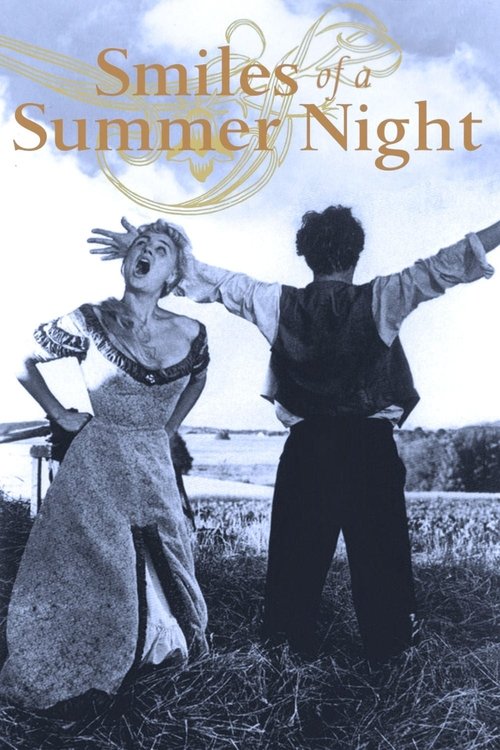
Smiles of a Summer Night
1955 · Ingmar Bergman
For a civilized, seductive evening — when you want romance with sharp dialogue and grown-up feelings, something sparkling rather than saccharine. A cozy classic that goes down like champagne.
What it's about
In turn-of-the-century Sweden, a middle-aged lawyer with a young wife he's never touched crosses paths again with his former lover, a celebrated actress — who arranges a weekend at a country estate where four mismatched couples are thrown together under the long, pale light of a summer night. Pride, desire, and carefully laid schemes do the rest.
The experience
Witty, elegant, and quietly wise — a romantic comedy where the laughs come with a melancholy aftertaste about vanity and the passage of time. It's playful on the surface and surprisingly tender underneath.
Performances
Eva Dahlbeck is magnificent as the actress who runs the whole game with amused, worldly command, playing beautifully off Gunnar Björnstrand's puffed-up, secretly vulnerable lawyer.
The craft
Bergman directs it like a piece of chamber theater set loose outdoors — luminous black-and-white summer light, epigrammatic dialogue where nearly every line cuts two ways, and a plot of swapped partners engineered with watchmaker precision. Its script is one of the most quotable in romantic comedy.
Why it matters
The international breakthrough that made Bergman's name, it proved a comedy could carry his depth and later inspired the Broadway musical A Little Night Music.
Snapshot
A comedy of romantic manners set in a luminous Swedish turn-of-the-century summer, Smiles of a Summer Night (Sommarnattens leende) follows four couples through a weekend country retreat at which every attachment is tested, re-sorted, and — for most — mercifully renewed. The middle-aged lawyer Fredrik Egerman pursues his former lover Desiree Armfeldt while his young, unconsummated wife Anne circles toward Fredrik's pious son Henrik; the soldier Count Malcolm jousts with his wife Charlotte over pride and possession; and the servants Frid and Petra claim their own vigorous happiness on the lawn. The film is Bergman at his most overtly theatrical and sociable, a work that subordinates his characteristic metaphysical anguish to the older comedy-of-desire tradition — while never entirely suppressing the undertow of sadness that even midsummer cannot banish.
Industry & production
By the mid-1950s Bergman had made more than a dozen films for Svensk Filmindustri (SF) but remained a director of irregular commercial returns. SF's production chief Carl-Anders Dymling had backed Bergman through early work ranging from the accessible (Summer with Monika, 1953) to the more challenging (Sawdust and Tinsel, 1953), but the studio needed a reliable earner. Smiles of a Summer Night was commissioned with that goal explicitly in mind: Bergman wrote the original screenplay quickly and was candid in later interviews about the commercial brief. The project was financed and produced entirely within the SF studio system, shot at Råsunda Studios outside Stockholm in the autumn and winter of 1954–55. Because the country-estate sequences required a convincing summer atmosphere, the production relied heavily on studio-constructed exteriors and careful lighting to simulate long Nordic summer evenings — an indoor achievement that lends the film its slightly artificial, theatrically stylized luminosity.
The film was released in Sweden in December 1955. Its selection for — and prize at — the 1956 Cannes Film Festival transformed Bergman's international profile overnight and made Smiles the pivot on which his global reputation turned. It was the first Bergman film to receive sustained attention from French critics, and its Cannes success cleared the path for The Seventh Seal and Wild Strawberries (both 1957) to be received as the work of an already-acclaimed artist rather than an unknown.
Technology
The film was shot in standard 35mm on black-and-white stock, as was normal for Swedish production of the period. No anamorphic or wide-gauge processes were used. The studio-based photography meant that lighting could be controlled to an unusually fine degree, allowing cinematographer Gunnar Fischer to craft a consistent high-key luminosity for the country-house sequences that reads, paradoxically, as outdoor summer brightness while being entirely artificial. Editing was accomplished by conventional optical means; there are no special-effects sequences. The sound design is clean and stagily precise — dialogue-forward, with music deployed as punctuation rather than underscore.
Technique
Cinematography
Gunnar Fischer, Bergman's principal director of photography throughout the 1950s, brings to Smiles a register noticeably different from the expressionist chiaroscuro he used in The Seventh Seal or the stark coastal naturalism of Summer with Monika. Here the palette is polished and even: broad, diffused sources that evoke the glow of pale northern summer without casting strong shadow. Fischer composes the interior scenes — the dining room, Desiree's dressing room, the Armfeldt drawing room — with a theatrical spatial logic, placing characters so that social hierarchy and erotic geometry are readable at a glance. The camera moves deliberately but sparingly; the film distrusts the fussy cutting of classical Hollywood comedy and prefers longer takes in which performance and staging carry the scene. The outdoor night sequences deploy a soft, slightly overexposed quality that sustains the film's governing metaphor of a night so brief, so suffused with light, that ordinary rules dissolve.
Editing
Oscar Rosander, who edited many of Bergman's films in this period, keeps the cutting unobtrusive and rhythmically subordinate to the ensemble structure. Scenes seldom end on a single dramatic beat; Rosander tends to linger a moment beyond the obvious cut, allowing comic or melancholy afterthoughts to register. The intercutting between simultaneous events at the Armfeldt estate — multiple couples in parallel crisis or consummation — is handled with light-touch precision, maintaining the farcical momentum without sacrificing psychological detail.
Mise-en-scène / staging
Bergman's theater career — he was already one of Sweden's most respected stage directors — is most legible here. The country house functions as a Shakespearean green world: a place bracketed off from ordinary time and social constraint where characters may test identities, make confessions, and be remade. Bergman stages the ensemble with notable spatial intelligence; the hierarchical distinction between the aristocratic dining table and the servants' haymow is maintained architecturally, but the film's sympathies circulate freely between them. Characters are regularly blocked in triangles that make visible the erotic competition the dialogue only obliquely names. The famous "strawberries-and-cream" breakfast between Desiree and Fredrik, conducted in Desiree's theatrical dressing room, is an exercise in intimate two-hander staging — furniture, props, and eyelines doing the work of confession that decorum forbids in words.
Sound
Erik Nordgren's score is chamber-scaled: strings, piano, occasional woodwind, with a period flavoring that evokes fin-de-siècle salon music without pastiche. The waltz that recurs across the film anchors the comic rhythm and signals the film's commitment to formal elegance as a mode of emotional deflection. Nordgren does not underscore emotion so much as ironize it — the music arrives slightly askance of the dramatic moment, giving the comedy its characteristic Bergman edge. Dialogue recording is clean and centered; the studio origin means that ambient sound is stylized rather than naturalistic.
Performance
The ensemble is distinguished by a tonal consensus unusual in comedy: every performer understands that this is a film about people performing for one another. Gunnar Björnstrand, one of Bergman's most trusted actors, plays Fredrik with a rueful elegance that keeps sentiment from curdling into self-pity. Eva Dahlbeck as Desiree is the film's intelligence-in-motion, a woman who has arranged the entire weekend and remains a step ahead of every other character while concealing her own considerable need; Dahlbeck's comic timing is precise without ever feeling mechanical. Jarl Kulle's Count Malcolm is braggadocio edged with genuine menace, a man who confuses virility with virtue and is lightly punished for the confusion. Harriet Andersson's Petra and Åke Fridell's Frid operate in a different key entirely — bodily, direct, liberated — and their frankness throws the aristocratic repression of the main plot into relief. Ulla Jacobsson's Anne is the film's most delicate performance, playing innocence without vacancy.
Narrative & dramatic mode
Smiles operates within the classical comic structure of displacement and return: characters are removed from their habitual settings, subjected to confusion and revelation, then restored to better-matched partnerships. Bergman draws explicitly on the machinery of theatrical farce — mistaken assumptions, overheard conversations, doors operated at inconvenient moments — but tempers it with a melancholy that is distinctly his own. The three smiles of the title are glossed within the film itself: the summer night smiles first for the young and innocent, then for the worldly and jesting, and finally for the sorrowful. This triptych framing insists that even in a comedy the costs of experience register, and that erotic happiness, when it arrives, arrives asymmetrically — at the expense of someone's dignity or illusion. The film is never cruel, but it is never wholly kind either.
Genre & cycle
The film belongs to a long tradition of aristocratic pastoral comedy that runs from Shakespeare's Arden-forest plays through Marivaux's comedies of emotional self-deception to the country-house entertainments of Oscar Wilde and the later drawing-room farce. Jean Renoir's La Règle du Jeu (1939) is the most immediate cinematic antecedent: both films use a weekend retreat to stage a social comedy in which class, desire, and performance intersect with a lightly tragic undersong. Whether Bergman had Renoir consciously in mind is not established in the biographical record, but the structural resonances are persistent enough to have been noted by critics since the film's first international release. Smiles also participates in the brief cycle of Bergman comedies — distinct from the bulk of his output — that includes Waiting Women (1952) and A Lesson in Love (1954); it represents the apex of that mode.
Authorship & method
Bergman wrote the original screenplay himself, a consistent practice throughout his career. The speed of composition — by his own account completed under commercial pressure in a concentrated burst — may account for the film's unusual fluency and structural tidiness compared to more labored scripts. His working method on set was collaborative: he relied heavily on Fischer's visual intelligence and on actors with whom he had established long-term working relationships. The ensemble repertory dynamic that characterizes Bergman's great period — returning to the same performers across multiple films, building a shared vocabulary of gesture and tone — is already fully developed here. Nordgren's score is characteristic of SF-period Bergman in its restrained classicism; the more expressionistic musical experiments would come later. As editor, Rosander brought a disciplined economy to the cutting that complemented Bergman's preference for extended takes.
Movement / national cinema
Smiles of a Summer Night is recognizably Swedish in its deployment of the summer-night mythology — the pale, barely-dark Nordic midsummer night as a zone of licensed transgression and emotional truth — but it is also the film through which Swedish cinema most directly entered the European art-cinema conversation. Swedish filmmaking in the 1950s was a mature studio industry centered on SF, with a tradition of literary adaptation and prestige drama stretching back to Victor Sjöström and Mauritz Stiller in the silent era. Bergman's work built on that tradition while pushing it toward a more personal, auteurist mode. Smiles was the catalyst: its Cannes prize established both Bergman and, by extension, Swedish cinema as serious participants in the postwar European art-film network then coalescing around festivals, cine-clubs, and specialist distribution.
Era / period
The film's turn-of-the-century setting — imprecisely located but legible as circa 1900 — places its romantic comedy in a social world defined by rigid propriety and visible class stratification, conventions that the narrative systematically dismantles. The historical distance is enabling: it allows Bergman to treat sexual desire with a frankness that would have been harder to sustain in a contemporary setting within the Swedish production context of 1955, while also casting an ironic backward glance at a social order whose brittleness is already visible. The film was made at the height of postwar European reconstruction, a moment when comedy of manners was returning to prominence across European cinemas — Renoir's late films, the British Ealing comedies, the Ophüls cycle — as a mode for processing social change through elegant formal containers.
Themes
Desire and its displacements organize the film: every character's avowed attachment turns out to be a substitute for a truer or more dangerous one. Fredrik claims to love his young wife but circles obsessively around Desiree; Henrik directs his ardor toward theology because the real object (Anne) is prohibited; Charlotte weaponizes the other women against Malcolm because direct confrontation with her husband is too threatening. The comedy arises from the distance between what characters say they want and what they demonstrably pursue. Bergman is also interested in performance as a survival strategy: Desiree, a professional actress, is the most honest character in the film precisely because she is most practiced in the arts of theatrical manipulation; her honesty is the honesty of someone who has no further illusions about the theater-nature of social life. The servant subplot is not decorative: Petra and Frid's uncomplicated eros functions as a rebuke to the aristocratic tangle above them, and the film offers their pastoral happiness without condescension, though also without naivety about its social preconditions.
The film is also, obliquely, about the passage of time and the comedy of aging: Fredrik is past the first bloom of desirability; Desiree has arranged this weekend partly because she recognizes that this particular kind of opportunity will not recur indefinitely. Beneath the comedy's lightness runs a current of autumnal awareness — the summer night smiles, but it is brief.
Reception, canon & influence
Critical reception. The film opened in Sweden to positive reviews; Swedish critics recognized it as commercially oriented Bergman but did not dismiss it for that. The decisive event was Cannes 1956, where Smiles of a Summer Night won the Special Jury Prize. French critics, particularly those associated with Cahiers du Cinéma, were enthusiastic — Bergman's formal control and the film's evident literary intelligence aligned with what Cahiers valued in auteur cinema — and their advocacy helped establish the film's European reputation rapidly. In retrospect, critics have sometimes ranked it below the existential masterworks of 1957–63, treating it as a prologue to the "serious" Bergman. A counter-tradition, represented by critics who value Bergman's range, regards Smiles as a complete achievement on its own terms — one of the century's great comedies of manners — rather than merely a gateway film.
Influences on the film (backward). The pastoral comedy tradition — Shakespeare's A Midsummer Night's Dream, As You Like It, and Twelfth Night — provides the structural template: a green world in which social constraint briefly lifts and desire finds its true objects. Marivaux's comedies of the heart, with their emphasis on characters who cannot speak desire directly, are a plausible literary influence given Bergman's theater background, though his direct engagement with Marivaux's texts is not thoroughly documented in the scholarly record. Renoir's La Règle du Jeu supplies the closest cinematic model: the country house, the interlocking triangles, the parallel servant plot, the undercurrent of violence that the comic frame barely contains. The Strindberg theatrical tradition — present in almost everything Bergman made — inflects the film's battle-of-the-sexes dynamics even as Bergman consciously lightens and reconciles what Strindberg would have left as wound.
Legacy and forward influence. The film's most direct and extensively documented descendant is Stephen Sondheim and Hugh Wheeler's musical A Little Night Music (1973), which adapts the screenplay's structure, characters, and central situation with Bergman's acknowledged permission. Sondheim has spoken of the film as the primary source; the musical's signature waltz-time scoring and its title song — itself about smiles of a summer night — are explicit homages. The 1977 Harold Prince film adaptation of the musical completes a recursive loop: Bergman's film adapted to stage, the stage work then re-filmed. Smiles also exerted influence on subsequent European comedy-of-manners filmmaking and is regularly cited by directors working in the tradition of ensemble romantic comedy as a model of tonal control — the management of comedy and melancholy as simultaneous rather than alternating registers. Within Bergman's own career, the film's success authorized the daring of The Seventh Seal and Wild Strawberries by demonstrating that he had commercial capital to spend; without the Cannes prize, the extraordinary risk-taking of 1957 might not have been institutionally possible. Its place in the canon is secure, if somewhat anomalous: the great exception in a body of work more often associated with existential darkness than with the civilized comedy of summer and desire.
A Deleuzian reading
The lawyer Fredrik Egerman arrives at the actress's apartment having fallen into a puddle, and Desiree Armfeldt wraps him in a dressing gown that plainly belongs to some other man.
The full Deleuzian reading of Smiles of a Summer Night →
Reception
Bergman made it at a personal and professional low point, and its surprise prize at Cannes 1956 (for 'poetic humor') turned him into an international name overnight. Today it's cherished as the great outlier in his filmography — proof the gloomiest of directors could make a perfect comedy.
How Smiles of a Summer Night was received, from release to now →
Influences: the films it descends from and the films it influenced
- La Règle du Jeu (1939) — Renoir's country-house ensemble organizes interlocking master-servant romantic triangles within a simultaneously comic and tragic tonal register — the direct structural and tonal template Bergman adapts for his aristocratic pastoral.
- La Ronde (1950) — Ophüls's carousel of rotating sexual triangles in European aristocratic society uses recurring waltz-motif scoring as both ironic underscoring and structural device, establishing the model for Bergman's own waltz-driven round of desire.
- Trouble in Paradise (1932) — Lubitsch's ironic musical underscoring of emotional reversals in aristocratic triangular plotting establishes the tonal contract — comedy and melancholy as simultaneous rather than alternating registers — that Bergman inherits and extends.
- Design for Living (1933) — Lubitsch's three-person romantic triangle, staged through triangular blocking across European bourgeois interiors and resolved by the trio's withdrawal from social convention, establishes the comic architecture Bergman adapts for his aristocratic summer retreat.
- A Midsummer Night's Dream (1935) — The filmed green-world space — forest as site of erotic rerouting away from social constraint — supplies the structural template for Bergman's country-estate displacement of desire and the Shakespearean parallel-pairing of master and servant plots.
- Les Enfants du Paradis (1945) — Carné's theatrical spatial composition — staging ensemble romantic triangles in a period setting with post-beat-linger cutting that holds on the actor's face after the line — gives Bergman a cinematic language for the theater-derived blocking he brings from the stage.
- A Lesson in Love (1954) — The direct formal descendant: Bergman applies the same Björnstrand/Dahlbeck pairing, threshold-blocking staging, and comic-rhythm editing within a larger ensemble structure, refining every technique A Lesson in Love developed — the Cannes prize carried the credit for what the earlier film had tested.
- A Little Night Music (1977) — The film directly adapts Bergman's screenplay, with Sondheim's waltz-time scoring as explicit homage to the recurring waltz motif; the triptych structure, triangular blocking, and parallel servant subplot are preserved verbatim from Bergman's original.
- A Midsummer Night's Sex Comedy (1982) — Allen transplants Bergman's country-house triangular blocking and desire-as-displacement structure to upstate New York, using the Shakespearean green-world premise and post-beat-linger cutting in ensemble dialogue scenes as an explicit formal homage.
- Fanny and Alexander (1982) — Bergman returns to the high-key studio luminosity and theatrical ensemble staging first achieved in Smiles, deploying the triptych-like structure and the same repertory company across a period family chronicle on a six-hour canvas.
- Much Ado About Nothing (1993) — Branagh realizes Shakespeare's green-world comedy through high-key summer luminosity and theatrical triangular blocking in a Tuscan country-house pastoral, translating into English-language film the same Shakespearean stagecraft Bergman had adopted from theater to screen.
- Hannah and Her Sisters (1986) — Allen adopts Bergman's triptych narrative structure — three movements across seasons — with parallel interlocking romantic triangles among a bourgeois ensemble, using ironic musical underscoring to hold comedy and melancholy in simultaneous suspension.
- Gosford Park (2001) — Altman extends Bergman's parallel master-servant ensemble plotting in a country house, using overlapping sound design to track multiple simultaneous romantic triangles across the upstairs-downstairs class divide.
- The Devil's Eye (1960) — Bergman's own immediate template: Gunnar Fischer's high-contrast studio lighting, the full repertory ensemble in comic mode, and the comedic inversion structure — desire frustrated by moral circumstance — that The Devil's Eye extends into supernatural allegory.
- The Earrings of Madame de... (1953) — Ophüls and Bergman contemporaneously use the recurring waltz motif as ironic underscoring of triangular romantic obsession in European aristocratic period settings, treating the dance as structural destiny rather than mere accompaniment.
- Wild Strawberries (1957) — Made immediately after Smiles with the same repertory ensemble, Wild Strawberries redirects the displacement-and-return structure toward existential retrospection, using the journey away from social context as the mechanism for desire's resolution.
- Claire's Knee (1970) — Rohmer inherits Bergman's theatrical spatial composition and post-beat-linger cutting in pastoral summer ensemble scenes, staging desire-as-displacement among an aristocratic-adjacent lakeside group through long-take dialogue choreography.
Similar films
- Wild Strawberries (1957) — influence & lineage · often watched together
- Trouble in Paradise (1932) — influence & lineage · often watched together
- The Rules of the Game (1939) — influence & lineage
- Summer with Monika (1953) — often watched together
- Gertrud (1964) — often watched together
- The Swimming Pool (1969) — often watched together
- The Swimmer (1968) — often watched together
- A Lesson in Love (1954) — shared sensibility