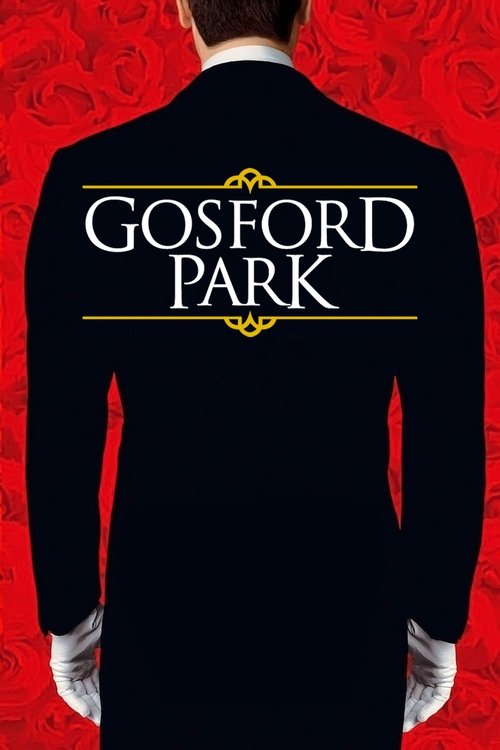
Gosford Park
2001 · Robert Altman
For a rainy Sunday when you want a smart, sumptuous ensemble piece — a murder-mystery evening that's really about people-watching. Comfort viewing with claws.
What it's about
In 1932, aristocrats and their hangers-on gather at an English country estate for a weekend shooting party, attended by the small army of servants who keep their world running. When the host is murdered, the whodunit turns out to be the least of it: the film's real subject is the intertwined lives above and below stairs — the affairs, debts, resentments, and secrets flowing between masters and the people who dress them.
The experience
Busy, gossipy, and richly pleasurable — dozens of characters, overlapping conversations, and a camera that drifts through rooms like an eavesdropping guest. It asks a little attention up front and repays it doubly; the sharpness of the class observation sneaks up under the period-drama comfort.
Performances
One of the deepest British ensembles ever put on screen, with Maggie Smith's imperious, penny-pinching countess dropping withering one-liners, and Helen Mirren quietly devastating as the housekeeper whose stillness hides the film's heart.
The craft
Robert Altman's signature method — roving cameras, overlapping sound, no one officially the lead — applied to Julian Fellowes's intricately researched, Oscar-winning script, so every scene carries three conversations and five agendas at once. It's a film you can rewatch and keep finding new exchanges in the background.
Why it matters
A late-career triumph for Altman that proved his ensemble style could conquer the English period drama — and its upstairs/downstairs world directly seeded a wave of servant-and-master storytelling on television.
Snapshot
Gosford Park is Robert Altman's late-career masterwork: an ensemble murder mystery set at a 1932 English country-house shooting party that uses the conventions of the Agatha Christie whodunit as a Trojan horse for a dissection of class. Across a single weekend, a host of aristocrats and their hangers-on gather at the estate of the industrialist Sir William McCordle, while the servants who sustain them labor in the floors below. When Sir William is murdered, the film treats the crime almost as an afterthought—the investigation is bungling and beside the point—because Altman's real subject is the rigid, intimate, mutually dependent ecology of "upstairs" and "downstairs." Written by Julian Fellowes from a concept by Altman and Bob Balaban, photographed by Andrew Dunn, and acted by one of the deepest British ensembles ever assembled, the film won the Academy Award for Best Original Screenplay and stands as both a summation of Altman's ensemble method and the direct creative seedbed for Downton Abbey.
Industry & production
Gosford Park was an Anglo-American co-production assembled in the independent financing model of its era, with backing routed through USA Films, Capitol Films, and the UK Film Council, among others; Altman, Balaban, and David Levy produced. The project's origin is well documented: Balaban approached Altman about collaborating, and the two developed the premise of an Agatha Christie–style country-house mystery told from the servants' vantage. Altman, an American with limited firsthand knowledge of the minutiae of English domestic service, recruited Julian Fellowes—an actor and writer steeped in that world—to write the screenplay and serve as on-set authority on protocol.
Production took place largely in England, with the principal house interiors and exteriors centered on Wrotham Park in Hertfordshire and additional work at Shepperton Studios, where the below-stairs kitchen and service spaces were built or dressed to allow Altman's roving cameras free movement. The budget was modest by studio standards—this was an independently financed picture, not a blockbuster—and Altman, by his own account and that of collaborators, assembled the extraordinary cast partly on the strength of his reputation and the appeal of the material rather than on lavish fees. The film proved a strong commercial performer relative to its cost and a major awards contender, marking a genuine resurgence for a director whose preceding decade had been uneven. (I avoid citing precise budget or gross figures here, as the publicly repeated numbers vary in reliability.)
Technology
Technologically, the film is notable less for novelty than for the disciplined deployment of Altman's long-refined production techniques. Central is his use of independent radio microphones on actors throughout the ensemble, allowing simultaneous capture of overlapping conversations across a crowded frame and giving the sound designers a rich multitrack field to balance in post. Altman characteristically shot with multiple cameras running at once—frequently two—often on Steadicam or fluid dollies, with extensive use of the slow zoom that had been his signature since the 1970s. Shot on 35mm film (the standard for prestige features of 2001, before digital acquisition became routine), the picture relies on conventional photochemical tools; its innovation is methodological rather than mechanical—the orchestration of bodies, microphones, and a wandering lens within densely populated, practically lit period spaces.
Technique
Cinematography
Andrew Dunn's cinematography is built around movement and selective attention. The camera rarely sits still; it drifts, glides, and zooms, picking faces out of crowded rooms and corridors, eavesdropping rather than presenting. This roving observational style refuses to privilege a single protagonist among the masters, instead treating the house as a single organism. Dunn lights the upstairs world in burnished, candlelit, autumnal tones appropriate to a 1932 November shoot, while the downstairs domain is busier, harder, more functional in its illumination. The mobile camera also enacts the film's class argument formally: it follows servants through doors that the aristocrats never see, threading the geography of the house so that the viewer learns the building the way the staff do—by its passages and back stairs.
Editing
Tim Squyres edited the film, and the cut is among its quietest achievements. With dozens of speaking characters and overlapping dialogue tracks, the editing must continually decide where the audience's attention lands—often layering conversations so that a foregrounded exchange is undercut or commented upon by a half-heard remark behind it. The rhythm is unhurried but never slack, accumulating character and social information in fragments. The murder, when it comes, is handled with deliberate anticlimax; Squyres and Altman decline the genre's usual tightening of suspense, keeping the assembly of clues diffuse and the resolution muted.
Mise-en-scène / staging
The mise-en-scène is the film's intellectual core. Stephen Altman's production design and Jenny Beavan's costumes render the two worlds as distinct social strata stacked vertically within one structure. Staging is choreographic: large groups move through dinners, drawing rooms, kitchens, and servants' halls in continuous, overlapping action, and the blocking constantly reminds us of hierarchy—who enters first, who waits, who is invisible. A celebrated piece of detail, drawn from Fellowes's knowledge and dramatized in dialogue, is that the visiting servants are addressed below stairs by their employers' surnames, their own identities subsumed into those they serve. The doubling of upstairs and downstairs—each with its own rivalries, romances, and snobberies—is sustained throughout the staging.
Sound
Sound is inseparable from Altman's whole conception. The multitrack capture yields a dense, naturalistic murmur in which conversations collide and overlap, demanding active listening and rewarding repeat viewing. Crucially, the film's music is largely diegetic: Jeremy Northam, playing the real composer-actor-singer Ivor Novello (a guest at the party), performs Novello's own songs at the piano, and the strains drift down through the house, where the servants pause to listen—a quietly devastating image of culture flowing one way across the class line. Patrick Doyle's score frames and extends this material rather than overpowering it.
Performance
The performances operate as a true ensemble, with no single lead dominating, though Kelly Macdonald's lady's maid Mary functions as the audience's point of entry into the downstairs world. The cast is a who's-who of British acting—Maggie Smith, Michael Gambon, Helen Mirren, Eileen Atkins, Kristin Scott Thomas, Emily Watson, Clive Owen, Derek Jacobi, Alan Bates, Charles Dance, Richard E. Grant, Tom Hollander, Stephen Fry, Geraldine Somerville, Jeremy Northam—with Balaban and Ryan Phillippe as the American interlopers. Altman's direction encourages overlapping, throwaway, lived-in delivery; the acting honors rank as performance, the servants masking feeling behind deference, the gentry performing leisure over anxiety. Mirren and Smith earned Supporting Actress nominations, and Mirren's final-act revelation as the housekeeper Mrs. Wilson is the emotional hinge on which the mystery's true meaning turns.
Narrative & dramatic mode
The dramatic mode is choral rather than linear. Gosford Park deliberately withholds a conventional protagonist and replaces the propulsive engine of the detective story with a panoramic, simultaneous account of a community over a few days. Information is distributed, partial, and overheard; the audience assembles social meaning the way an attentive servant might. When the murder finally drives a plot, the investigating Inspector Thompson (Stephen Fry) is comically incompetent, repeatedly missing evidence in plain sight—an inversion of the genre's reverence for the brilliant sleuth. The true solution is uncovered not through ratiocination but through the buried histories of the downstairs staff, and it is delivered quietly, as private grief rather than public unmasking. The effect is a whodunit whose answer is finally about who was wronged, and by whom, long before the weekend began.
Genre & cycle
The film stands at the intersection of several traditions. It is, on its surface, a country-house murder mystery in the Agatha Christie mold, complete with a closed circle of suspects and a body in the study. But it belongs equally to the British "upstairs/downstairs" tradition—the social tableau of master and servant that runs through Upstairs, Downstairs on television and Isabel Colegate's novel The Shooting Party (and its 1985 film adaptation), to which Gosford Park is clearly kin in setting and theme. It is also, unmistakably, an Altman ensemble film, sharing DNA with Nashville and Short Cuts in its mosaic structure. The picture's most important single ancestor, repeatedly cited by Altman himself, is Jean Renoir's La Règle du jeu (1939), another country-house gathering in which the affairs of masters and servants mirror and entangle one another and a death punctures the social comedy.
Authorship & method
Gosford Park is a film of dual authorship in an unusually productive sense. Altman supplied the method—the ensemble, the overlapping sound, the roving camera, the refusal of conventional suspense, the anthropological eye for a self-contained society—while Fellowes supplied the texture and the social grammar of a vanished English world Altman could not have written himself. Fellowes won the Academy Award for Best Original Screenplay for it, his breakthrough. Among the key collaborators: cinematographer Andrew Dunn shaped the observational visual language; editor Tim Squyres managed the immense problem of attention across the ensemble; composer Patrick Doyle scored the film around the diegetic Novello songs; production designer Stephen Altman (the director's son) and costume designer Jenny Beavan built the two-tiered material world. Bob Balaban deserves notice not only as co-conceiver and producer but as on-screen embodiment of the film's sly self-awareness, playing a Hollywood producer researching a Charlie Chan mystery—a film-within-the-film that lets Gosford Park wink at the very genre it is dismantling.
Movement / national cinema
The film sits athwart national categories. Directed by an American auteur working at the end of a long career associated with the New Hollywood, it is nonetheless saturated in Englishness—its cast, crew, locations, language, and social material are British, and it reads as a contribution to British heritage cinema even as it complicates that genre's nostalgia. It can be understood as an outsider's heritage film: Altman uses the lush surfaces beloved of the Merchant-Ivory tradition while turning the camera's sympathies decisively downward, toward the labor that makes the spectacle possible. In this sense it both belongs to and critiques the British costume drama, an American sensibility refracted through English material.
Era / period
Set in November 1932, the film is precisely located in the interwar twilight of the British aristocracy—after the trauma of the First World War, amid economic strain, and before the Second World War would finish the dismantling of the old order and the country-house system of domestic service. The period is not mere backdrop: the gentry's anxieties about money, marriage, and maintaining appearances, and the servants' dwindling but still rigid world of place and deference, are products of this specific moment. Made in 2001, the film looks back across seventy years with full knowledge of how the story ends—the great houses sold or surrendered, the servant class dispersed—lending its comedy an elegiac undertone.
Themes
The governing theme is class as a total system—not merely inequality but interdependence, intimacy, and mutual surveillance. The film insists that masters are made by servants, that the two worlds are bound in a single household economy, and that the social order is sustained by performance on both sides. Adjacent themes proliferate: the invisibility of labor (servants are present at every private moment yet unseen); identity erased by service (servants called by their masters' names); the hollowness behind aristocratic prestige (debt, snobbery, sexual exploitation); and buried personal history surfacing as crime. Sexual predation across the class line—the droit du seigneur of an employer toward the women in his service—is revealed to be the true engine of the plot, making the murder an act of long-delayed reckoning rather than mere mystery-plot mechanics.
Reception, canon & influence
Critically, Gosford Park was widely acclaimed and hailed as a major return to form for Altman, praised for its screenplay, its ensemble, and its formal control. It was a substantial awards presence: nominated for multiple Academy Awards including Best Picture and Best Director, with Supporting Actress nominations for Helen Mirren and Maggie Smith, and a win for Julian Fellowes's screenplay. It contributed to the late-career re-evaluation that culminated in Altman's honorary Academy Award in 2006, the year of his death.
Its influences run backward to Renoir's La Règle du jeu, to Agatha Christie and the golden-age detective novel, to the Upstairs, Downstairs television tradition and the shooting-party milieu of Colegate, and to Altman's own Nashville and Short Cuts. Its forward legacy is unusually concrete: Julian Fellowes drew directly on the world, research, and upstairs/downstairs architecture of Gosford Park to create Downton Abbey (2010– ), the global television phenomenon that brought the country-house ensemble to a mass audience and inaugurated a wider revival of period domestic drama. Gosford Park thus occupies a pivotal place: simultaneously a culmination of Altman's lifelong experiment in ensemble cinema and the proximate origin of one of the most influential television franchises of the twenty-first century. It endures as the rare murder mystery whose lasting power lies not in its solution but in its anatomy of a society—observed, as Altman insisted it must be, from the servants' stairs looking up.
A Deleuzian reading
Listen first.
The full Deleuzian reading of Gosford Park →
Reception
A prestige hit on arrival — seven Oscar nominations and Altman's late-career victory lap — it's since been rediscovered by a whole new audience as the secret origin of Downton Abbey and the sophisticated grandparent of the Knives Out-era whodunit revival.
How Gosford Park was received, from release to now →
Influences: the films it descends from and the films it influenced
- La Règle du jeu (1939) — Renoir's deep-focus staging of a country-house weekend in which servants' and masters' plots run in parallel through the same rooms is the direct template for Altman's upstairs/downstairs architecture and his refusal to subordinate the ensemble to a single protagonist.
- Nashville (1975) — Altman's own multi-track radio-mic recording and 24-character mosaic established the overlapping-dialogue ensemble grammar — letting voices collide and bury exposition — that Gosford Park transplants into a single house.
- Short Cuts (1993) — Its interweaving of two dozen lives via roving camera and choral cross-cutting perfected Altman's attention-layering editing, where the cut chooses which simultaneous conversation we eavesdrop on.
- McCabe & Mrs. Miller (1971) — The pioneering use of multiple radio microphones and a constantly drifting, slow-zooming camera that finds its subject within a busy frame is the cinematographic method Andrew Dunn extends in Gosford Park's observational long takes.
- The Shooting Party (1985) — Its Edwardian shooting-party milieu and elegiac portrait of an aristocracy on the eve of collapse supplied the exact interwar-twilight social setting and field-sport set-piece that Gosford Park reconstructs.
- The Rules of the Game tradition of Gosford's source — Upstairs, Downstairs (1971) — The TV serial's split-household structure — every scene above stairs answered by its mirror below — is the dramaturgical scaffold Fellowes imports, organizing the cast by service hierarchy rather than by plot function.
- Murder on the Orient Express (1974) — The golden-age closed-circle whodunit with a starry ensemble of suspects is the genre frame Gosford Park inhabits in order to dismantle it, deliberately making the solution anticlimactic and beside the point.
- Grand Hotel (1932) — The 'all-star cast confined to one building, lives intersecting in lobby and corridor' portmanteau structure prefigures Gosford Park's single-location ensemble traffic of overheard, overlapping encounters.
- The Servant (1963) — Its forensic anatomy of master–servant power and the class system as an architecture of rooms and stairs shares Gosford Park's theme of class-as-system and the gaze trained on invisible labor.
- Remains of the Day (1993) — Ivory centers the below-stairs perspective — the butler's discretion and self-effacement as the film's moral lens — paralleling Altman's insistence that the house be observed from the servants' stairs looking up.
- The Discreet Charm of the Bourgeoisie (1972) — Buñuel's satirical dissection of a leisured class at table, where the social ritual matters more than any resolved event, shares Gosford Park's anticlimactic structure and its mockery of the milieu it depicts.
- Sense and Sensibility (1995) — Altman's multi-figure social choreography in British country-house settings extends Lee's threshold-framing into a fully orchestrated system: characters move through spaces whose architectural hierarchies are as psychologically loaded as Lee's doorways, with overlapping sound tracks now doing the work Lee's editing performs.
- Downton Abbey (2010) — Fellowes lifted Gosford Park's research, upstairs/downstairs floor plan and service-hierarchy ensemble wholesale, converting the film's anatomy of the country house into a serial format for a mass audience.
- Magnolia (1999) — P.T. Anderson explicitly built on Altman's choral mode — interlocking lives, restless camera, scored ensemble — inheriting the attention-layering and refusal of a single protagonist directly from Nashville and Short Cuts.
- Knives Out (2019) — Johnson's wealthy-family whodunit deliberately routes the mystery through the immigrant servant's point of view and treats class-as-system as the real subject, a structural debt Johnson has credited to Gosford Park.
- Triangle of Sadness (2022) — The behavioral-observation ensemble method: staging characters in overlapping action across multiple spatial registers so that class hierarchy emerges from blocking and eyeline rather than expository dialogue.
- Parasite (2019) — Altman maps social hierarchy onto a country house's upstairs/downstairs architecture — servants' below-stairs kitchen versus family's above-stairs reception rooms — with characters' physical position encoding their social rank without exposition, the spatial logic Bong reconfigures into the sub-basement/ground floor/garden tiers.
- The Menu (2022) — Altman's grammar of simultaneous action across class-stratified vertical space — above (dining room) and below (kitchen) stairs counterpointed within a single location, with social status tracked through spatial positioning — is the architectural model for The Menu's kitchen/dining room as separate power zones under continuous intercutting.
- Glass Onion: A Knives Out Mystery (2022) — Altman deploys the country-house murder mystery as a vehicle for class-stratified ensemble comedy, where overlapping dialogue and split-screen social geography expose hierarchy through group staging rather than individual close-up — the direct structural model Johnson adapts for the tech-billionaire island gathering.
- Murder on the Orient Express (2017) — A period country-house closed-circle murder whose vast star ensemble is choreographed through overlapping group staging — the upstairs-downstairs whodunit blocking Branagh echoes.
- Saltburn (2023) — Treats the English country house as a stratified upstairs/downstairs ecosystem, using production design and ensemble blocking as the primary instrument of class anatomy.
- The Second Mother (2015) — Cross-cuts upstairs and downstairs to stage class through the rules of who may enter which room, the ensemble threshold-blocking Muylaert compresses into a single house.
- Wake Up Dead Man: A Knives Out Mystery (2025) — The anglophile country-house ensemble whose deep-staged, layered blocking lets several suspects perform simultaneously within one frame — a direct model for Johnson and Yedlin's deep staging.
- The Butler (2013) — Shot by Andrew Dunn, The Butler's DP: Altman's upstairs/downstairs cutting and his habit of holding servants in a racked-soft background plane while principals talk in front of them is the identical framing logic Dunn carries into the White House sequences.
- Gloria / A Wedding (1978) — A Wedding gathers 48 characters in one house for a single event, the most literal rehearsal of Gosford Park's method: a self-contained society observed anthropologically across a compressed gathering.
- The Royal Tenenbaums (2001) — Anderson's single-house ensemble, choral narration and dollhouse staging extend the Altmanesque mode of a family-society mapped room by room with the camera as anthropologist.
- Babette's Feast (1987) — Its rapt attention to kitchen labor and the dignity of service — the meal assembled below as the event unfolds above — mirrors Gosford Park's foregrounding of invisible labor as the film's true craft subject.
- A Room with a View (1985) — The Merchant-Ivory period-drama vocabulary — Jenny Beavan's costuming and meticulous Edwardian material world — is the heritage-film craft Gosford Park both draws on and complicates with Altman's restless ensemble eye.
- Howards End (1992) — Extends the country-house ensemble and upstairs/downstairs class anatomy, but inverts Howards End's classical unhurried editing with overlapping sound and roving camera to foreground the servants the heritage frame keeps marginal.
- Monsoon Wedding (2001) — A same-year Altman ensemble that cross-cuts a large house-party across class strata, sharing the technique of layering upstairs and downstairs (family and servants) as simultaneous parallel narratives.
- Maurice (1987) — Choreographs a cross-class ensemble through the upstairs/downstairs geography of the English country house — the servant-and-master threshold staging Maurice's Penge and gamekeeper scenes prefigure.
Similar films
- Nashville (1975) — influence & lineage · often watched together
- The Rules of the Game (1939) — influence & lineage
- The Royal Tenenbaums (2001) — influence & lineage
- The Servant (1963) — influence & lineage
- Murder on the Orient Express (1974) — influence & lineage
- Saltburn (2023) — shared sensibility
- The Little Foxes (1941) — shared sensibility
- The Remains of the Day (1993) — shared sensibility
All the films related to Gosford Park →