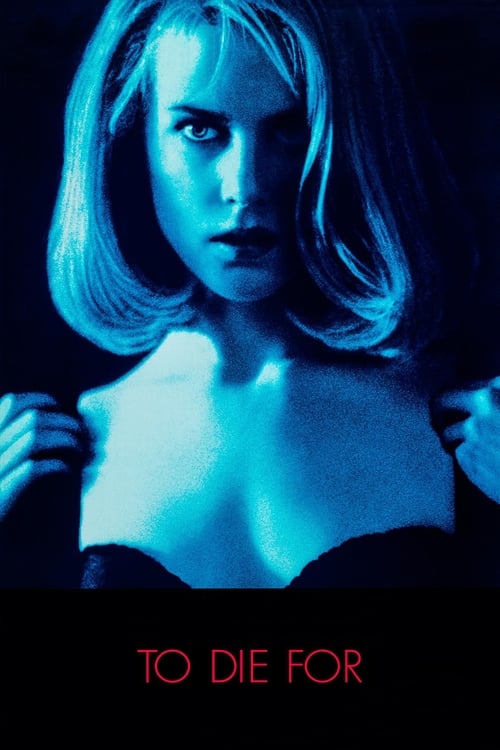
To Die For
1995 · Gus Van Sant
For when you want something sharp and dark rather than cozy — a film to watch with someone you'll want to talk to afterward about fame, television, and people who believe their own press.
What it's about
Suzanne Stone is a small-town New Hampshire weather girl who has decided, with the serene certainty of a true believer, that she is destined for network television — and that nothing, including her sweet, unambitious husband, will be allowed to slow her down. Her plan draws in three aimless local teenagers, and the story of what happens unspools through talking-head interviews, home video, and tabloid TV footage, as everyone involved tells their version to the cameras.
The experience
Wickedly funny and increasingly chilling — a satire that keeps you laughing right up until you realize what you're laughing at. The mock-documentary style makes you complicit: everyone's performing for you, and Suzanne most of all.
Performances
Nicole Kidman, in the role that redefined her career: her Suzanne is a monster of pure sunny ambition, funny and terrifying in the same breath, delivered straight to camera without a flicker of self-doubt. A young Joaquin Phoenix is quietly devastating as the teenager pulled into her orbit.
The craft
Buck Henry's script (from Joyce Maynard's novel, loosely inspired by a real New Hampshire case) is built entirely of testimony — interviews, courtroom footage, home video — so the film becomes a satire of the very media frenzy it depicts. Gus Van Sant directs the tabloid textures with deadpan precision, letting the format do the moral arguing.
Why it matters
It anticipated the true-crime and reality-TV obsession by decades, marked Van Sant's sharpest turn toward the mainstream, and remains the performance people cite when they talk about Kidman's fearlessness.
Snapshot
To Die For is the film in which Gus Van Sant, a director then known for the drifting, elegiac queer Americana of Mala Noche, Drugstore Cowboy, and My Own Private Idaho, made his sharpest turn toward mainstream satire — and, in doing so, delivered the performance that redefined Nicole Kidman's career. Adapted by Buck Henry from Joyce Maynard's 1992 novel, itself loosely inspired by the 1990 Pamela Smart case in New Hampshire, the film follows Suzanne Stone Maretto, a small-town weather girl of implacable ambition who recruits three local teenagers to murder her husband so that nothing will impede her rise to network television.
Its formal signature is the mock-documentary frame: the story arrives almost entirely through testimony — talking-head interviews, home video, tabloid television footage, courtroom material — so that the film is less a narrative about a murder than an anatomy of how a murder becomes content. The satire's target is not simply an ambitious woman but a media ecology in which visibility is the only recognized form of existence, and in which everyone, including the bereaved, eventually finds a camera to speak into. Released in the fall of 1995 by Columbia Pictures, it was warmly received by critics and won Kidman the Golden Globe for Best Actress in a Musical or Comedy. In retrospect it sits at a hinge point: the last major American satire made just before the internet made its premise universal, and the film that established Kidman as an actor of genuine and unsettling precision.
Industry & production
To Die For is a product of the mid-1990s American studio system's brief, generous appetite for director-driven work with independent pedigree. Van Sant had come out of the Portland independent scene and had been absorbed into studio filmmaking with Even Cowgirls Get the Blues (1993), a Fine Line release adapted from Tom Robbins that was widely regarded as a failure and that damaged his commercial standing. To Die For, produced for Columbia Pictures, functioned as a recovery — a tightly constructed, star-driven picture with a recognizable comic register.
The screenplay was by Buck Henry, whose credentials as a satirist of American appetite ran back to The Graduate (1967, co-written with Calder Willingham) and included Catch-22 (1970), The Owl and the Pussycat (1970), and Heaven Can Wait (1978, co-directed with Warren Beatty). Henry's involvement is the film's decisive authorial fact after Van Sant's: the mordant, deadpan control of the dialogue, and the willingness to let a character indict herself in her own words, are recognizably his. Henry also appears onscreen in a small role, a habit of his going back to his cameo in The Graduate.
The casting of Kidman is the production's most consequential decision. She was known at that point chiefly through Dead Calm (1989) and through studio films opposite Tom Cruise — Days of Thunder (1990), Far and Away (1992) — and had not yet been given a role that used her intelligence rather than her poise. The supporting ensemble is unusually strong for a comedy of this scale: Matt Dillon, who had starred in Van Sant's Drugstore Cowboy, as the doomed husband Larry; Joaquin Phoenix (billed at the time under his given name in some materials, having previously worked as "Leaf Phoenix") as Jimmy, the teenager Suzanne seduces into killing; Casey Affleck and Alison Folland as his accomplices; Illeana Douglas as Larry's sister; and Dan Hedaya as his father. Phoenix's performance here is generally treated as the beginning of his adult career.
The film premiered at the Cannes Film Festival in 1995 — in competition — before its autumn American release. It was a moderate commercial performer rather than a hit; specific box-office figures are reported inconsistently across sources and are not worth asserting here with false precision. Its real industrial consequence was reputational: it restored Van Sant's standing sufficiently that he was entrusted with Good Will Hunting two years later, and it moved Kidman from the category of star's spouse to that of serious actor.
Technology
To Die For was shot on 35mm in a period when that was simply the default, but the film's technical interest lies in its deliberate mixing of image formats. Its faux-documentary architecture requires the film to reproduce, within a 35mm feature, the look of consumer camcorder video, broadcast news video, and tabloid-TV segments. The result is a picture that constantly shifts textures: the polished anamorphic-scale gloss of the dramatic scenes against the smeared, low-resolution, interlaced quality of video inserts.
This was a technically ordinary but culturally loaded choice in 1995. The camcorder had become domestically ubiquitous during the 1980s, and by the early 1990s home video had entered the public sphere as evidence and as spectacle — the Rodney King tape in 1991, the proliferation of tabloid newsmagazines, the rise of America's Funniest Home Videos and the reality-programming boom. A film about a woman who believes reality only counts when televised was necessarily a film about video as a technology of self-presentation. The video-within-film device carries the argument: Suzanne's home tapes and her cable-access segments are not documents of her life but the point of it.
The film also belongs to the last moment before digital nonlinear editing became standard practice on studio features; the mid-1990s were precisely the transition years, and the assembly of a picture built from heterogeneous formats and multiple testimonial strands would have been an intricate cutting problem regardless of platform.
Technique
Cinematography
Eric Alan Edwards shot the film. He and Van Sant had a long association reaching back to the Portland years — Edwards and John Campbell shot My Own Private Idaho — and Edwards would later shoot Cop Land and Kids. His work here is notable for refusing the loose, lyrical handheld manner associated with early Van Sant. Instead the dramatic sequences are composed with a hard, clean, brightly lit precision: symmetrical framings, saturated color, glossy surfaces. The visual grammar borrows from advertising and from local-television production values, which is exactly the register Suzanne aspires to. Her world is lit like a commercial because a commercial is what she wants her life to be.
Against this, the testimonial material is flatter and more frontal — subjects addressing the lens directly, often against neutral or domestic backdrops. The tonal collision between the two registers is the film's basic visual joke and its basic visual argument. There are also passages of genuine lyricism, most famously the sequence in which Suzanne dances in the falling snow, where the film briefly grants her the beauty she has been chasing — a gesture that complicates rather than dissolves the satire.
Editing
Curtiss Clayton, Van Sant's regular editor from Drugstore Cowboy onward, cut the film, and the editing is where the picture's structure lives. The narrative is assembled from testimony rather than told forward: interviews interrupt scenes, scenes illustrate interviews, and the chronology is continuously reshuffled so that the audience knows the outcome long before it understands the mechanism. This is fundamentally an editorial architecture — the film exists in the joins.
Two techniques recur. First, ironic juxtaposition: a character's account is immediately contradicted or embarrassed by the dramatized scene that follows. Second, the withholding and late delivery of key information, so that comedy accumulates before the material's genuine cruelty lands. The pacing is brisk and the cuts often land on a punchline, giving the film a rhythm closer to sketch comedy than to Van Sant's earlier drifting long takes.
Mise-en-scène / staging
The production design renders small-town New England — the fictional Little Hope, New Hampshire — as a landscape of vinyl siding, wood paneling, strip-mall restaurants, and local-cable studios. Suzanne's costuming, all pastel suits, coordinated accessories, and immaculate blonde styling, is a satire of aspirational professionalism: she dresses as a network anchor years before she is qualified to read a weather map. The contrast with the teenagers' shabby, unstyled world — trailers, bedrooms, parking lots — is the film's class argument staged in décor.
Van Sant repeatedly frames Suzanne within screens, mirrors, and rectangles: monitors, windows, the proscenium of a television set. The staging insists that she is only ever legible as an image. Her most consequential seductions happen in front of a camera she herself is operating.
Sound
Danny Elfman composed the score, working in a mode distinct from the gothic orchestral idiom of his Tim Burton collaborations: the music here is lighter, more ironic, tilted toward lounge and pop pastiche in ways that flatter Suzanne's self-image while quietly mocking it. The film also makes extensive use of source music and of the ambient sound of television — the drone of broadcasts, the tinniness of monitor audio, the artificial warmth of a news signature.
The most discussed sound choice is the deployment of a Donovan song during the murder sequence, where the pop track's gentle affect runs against the violence being committed — the sort of ironic needle-drop that would be endlessly imitated. Elsewhere, the film's soundscape is organized around voice: Suzanne narrates herself relentlessly, and much of the picture is carried by direct address, so that the audience is placed in the position of an interviewer being managed.
Performance
Kidman's Suzanne is the film's engine. The performance works by never breaking the surface: she plays Suzanne's banality straight, delivering platitudes about television and self-improvement with total conviction, so that the character's monstrousness emerges from her sincerity rather than from any signaled villainy. The comic effect depends on the audience seeing what Suzanne cannot. It is a performance built on control of tone — a fractional over-brightness, a slightly too-quick smile — and it earned Kidman the Golden Globe for Best Actress in a Musical or Comedy.
Around her, the ensemble plays in a lower, sadder key. Dillon's Larry is genuinely affectionate and genuinely unequal to his wife's ambition, which makes his fate land. Phoenix's Jimmy is the film's moral wound: inarticulate, hormonal, wholly outmatched, and played with a raw slackness that makes the seduction feel less like romance than like predation. Illeana Douglas supplies the film's most human counterweight as Janice, the sister-in-law who sees Suzanne clearly from the start, and whose final appearance provides the film's closing note of unglamorous justice.
Narrative & dramatic mode
The film's mode is retrospective testimony, and its dramatic irony is total: the murder has already occurred when the film begins, and the question is never what happened but how a person could arrive there and describe it in this language. Because Suzanne addresses the camera directly, the film enlists her as a co-narrator of her own indictment. She is not an unreliable narrator in the conventional sense — she does not lie so much as she reframes, and the reframing is the character.
Structurally, this places To Die For in the lineage of the mock-documentary and the confessional true-crime narrative rather than the thriller. It withholds suspense deliberately, substituting a mounting sense of inevitability. The comedy comes from the gap between Suzanne's self-description and the visible facts; the horror comes from how effectively her self-description works on the people around her. The teenagers' testimony is the film's most affecting register, because they are describing, without understanding it, the moment their lives ended.
The ending departs decisively from the comic frame. The film's final movement — Suzanne's fate arriving from outside the media apparatus she has mastered, and the image of Janice on the ice above her — is one of the more startling tonal shifts of 1990s American cinema, converting satire into something colder and more elegiac.
Genre & cycle
The film belongs to two overlapping mid-1990s cycles. The first is the American media satire: the postwar tradition running from A Face in the Crowd (1957) and Ace in the Hole (1951) through Network (1976) and, most proximately, Natural Born Killers (1994), which had appeared the previous year and had staked out the maximalist end of the same terrain. To Die For is Natural Born Killers' opposite in method — controlled where Stone is delirious, deadpan where Stone is assaultive — while pursuing a comparable thesis about murder as broadcast material.
The second is the mid-1990s true-crime cycle, energized by the tabloid-television boom and by a set of cases that had become national narratives: the Pamela Smart trial (the first fully televised criminal trial in New Hampshire, and the case behind Maynard's novel), the Menendez brothers, Amy Fisher and Joey Buttafuoco, and above all the O. J. Simpson trial, whose verdict came in October 1995, within days of the film's American release. The coincidence is remarkable and helped fix the film's cultural reading.
Genre-wise the film is a black comedy carrying a noir chassis. The plot — a scheming woman persuades a besotted patsy to kill her husband — is the plot of Double Indemnity and The Postman Always Rings Twice, retooled so that the femme fatale's motive is not money or escape but airtime. The mock-documentary format connects it to Zelig (1983) and This Is Spinal Tap (1984) on the comic side and, further back, to the newsreel armature of Citizen Kane (1941).
Authorship & method
Van Sant's career divides untidily into independent lyricism, studio commissions, and the austere formalist experiments of the 2000s (Gerry, Elephant, Last Days), and To Die For is usually filed under the second category. That filing undersells it. What links it to the rest of his work is the attention to adolescent boys at the margins — Jimmy, Russel, and Lydia are recognizably Van Sant's people, drifting, inarticulate, sexually confused, and structurally powerless — and the film's real sympathy is with them rather than with the satire's target. Van Sant's characteristic tenderness toward the dispossessed survives inside a comedy about ambition.
Buck Henry's screenplay supplies the architecture and the tone. Henry's method — letting characters convict themselves through fluent, self-regarding speech — is the film's governing device. He was adapting Joyce Maynard's novel, which had already fictionalized the Smart case; the film is thus at two removes from the events, and its interest is in the mediation itself rather than in the facts.
The key collaborators are consistent Van Sant associates: Eric Alan Edwards (cinematography), a Portland-scene colleague; Curtiss Clayton (editing), who cut most of Van Sant's work from Drugstore Cowboy through the late 1990s; Missy Stewart (production design). Danny Elfman is the outlier — a composer identified with a different directorial partnership — and his presence signals the film's studio-comedy positioning. Laura Ziskin produced.
Movement / national cinema
To Die For sits at the point where the American independent movement of the late 1980s was being absorbed into the studios. Van Sant, Steven Soderbergh, Richard Linklater, Todd Haynes, and others who emerged through Sundance and the specialty distributors were, by the mid-1990s, being offered studio resources — a process that produced both the artistic gains of the late 1990s and the flattening that critics of the "Indiewood" formation have described.
The film is emphatically American in subject: its landscape is small-town New England, its mythology is the myth of self-invention through publicity, and its idiom is the vernacular of local television. Its critique — that American selfhood has become inseparable from mediated visibility — belongs to a specifically American lineage of self-examination that runs through Kazan, Wilder, and Lumet.
Era / period
The film is a precise document of 1995. The tabloid-television infrastructure it satirizes — Hard Copy, A Current Affair, courtroom cable coverage — was then at its peak, and the televised trial had become the country's dominant dramatic form. Cable had multiplied outlets faster than it had multiplied talent, creating exactly the ladder Suzanne is climbing: cable access to local affiliate to network.
What dates the film is also what makes it prescient. Suzanne's belief that "you're not anybody in America unless you're on TV" was, in 1995, a satirical exaggeration attributable to a delusional character. Within a decade — reality television, then social media — it had become an ordinary description of how attention economies work. The film anticipates the logic of self-broadcast without having access to its eventual technology, which is why it reads now less as period satire than as an early diagnosis.
Themes
Visibility as existence. The film's central proposition is that Suzanne does not want fame as a reward for achievement; she experiences unmediated life as non-existence. Murder is not a means to an end but a plot point in a story she is producing about herself.
Class and the ladder. Suzanne's ambition is inseparable from her horror of the life Larry offers — the family restaurant, the local bar, the children. The film is attentive to the American promise that self-invention is available to anyone, and to what happens when that promise meets a person with no talent and no scruples.
Adolescence as raw material. The teenagers are the film's ethical center. Poor, neglected, and starved for attention, they are consumed by an adult who recognizes their hunger and uses it. The sexual dynamic is unmistakably exploitative, and the film does not soften it.
Banality. The film's deepest joke is that its monster has no depth. Suzanne's aphorisms are borrowed, her aspirations are generic, her interior life is a career-advice pamphlet. The evil is in the absence of anything behind the surface.
The camera as accomplice. Everyone in the film eventually speaks to a camera — the grieving, the guilty, the exploited. The apparatus doesn't merely record the tragedy; it supplies the motive and then distributes the aftermath.
Reception, canon & influence
Critical reception in 1995 was strong, and the consensus formed quickly around two points: that the film was Van Sant's most disciplined work to date, and that Kidman's performance was a revelation. The Golden Globe for Best Actress in a Musical or Comedy followed, along with a BAFTA nomination; the film's absence from the Academy Award nominations for Kidman was widely remarked upon at the time as an oversight. The film competed at Cannes. Its commercial performance was modest relative to its critical standing.
Influences on the film (backward). Three lineages converge. From film noir comes the plot itself — the wife who engineers a husband's death through a manipulable accomplice, as in Double Indemnity (1944). From the American media-satire tradition come both the thesis and the tone: Ace in the Hole (1951) on the reporter who manufactures a story, A Face in the Crowd (1957) on the television personality as constructed monster, Network (1976) on broadcasting as an amoral machine. From the mockumentary and pseudo-documentary tradition comes the form: Citizen Kane's newsreel and interview scaffolding, Zelig's archival pastiche, and the direct-address comedy of This Is Spinal Tap. Buck Henry's own The Graduate supplies a further precedent for the seduction of an inexperienced young person by a bored, unhappy older one — a comparison contemporary critics drew, with the darkness considerably deepened.
Legacy (forward). The film's most concrete legacy is Kidman's career: To Die For is the performance that made Eyes Wide Shut, Moulin Rouge!, The Hours, and the subsequent decades of ambitious work legible as a possibility, and it established the register — immaculate surface concealing something disordered — that she has returned to repeatedly, including in later television work about outwardly perfect women. It similarly launched Joaquin Phoenix's adult career.
For Van Sant, the film's success enabled Good Will Hunting (1997) and the studio period that followed. More broadly, To Die For became a touchstone for a strain of American satire about ambitious, media-fluent women that runs through Election (1999) — whose Tracy Flick is frequently and reasonably compared to Suzanne Stone — and into later work about self-mediating protagonists such as Nightcrawler (2014) and Ingrid Goes West (2017). Its mock-documentary construction anticipated the true-crime documentary boom of the 2010s and the mockumentary sitcom format that became a television default.
Its critical reputation has risen steadily. Initially received as a sharp comedy about a specific media moment, it is now more often read as an early and unusually clear-eyed account of the attention economy — a film whose central claim, once absurd, became the operating assumption of a culture. The 2018 Criterion Collection release consolidated its standing as a canonical work of 1990s American cinema rather than a well-regarded studio comedy.
A Deleuzian reading
She films her own seduction.
The full Deleuzian reading of To Die For →
Reception
Well-reviewed in 1995 as Nicole Kidman's proof she was a real actress, it's since been upgraded to prophecy — a pre-internet satire of fame-for-fame's-sake that only got sharper once reality TV and influencer culture made Suzanne Stone look less like a cartoon and more like a forecast.
How To Die For was received, from release to now →
How to watch To Die For: what to notice on a first viewing
- Notice how bright and glossy Suzanne's world is lit. Eric Alan Edwards shoots her scenes with symmetrical framing and saturated, advertising-style gloss, while testimony scenes go flatter and more frontal. Her life is lit like a commercial because that's what she wants it to be.
- Notice how often someone talks straight into a camera. The story arrives almost entirely through interviews, home video, and courtroom footage, so characters are constantly addressing a lens rather than each other. You are placed in the position of the interviewer everyone is performing for.
- Watch how often Suzanne appears inside a frame within the frame. Van Sant repeatedly shoots her through monitors, mirrors, and windows, so she is only ever legible as an image rather than a person outside one. Look for her outside a frame and there's simply no one there.
- Listen for the gentle pop song under the film's darkest scene. A Donovan track plays with its own soft, unbothered affect directly against violence being committed, an ironic needle drop other films would imitate for years. The mismatch between the song's mood and the scene's is the whole joke.
The whole guide to watching To Die For, with the keys for a rewatch →
Influences: the films it descends from and the films it influenced
- Citizen Kane (1941) — Supplies the structural template To Die For runs on — a dead-center subject reconstructed from mutually contradictory witness testimony, prefaced by a newsreel-style media package that tells you the outcome before the film investigates the person.
- Double Indemnity (1944) — The noir engine Buck Henry rewires: a woman recruits a pliable male accomplice to kill her husband, and the whole thing is delivered as retrospective confession, so suspense is displaced from 'what happens' onto 'how the teller justifies it.'
- Ace in the Hole (1951) — Establishes the media-satire grammar of the manufactured story — the journalist as author rather than observer — and the deadpan staging of a circus assembling itself around a corpse, which To Die For reprises as the tabloid feeding frenzy Suzanne engineers.
- A Face in the Crowd (1957) — Invents the on-monitor/off-monitor split performance: the character's televised self is warm and legible while the camera catches the private self between takes, exactly the two-register acting problem Kidman solves in every broadcast-desk scene.
- The Graduate (1967) — Buck Henry's own precedent for the seduction of an inarticulate young man by a bored older woman, and for his signature dialogue method — characters convicting themselves through fluent, self-regarding speech that the film never editorializes over.
- Network (1976) — Model for cutting broadcast video into dramatic scenes as a competing текст — the diegetic monitor image treated as a second camera with its own lighting and aspect logic, which To Die For extends into the film's video-within-film construction.
- Zelig (1983) — Pioneers the feature-length archival pastiche: talking-head experts, faked period footage, and pseudo-scholarly framing used comically, the same mock-documentary scaffolding that lets To Die For's interviews arrive in different stocks, formats and settings.
- This Is Spinal Tap (1984) — Codifies direct address as a comedy of self-incrimination — the subject looks into the lens, explains themselves with total sincerity, and the joke is the gap between the explanation and what we just saw.
- The Thin Blue Line (1988) — Gives To Die For its true-crime interview grammar: frontally lit subjects addressing a fixed camera, stylized reenactments that dramatize testimony rather than fact, and a score used to lend banal statements portentous weight.
- Edward Scissorhands (1990) — Danny Elfman's suburban idiom — chimes, celesta and choirboy sincerity scoring pastel small-town artifice — which Elfman brings intact to Little Hope so the music treats Suzanne's ambition with the reverence she believes it deserves.
- My Own Private Idaho (1991) — The Eric Alan Edwards collaboration and Van Sant's abiding attention to drifting, sexually confused, structurally powerless boys — Jimmy, Russel and Lydia are shot with the same unhurried sympathy Edwards and Van Sant gave Mike and Scott.
- The King of Comedy (1982) — Extends the delusional-aspirant-to-media-fame study through a sociopath who confuses celebrity with self-worth, narrated in mockumentary broadcast-confessional texture.
- Election (1999) — Lifts the multi-narrator retrospective testimony wholesale — competing voiceovers and freeze-frames that let each speaker damn themselves — and rebuilds Suzanne Stone as Tracy Flick, ambition rendered as unembarrassable civic fluency.
- Confessions of a Dangerous Mind (2002) — Interleaves a TV producer's self-mythologizing account with real talking-head interviews, using the documentary insert to undercut rather than corroborate the narrator — the exact irony-by-juxtaposition edit To Die For runs between Suzanne's monologues and everyone else's.
- Gone Girl (2014) — Extends the immaculate-surface wife into full media strategy: the televised interview rehearsed as performance, the confessional diary voice revealed as authored, and the true-crime apparatus treated as a medium the protagonist composes in.
- Nightcrawler (2014) — Direct inheritor of the self-mediating protagonist who speaks entirely in careerist boilerplate — the character's ambition is expressed as vocabulary, and local TV news is again the machine that rewards it with airtime.
- I, Tonya (2017) — Rebuilds a tabloid crime from to-camera testimony that openly contradicts itself, with subjects breaking the fourth wall mid-scene to dispute the dramatization — the mock-documentary-as-true-crime form To Die For prototyped two decades earlier.
- Confession of Murder (2012) — The structural model for a criminal who performs innocence through media charisma while the audience holds certain knowledge of guilt — the dramatic irony engine Confession of Murder deploys with its confessing-yet-concealing protagonist.
- Man Bites Dog (1992) — The other early-90s mockumentary that makes the documentary apparatus complicit in the killing — the crew's presence is what the subject performs for, the same causal loop by which Suzanne's murder exists to generate footage.
- Natural Born Killers (1994) — Contemporary experiment in cutting a murder narrative out of mixed formats — video, film stock, tabloid TV inserts, a mock newsmagazine segment — though it pursues by assault what To Die For pursues by immaculate advertising gloss.
- Heathers (1989) — Buck Henry's script gives a media-poisoned murderess direct-address testimony and plays homicide as a normal step in a career plan; Van Sant shoots it in the same bright, composed, non-nudging register, refusing the ironic camera move that would tell you it's a joke.
Similar films
- Natural Born Killers (1994) — influence & lineage
- Network (1976) — influence & lineage
- Gone Girl (2014) — influence & lineage
- Nightcrawler (2014) — influence & lineage
- Dogville (2003) — shared sensibility
- Woman of the Hour (2024) — shared sensibility
- Basic Instinct (1992) — shared sensibility
- High Art (1998) — shared sensibility