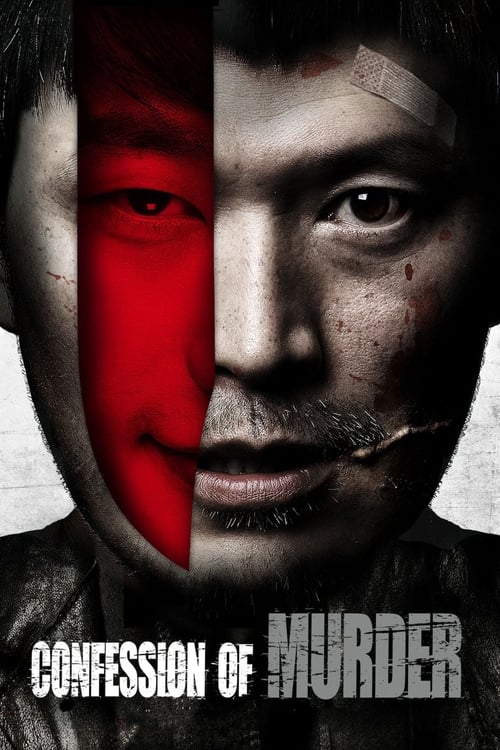
Confession of Murder
2012 · Jung Byung-gil
For a night when you want pure adrenaline with teeth — a crowd-pleaser that also leaves you a little outraged. Great with friends who like their thrillers loud, twisty, and unafraid of big swings.
What it's about
Fifteen years after murdering ten women, a serial killer resurfaces — untouchable, because the statute of limitations has run out — and publishes a glossy memoir confessing everything. The detective who failed to catch him is forced to share the spotlight with him, the victims' families plot their own justice, and a masked stranger appears on live television claiming the author is a fraud and he is the real killer. The whole country tunes in.
The experience
Fast, furious, and gleefully over the top — breakneck chases and wild stunt set pieces welded to genuine moral anger about a killer becoming a celebrity. It swerves between action, satire, and grief, and rarely lets you catch your breath.
Performances
Jung Jae-young gives the detective a scraped-raw weariness that grounds the mayhem, while Park Si-hoo is perfectly punchable as the preening celebrity killer — vain, telegenic, and unreadable.
The craft
Director Jung Byung-gil came up through stunt work, and it shows: the chases are elaborate, physical, and inventive in ways CGI-heavy action rarely is, with bodies hurtling through traffic and apartments. The media-circus scenes are staged with the same energy, turning press conferences into arenas.
Why it matters
One of the standout Korean genre hits of the early 2010s, it announced Jung Byung-gil as an action stylist and fed a national conversation about statutes of limitations for murder. It later spawned a Japanese remake.
Snapshot
A high-concept action-thriller built on one of South Korean law's most contested provisions, Confession of Murder (Korean: 내가 살인범이다, Naega Sallin Beomida, lit. "I Am a Murderer") posits a scenario both legally plausible and morally outrageous: a serial killer who murdered ten women returns fifteen years later, immune from prosecution under the statute of limitations, and parlays his crimes into a bestselling memoir and a media career. Part procedural cat-and-mouse, part blockbuster action film, part furious social satire, it is among the most kinetically inventive Korean genre pictures of the early 2010s — a film that deploys elaborate stunt choreography in the service of sustained moral rage. Director Jung Byung-gil, whose background lay in stunt coordination rather than literary auteurism, made a debut feature that was defiantly physical, grounding abstracted questions of justice and collective grief in car chases, rooftop pursuits, and the bruised, sweating bodies of men who cannot escape what the law has declared finished.
Industry & Production
Confession of Murder was produced within the infrastructure of South Korea's mature commercial film industry, which by 2012 had spent roughly two decades building the institutional and financial apparatus capable of sustaining mid-to-large-budget genre films with global ambitions. The film was released in November 2012 and achieved solid commercial performance domestically, though precise box-office figures are not cited here as exact numbers from this period in the South Korean market are not reliably confirmed in sources available to this writer. Its success was sufficient to earn a Japanese remake — directed by Shinsuke Sato and released in 2017 — testifying to the commercial appeal of its central premise across Northeast Asian markets where the statute of limitations on violent crime had been a live public policy debate.
The film's central legal conceit was not invented for dramatic convenience but rooted in genuine South Korean jurisprudence: at the time of production, the statute of limitations on murder stood at fifteen years. Cases where killers went unidentified within that window were closed — permanently. Public anger over this provision had been simmering for years, stoked by high-profile unsolved murders including the Hwaseong serial killings of the late 1980s (themselves the basis for Bong Joon-ho's Memories of Murder, 2003). The National Assembly abolished the statute of limitations on murder in 2015, three years after this film's release, a change that the broader cultural conversation — in which Confession of Murder participated — arguably helped accelerate.
The casting of Park Si-hoo as Lee Du-seok, the killer-turned-celebrity author, was commercially significant: Park was at that point a well-known television star whose conventional attractiveness made the film's commentary on celebrity culture and public credulity sharper and more unsettling. Jung Jae-young, a reliable presence in Korean genre pictures, plays the detective Choi Hyeong-goo with the rumpled, barely-contained fury the film requires.
Technology
Confession of Murder was shot digitally, consistent with industry practice by the early 2010s, and deployed a widescreen aspect ratio appropriate to its action setpieces and crowd compositions. The production's technological ambitions were most evident not in camera systems but in practical stunt infrastructure: Jung Byung-gil's prior career meant the unit possessed unusual expertise in coordinating vehicular stunts, wire-assisted falls, and extended physical sequences without heavy reliance on CGI augmentation. This practical emphasis gives the film's action a tactile, consequential quality — impacts register as mass and force rather than as digital events. Specific details about the camera package and lens complement are not confirmed in sources readily available, and attribution of specific technological choices to particular crew members would require more granular production documentation than is currently established in the scholarly record.
Technique
Cinematography
The film's visual grammar operates in two distinct registers that reflect its hybrid genre ambitions. In its thriller mode — interrogation rooms, police corridors, the harshly lit staging of press conferences — the camera works with functional economy, holding on faces under pressure and exploiting institutional spaces for their atmospheric authority. In its action sequences, the cinematography opens into wider lenses, faster cutting rhythms, and mobile framings that keep the geography of pursuit legible even at elevated tempo. The extended freeway chase sequence, in which vehicles careen through Seoul traffic, demonstrates a commitment to long-duration stunt photography: shots are held long enough to register real speed and real jeopardy, resisting the tendency toward micro-editing that can evacuate kinetic impact from action cinema. Throughout, the film uses Seoul's urban fabric — underpasses, elevated highways, cramped apartment interiors, the glass and steel of broadcast studios — as a recognizable, pressure-bearing environment rather than an abstracted action backdrop.
Editing
The editing structure reflects Jung Byung-gil's understanding of action choreography as a rhythmic form. Transitions between set-pieces are handled with compression rather than elaboration — the film is not interested in the procedural connective tissue that sustains slower Korean crime dramas, and it moves briskly between its confrontations. Within action sequences, the cutting is aggressive but spatially coherent: stunt coordination and editorial assembly work in tandem to maintain orientation. The film's most structurally demanding editorial problem is its tonal whiplash, moving between near-farcical media satire and brutally earnest grief — a difficulty it navigates imperfectly but with more consistency than its detractors have allowed.
Mise-en-scène / Staging
The staging of the film's media sequences — press conferences, television appearances, book launch events — constitutes its most pointed formal statement. Lee Du-seok appears in public contexts governed by the conventions of celebrity spectacle: podiums, cameras, microphones, the organized attention of crowds. These spaces mirror the actual apparatus through which true crime content is packaged and consumed, and Jung frames them with a satirist's clarity, placing the murderer inside a machine built to celebrate notoriety regardless of its origin. The scenes in which victims' families appear in these same spaces — their grief forced into the same channels as entertainment — produce the film's sharpest discomfort. Physical staging throughout assigns spatial dominance carefully: the detective is repeatedly framed in cramped, subordinate positions relative to the killer, whose physical ease and performative confidence constitute their own form of violence.
Sound
The sound design underscores the film's action sequences with the blunt authority characteristic of Korean genre production in this period — the emphasis is on impact, friction, and the physical evidence of force. The score (specific composer attribution is not confirmed with sufficient certainty to state here) functions conventionally within the action-thriller idiom, amplifying tension during pursuits and providing ironic counterpoint in the more satirical public-spectacle scenes. Of greater formal interest is the film's incorporation of diegetic media sound — broadcast voice-overs, the ambient noise of press events, the murmur of crowds consuming the killer's celebrity — which builds an acoustic environment in which the mechanisms of public culture are as audible as any chase sequence.
Performance
Park Si-hoo's performance as Lee Du-seok is the film's most discussed element and the locus of its central dramatic tension. The casting logic demands an actor whose charisma can plausibly produce the public's credulous adoration while leaving room — visible in careful framings and momentary unguarded expressions — for the horror beneath. Park's television-cultivated attractiveness is used against itself: the very qualities that made him a romantic lead become indices of menace when redirected into a character whose manipulation is total. Jung Jae-young provides necessary ballast as Choi Hyeong-goo, playing a man whose professional failure has become a permanent wound. His register is internal where Park's is performative, and the film gains from this dynamic — two modes of damaged masculinity circling each other. Kim Young-ae, as a mother of one of the victims, carries the film's emotional center in scenes that resist the sensationalism elsewhere dominant.
Narrative & Dramatic Mode
The film operates through escalating dramatic irony: the audience possesses knowledge — that Lee Du-seok is the actual killer — that the public within the film either lacks or refuses to credit. This gap between what we know and what the narrative's internal society accepts is the engine of the film's social critique. The introduction of "J," the masked figure who appears claiming to be the real killer, further complicates the epistemological landscape, raising genuine uncertainty about identity and providing the structural basis for the third-act revelation. The film is less interested in sustained psychological ambiguity than in the spectacle of institutional and cultural failure: justice systems that produce perverse outcomes, media systems that reward infamy, a public whose appetite for narrative makes it susceptible to any sufficiently attractive story.
The victims' families occupy a separate narrative strand, staging the revenge plot that common moral sense demands and the law forecloses. Their vigilantism is presented with sympathy but also with the film's characteristic irony: their plans are repeatedly frustrated, redirected, instrumentalized by forces they cannot control. This is not a film that resolves its anger through cathartic violence; its conclusions are more ambiguous and more bitter than simple revenge would permit.
Genre & Cycle
Confession of Murder belongs to a specific cycle of South Korean serial-killer and crime-revenge films that reached international visibility in the decade following Bong Joon-ho's Memories of Murder (2003). That cycle — which includes Park Chan-wook's revenge trilogy, Na Hong-jin's The Chaser (2008), Kim Jee-woon's I Saw the Devil (2010), and others — is characterized by extreme tonal range (incorporating comedy, melodrama, and visceral violence within individual films), a persistent engagement with institutional failure as both narrative subject and formal preoccupation, and a willingness to deny audiences the comfortable catharsis of Western genre conventions.
Within this cycle, Confession of Murder occupies a particular position: it is more openly commercial and more kinetically action-oriented than the art-aligned productions with which it shares subject matter, closer in sensibility to a blockbuster thriller than to the austere brutalism of I Saw the Devil. This has made it somewhat easier to dismiss for critics invested in the prestige tier of Korean genre cinema, though its formal intelligence in the staging of action and its precision in satirizing media culture deserve more sustained attention than they have received in English-language scholarship.
The film also participates in a global cycle of "celebrity criminal" narratives — films and television productions exploring the cultural mechanisms by which notoriety is manufactured and consumed — that accelerated markedly in the streaming era, making the film in retrospect a prescient text about dynamics that have only intensified.
Authorship & Method
Jung Byung-gil arrived at feature direction from stunt coordination and action choreography, a trajectory that produced a distinctive authorial signature: an unusual attentiveness to the grammar of physical action, to the spatial and temporal architecture through which bodies move through danger. His approach to filmmaking is less concerned with the literary or psychological depths that characterize the auteurist tier of Korean cinema than with the visceral legibility of conflict — what it looks like when people pursue, evade, and confront each other across real urban space.
His subsequent film, The Villainess (2017), extended these preoccupations into more flamboyant formal territory — the opening first-person sequence of that film became widely circulated as an example of virtuoso action filmmaking — and established more firmly his status as one of South Korean cinema's most technically ambitious genre directors. Confession of Murder is best understood as a demonstration of that sensibility at feature scale: the action vocabulary already present, the satirical register still being calibrated. Specific details about his working relationships with his cinematographer, editor, and composer on this production are not sufficiently established in publicly available sources to state with confidence, and this dossier declines to attribute collaborator credits that cannot be verified.
Movement / National Cinema
The film is a product of the mature institutional phase of the Korean Wave (Hallyu) in cinema — a moment when the domestic industry's global profile, built through the 1990s and 2000s, had created stable conditions for mid-to-large-budget genre production oriented simultaneously toward domestic and export markets. The legal and social specificity of its premise — rooted in Korean statute, Korean public debate, and Korean cultural anxieties about justice and media — is simultaneously the source of its local relevance and, paradoxically, of its international legibility, since the anxieties it stages (about impunity, about the commodification of violence, about the failure of institutions to protect the ordinary citizen) are not culturally bounded.
The film sits within a national cinema tradition that had, by 2012, developed a distinctive and internationally recognized capacity for genre work that carries genuine moral and social weight without sacrificing commercial energy. This tradition — in which formal virtuosity, popular entertainment, and social critique are understood as compatible rather than competing — is one of South Korean cinema's defining contributions to world film culture in the early twenty-first century.
Era / Period
Released in November 2012, the film belongs to a moment of peak cultural anxiety in South Korea about two related issues: the inadequacy of the criminal justice system in providing closure for victims of violent crime, and the increasingly intrusive and ethically compromised behavior of tabloid and broadcast media. The Hwaseong serial murders — still officially unsolved at the time of the film's release, though DNA evidence would eventually identify a suspect in 2019 — remained a source of national grief and institutional shame that provided the film's legal premise with emotional resonance beyond mere legal technicality. The early 2010s were also a period of heightened public scrutiny of South Korean media practices, including controversy over sensationalized crime coverage, providing context for the film's satirical treatment of its press sequences.
Themes
The film's thematic architecture is organized around three interlocking concerns. The first is the gap between legal and moral justice: the statute of limitations creates a situation in which the law's verdict (no crime, for procedural reasons) diverges absolutely from moral reality, and the film explores what happens to individuals and communities when that gap is made public and permanent. The detective Choi Hyeong-goo incarnates the personal cost of this institutional failure — his is a wound that the legal system has ruled cannot be healed because the case is officially closed.
The second theme is the mechanics of celebrity culture as a system for laundering moral categories. The film is sharply attentive to the ways in which public attention — mediated through television, publishing, and crowd dynamics — can transform a murderer into an object of fascination, sympathy, and even admiration when his story is packaged correctly. Lee Du-seok is attractive, articulate, and emotionally skilled at performing victimhood; these qualities are not incidental to his crimes but continuous with them, and the culture industry rewards rather than interrogates them.
The third theme, carried primarily by the victims' families, concerns collective grief and the inadequacy of available channels for its expression. When legal redress is impossible and media culture appropriates personal loss for entertainment, what remains? The film offers no clean answer, but it takes the question seriously enough to resist the satisfactions of simple revenge plotting.
Reception, Canon & Influence
Critical reception in South Korea was broadly positive with reservations: reviewers praised the film's central concept, Park Si-hoo's performance, and the quality of its action sequences, while some found the tonal management uneven and the third-act revelations somewhat mechanical. In English-language criticism, the film has received less sustained attention than its more austere Korean contemporaries, occupying a middle tier in the hierarchies constructed by critics who tend to privilege the art-cinema inflected work of Bong Joon-ho, Park Chan-wook, and Hong Sang-soo over genre-commercial production. This relative critical neglect is worth noting as a feature of reception rather than a reliable guide to the film's formal achievement.
The film's most direct debts run backward to the procedural tradition established by Memories of Murder, from which it inherits its preoccupation with institutional failure and the lasting damage of unsolved violence, and to the action-thriller infrastructure of American and Hong Kong cinema that provided the formal vocabulary for its kinetic sequences. The influence of Chan-wook's revenge films is audible in the moral structure — the insistence that revenge is not the same as justice, and that the desire for it is a legitimate response to institutional abandonment — even where the tonal register is very different.
The film's forward influence is harder to trace with precision, as scholarly documentation of influence networks within contemporary Korean genre cinema remains relatively underdeveloped in English-language scholarship. The 2017 Japanese remake demonstrates the commercial and conceptual durability of the central premise. More broadly, Confession of Murder represents an important moment in Jung Byung-gil's career development and in the Korean genre industry's capacity to make action-driven films that carry meaningful social content — a capacity his subsequent The Villainess would display with greater formal bravado and wider international recognition.
A Deleuzian reading
Watch the detective at the book launch.
The full Deleuzian reading of Confession of Murder →
Reception
A solid mid-size hit in Korea in 2012, it's now mostly encountered in reverse — cinephiles who fall for The Villainess or Carter work backwards and discover this was where Jung Byung-gil's stunt-crazy style first announced itself.
How Confession of Murder was received, from release to now →
Influences: the films it descends from and the films it influenced
- Memories of Murder (2003) — Provides the procedural architecture in which the statute of limitations functions as the specific mechanism of state complicity — the dramatic engine Confession of Murder reactivates, shifting the unsolved-case structure from investigator's failure to survivor's reckoning.
- Sympathy for Mr. Vengeance (2002) — Establishes the Korean revenge film's insistence that vengeance desire is morally legible even as its execution produces cascading damage — the ethical architecture that grants Confession's survivor-avenger moral standing without granting him victory.
- Oldboy (2003) — The spatially rigorous corridor-fight model — a single long-take that tracks real physical exhaustion through precisely mapped terrain — becomes the technical and ethical standard for Korean action cinema's coherent staging that Jung inherits.
- Natural Born Killers (1994) — Pioneers the formal device of embedding diegetic media (news segments, talk-show footage) as satirical counterpoint to violence, making the celebrity-criminal apparatus itself a structural element of the film's grammar rather than a theme.
- To Die For (1995) — The structural model for a criminal who performs innocence through media charisma while the audience holds certain knowledge of guilt — the dramatic irony engine Confession of Murder deploys with its confessing-yet-concealing protagonist.
- Police Story (1985) — Establishes long-duration practical stunt photography as an ethical and aesthetic contract: the camera's extended attention to bodies performing real danger functions as authenticity guarantee, the standard Jung's action sequences inherit over CGI substitution.
- Hard Boiled (1992) — Provides the Hong Kong action grammar of precisely tracked spatial geography within sustained sequences — who occupies which zone, what sight lines connect them — the technical standard Korean action filmmakers absorbed for spatially coherent cutting.
- A Bittersweet Life (2005) — Refines spatial dominance assignment as a Korean action-film device: physical position within the frame communicates hierarchical power before any blow is struck, assigning screen zones to bodies as a grammar of control that Confession's confrontation sequences deploy.
- The Chaser (2008) — Develops the Korean crime thriller's spatially coherent pursuit grammar and the structural premise of a known criminal operating freely while institutions fail to contain him — the procedural DNA Confession of Murder reconfigures around media spectacle.
- I Saw the Devil (2010) — Develops charisma redirected as menace in a serial-killer antagonist who weaponizes surface charm as a tactical instrument — the performance mode Park Si-hoo's confessor adapts — and treats extended action sequences as moral arguments rather than pure spectacle.
- The Villainess (2017) — Extends Jung's dual-register visual grammar to its logical extreme: the opening first-person kill-corridor sequence makes explicit the stunt coordinator's spatial logic implicit in Confession's action staging, applying the same practical-over-CGI ethics at greater formal bravado.
- The Drug King (2018) — Inherits the celebrity-criminal apparatus — a charismatic figure who constructs public identity as spectacle and performs innocence through media access — extending Confession's satirical interest in how criminality generates celebrity into the biographical-crime format.
- The Yellow Sea (2010) — Shares the commitment to extended practical action across real urban geography, maintaining spatial coherence across multi-minute pursuit sequences through location-specific staging rather than rapid cutting deployed to conceal disorientation.
- New World (2013) — Demonstrates the mature-phase Korean genre film's tonal compression — tragedy, institutional critique, and action spectacle held within a single coherent register — the same tonal management problem Confession of Murder addresses through its media-satire frame.
- A Hard Day (2014) — Deploys epistemological uncertainty as a sustained narrative engine — the audience's calibrated partial knowledge generating dramatic irony from the gap between what different characters know — the same structural mechanism that drives Confession of Murder's central conceit.
- Asura: The City of Madness (2016) — Extends the Korean crime genre's systemic institutional-failure critique into state-level corruption, sharing the tonal compression of genre excitement and social indictment that Confession of Murder calibrates through its celebrity-criminal spectacle apparatus.
Similar films
- Memories of Murder (2003) — influence & lineage
- A Hard Day (2014) — influence & lineage
- I Saw the Devil (2010) — influence & lineage
- The Chaser (2008) — influence & lineage
- Asura: The City of Madness (2016) — influence & lineage
- The Yellow Sea (2010) — influence & lineage
- The Villainess (2017) — influence & lineage
- New World (2013) — influence & lineage