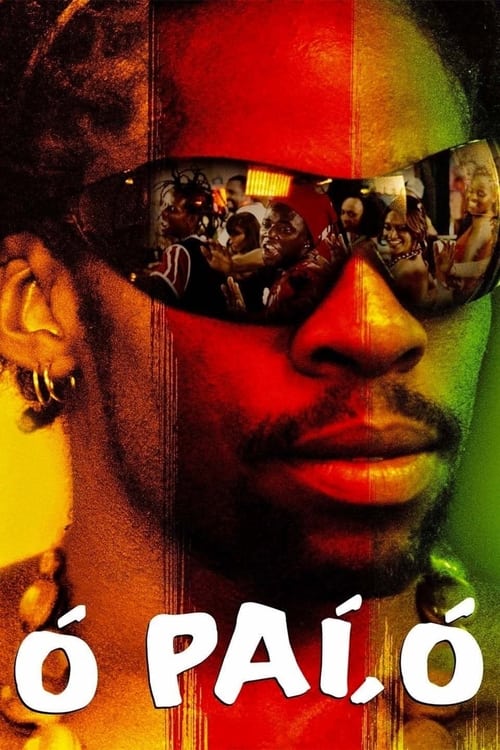
Ó Paí, Ó: Look at This
2007 · Monique Gardenberg
When you want energy — music, color, big ensemble comedy that still says something. A great pick for a night you want to be swept up rather than lulled, and to come out humming.
What it's about
During Carnival in Pelourinho, the historic heart of Salvador da Bahia, the residents of a crumbling tenement scramble to get through one day and night — dodging an unpayable rent, a predatory cop, and each other. There's no single hero: a young woman who wants to sing, hustlers working the tourist trade, an evangelical convert at war with her Candomblé-practicing neighbors, lovers and rivals across a courtyard — all of it carried on a current of drumming that never really stops.
The experience
Exuberant, loud, and funny, with music driving nearly every scene — but the comedy has real teeth, and flashes of anger and grief cut through the party. It moves like Carnival itself: irresistible momentum with something serious underneath.
Performances
A vibrant Brazilian ensemble, with Lázaro Ramos leading the tenement's cast of schemers and dreamers with infectious charisma.
The craft
Monique Gardenberg shoots on location in Pelourinho and lets Bahian music — samba, axé, sacred drumming — do the storytelling, braiding a dozen lives into a single day's rhythm. The sound is the star: this is a film that rewards good speakers and a willingness to let the percussion carry you.
Why it matters
A landmark of Afro-Brazilian popular cinema that brought Salvador's street culture, humor, and religious tensions to the screen on their own terms, and later spun off into a beloved Brazilian TV series.
Snapshot
Ó Paí, Ó is a Brazilian musical comedy that compresses the lives of a dozen or more residents of a crumbling tenement in Salvador's Pelourinho district into roughly a single cycle of Carnival — one day tilting into one night, with the drums never fully stopping. It has no protagonist in the conventional sense. Instead it braids a mosaic of survival strategies: rent that cannot be paid and a landlord who wants it, a policeman whose authority is indistinguishable from predation, an evangelical convert waging war on her Candomblé-practicing neighbors, a young woman who wants to sing, hustlers improvising an income out of the tourist trade, lovers and enemies separated by a courtyard wall. The title is a Bahian interjection — roughly olha para isso, olha, "oh look at that, look" — and the English subtitle "Look at This" makes the film's central gesture explicit: it is a work about who gets looked at in Brazil, on whose terms, and what the looking is worth.
Its historical significance rests on two facts. First, it is a screen adaptation of a landmark work of Brazilian Black theater, the collectively created play Ó Paí, Ó developed by the Bando de Teatro Olodum in Salvador under the direction of Márcio Meirelles — a company formed in 1990 in the orbit of the Grupo Cultural Olodum, dedicated to putting Black Bahian life on stage in a national theater culture that had largely excluded it. Second, it reached a mass commercial audience with a predominantly Black cast, made in Bahia rather than the Rio–São Paulo production axis, at a moment when Brazilian cinema's popular wing was overwhelmingly white in front of the camera and geographically concentrated behind it. The film is funny, loud, crowded, and formally closer to a revue than to a well-made screenplay; it is also, underneath the comedy, an argument about heritage tourism, policing, and the myth of racial democracy.
Industry & production
The film belongs squarely to the post-retomada configuration of Brazilian cinema. By 2007, the reconstruction of the national industry that began in the mid-1990s had settled into a stable if contested model: production financed largely through fiscal-incentive mechanisms (the Audiovisual Law and related instruments) in which corporations direct tax liability into approved projects, coordinated by ANCINE, with television capital — above all Globo Filmes — supplying the promotional muscle that turns a Brazilian film into a Brazilian hit. Globo's participation in this period was the practical precondition for domestic box-office success, since it delivered the on-air visibility no independent marketing budget could buy. Ó Paí, Ó was made and released inside that system and performed strongly with domestic audiences; I do not assert specific admissions or budget figures here, because the numbers circulating for Brazilian releases of this period vary by source and I cannot verify a single authoritative set.
Two structural decisions shaped the production. The first was adapting a proven property. The stage version had run for years in Salvador and toured, accumulating a repertoire of characters, bits, songs, and audience relationships that the film could inherit wholesale. The second, following from it, was casting the film substantially from the theater company that had created the work, supplemented with names carrying marquee value: Lázaro Ramos and Wagner Moura — both Bahians formed in Salvador's theater scene, Ramos himself a Bando de Teatro Olodum alumnus — alongside Dira Paes, Stênio Garcia, Emanuelle Araújo, Érico Brás and a large ensemble drawn from the company. This is a de-risking strategy familiar from theatrical adaptation everywhere, but it had an additional effect here: it moved an entire cohort of Black Bahian performers, previously known regionally, onto a national screen simultaneously.
The production logistics were unusual in one respect. Carnival in Salvador is among the largest street events on earth, and a film set inside it must either build its own crowd or negotiate the real one; either path imposes constraints on lighting, sound recording, camera placement, and continuity that ordinary location shooting does not. The film's texture — the density of bodies, the sense of a camera embedded in a moving mass rather than observing it — reflects work done in and around the actual streets of Pelourinho.
The commercial afterlife is itself an industrial fact worth recording: the film's success produced a Globo television series of the same name that carried much of the cast into weekly national broadcast, and, more than fifteen years later, a feature sequel, Ó Paí, Ó 2 (2023), again directed by Gardenberg. A film-to-network-series pipeline of that kind was rare in Brazil and indicates how thoroughly the property was understood as an ensemble and a world rather than a single story.
Technology
Technologically the film is unremarkable and sits at a predictable point in its moment. A Brazilian theatrical feature of this budget class in 2007 would almost certainly have originated on 35mm and finished through a digital intermediate — the practice by then standard for color control on Brazilian releases — with a Dolby Digital theatrical mix. I flag this as inference from the norms of the period rather than a verified credit.
The genuinely interesting technical demands are those of music and crowd. A film built on Carnival percussion and song has to reconcile three incompatible sound worlds: performed numbers requiring playback and post-synchronisation, dialogue recorded in courtyards and alleys where reverberation and overlapping voices are constant, and the ambient wall of sound produced by blocos, drum corps and trio elétrico sound trucks, which in Salvador is loud enough to make conventional location dialogue recording impossible. The mix has to construct an environment that feels overwhelming without becoming unintelligible, and to move fluidly between music that characters are hearing and music the film is using. Similarly, camera support in narrow colonial streets and steep tenement stairwells pushes toward handheld and stabilised-rig work rather than dollies. None of this constitutes technological innovation; it is competent application of available tools to a difficult shooting environment.
Technique
Cinematography
The photography works a deliberate opposition between two Pelourinhos. One is the postcard: the restored eighteenth-century façades in pastel yellows, blues and pinks, the sloping cobbles, the churches — the image the Bahian tourism economy sells and the frame within which foreign visitors, and the camera, are trained to see. The other is the interior the film actually inhabits: the sobrado behind the façade, sunless, water-stained, subdivided into rooms too small for the lives in them. The color is saturated and warm throughout — this is not a film that reaches for gray naturalism — but the meaning of the saturation shifts, from the seductive brightness of the exterior to the hot, close, sweated color of the courtyard.
The architecture does much of the compositional work. A tenement organized around a shared central well of space produces natural frames-within-frames: balconies, shutters, doorways, stair landings, windows through which neighbors watch neighbors. The camera exploits verticality, looking up and down through the building's core, so that eavesdropping and surveillance become spatial rather than expository. Wide lenses in tight rooms keep multiple characters in the frame at once, preserving the ensemble even in intimate scenes. Outdoors during Carnival, the strategy inverts: the camera goes into the crowd, and the image becomes shallow, jostled and partial.
Editing
The cutting has two distinct jobs. Structurally, it must keep a large number of parallel strands legible across a compressed time frame, and it does so through steady rotation among households, using the building itself as connective tissue — a sound heard through a wall, a figure crossing a landing — so that transitions feel spatial rather than arbitrary. Rhythmically, it is keyed to percussion. Musical sequences are cut on the beat, and the film's overall tempo accelerates as the day advances toward the Carnival night, a ratchet that also carries the tonal shift from comedy toward menace. The film's willingness to stop for a number, in the manner of a stage revue, is a structural inheritance from its source and one of the things that separates it from the tighter, more classically plotted Brazilian ensemble films of the same decade.
Mise-en-scène / staging
This is the most visibly theatrical dimension of the film and the source of most of the criticism directed at it. The tenement functions as a set in the fullest sense: a fixed, bounded, multi-level playing space with a courtyard for a stage and balconies for a gallery, into which characters enter and from which they exit. Blocking is often frontal and presentational, with groups arranged for legibility to the audience rather than for naturalistic plausibility; scenes are built as bits with beats and buttons. Costume and property design lean into brightness and typing — each figure is instantly readable by dress and posture, as in the popular theater traditions the company draws on. The boundary between private room and public courtyard is deliberately porous: doors stand open, arguments are conducted for an audience of neighbors, and privacy is presented as a material privilege the building does not provide.
Sound
Music is not accompaniment here but the film's medium. The soundtrack draws on the Afro-Bahian Carnival repertoire — samba-reggae in the Olodum lineage, axé, afoxé and street percussion — and the drums are effectively continuous, receding and surging but never absent. Language is equally central: the dialogue is dense with Bahian speech, slang and rapid overlap, and the film makes no concession to standardization. This is a specific political choice in a national film culture where the Rio and São Paulo accents have long been the unmarked default. Songs carry exposition, punctuate scenes, and stand in for interiority that the film's presentational style otherwise declines to provide.
Performance
The acting is broad, physical and outward-facing — the register of popular comic theater rather than screen naturalism, with characters built as types: the venal landlord, the sanctimonious convert, the aspirant singer, the swaggering cop. Coming from a company that developed these figures collectively over years of performance, the ensemble plays them with an assurance that keeps most of them from collapsing into thinness; the interplay is fast and communal, with several actors frequently active in a single frame. Ramos and Moura calibrate downward for the camera, and Moura's policeman is the film's clearest instance of comic type curdling into genuine threat — a performance worth setting beside his work the same year in Tropa de Elite, where he plays a very different kind of Brazilian police officer. The risk in this mode is real and reviewers noted it: broad typing of Black characters in a comic register can read as caricature, and whether the film's affection and its satirical target rescue it from that charge is precisely where critical opinion divided.
Narrative & dramatic mode
The film observes something close to the classical unities, inherited from the stage: one place, one continuous stretch of time, one collective action. It is a mosaic rather than a story, in which no strand is subordinated to another and resolution is distributed rather than concentrated. The Carnival frame supplies both engine and license — it explains why everyone is in the street, why the ordinary rules are suspended, why the sexual, the sacred and the violent can occupy the same square. This is carnival in something close to the Bakhtinian sense: inversion of hierarchy, the grotesque and celebratory body, the temporary and bounded freedom of the licensed festival, with the emphasis on bounded. What the film finally argues is that the suspension expires. As night falls the comedy hardens; the same crowd that permitted joy permits harm, and the structures the festival appeared to dissolve — money, the police, the landlord's claim — are all still standing in the morning. The dominant mode is comic, but the underlying architecture is melodramatic: coincidence, moral polarity, and a late turn toward consequence.
Genre & cycle
Ó Paí, Ó sits at the intersection of three genres. It is a Carnival film, a Brazilian form with roots in the 1930s musical shorts and in the chanchada — the Atlântida studio comedies of the 1940s and 1950s that combined popular music, farce, satire of the powerful, and a topical Carnival release calendar. It is a musical, in the loose revue sense of numbers punctuating episodic action. And it is a cortiço film, joining a Brazilian tradition of collective-tenement narratives that reaches back to Aluísio Azevedo's naturalist novel O Cortiço (1890) and forward through Nelson Pereira dos Santos's Rio, 40 Graus (1955) and Rio, Zona Norte (1957) to the favela-mosaic cinema of the 2000s. Within its own decade it belongs to the popular, Globo-supported wave of Brazilian features that followed Cidade de Deus (2002) — films with large casts, poor-neighbourhood settings and mainstream comic or thriller packaging.
Authorship & method
Authorship here is genuinely divided, and honestly describing it matters more than assigning a single signature. The originating authorship is collective and Black: the Bando de Teatro Olodum, working through the workshop and collective-creation methods associated with Márcio Meirelles, built the characters, situations and comic language over years of live performance. The film's directing authorship is Monique Gardenberg's — a Salvador-born filmmaker who came to cinema from the world of music production and large-scale live events, and whose earlier features were Jenipapo (1995) and Benjamim (2003), the latter adapted from Chico Buarque's novel. Her affinity for music and performance is evident in the film's construction, and she returned to the material for the 2023 sequel.
That division is the film's central critical question. A white director adapting a Black company's collectively authored work for a mass market is precisely the configuration that Brazilian debates about cinema negro — running through Zózimo Bulbul's work and Joel Zito Araújo's documentary A Negação do Brasil (2000) and feature Filhas do Vento (2004) — had been examining, and the same argument had attached to Cidade de Deus. The most defensible account is that the film's method mitigates but does not dissolve the problem: the source material, the performers, the language and the music are the company's, and the film's value lies substantially in transmitting them intact.
I will not name the individual credits for photography, editing and score. I cannot verify them with confidence, and inventing or half-remembering below-the-line attributions would be worse than the omission; readers should consult the film's credit block or a reliable filmographic database. What can be said about method without risk is that the score and music supervision are functionally co-authorial — the film's shape is set by its songs — and that the editorial and photographic strategies described above are consistent, disciplined choices rather than accidents of a difficult shoot.
Movement / national cinema
The film is Brazilian and, more specifically, Bahian, and both terms carry weight. Bahia has a disproportionate place in Brazilian film history: the Ciclo Baiano of the late 1950s and early 1960s produced Roberto Pires's Redenção (1959) and A Grande Feira (1961) and Trigueirinho Neto's Bahia de Todos os Santos (1960), and Glauber Rocha's first feature Barravento (1962) was shot on the Bahian coast before Cinema Novo became a national program. Bahia also supplied Brazilian cinema with its most exportable exotic imaginary, largely through adaptations of Jorge Amado — the Bahia of syncretic religion, sensuality and picturesque poverty that Dona Flor e Seus Dois Maridos (1976) sold to the world. Ó Paí, Ó works inside that imaginary and against it simultaneously: it delivers the color, music and sensuality the tradition promises while making the tourist economy built on them one of its explicit subjects. In the 2000s it belongs alongside Sérgio Machado's Cidade Baixa (2005) — another Salvador-set film featuring Ramos and Moura — as evidence of renewed feature production outside the Rio–São Paulo axis.
Era / period
The film's 2007 context is unusually legible. Pelourinho had been through a major state-led heritage restoration beginning in the early 1990s, which rebuilt the historic center for tourism and UNESCO World Heritage presentation and, in the process, displaced substantial numbers of its poor Black residents — the precise grievance the film's tenement dramatizes. Olodum itself had become internationally visible through that same decade: its drummers appeared on Paul Simon's The Rhythm of the Saints (1990) and in the Salvador-shot video for Michael Jackson's "They Don't Care About Us" (1996), directed by Spike Lee. The film arrives, then, at a moment when Black Bahian culture had global commercial currency while Black Bahians remained the population most exposed to police violence, precarious housing and the informal economy.
Nationally, 2007 fell in Lula's second term, amid intense public argument over racial quotas in universities and over the racial-equality legislation then under debate — arguments that pressed directly on the doctrine of democracia racial, the long-standing national self-description as a society without a color line. The film's insistence that its characters are poor and Black, and that the two facts are connected, is a contribution to that argument. It was also a strong year for Brazilian cinema's engagement with policing, with Tropa de Elite released the same year to far greater controversy.
Themes
The organizing theme is the gaze. The title is an imperative to look, and the film keeps asking who is looking at Pelourinho: tourists photographing the façades, the state marketing heritage, the police watching for pretexts, neighbors watching each other across a courtyard, and finally a national audience watching a part of Brazil it rarely sees rendered as protagonist rather than backdrop.
From this radiate the rest. Race and the failure of racial democracy run through everything, encoded in who owns property, who collects rent, who is stopped, and whose culture is monetized by others. Heritage and displacement supply the material grievance: the restored city as a stage set whose upkeep requires the removal of its inhabitants. Religion is treated with unusual directness, staging the real and then-escalating conflict between Candomblé and neo-Pentecostal Protestantism, with the convert's intolerance played as comedy that is not quite funny. Police power appears not as institutional abstraction but as one man with a uniform and appetites. Sexuality and gender nonconformity are present without special pleading, as ordinary facts of the building's life. Against all of it the film sets its counter-value: jeitinho and joy — improvisation, irony, music and mutual aid as the actual technology of survival — while refusing the sentimental conclusion that they are sufficient.
Reception, canon & influence
Domestically the film was a popular success and was received as a significant event for Black representation in Brazilian commercial cinema; critical response was warm toward its energy, its music and its ensemble, and more divided about its theatrical staginess and its reliance on broad comic types, with some critics arguing that the mass-market comic frame softened the source material's edge. That division is the honest summary; I avoid attributing particular verdicts, quotations or award tallies I cannot reproduce precisely.
Looking backward, the influences are clear and layered. The immediate source is the Bando de Teatro Olodum's stage work and Meirelles's collective-creation method, itself indebted to Brazilian popular and political theater traditions. Behind that stand the chanchada and the Carnival musical; the cortiço narrative from Azevedo forward; the Carnival-as-tragedy lineage of Orfeu Negro (1959) and Carlos Diegues's revisionist Orfeu (1999); and the Amadian Bahia the film both exploits and interrogates. Formally, its mosaic structure and street density belong to the moment opened by Cidade de Deus. The comparison critics most readily reach for, and the most illuminating one, is Spike Lee's Do the Right Thing (1989): a single block, a single hot day, a comic ensemble of neighborhood types, music as narrator, and a slow escalation into violence that exposes the structures the comedy had made bearable. I offer that as an analytic resonance rather than a documented lineage.
Looking forward, the film's legacy is institutional as much as aesthetic. It moved an entire Black Bahian theater company onto national screens and into sustained careers — most visibly Lázaro Ramos, already established and later a director in his own right, and Érico Brás, who became a familiar television comic presence, with other company members continuing across Brazilian film and television. It generated a Globo series that extended the world into weekly national broadcast, and a 2023 sequel that reunited much of the ensemble. It demonstrated commercially that a majority-Black Brazilian film made outside the Rio–São Paulo axis, in unapologetically regional speech, could find a mass audience — a demonstration that mattered to the subsequent, larger wave of Black-authored and Black-led Brazilian screen work. Its canonical standing is that of a popular landmark rather than an art-cinema monument: formally conservative, structurally theatrical, occasionally coarse, and genuinely consequential for who appears, and who speaks, in Brazilian cinema.
Reception
A modest theatrical event in 2007 that some critics shrugged at, it kept growing in stature — spawning a Globo TV series in 2008, a sequel in 2023, and a firm place among the landmarks of Black Brazilian cinema.
How Ó Paí, Ó: Look at This was received, from release to now →
How to watch Ó Paí, Ó: Look at This: what to notice on a first viewing
- Watch how many neighbors are visible at once in the courtyard. Gardenberg keeps the tenement's balconies, stairs, and open doors in frame together, so private scenes always have an audience of onlookers. Privacy is shown as something this building cannot afford anyone.
- Listen for the drums, which never fully stop. Percussion underlies nearly every scene, surging during Carnival numbers and receding but persisting through dialogue, so the film never returns to true silence. The music is not decoration here, it is the medium the story moves through.
- Track how the cutting speeds up as the day turns to night. Musical sequences are cut on the beat, and the overall tempo ratchets upward as Carnival night approaches, carrying comedy toward menace. The accelerating rhythm is how the film signals that the festival's license is running out.
- Notice the two versions of Pelourinho the camera shows you. Restored pastel facades and cobbled tourist streets alternate with the sunless, water stained interior of the tenement behind them. The postcard image and the lived space are shown as two different buildings, one for sale and one for living.
- Watch how broadly each character is played, almost like a type. The venal landlord, the sanctimonious convert, and the swaggering cop are each instantly readable by dress, posture, and habit, drawn from years of live stage performance. Broad typing lets a large cast register fast, in the manner of popular theater rather than screen naturalism.
The whole guide to watching Ó Paí, Ó: Look at This, with the keys for a rewatch →
Influences: the films it descends from and the films it influenced
- Rio, 40 Graus (1955) — Establishes the Brazilian one-hot-day mosaic: five loosely braided strands of street vendors and popular types cut against each other across a single diurnal arc, with samba and the samba school functioning as the connective rhythm rather than as decoration — the exact structural template Ó Paí, Ó transposes to a Salvador Carnival Tuesday.
- Carnaval Atlântida (1952) — Codifies the chanchada's economy of interruption — plot suspended for a fully staged musical number, then resumed — plus the paired comic typing (Grande Otelo/Oscarito) of fixed, instantly legible neighborhood archetypes, which is precisely the performance grammar the Bando's characters and Ó Paí, Ó's number-driven structure inherit.
- Orfeu Negro (1959) — Uses the Carnival calendar itself as the narrative clock — rehearsal, eve, parade, aftermath — and cuts image to batucada so that percussion, not dialogue, governs shot duration; Ó Paí, Ó's cut-to-percussion editing and its compression into the run-up to a single Carnival night are direct descendants of this device.
- Barravento (1962) — Films candomblé as sustained, uninterrupted communal ritual — long takes of drumming and possession in which the drum sets the tempo of the cut — legitimizing Afro-Bahian religious practice as a formal generator of screen rhythm rather than as exotic insert, which is how Ó Paí, Ó handles its terreiro and orixá material.
- Tenda dos Milagres (1977) — Adapts Amado's Salvador by staging the racial-democracy myth as an argument conducted in the street — candomblé, capoeira and mestiçagem presented simultaneously as tourist commodity and as living practice — giving Ó Paí, Ó the double register in which heritage-tourism Bahia is both sold and interrogated inside the same frame.
- O Cortiço (1978) — Films Azevedo's naturalist tenement as a single courtyard set with a collective protagonist, staging overlapping domestic quarrels on stacked balconies and shared washing space; Ó Paí, Ó's tenement-as-stage blocking, its frames-within-frames of windows and doorways, and its refusal of a single lead all descend from this cortiço grammar.
- The Harder They Come (1972) — Proves a film can be built in a vernacular so local it required subtitling for outside audiences while letting the music economy — studio, sound system, record — carry the plot; Ó Paí, Ó's unapologetic Bahian speech and its samba-reggae bloco as narrative engine follow the same wager, and Olodum's rhythm is itself a Bahian reworking of the Jamaican source.
- Do the Right Thing (1989) — One block, one heat wave, an ensemble of comic types introduced in near-frontal address, a radio voice functioning as chorus, and a slow escalation that converts the comedy retroactively into diagnosis — the closest formal analog to Ó Paí, Ó's compressed unities, its music-as-narrator, and its late turn to violence.
- Orfeu (1999) — Revises Camus by relocating Carnival authorship inside the community — the samba-school composer as protagonist, rehearsal sequences shot as work rather than spectacle, Caetano Veloso's score written from within the tradition; Ó Paí, Ó adopts this insistence that the music be authored by the people performing it, not scored over them.
- Cidade de Deus (2002) — Opens the post-Retomada mode Ó Paí, Ó works inside: a workshop-trained, non-star ensemble drawn from a community-based acting program, mosaic chapter structure, and cutting keyed to percussive score — and it also bequeaths the unresolved authorship question of outside directors shaping collectively generated Black material.
- Filhas do Vento (2004) — Assembles a majority-Black Brazilian cast out of the theater — Ruth de Souza, Milton Gonçalves, Léa Garcia — and builds the film around long, stage-scaled dialogue scenes, establishing the theater-to-screen pipeline for Black Brazilian performers that Ó Paí, Ó then scales to a commercial ensemble.
- Besouro (2009) — Extends the cut-to-percussion principle into action choreography, editing capoeira ginga to berimbau and atabaque so that fight rhythm is set by Afro-Bahian instrumentation, and it banks on the market Ó Paí, Ó had just proved existed for Black Bahian genre spectacle with Afro-Brazilian religion at its center.
- Café com Canela (2017) — Shoots the Recôncavo Baiano with a locally cast Black ensemble in unmodified regional speech, holding long domestic two-shots in real houses — the low-budget, Black-authored continuation of Ó Paí, Ó's demonstration that a Bahian vernacular film need not translate itself for the Rio–São Paulo axis.
- Medida Provisória (2020) — The clearest institutional descendant: Ó Paí, Ó's lead moves to direction and brings the method with him — an Aldri Anunciação play adapted with its theatrical unities intact, a Black ensemble working in declamatory stage register, and satire used as the delivery system for structural argument.
- Ó Paí, Ó 2 (2023) — Reunites the Bando-derived ensemble and reruns the tenement-as-stage blocking and Carnival-clock structure, but with a Black Bahian woman directing — closing the authorship gap the original left open while keeping the comic typing, samba-reggae scoring and single-location staging intact.
- Madame Satã (2002) — Uses Lázaro Ramos's body as the film's principal formal instrument — cabaret numbers staged as performances within the performance, the camera holding on transformation rather than cutting away — the same performance-as-authorship logic that lets Ó Paí, Ó carry whole scenes on typed comic bodies alone.
- Carandiru (2003) — Builds a feature entirely from vignettes inside one confined architecture, introducing each inmate as a self-contained comic or melodramatic turn before the collective catastrophe binds them — the same enclosed-location mosaic with popular typing that Ó Paí, Ó runs on a tenement instead of a prison block.
- Cidade Baixa (2005) — Remaps Salvador away from the Pelourinho postcard onto the port and Baixa dos Sapateiros using handheld, available-light immersion and Lázaro Ramos as the body through which the city is read — the exact same year-adjacent Bahian project as Ó Paí, Ó, pursued in the naturalist register rather than the theatrical one.
Similar films
- Black Orpheus (1959) — influence & lineage
- City of God (2002) — influence & lineage
- Mango Yellow (2002) — shared sensibility
- Bacurau (2019) — shared sensibility
- Elite Squad (2007) — shared sensibility
- Lisbela and the Prisoner (2003) — shared sensibility
- The Man Who Copied (2003) — shared sensibility
- Latin Blood – The Ballad of Ney Matogrosso (2025) — shared sensibility