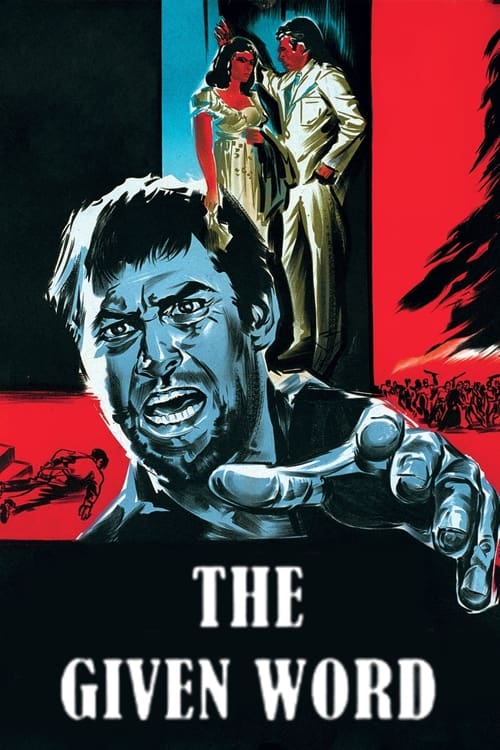
The Given Word
1962 · Anselmo Duarte
For when you want a film with a spine — a clear, powerful story about faith and hypocrisy that gets your blood up and gives you plenty to argue about afterward.
What it's about
Zé is a poor Brazilian farmer whose dearest companion is his donkey. When the animal falls deathly ill, he vows to Saint Bárbara that if it recovers he'll carry a wooden cross on foot all the way to her church in Salvador. The donkey lives, Zé keeps his word — but at the church door, the priest refuses the cross, because the vow was made in an Afro-Brazilian Candomblé shrine. One man's simple act of gratitude turns into a public standoff that draws in the church, the press, and the street.
The experience
It starts as a folk tale and tightens, scene by scene, into something urgent and enraging — a stubborn innocent against institutions that each want to claim or condemn him. Simple on the surface, morally loaded underneath.
The craft
Adapted from Dias Gomes's stage play, it keeps a play's concentrated pressure — much of it unfolds on the church steps — while filling the frame with the music, ritual, and street life of Salvador. The collision of Catholic and Candomblé worlds isn't backdrop; it's the engine of the drama.
Why it matters
The only Brazilian film ever to win the Palme d'Or, taken at Cannes in 1962 — a landmark that put Brazilian cinema on the world map at the dawn of its great modern wave.
Snapshot
O Pagador de Promessas — released in English variously as The Given Word, The Payer of Promises, and Keeper of Promises — is a Brazilian drama adapted by Anselmo Duarte from Dias Gomes's stage play, and it occupies a singular place in the country's film history as the only Brazilian feature to win the Palme d'Or, awarded at the 1962 Cannes Film Festival. It follows Zé do Burro, a poor farmer who vows to Saint Bárbara that he will carry a wooden cross on foot to her church in Salvador if his sick donkey recovers. The animal lives; Zé completes his via crucis; but the parish priest refuses to admit the cross into the church once he learns the vow was made in a Candomblé terreiro, where Saint Bárbara is syncretized with the Afro-Brazilian orixá Iansã. What begins as one man's act of gratitude escalates into a public confrontation over faith, orthodoxy, race, and institutional power, ending in Zé's death and his elevation, by the very crowd around him, into an inadvertent martyr. The film was also the first Brazilian production nominated for the Academy Award for Best Foreign Language Film.
Industry & production
The film was produced by Oswaldo Massaini's company Cinedistri, a São Paulo–based outfit that was among the more commercially durable Brazilian production and distribution firms of the era. Its making sits at a transitional moment in Brazilian cinema: the collapse of the ambitious Vera Cruz studio project in São Paulo (which had tried to build a Hollywood-style prestige industry in the early 1950s) had scattered its trained personnel, and Duarte himself came out of that studio-actor tradition. O Pagador de Promessas was shot on location in Salvador, Bahia, drawing on the city's churches, streets, and Afro-Brazilian cultural life. The production is best understood as a well-resourced, professionally crafted feature made outside the low-budget insurgency of the emerging Cinema Novo, even as it engaged comparable social material. Precise budget and box-office figures are not reliably documented in the standard English-language record, and I will not invent them; what is certain is that the Cannes victory transformed the film's international profile and lent it a commercial and reputational afterlife it might not otherwise have had.
Technology
The film was shot in black-and-white on 35mm in the standard configuration of early-1960s Brazilian production, using location sound and studio post-synchronization typical of the period rather than any novel technical apparatus. There is no evidence that the film pioneered new equipment or processes; its accomplishment is one of classical craft executed with discipline rather than technological innovation. The choice of monochrome — at a moment when color was increasingly available internationally — reads as an aesthetic and economic decision consistent with the sober, near-documentary register the film adopts for its Bahian setting, and it aligns the picture visually with the austere black-and-white idiom that Cinema Novo would soon make emblematic of a "serious" Brazilian national cinema.
Technique
Cinematography
The cinematography is credited to H. E. "Chick" Fowle, a British-trained cameraman who had worked within the orbit of Alberto Cavalcanti and the Vera Cruz apparatus and who brought a polished, tonally controlled sensibility to Brazilian production. The photography of O Pagador de Promessas is notable for its high-contrast handling of the Bahian sun, its use of the church steps and the surrounding square as a monumental stage, and its recurrent low and frontal framings of Zé and his cross that quietly summon Passion iconography. The camera treats the church façade as an architecture of exclusion — a threshold Zé cannot cross — and repeatedly places the human figure against sky, stone, and crowd to underline the parable's scale. The style is legible, classical, and compositionally deliberate rather than handheld or improvisatory, a distinction that would matter greatly to how contemporaries positioned the film relative to Cinema Novo.
Editing
The cutting builds tension through the gradual accretion of onlookers, factions, and agendas around a static physical situation — a man and a cross stalled at a church door. The film's dramatic engine is essentially spatial and temporal: it holds Zé in place across a single extended crisis while the surrounding world churns, so the editing's task is to orchestrate the swelling of the crowd and the intercutting of the parties (priest, journalist, capoeiristas, agitators, Zé's wife) into a rising social pressure. The specific editing credit is not something I can confirm with certainty from memory, and I will not attribute it falsely; what can be said is that the film's rhythmic strategy favors dramatic clarity and accumulation over disjunction or montage-driven abstraction.
Mise-en-scène / staging
Adapted from a stage play, the film is fundamentally a work of staging, and Duarte's handling of the church-square as a theatrical arena is its central achievement. The single dominant location — steps, portal, and plaza — functions as a pressure chamber where every social force in the drama can be brought into physical proximity: ecclesiastical authority above on the church side, the profane street below, and Zé pinned at the contested threshold between them. Duarte choreographs the encroaching crowd and the successive interlocutors so that the mise-en-scène itself dramatizes the theme, each group literally staking out territory around the cross. The staging retains its theatrical origins in the unity of place while opening the material outward through location texture, processional movement, and the documentary presence of Bahian street life.
Sound
Music is credited to Gabriel Migliori, and the score integrates Afro-Brazilian percussion and religious motifs into a dramatic idiom, reflecting the film's central collision between Catholic liturgy and Candomblé. The soundscape draws on the ritual and popular textures of Salvador — including the percussive world associated with capoeira and terreiro practice — so that the aural dimension carries the same syncretic tension the plot dramatizes. Sound thus does real thematic work: the film's argument about two coexisting spiritual systems is audible as well as visible.
Performance
Leonardo Villar's Zé do Burro anchors the film with a performance of stubborn, uncomprehending sincerity — a man whose literal-minded fidelity to his vow is both his dignity and his doom. Villar plays him not as a saint but as an ordinary, obstinate believer who never grasps why his simple act of gratitude has become a scandal, and this incomprehension is the source of the film's pathos. The ensemble surrounding him includes Glória Menezes as his wife Rosa, Dionísio Azevedo as the intransigent priest whose doctrinal rigidity sets the tragedy in motion, and supporting players embodying the journalist, the seducer, and the street factions who convert Zé's private devotion into public spectacle. The acting register is broadly classical and legible, in keeping with the film's theatrical lineage.
Narrative & dramatic mode
The film's structure is that of a tragedy compressed into a near-continuous crisis: a protagonist of unshakable good faith is destroyed by the collision of incompatible institutional and social logics he cannot navigate. Its dramatic mode is parable — the individual innocent crushed between church and world — inflected with irony, since every party projects its own meaning onto Zé (the Church sees heresy, the press sees a story, leftists see a symbol of resistance, the devout see a miracle) while none sees the man. The Christ allegory is explicit and structural: Zé's journey is a Passion, his cross literal, his death a crucifixion by intolerance, and the final image of his body borne into the church atop the cross completes the martyrdom the institution had refused him in life. The narrative's power lies in its refusal to let any faction's interpretation stand as the truth — the tragedy is precisely that a simple promise cannot survive contact with the meanings others impose on it.
Genre & cycle
As drama, the film belongs to a cycle of socially engaged Brazilian features of the early 1960s that turned to the rural poor, the Northeast, and Afro-Brazilian culture as subjects worthy of serious cinema. It shares thematic terrain with the concurrent Cinema Novo — the dignity and destruction of the marginalized, the weight of religion and folk belief, the exposure of Brazilian social contradiction — while differing markedly in form. Where the emerging movement pursued a rough, improvisatory aesthetic, O Pagador de Promessas delivers a classically constructed literary-theatrical adaptation. It is thus often read as a bridge or a border case: thematically of its moment, formally of the studio tradition that preceded it.
Authorship & method
Anselmo Duarte's authorship is inseparable from his earlier career as a leading man — a matinee idol of Brazilian and studio-era cinema who turned to directing and, with this film, achieved a career-defining critical triumph. As both adapter of the screenplay and director, Duarte's method here was one of faithful, disciplined translation: he took Dias Gomes's acclaimed 1960 play and rendered it cinematically while preserving its theatrical unity of place and its debate-driven dramaturgy. His key collaborators shaped the film's distinctive texture — the playwright Dias Gomes, whose politically and socially charged material gave the film its spine; cinematographer H. E. Fowle, whose controlled monochrome supplied its monumental visual grammar; and composer Gabriel Migliori, whose score bound Catholic and Candomblé sound-worlds together. The film's success is a case study in the fruitful adaptation of a strong theatrical source by a craftsman-director attuned to performance and staging.
Movement / national cinema
The film's relationship to Cinema Novo is the crux of its historiographic position. It appeared in 1962, the same broad moment as the movement's early works (Glauber Rocha's Barravento, and preceding the canonical Vidas Secas and Deus e o Diabo na Terra do Sol), and it addressed the same national wounds — poverty, faith, race, the Northeast. Yet its polished, classical form placed it at odds with the movement's ethos of an "aesthetic of hunger," a cinema whose very roughness was meant to embody underdevelopment. When Duarte's film — rather than a Cinema Novo work — won the Palme d'Or, it produced a genuine tension within Brazilian film culture: international validation had gone to a picture the young insurgents regarded as academic. The film is therefore best framed not as a Cinema Novo work but as a distinguished product of a transitional Brazilian cinema, standing between the collapsed Vera Cruz studio model and the movement that would soon define the country's art cinema abroad.
Era / period
The film belongs to the early 1960s, a politically charged interval in Brazil preceding the 1964 military coup, when Brazilian intellectual and artistic life was intensely preoccupied with questions of national identity, underdevelopment, and social justice. Its treatment of religious intolerance, the exploitation of the poor by the press and by political opportunists, and the fraught coexistence of European and African spiritual traditions all resonate with the ferment of the period. The film's international recognition arrived just before the cultural rupture of the dictatorship, making it a high-water mark of a particular pre-coup moment of Brazilian cultural confidence on the world stage.
Themes
The dominant theme is religious intolerance and the violence of institutional orthodoxy: the Church's refusal to recognize a vow made through Candomblé dramatizes the persecution of Afro-Brazilian religion and the racial hierarchy embedded in it. Bound to this is the theme of syncretism — the historical fusion of Catholic saints and Candomblé orixás (Saint Bárbara and Iansã) that the priest's rigidity denies but that Brazilian popular faith lives out. A third strand is the appropriation of the individual by collective agendas: Zé is claimed in turn by the press seeking sensation, by leftist agitators seeking a symbol, and by the devout seeking a miracle, so that the film indicts a whole society's habit of converting a person into an instrument. Beneath these runs the Christ parable — innocence, sacrifice, and martyrdom — and a clear-eyed portrait of the powerlessness of the poor before the institutions, sacred and secular, that surround them. Capoeira and Bahian street culture appear not as decoration but as the living counterworld the Church seeks to exclude.
Reception, canon & influence
Critically, the film's defining event was the 1962 Palme d'Or, an award that remains, to date, the only Golden Palm won by a Brazilian film and the anchor of the picture's canonical standing. The subsequent Academy Award nomination for Best Foreign Language Film — the first for a Brazilian production — extended its international recognition. Within Brazil, reception was more complicated: the film was widely admired for its craft and its performances, yet its triumph became a flashpoint in debates over what Brazilian cinema should be, with Cinema Novo partisans inclined to see its classicism as a relic rather than a way forward. The influences on the film run backward through Dias Gomes's celebrated stage play and, more broadly, through the studio-theatrical tradition of the Vera Cruz era and the classical dramaturgy of adaptation. Its legacy forward is dual: it stands as proof of concept that Brazilian cinema could command the world's highest festival honors — a psychological and reputational milestone for the national industry on the eve of Cinema Novo's international breakthrough — while also serving, by contrast, to sharpen the movement's self-definition against it. Its enduring themes of religious syncretism, intolerance, and the martyrdom of the poor have kept it a reference point in discussions of race, faith, and power in Brazilian film. The finer details of its commercial performance and some of its technical credits are unevenly documented in the widely available English-language record, and those gaps should be acknowledged rather than filled with invention; what is secure is its status as a landmark — the film that first carried Brazilian cinema to the summit of international prestige.
A Deleuzian reading
A man stands at the foot of a church's steps in Salvador with a wooden cross on his shoulder, and the door does not open.
The full Deleuzian reading of The Given Word →
Reception
It won the Palme d'Or in 1962 — still Brazil's only one — yet the young Cinema Novo crowd back home sniffed at it as too polished and theatrical next to their radical new wave; decades on it's been fully re-embraced as a cornerstone of Brazilian cinema.
How The Given Word was received, from release to now →
How to watch The Given Word: what to notice on a first viewing
- Notice Ze framed low against the sky, cross on his shoulder. Fowle repeatedly frames Ze low and frontal against sky, stone, and crowd, quietly summoning Passion iconography without the film ever needing to explain the comparison in dialogue. The framing tells you what kind of story this is before anyone calls it that out loud.
- Notice the harsh contrast of sunlight against the church's dark stone. Fowle's high-contrast black-and-white photography turns the Bahian sun and the church facade into a monumental stage, light and shadow doing dramatic work the actors don't have to. The contrast itself gives the confrontation a scale bigger than one man and one door.
- Watch how the whole story stays fixed at the church steps. Duarte keeps the play's unity of place, turning the church square into a single pressure chamber where every social force in the drama can be brought into physical proximity. Confining the whole film to one place is what lets the crowd's pressure build without a single cut away.
- Listen for percussion threaded through the liturgical music. Migliori's score binds Afro-Brazilian percussion into Catholic religious motifs, so the film's central collision between two faiths is audible as well as visible in nearly every scene. You can hear the film's whole argument about two coexisting religions in a single piece of music.
The whole guide to watching The Given Word, with the keys for a rewatch →
Influences: the films it descends from and the films it influenced
- The Passion of Joan of Arc (1928) — Establishes the passion-iconography grammar Duarte inherits — a martyr crushed by ecclesiastical authority rendered in stark high-contrast monochrome and sanctified, close-framed suffering.
- A Streetcar Named Desire (1951) — Model of faithfully transposing an acclaimed stage play to screen while preserving its unity of place and performance-driven, debate-heavy dramaturgy — exactly Duarte's disciplined-translation method with the Dias Gomes text.
- Diary of a Country Priest (1951) — The Catholic martyr-parable in which a humble protagonist's literal via crucis of suffering is set against an unsympathetic institutional Church that withholds grace.
- High Noon (1952) — Turns a single public square into a near-real-time moral arena where a community incrementally abandons its righteous man — the accumulating-crowd staging logic of the church-square standoff.
- O Cangaceiro (1953) — The Vera Cruz studio-craft tradition and Cannes-prize ambition Duarte emerged from, and a direct collaborator debt: composer Gabriel Migliori, whose folkloric orchestration of regional Brazilian idioms he reprises here.
- Ordet (1955) — Austere, theatrically-staged treatment of rural faith building to a church-set climax through the patient accumulation of argument between believers and skeptics.
- 12 Angry Men (1957) — Confined-arena, debate-driven dramaturgy where a single bounded space becomes a moral tribunal and dramatic tension is generated by the shifting verdict of a group.
- Nazarín (1959) — The Christ-allegory of a holy fool whose Christian charity is rejected and punished by the very society and Church he serves — Latin American martyrdom-of-the-poor parable.
- Black God, White Devil (1964) — Pushes the film's folk-Catholic messianism and martyrdom-of-the-poor into a mythic register of beatos and cangaceiros, keeping religious syncretism as the axis of social struggle.
- Antonio das Mortes (1969) — Fuses syncretic religiosity and Candomblé iconography with ritualized folk performance and the martyr-figure staged in open communal space.
- Central Station (1998) — Revives classical, performance-centered socially-engaged Brazilian humanism — a monumental lead performance and folk-Catholic pilgrimage narrative — as the national cinema's international-prestige calling card, the role this film first played.
- A Dog's Will (2000) — Stages Northeastern popular piety as a public trial of faith on the church steps, supplying the folk-Catholicism-versus-clergy confrontation that drives the film's morality-play conflict.
- Orfeu Negro (1959) — The immediate Palme d'Or precedent set in Brazil, fusing Catholic ritual with Candomblé macumba and Afro-Brazilian percussion as narrative engine — the syncretic sound-world Migliori formalizes into a score.
- Barravento (1962) — The Cinema Novo counter-statement drawing on the same Candomblé ritual and Afro-Brazilian percussion, but deliberately replacing classical unity-of-place staging with handheld, dialectical montage.
- Vidas Secas (1963) — Extends the socially-engaged monochrome portrait of the northeastern poor, wielding harsh high-contrast sertão light as ethical rather than merely pictorial statement.
- The Gospel According to St. Matthew (1964) — Renders the Passion in austere high-contrast monochrome using non-actor faces and popular-religious immediacy, sacralizing the peasant body as Duarte sacralizes Zé do Burro.
Similar films
- Nazarín (1959) — influence & lineage
- Antonio das Mortes (1969) — influence & lineage
- Black God, White Devil (1964) — influence & lineage
- Barren Lives (1963) — influence & lineage
- Central Station (1998) — influence & lineage
- Diary of a Country Priest (1951) — influence & lineage · often watched together
- Viridiana (1962) — often watched together
- Au Hasard Balthazar (1966) — often watched together