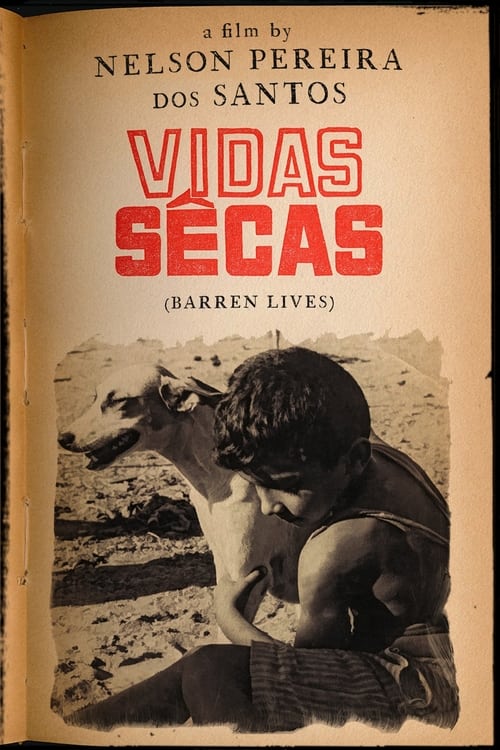
Barren Lives
1963 · Nelson Pereira dos Santos
For when you want cinema stripped to the bone — a hard, honest film to sit with, not an escape. Choose it on a night you're ready to be challenged and moved by something that refuses every comfort.
What it's about
A cowherd named Fabiano, his wife Vitória, their two young boys, and their dog Baleia walk the drought-cracked backlands of northeast Brazil, looking for work, water, and any foothold that might let them stop moving. Adapted from Graciliano Ramos's landmark novel, it follows the family through a stretch of borrowed shelter, humiliating labor, and run-ins with a state that exists only to take from them — all under a sun that never lets up.
The experience
Spare, slow, and blindingly bright — the film strips away music and dialogue until you're left with dust, glare, and the creak of a cart wheel. It's austere but never cold: the family's small gestures of stubbornness and care, and the dog Baleia most of all, get under your skin and stay there.
Performances
The whole cast underplays to devastating effect, and the dog Baleia gives one of the most affecting animal performances ever put on screen — she becomes a full member of the family, and you feel it.
The craft
Shot on location in deliberately overexposed black-and-white, so the screen itself seems to radiate heat — the light is almost painful, which is exactly the point. There's no score to soften anything; the squeal of an oxcart wheel does the emotional work music usually would. It rewards a big screen, where the white-hot landscape becomes an environment you're trapped in too.
Why it matters
A founding masterwork of Brazil's Cinema Novo movement, it announced to the world a cinema made from poverty about poverty, and it remains the standard against which politically committed Brazilian film is measured.
Snapshot
Vidas Secas — released in English as Barren Lives — is one of the founding masterworks of Brazilian Cinema Novo and among the most rigorous adaptations of a modernist novel ever committed to film. Drawn from Graciliano Ramos's 1938 novel of the same name, it follows a family of retirantes — drought refugees — across the parched sertão of Brazil's northeast: the cowherd Fabiano, his wife Vitória, their two unnamed boys, and the dog Baleia. The film opens and closes on the family in migration, framing the intervening episodes as a single turn of an inescapable cycle of poverty, dispossession, and state indifference. Shot in blistering, deliberately overexposed black-and-white on location, it translates Ramos's austere prose into a cinema of glare, dust, and silence. It is at once a work of social denunciation and a formal experiment, and it did more than almost any other single film to define what Cinema Novo could be: a camera in the hand, an idea in the head, and the harsh light of the backlands as both subject and style.
Industry & production
Vidas Secas was made at the moment Brazilian cinema was breaking decisively from the studio model epitomized by São Paulo's Vera Cruz (defunct since the mid-1950s) and the popular chanchada comedies of Rio's Atlântida. Nelson Pereira dos Santos, who had already pioneered an independent, location-based practice with Rio, 40 Graus (1955) and Rio, Zona Norte (1957), produced Vidas Secas through his own low-budget, artisanal model — the same ethos of self-financed, cooperative production that would become Cinema Novo's economic signature. The film was shot on location in the sertão of the Northeast (the Bahia backlands are the region generally cited), under conditions of real scarcity that mirrored the story's own. Precise budget and box-office figures are not well documented in the accessible record, and I will not invent them; what the literature consistently emphasizes is the film's poverty of means as an aesthetic and political choice rather than merely a constraint. This economy of production is inseparable from the movement's contemporaneous theorization — Glauber Rocha would soon name it the "aesthetics of hunger," an art whose formal roughness testifies to the material deprivation it depicts.
Technology
The film was made with lightweight, largely handheld-capable equipment and a small crew, exploiting the same postwar technological loosening — portable cameras, faster film stocks, location shooting — that had enabled Italian neorealism and would enable the various new waves. It was shot on 35mm black-and-white stock. Its most consequential technical decision concerns exposure: rather than "correct" for the ferocious equatorial sun of the sertão, the production embraced it, printing images at or beyond the threshold of overexposure so that the sky and land bleach toward a punishing white. The soundtrack was, by the standards and constraints of the period, built around a spare recorded field of diegetic noise rather than a lush post-synchronized score. In every respect the technology serves reduction rather than spectacle — the machinery of cinema stripped to what the story of scarcity requires.
Technique
Cinematography
The cinematography, by Luiz Carlos Barreto (himself a photojournalist by background, and later a major Cinema Novo producer), is the film's signal achievement and one of the most discussed image-systems in LatAmerican cinema. Barreto shot in a flat, high-key, near-blinding register: the horizon dissolves into overexposed sky, figures are pinned against expanses of cracked earth and thorny caatinga scrub, and the light itself becomes an antagonist — a physical manifestation of the drought that drives the narrative. Where classical drama uses light to model faces and sculpt space, Vidas Secas uses it to flatten and erase, so that the human figure seems perpetually on the verge of being consumed by the landscape. The camera favors long takes, wide framings that dwarf the family, and a documentary-inflected observational distance consonant with dos Santos's neorealist formation. The famous images of the family strung out in a line across the white ground — at the opening and again at the close — have become emblematic of the entire movement.
Editing
The editing (credited to Rafael Justo Valverde) preserves the episodic, chaptered structure of Ramos's novel rather than smoothing it into conventional continuity. The film advances in discrete blocks — the arrival, the interlude of relative stability when the rains come, Fabiano's humiliating encounter with the law, the market, the return of the drought, the departure — with elisions that mimic the novel's fragmentary interiority. The rhythm is patient and often static, allowing duration itself to register hardship. The most celebrated editorial passage is the death of the dog Baleia, in which montage briefly shifts into the animal's own failing subjectivity — a sequence widely analyzed as the film's boldest formal gesture, granting a non-human consciousness a dignity the social order denies its human characters.
Mise-en-scène / staging
Staging is built on emptiness. Dos Santos composes around the sparse furnishings of rural poverty — the ox-drawn cart, a few pieces of dried meat, a battered house — and around vast negative space. Blocking tends to isolate figures within the frame, emphasizing distance between family members and their smallness against the land. The sertão is not a backdrop but the film's central character, and the mise-en-scène refuses any picturesque softening of it. Real locations, natural weathering, and an almost ethnographic attention to the objects and gestures of vaqueiro life anchor the film in a verifiable material world.
Sound
The soundscape is one of the film's most inventive elements. In place of a conventional orchestral score, Vidas Secas foregrounds harsh diegetic sound — above all the recurring shriek of the ungreased oxcart wheel, an abrasive leitmotif that bookends and punctuates the film and has been read as the very "voice" of the drought and of grinding, unrelenting labor. Dialogue is sparse, terse, consonant with characters whose oppression is partly the oppression of the barely articulate; Fabiano's inability to fully command language is itself a theme. The film's refusal of musical consolation is a pointed aesthetic-political stance: it withholds the emotional cushioning that conventional cinema supplies, leaving the spectator inside an environment as unaccommodating as the one the family endures. (I have not verified a conventional composer credit and so make no attribution.)
Performance
The performances favor restraint and physicality over psychological display. Átila Iório plays Fabiano and Maria Ribeiro plays Vitória, with the two boys and the dog Baleia completing the family unit. Acting is pared to gesture, posture, and endurance; faces are frequently turned away or lost to the glare. Consistent with the neorealist lineage, the performances aim not at star charisma but at the embodiment of a social type — the retirante — rendered with specificity rather than sentimentality. The dog Baleia's presence is treated with a seriousness that the film's admirers have long noted as central to its ethical vision.
Narrative & dramatic mode
The narrative mode is circular and anti-climactic by design. The film begins with the family entering the frame as migrants and ends with them departing again, the intervening events forming one revolution of a wheel that will keep turning. This is not the goal-directed arc of classical drama but a structure of repetition and entrapment: hope arrives with the rains only to be revoked by their failure. The dramatic register is observational and elliptical, drawn from the novel's fragmented, multi-perspectival construction — Ramos famously distributed his chapters across the consciousnesses of different family members, including the dog — and dos Santos honors that structure by treating each episode as a self-contained study rather than a plot beat. Conflict is less between individuals than between people and a system: drought, landowners, and the state (embodied in the "yellow soldier" who jails and humiliates Fabiano) form an impersonal machinery of oppression against which the family has almost no recourse.
Genre & cycle
Nominally a drama, Vidas Secas is more precisely a work of social-realist cinema and a keystone of the sertão cycle within Cinema Novo — the movement's recurring engagement with the drought-stricken Northeast as the privileged landscape of Brazilian underdevelopment and resistance. It sits alongside Glauber Rocha's Black God, White Devil (1964) and Ruy Guerra's Os Fuzis (1964) as one of the three canonical backlands films of Cinema Novo's first phase, each turning the sertão into a stage for questions of poverty, faith, violence, and revolt. Where Rocha's film mythologizes the backlands through baroque excess, dos Santos approaches the same terrain through austere realism, marking the internal breadth of the cycle.
Authorship & method
Dos Santos adapted the screenplay himself from Graciliano Ramos's novel, and his method is defined by fidelity of spirit rather than of incident: he sought a cinematic equivalent for Ramos's stripped, unsentimental prose and its distributed interiority. His authorial signature — established in the Rio films and deepened here — combines a neorealist commitment to real places and social truth with a growing formal daring. As the elder statesman and, by many accounts, the "conscience" of Cinema Novo, dos Santos modeled the movement's independent, low-budget, socially engaged practice.
The film is genuinely a collaborative authorship. Cinematographer Luiz Carlos Barreto supplied the overexposed visual language that is arguably as responsible for the film's meaning as the direction, and his subsequent career as a producer made him a structural pillar of the movement. Editor Rafael Justo Valverde shaped the chaptered rhythm and the celebrated Baleia sequence. And the decisive collaborator is the absent one: novelist Graciliano Ramos, whose 1938 book supplies not only the story but the very aesthetic of reduction the film pursues. The record on additional key collaborators (a formal music credit in particular) is thin in the accessible sources, and I decline to invent attributions.
Movement / national cinema
Vidas Secas is inseparable from Cinema Novo, the movement that transformed Brazilian national cinema in the late 1950s and 1960s and gave Latin American film a leading voice on the world stage. Emerging from a generation of critics-turned-filmmakers influenced by Italian neorealism and the French New Wave but committed above all to Brazilian social reality, Cinema Novo sought a cinema of and about underdevelopment. Dos Santos's earlier Rio, 40 Graus is frequently cited as the movement's most important precursor, and Vidas Secas stands as its early canonical statement of principle: an art wrenched from scarcity, refusing both Hollywood gloss and studio artifice. Glauber Rocha's manifesto "The Aesthetics of Hunger" (1965) would provide the theoretical frame — the idea that the "hunger" of the images is itself the message — and Vidas Secas is one of its clearest illustrations.
Era / period
The film belongs to a charged historical moment. Made in 1963 and released on the eve of the Brazilian military coup of April 1964, it emerged from the ferment of early-1960s Brazilian politics — the era of agrarian reform debates, peasant leagues in the Northeast, and intense cultural-nationalist energy on the left. Its portrait of rural dispossession spoke directly to contemporary arguments about land, poverty, and the neglect of the sertão. The coup that followed shortly after would reshape the conditions of Brazilian filmmaking and push Cinema Novo toward the more allegorical, self-questioning register of its later phases; Vidas Secas thus stands at the threshold, a work of the brief democratic-populist opening just before it closed.
Themes
The film's governing themes are poverty as a structural, cyclical condition rather than an individual misfortune; the dehumanization wrought by drought and by an indifferent or actively cruel state; and the tension between endurance and revolt. Fabiano's near-muteness dramatizes a theme of dispossessed language — the way oppression strips its victims not only of land and livestock but of the capacity to name and contest their situation, with Vitória's dream of a leather bed standing as one of the few images of aspiration. The "yellow soldier" episode crystallizes the theme of arbitrary state power. Running beneath all of these is the film's radical extension of dignity and consciousness to the non-human, most powerfully through Baleia, whose death insists that the moral circle of the drama includes even the animal the social order treats as expendable. The circular structure makes cyclicality itself thematic: the migration that opens and closes the film asserts that, absent structural change, the wheel will keep turning.
Reception, canon & influence
Vidas Secas was quickly recognized as a major work and became a fixture of the Cinema Novo canon and of the international art-cinema circuit. It screened in competition at the Cannes Film Festival in 1964, where it is generally credited with an award from the OCIC (the international Catholic film office); I state this with the caveat that festival-prize records should be verified against a primary source before being quoted as definitive. Critically, it has been enshrined in Brazilian polls and histories as one of the greatest of all Brazilian films, and it is routinely taught as a paradigm of Third Cinema and of politically committed adaptation.
Looking backward, the film's influences are legible: Italian neorealism (De Sica, Rossellini, Visconti's La terra trema) supplies the location shooting, non-glamorized performance, and social focus; the documentary tradition and photojournalism (via Barreto) inform the observational image; and, most decisively, Graciliano Ramos's modernist novel supplies the fragmented structure and the aesthetic of austerity. Dos Santos's own Rio films are its immediate national antecedents.
Looking forward, its legacy is large. Within Cinema Novo it helped set the terms — and the sertão iconography — for the movement's first phase and for Rocha's and Guerra's near-contemporaneous backlands films. Its "aesthetics of hunger" became a touchstone for Third Cinema movements across Latin America and beyond, offering a model of how formal poverty could be turned into political and artistic strength. Dos Santos himself continued as the movement's guiding figure, later making landmarks such as How Tasty Was My Little Frenchman (1971). And the film's imagery and preoccupations echo forward into subsequent Brazilian cinema's returns to the Northeast, including the retomada of the 1990s and beyond, where the migrant, the drought, and the sertão remain enduring subjects. More than half a century on, Vidas Secas endures as both a historical document of a specific Brazilian reality and a permanent demonstration that the most stripped-down means can yield some of cinema's most exacting art.
A Deleuzian reading
Five figures cross a white field.
The full Deleuzian reading of Barren Lives →
Reception
Unlike most art-house classics, it never needed rescuing: it hit Cannes in 1964, helped announce Cinema Novo to the world, and has sat near the top of every greatest-Brazilian-films list since. What's changed is the frame — once read as a national statement about the drought-stricken sertão, it's now embraced globally as one of the great films about poverty, full stop.
How Barren Lives was received, from release to now →
How to watch Barren Lives: what to notice on a first viewing
- Watch the sky and ground bleach into pure white. Barreto overexposes the image until the horizon disappears, so figures look like they are being slowly consumed by a glare with nowhere to hide from. The light itself is working against the family, not just illuminating their struggle.
- Listen for the ungreased cart wheel's recurring shriek. In place of any music score, the film keeps returning to the same harsh, mechanical squeal of the oxcart's axle, bookending and punctuating scenes throughout. The wheel does the work a score would, and it never once lets the discomfort soften.
- Watch how small each family member looks against the land. Dos Santos keeps blocking the family with wide gaps between them and vast empty ground on every side, rarely letting them fill more than a fraction of the frame. The distance between them in the frame is doing the same work the drought does to the family itself.
- Watch Fabiano's body do the talking his words can't. Átila Iório plays him through posture, carrying, and endurance rather than speech, a man whose oppression includes barely being able to name what is happening to him. His silence is not a lack of feeling. It is what the system has left him able to do.
The whole guide to watching Barren Lives, with the keys for a rewatch →
Influences: the films it descends from and the films it influenced
- La terra trema (1948) — Long, wide takes of real laborers in real locations that subordinate the individual to landscape and collective toil — the template for filming social types non-glamorously that Barreto and dos Santos adopt for the sertão.
- Bicycle Thieves (1948) — Episodic, anti-dramatic structure assembled from quotidian humiliations rather than plot mechanics, modeling neorealism's refusal of climax that Vidas Secas pushes toward pure circularity.
- Umberto D. (1952) — Dedramatized attention to a marginal old man and his dog, withholding sentiment across dead time — direct precedent for the Baleia sequence and the non-charismatic protagonist.
- Los Olvidados (1950) — Sun-scorched Latin American poverty filmed without redemption, punctuated by subjective/oneiric inserts that rupture the neorealist surface — a model for the animal-subjectivity montage.
- O Cangaceiro (1953) — First internationally successful Brazilian film to treat the sertão and its blinding light as a visual subject, establishing the backlands iconography Cinema Novo inherits.
- Rio, 40 Graus (1955) — Dos Santos's own inaugural neorealist feature — location shooting with non-professionals across a mapped social geography — the working method he transplants from Rio to the drought.
- Aruanda (1960) — Grainy observational documentary of drought labor in the Paraíba backlands whose photojournalistic image directly fed Cinema Novo's austere sertão realism.
- Rio, Northern Zone (1957) — Carries forward the principle of adjusting form to material: non-professionals, minimal dialogue, no score, and Luiz Carlos Barreto's deliberately overexposed flat light — the sertão equivalent of the anti-picturesque location realism Hélio Silva gave the morro.
- Limite (1931) — Luiz Carlos Barreto's deliberately overexposed, glare-blown horizon-bisected compositions carry Limite's sky-versus-line framing into Cinema Novo, together with a cast held to non-performing stillness in long, uncut takes.
- The Hour of the Furnaces (1968) — Argentine Third Cinema film that operationalizes the 'aesthetics of hunger' — turning formal poverty and imperfection into militant political method across Latin America.
- Blood of the Condor (1969) — Bolivian Third Cinema using non-professional Indigenous performers as social types to indict arbitrary state power (forced sterilization), extending dos Santos's committed realism.
- How Tasty Was My Little Frenchman (1971) — Dos Santos's own later landmark that retains the anthropological location realism and observational distance while redirecting it into satirical ethnography.
- Central Station (1998) — Retomada return to the migrant and the Northeastern interior, with a non-professional child performance and journey structure re-staging Vidas Secas's migration across the sertão.
- Behind the Sun (2001) — Parched backlands film whose circular, cyclical narrative of arbitrary rural violence and drought inherits the sertão's landscape-as-fate framing.
- Bacurau (2019) — Contemporary sertão film about arbitrary external power descending on a backlands community, self-consciously in dialogue with Cinema Novo's politics of the landscape and negative space.
- Pixote (1980) — Establishes Cinema Novo's harsh muted-palette realism and refusal of melodramatic relief in depicting national destitution, an ethic Pixote disciplines its melodrama against.
- The Second Mother (2015) — Cinema Novo's foundational method of dramatizing Brazilian class dispossession through spare, observational staging of laboring bodies, the movement lineage Muylaert inherits.
- Mars One (2022) — Cinema Novo's neorealist attention to a poor family's endurance and thwarted aspiration, the Brazilian social-realist tradition Mars One updates.
- Foreign Land (1996) — Cinema Novo's migration film — displaced people driven across a punishing landscape by economic catastrophe, shot with documentary austerity in stark black-and-white; the social-conscience emigration theme Foreign Land updates to the Collor-era diaspora.
- Entranced Earth (1967) — The harsh, blown-out high-contrast 'aesthetics of hunger' realism and drought imagery that codified Cinema Novo's visual grammar.
- Twenty Years Later (1984) — Cinema Novo's neorealist treatment of drought-stricken sertão peasants supplied the aesthetic and political frame of Coutinho's original abandoned 1964 fiction, whose ruins the 1984 film reassembles.
- Barravento (1962) — Near-contemporaneous first-phase Cinema Novo film shooting a poor fishing community with the same ethnographic location gaze and hand-held social-realist framing.
- Black God, White Devil (1964) — The other defining drought film, sharing the negative-space horizon framing, harsh light, and the 'aesthetics of hunger' credo Rocha would theorize the same year.
- The Guns (1964) — Backlands film built around arbitrary military/state power over starving peasants, with the same anti-heroic non-charismatic soldiers and austere wide staging.
- The Turin Horse (2011) — A distant kin in the cinema of austerity — animal subjectivity, refusal of incident, a wind-and-labor sound leitmotif, and long wide takes over emptiness that make deprivation the formal principle.
- Black Orpheus (1959) — Pereira dos Santos used the same neorealist toolkit — location shooting in actual Brazilian landscapes, non-professional cast, available-light cinematography — but stripped away color saturation and mythological aestheticization to produce a counter-image of Brazilian reality, positioning the film as a deliberate formal rebuttal to Camus's precedent.
- The Given Word (1962) — Extends the socially-engaged monochrome portrait of the northeastern poor, wielding harsh high-contrast sertão light as ethical rather than merely pictorial statement.
- São Paulo, Incorporated (1965) — Luiz Carlos Barreto's deliberately harsh, grain-forward, over-exposed negative made contrast an ethical claim rather than a look; Person's film is the urban inversion of the same doctrine, trading white glare for black industrial mass.
Similar films
- Black God, White Devil (1964) — influence & lineage
- Bacurau (2019) — influence & lineage
- Central Station (1998) — influence & lineage
- Memories of Prison (1984) — shared sensibility
- Antonio das Mortes (1969) — shared sensibility
- Pixote (1980) — shared sensibility
- Rio, Northern Zone (1957) — shared sensibility
- Twenty Years Later (1984) — shared sensibility