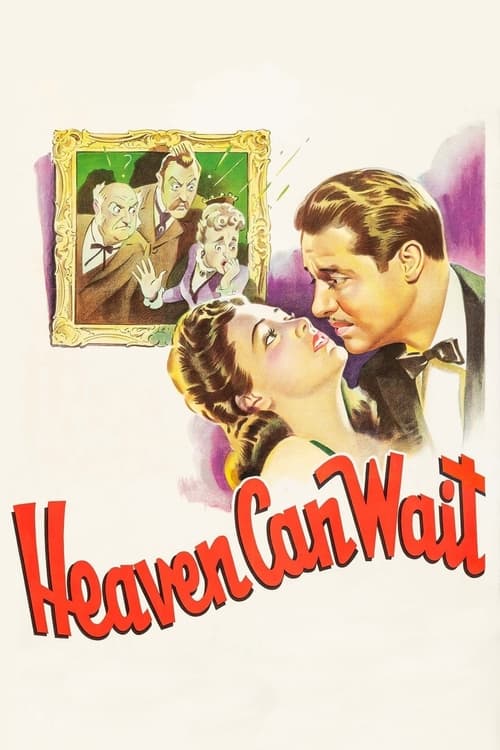
Heaven Can Wait
1943 · Ernst Lubitsch
For a cozy, civilized evening when you want to be charmed rather than challenged — a comfort watch about love, mischief, and mortality that leaves you misty and smiling. Good when you want something old Hollywood that's genuinely funny and quietly wise about long marriages.
What it's about
A New York playboy from three generations of money dies and presents himself at the gates of Hell, certain seventy years of self-indulgence have earned him a spot. The courteous devil isn't convinced, so Henry Van Cleve makes his case by recounting his whole life — a Gilded Age boyhood, a long marriage to the woman he stole from a stuffy cousin, and a career of charming misbehavior. The comedy is that his confession keeps coming out as a love story.
The experience
Warm, wry, and unhurried, with wit that works by implication rather than punchlines — the jokes land a beat after the cut. It sneaks up on you: what starts as a droll fantasy about damnation turns quietly moving as the decades roll by, and the last stretch has a tenderness about aging and marriage that catches people off guard.
Performances
Don Ameche gives Henry a self-delighted charm that never curdles, aging convincingly across seventy years, and Gene Tierney makes Martha far more than the wronged wife. Charles Coburn nearly steals the picture as the impish grandfather who's Henry's true co-conspirator.
The craft
Lubitsch's first film in Technicolor, and the plush period interiors — nurseries, parlors, a whole vanished New York — glow in it. The structure is a life told through birthdays, an elegant relay of ellipses where what's skipped is as expressive as what's shown; the famous Lubitsch discretion means the film says risqué things without ever saying them out loud.
Why it matters
A landmark of the sophisticated Hollywood comedy and one of the defining works of Lubitsch's late career — proof that the lightest touch in movies could carry real feeling about death, fidelity, and forgiveness. Its generosity toward human weakness has made it a touchstone for comedy directors ever since.
Snapshot
Ernst Lubitsch's Heaven Can Wait is a comedy about damnation that declines to damn anyone. Henry Van Cleve — New York money, three generations of it — presents himself at the reception hall of Hell, confident he has earned the place. "His Excellency," a courteous executive in evening dress, requires a full accounting, and Henry supplies one: seventy years of pleasant misbehavior, organized around birthdays, from a nursery in 1872 to a sickroom in the early 1940s. The self-indictment fails. What Henry offers as evidence of a wasted life reads, in the telling, as a record of affection, loyalty, and ordinary human failure — and Hell has standards.
Made at 20th Century-Fox in three-strip Technicolor and released in August 1943, it was Lubitsch's first color film and his penultimate completed picture; he directed only Cluny Brown (1946) afterward before his death in 1947. It earned Academy Award nominations for Best Picture, Best Director, and Best Color Cinematography, losing all three in the year of Casablanca. Structurally it is unlike almost anything else in his filmography — not a compressed boudoir farce but a seventy-year chronicle — and yet it is the most concentrated demonstration of his method: the reticent camera, the closed door, the dramatic climax withheld and handed to the audience to complete. The film's central proposition is theological and quietly radical for Hollywood in 1943: lust is not the sin that matters, and cruelty is.
A persistent confusion attends it. The title was acquired from Harry Segall's play Heaven Can Wait, which had already been filmed as Here Comes Mr. Jordan (1941) and would be remade under the original title by Warren Beatty and Buck Henry in 1978. Lubitsch's film has no connection to any of them beyond the words on the poster.
Industry & production
Lubitsch came to Heaven Can Wait from an unusual position of strength and an immediate commercial disappointment. He had been briefly head of production at Paramount in the mid-1930s — the only major director of the era to hold such a post — and had made To Be or Not to Be (1942) independently for Alexander Korda's United Artists release. That film's reception was clouded by its subject and by the death of Carole Lombard in January 1942; it was not the hit its maker needed. Fox, under Darryl F. Zanuck, gave Lubitsch a producer-director contract, and Heaven Can Wait was made under his own production supervision — an arrangement that in the studio era meant real autonomy over casting, script, and cut.
The source was Birthday (Születésnap) by the Hungarian dramatist Leslie Bus-Fekete, one of the Central European playwrights whose work fed the Hollywood sophisticated comedy throughout the 1930s. The screenplay is by Samson Raphaelson, Lubitsch's most frequent and most sympathetic writer, in what would be their final collaboration. English-language scholarship on the play itself is thin, and it is safest to say only what the record supports: the adaptation departs substantially from its source, retaining the device of a life reviewed for judgment while inventing the Van Cleve dynasty, the Kansas Strabels, and most of what audiences remember.
The Production Code Administration was a live obstacle. A comedy in which Hell is a well-appointed hotel lobby, the Devil is charming, adultery is treated as a survivable domestic episode, and a self-confessed sinner is turned away from perdition on the grounds of insufficient wickedness ran against several of the Code's explicit provisions on the treatment of religion and the punishment of sin. The surviving correspondence documents friction over the depiction of the infernal and over Henry's extramarital straying; the finished film's strategy — everything indecent happens behind a door, and the moral verdict is delivered by a figure of impeccable manners — is as much a Code solution as an aesthetic one. It is worth noticing how completely Lubitsch converts the constraint into style.
Casting drew on the Fox contract roster: Don Ameche, a studio utility leading man, in the role that would define him; Gene Tierney, twenty-two and early in a career Fox was still shaping, as Martha; and a deep bench of character players — Charles Coburn, Eugene Pallette, Marjorie Main, Spring Byington, Louis Calhern, Allyn Joslyn, Signe Hasso, and Laird Cregar as His Excellency. The picture was a commercial success; precise figures vary across sources and are not worth guessing at here.
Technology
The decisive technical fact is Technicolor. By 1943 the three-strip process was a mature but expensive and jealously administered technology, licensed with Technicolor's own cameras, technicians, and the color-control supervision of Natalie Kalmus, credited here as usual. At Fox the process was overwhelmingly reserved for musicals and spectacle — Betty Grable vehicles, Latin American revues, outdoor adventure. Spending it on an intimate, dialogue-driven domestic comedy was a statement of intent about the picture's seriousness, and Lubitsch's first encounter with the medium after two decades of black-and-white.
The practical burdens were real. The three-strip camera was a large, blimped beam-splitter unit requiring high light levels, which pushed against the soft, low-key modeling that Lubitsch's interiors had traditionally used and made the fluid camera moves of the silent era costly to stage. The film's answer is to hold still: long, evenly lit, frontally composed takes in which color does the work that shadow used to. The palette is deliberately dampened — creams, wine reds, mahogany, muted period wallpapers — with saturated color deployed as punctuation rather than as continuous spectacle, against the house tendency of Kalmus-era Technicolor toward the maximally vivid.
Otherwise the film is a textbook of standard 1943 studio technology: Academy ratio 1.37:1, a single-channel optical soundtrack, sets rather than locations, and the optical printer doing the heavy lifting of a seventy-year chronicle through dissolves. Aging across the decades is handled with makeup, costume, and performance rather than any process trickery, and the film's time transitions are carried almost entirely by the dissolve and the cut to a new birthday.
Technique
Cinematography
Edward Cronjager, a Fox veteran and one of the more reliable Technicolor operators of the period, received an Oscar nomination for the photography. The style is emphatically classical: eye-level, symmetrical, unhurried, with camera movement reserved for entrances and for the traversal of the Van Cleve interiors. Lubitsch's habitual framing device is a doorway, and Cronjager lights the film so that the depth beyond a door — the next room, the hallway, the stairs — remains legible. A great deal of Heaven Can Wait is about what is happening in the space we can see but are not being shown.
Two registers coexist. The Hell frame is stylized and slightly abstract: polished marble, dark reds, a sourceless glow, an elevator. The remembered life is warmer and more particular, lit to flatter period fabric and skin. The film's most quoted image — Martha in a scarlet dress at the top of a staircase — works because the surrounding palette has been kept so disciplined that a single strong color registers as an event.
Editing
Dorothy Spencer, another Fox contract professional (she had cut Stagecoach), edits in the manner Lubitsch's staging dictates: few cuts within scenes, dialogue played out in sustained two-shots and masters, coverage used sparingly and pointedly. The consequential editing is structural rather than local. The film's rhythm is a series of tableaux separated by dissolves that swallow years, and its boldest cuts are the ones that skip the scene an ordinary picture would consider obligatory. An elopement is prepared and then simply has happened. A marital rupture is repaired somewhere we cannot see. Martha's death — the emotional center of the last act — is not staged at all; the film moves from her presence to Henry's solitude and lets the gap do the work. This is elision as dramaturgy, and it is the single most transferable thing in Lubitsch's technique.
Mise-en-scène / staging
The production design by James Basevi and Leland Fuller, with costumes by René Hubert, tracks American taste from gaslight through the Gilded Age to art deco, and the sets are constructed as social diagrams: the Van Cleve brownstone with its staircase and its serried doorways, the Strabel dining room in Kansas as a monument to meatpacking money, Hell's antechamber as the lobby of a very good hotel.
Lubitsch stages for the long shot and for the object. The famous Strabel breakfast — Eugene Pallette and Marjorie Main, husband and wife in a state of total nonverbal war, reading rival funny papers and dividing a sausage with the manners of duelists — is a scene of pure staging, virtually without dialogue, and it tells you everything about the marriage the film has otherwise declined to explain. The bookshop sequence in which Henry poses as a clerk to intercept his cousin's fiancée is built the same way: the joke lives in blocking, in the position of bodies relative to a counter, and in what a book title reveals about the woman holding it.
Sound
Alfred Newman, Fox's music director and one of the studio system's defining composers, supplies a score that is notably restrained by 1943 standards — period-flavored, waltz-inflected, and willing to fall silent. Lubitsch had trained the industry in how to use sound sparely; here the silences carry as much as the underscoring. The Strabel breakfast plays on cutlery and newsprint. Offscreen sound repeatedly does the narrative work the camera refuses: a door closing, a voice from another room, an argument overheard. The mono optical track's limited dynamic range is used as a constraint to design around rather than fought.
Performance
Don Ameche gives the performance of his career, and the film depends on it absolutely: he must be charming enough that we forgive Henry, and honest enough that Henry's late-life self-reckoning is not a joke. The aging — from a young man's spring to a seventy-year-old's careful economy of movement — is built from posture and tempo rather than prosthetics. Gene Tierney is the discovery; Martha requires wit, coolness, and a suggestion of appetite under decorum, and Lubitsch, a famous drillmaster of comic timing, gets it from her. Charles Coburn's Grandpa Hugo is the film's moral conspirator, the one relative who understands that Henry's failings are venial. Laird Cregar — who would be dead within two years, at thirty-one — plays the Devil as a discreet hotelier, and the entire theological argument of the film rests on his manner.
Narrative & dramatic mode
The film is a framed retrospective chronicle: a judgment scene that opens into a life. Formally this is closer to Citizen Kane territory than to Trouble in Paradise, and Lubitsch is candid about the risk — after the opening, the frame all but disappears, returning only to close the argument. The organizing unit is the birthday, an inherited device from the source play, which converts a shapeless span of decades into a countable series.
The narration is unreliable in a specific and productive way: Henry is prosecuting himself, so his account foregrounds his transgressions and buries his kindnesses, while the images consistently supply the exculpatory material he neglects to mention. The dramatic irony is therefore inverted — we know the verdict before he does, and the pleasure is watching a man fail to make his own case for damnation.
The mode is comic but the arc is elegiac. The last third moves steadily toward diminishment: a widower's flirtation with a chorus girl that is more melancholy than lecherous, a son who has become the responsible adult, a nurse, a final birthday. That Lubitsch made this in the same year he suffered serious heart trouble has encouraged valedictory readings, which the film supports without requiring.
Genre & cycle
Heaven Can Wait sits at the intersection of two 1940s formations. The first is the wartime afterlife cycle — Here Comes Mr. Jordan (1941), A Guy Named Joe (1943), Between Two Worlds (1944), The Horn Blows at Midnight (1945), A Matter of Life and Death (1946), Angel on My Shoulder (1946), It's a Wonderful Life (1946), The Bishop's Wife (1947) — a remarkable concentration of celestial bureaucracy in a period of mass death, offering audiences an administered, reasonable, and above all survivable cosmos.
The second is the Technicolor nostalgia film, the studios' turn toward a pre-modern American past: The Magnificent Ambersons (1942), Meet Me in St. Louis (1944), and the broader vogue for gaslight Americana. Heaven Can Wait participates in both while conspicuously refusing the war itself. Henry's death lands in the early 1940s and the conflict is nowhere in the film — an absence that reads less as evasion than as the point: this is a picture about private life offered to an audience with very little of it left.
Beneath both cycles it remains a Lubitsch sophisticated comedy, with the class-comedy machinery of old New York money meeting Kansas meatpacking fortune fully intact.
Authorship & method
Lubitsch is the rare studio-era director whose signature acquired a trade name in his own lifetime. The "Lubitsch touch" is often described as innuendo, which undersells it; it is more precisely a contract with the audience, in which the camera withholds the decisive action and the spectator supplies it. Billy Wilder, who wrote for Lubitsch and revered him, is documented as keeping a sign in his office reading "How would Lubitsch do it?" — the profession's most concise acknowledgment of a method.
Samson Raphaelson is the indispensable collaborator. Their partnership runs from The Smiling Lieutenant (1931) through Trouble in Paradise (1932), The Merry Widow (1934), Angel (1937), and The Shop Around the Corner (1940) to this film, and Raphaelson's later memoir writing about the friendship remains a primary source on how the two worked — dialogue built for rhythm, scenes constructed so that the funniest line is the one not spoken. Cronjager, Spencer, Newman, Basevi, Fuller, and Hubert were Fox house talent rather than a personal unit; the achievement is that the film sounds and looks unmistakably like Lubitsch anyway, which says something about how completely his method resided in staging and structure rather than in a crew.
Movement / national cinema
Lubitsch is the central figure of the German-to-Hollywood emigration, and the earliest: a UFA star director of costume spectacles and comedies who arrived in 1922 and did not return. He is the conduit by which the Central European operetta sensibility — Vienna, Budapest, the boulevard comedy of manners, the assumption that adults have sexual lives — entered American film and became the "sophisticated comedy." Bus-Fekete's Hungarian source is not incidental; it is the tradition itself.
By 1943 that Continental strain had been thoroughly assimilated, and Heaven Can Wait is the paradoxical case: a European moral sensibility applied to an all-American subject, a chronicle of Manhattan and Kansas capital written in the grammar of Viennese comedy. Its permissiveness about desire and its severity about unkindness are both European; its brownstones and its meatpacking money are not.
Era / period
1943 is the American studio system at maximum efficiency and maximum wartime obligation. Heaven Can Wait is a picture that meets none of those obligations directly and answers the moment obliquely — with a seventy-year past rendered in color, and a hereafter run on principles of decency rather than punishment. The Production Code was at its most vigorous; Technicolor was at its peak of scarcity and prestige; the contract system made a cast this deep in character actors routine. Within a year and a half Laird Cregar would be dead, Lubitsch would be working under medical restriction, and the confident studio classicism the film exemplifies would begin its slow dissolution.
Themes
The film's governing subject is moral accounting, and its argument is that most people misjudge their own ledgers. Henry catalogs appetite; the film records fidelity of a durable if imperfect kind, generosity, and a marriage that outlasted its own crises. Lubitsch's ethics are consistent across his work and stated most plainly here: sins of the flesh are trivial, and the real offenses are coldness, vanity, and the wounding of people who love you.
Running alongside is a study of marriage as a long comic negotiation. The Strabels — locked in decades of silent hostility over the breakfast table — are the film's warning; Henry and Martha's twenty-five years, with their rupture and unnarrated repair, are its proposal. Lubitsch declines to sentimentalize either: what makes the marriage good is not passion but the willingness to keep showing up.
Third is time itself. The birthday structure makes aging the film's real antagonist, and its final movement is unusually clear-eyed for a 1943 comedy about the pathos of an aging charmer who can still perform charm and no longer has anyone to perform it for. Threaded through all of it is class: three generations of Van Cleve money observed with affection and no illusions, a dynasty whose defining product is Henry.
Reception, canon & influence
Contemporary notices were broadly favorable, and the Academy's three nominations — Picture, Director, Color Cinematography — register the industry's regard, though the film won nothing in a year dominated by Casablanca. Some reviewers at the time found it slight or over-extended, a fair reaction to a chronicle structure from a director known for compression. It performed well commercially.
Backward, its debts are legible: the Hungarian boulevard comedy of Bus-Fekete and Molnár; Lubitsch's own UFA training in visual storytelling; the flashback-inquest architecture that Citizen Kane had made newly available two years earlier; and the immediate precedent of Here Comes Mr. Jordan (1941) for celestial bureaucracy — a connection made confusing rather than clarifying by the shared title.
Forward, its reputation rose steadily. Herman Weinberg's The Lubitsch Touch (1968) made the case for Lubitsch as a systematic artist; Andrew Sarris placed him in the Pantheon in The American Cinema; François Truffaut, in the essay collected as "Lubitsch Was a Prince," argued for him from the French side. Later scholarship — William Paul's Ernst Lubitsch's American Comedy (1983), James Harvey's Romantic Comedy in Hollywood (1987), Scott Eyman's biography Laughter in Paradise (1993), Kristin Thompson's Herr Lubitsch Goes to Hollywood (2005) — has generally treated Heaven Can Wait as one of the essential late works, and its Criterion Collection release consolidated that standing for home viewers.
Its influence operates on two levels. The narrow one is structural: the comic afterlife tribunal in which a life is screened and argued over, a device that resurfaces most directly in Albert Brooks's Defending Your Life (1991). The broad one is methodological, and larger. Wilder carried the ellipsis and the trust-the-audience principle into The Apartment and Avanti!; the whole American tradition of adult romantic comedy that declines to moralize about sex descends from this line. Among contemporary directors, Wes Anderson has repeatedly named Lubitsch as a model, and the mannered, symmetrical, melancholy-under-farce register of The Grand Budapest Hotel is a legible inheritance.
The film's most durable bequest, though, is the closed door — the discovery that the scene you refuse to show becomes the scene the audience remembers having seen. Every filmmaker who cuts away at the decisive moment and lets the viewer finish the thought is working, knowingly or not, in the tradition Heaven Can Wait refined to its clearest form.
A Deleuzian reading
A door closes and Lubitsch leaves the camera where it was.
The full Deleuzian reading of Heaven Can Wait →
Reception
A solid hit in 1943 but treated by some contemporary critics as minor Lubitsch, it has since been fully canonized — a Criterion release and a regular pick among the director's two or three supreme achievements.
How Heaven Can Wait was received, from release to now →
How to watch Heaven Can Wait: what to notice on a first viewing
- Watch how often a doorway frames the edge of a scene. Lubitsch's habitual device is a doorway, and Cronjager lights the depth beyond it, the next room, the hallway, so it stays visible but unexplained. A great deal of the story happens in the space you can see but are never shown directly.
- Notice how many big moments the film simply skips over. An elopement is prepared and then it has already happened; a rupture gets repaired somewhere off screen, with dissolves swallowing whole years between scenes. You are constantly handed the after, not the event, and asked to fill in what happened.
- Watch a married couple divide a sausage without saying a word. The Strabel breakfast plays almost entirely on cutlery and rival newspapers, staged like a duel, and it tells you the whole marriage without a line of dialogue. A whole marriage gets explained through breakfast props instead of a single spoken argument.
- Watch how disciplined the color stays until one scarlet dress arrives. The film keeps its palette dampened, creams and wine reds and mahogany, so that when Martha appears in scarlet at the top of the stairs it registers as an event. One strong color lands harder because the film has kept everything else so restrained around it.
- Watch Henry describe his life as worse than it looks. Ameche plays him prosecuting himself, foregrounding every transgression while the film quietly keeps showing you the kindness he forgets to mention. You end up knowing more about the case than the man testifying does himself.
The whole guide to watching Heaven Can Wait, with the keys for a rewatch →
Influences: the films it descends from and the films it influenced
- The Marriage Circle (1924) — The silent template for the doorway-and-reaction grammar: an entire adultery plot staged through who enters which door and what a face does after it shuts, the wordless comic tableau Heaven Can Wait reruns with sound available but unused.
- Trouble in Paradise (1932) — The Raphaelson-scripted origin of the closed-door contract — camera holds on the shut door, the clock, the shadow while the decisive erotic action happens offscreen — the exact elision-as-dramaturgy Heaven Can Wait extends across a whole marriage.
- Design for Living (1933) — Establishes the refusal to adjudicate sexual arrangements: the 'gentleman's agreement' collapses in a cut rather than a confession scene, licensing Henry Van Cleve's philandering to be chronicled without a moral verdict attached.
- Liliom (1934) — Molnár's celestial magistrate's court, where a dead man is retried by a bureaucrat who already holds the complete file on his life — the tribunal architecture Lubitsch converts from expressionist purgatory to drawing-room interview.
- The Shop Around the Corner (1940) — Perfects the set-as-social-diagram: a single interior whose thresholds, counters and back rooms encode rank and permission, transposed here to the Van Cleve staircase and parlor read across three generations.
- Citizen Kane (1941) — The interrogation-frame chronicle — a life reconstructed as dissolve-linked episodes by narrators with a stake in the telling — which Lubitsch compresses to one unreliable witness testifying about himself to His Excellency.
- Here Comes Mr. Jordan (1941) — Immediate precedent for playing the afterlife as courteous administration — a well-tailored functionary with a desk and a paperwork problem — the register Laird Cregar's Excellency inherits and reduces to pure understatement.
- Blood and Sand (1941) — Fox's demonstration that three-strip Technicolor could be keyed to old-master painting rather than spectacle, desaturated and controlled through costume and drape — the restrained-palette method Cronjager continues on this picture.
- A Matter of Life and Death (1946) — Escalates the celestial tribunal into full forensic argument over one man's earthly record, and, like Lubitsch, makes the color scheme itself the dramaturgy — Technicolor earth against monochrome heaven.
- Sunset Boulevard (1950) — Wilder pushes the posthumous first-person frame to its limit: the dead man narrating his own life backward, with the same ironic gap between what the voice claims and what the images show.
- The Apartment (1960) — 'How would Lubitsch do it?' in practice — the compromising events are withheld and carried by props and thresholds (the key, the cracked-mirror compact, the bathroom door), trusting the viewer to complete an adult situation uncommented.
- Avanti! (1972) — Late Wilder deliberately restaging the Lubitsch tempo: a long-form adult comedy of an affair built on elisions, repeated doorways and offscreen decisions, declining sentiment and moral resolution alike.
- Barry Lyndon (1975) — A rake's entire life told as dissolve-separated chapters beneath an ironic narrator whose account quietly contradicts the images — the unreliable retrospective chronicle promoted from comic device to structural principle.
- Defending Your Life (1991) — The most literal inheritance of the structure: the afterlife as a mild administrative facility where a man's life is screened, litigated and judged on precisely the episodes he would prefer not to discuss.
- The Grand Budapest Hotel (2014) — Nested retrospective narration and frontal, symmetrical doorway staging avowedly modeled on Lubitsch — farce played across thresholds in decor that maps social rank, with the melancholy carried by what the cut refuses to show.
- The Devil's Eye (1960) — A Don Juan-type protagonist pleading his romantic history before the Devil in an infernal bureaucracy using theatrical flashback framing — the specific structural conceit of Hell as moral tribunal for a seducer that Bergman's film directly echoes, down to the comic bureaucratic register of the afterlife.
- Eternity (2025) — Structures a whole life's romantic history as testimony delivered in the afterlife's antechamber, applying a light comedy-of-manners register to eschatology rather than solemnity.
- The Magnificent Ambersons (1942) — Parallel experiment in the decades-chronicle: ironic offscreen narration laid over dissolve-elided years, with a great house's rooms and staircase serving as the literal diagram of a family's social decline.
- Meet Me in St. Louis (1944) — Period Technicolor Americana in the same low-saturation register — turn-of-the-century decor lit for warmth rather than brightness — with a family's chronicle segmented into title-and-dissolve episodes staged almost entirely inside one house.
- Cluny Brown (1946) — Lubitsch's last completed film applies the identical method to class instead of marriage: status is read off who may enter which room, and the plumbing running-gag hands the innuendo entirely to the audience to assemble.
Similar films
- Trouble in Paradise (1932) — influence & lineage
- A Matter of Life and Death (1946) — influence & lineage
- The Shop Around the Corner (1940) — influence & lineage · often watched together
- Charade (1963) — often watched together
- Laura (1944) — often watched together
- The Big Sleep (1946) — often watched together
- To Be or Not to Be (1942) — shared sensibility
- Leave Her to Heaven (1945) — shared sensibility