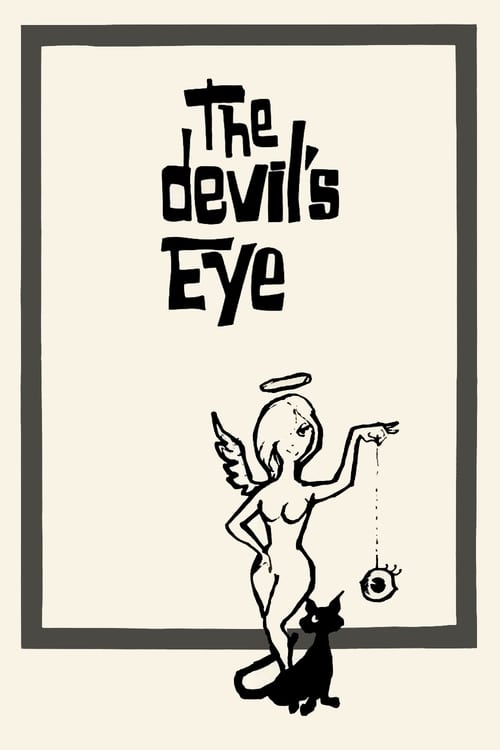
The Devil's Eye
1960 · Ingmar Bergman
For a mischievous, low-stakes evening when you want something witty and old-fashioned — a comfort watch for people who like their romantic comedy with a whiff of brimstone and a raised eyebrow.
What it's about
A pastor's daughter in Sweden is so serenely virtuous that her purity gives the Devil a sty in his eye — so Hell dispatches its most decorated specialist, Don Juan, to seduce her before her wedding and restore the infernal order of things. The complication: for the first time in three hundred years, the great seducer starts to actually feel something.
The experience
Light, wry, and stagey in the best sense — a talky, elegant comedy of temptation that keeps winking at you through a narrator who addresses the audience directly. It's Bergman at play, with melancholy peeking through the jokes.
Performances
Jarl Kulle plays Don Juan with silky, wounded vanity — a legend discovering his own obsolescence — opposite Bibi Andersson, whose warmth and mischief make the 'pure' daughter anything but a prop.
The craft
Polished studio black-and-white, deliberately theatrical staging, and a framing narrator that turns the whole film into a wicked little parable performed for your benefit. It's a reminder that Bergman's craft worked just as precisely in a minor key as in his heavyweight dramas.
Why it matters
A curio in Bergman's canon — a comic breather made between his most demanding pictures — it shows the lighter, theatrical side of a director the world knows for anguish, and it's a favorite rediscovery for people working through his filmography.
Snapshot
Djävulens öga (The Devil's Eye) is a self-consciously theatrical comedy in which Satan dispatches Don Juan from Hell to seduce a Swedish pastor's virgin daughter, whose intact purity has lodged a sty in the Devil's eye. Bergman shoots it in polished studio black-and-white, frames it with a narrator who addresses the audience directly, and builds the comic engine around a seducer who, for the first time in several hundred years, falls genuinely in love with the woman he has been sent to corrupt. Among the director's most unusual works — a deliberate holiday between two extremely demanding pictures — it occupies an odd corner of his canon: too playful to satisfy devotees of the silence-of-God trilogy, yet too inward to win mainstream comedy audiences. Its real interest lies in how thoroughly Bergman subordinates his habitual metaphysical weight to wit and choreographic staging, and in how thoroughly the film's light surfaces still conduct his persistent themes of faith, deceit, and the failure of pure seduction to pierce genuine innocence.
Industry & production
The film was produced by Svensk Filmindustri (SF), the Stockholm studio that had been Bergman's institutional home since the late 1940s. SF gave Bergman considerable creative latitude by 1960; his extraordinary run of international successes — Smiles of a Summer Night (1955), The Seventh Seal and Wild Strawberries (1957), The Magician (1958) — had made him both a prestige asset and a bankable art-house director. The Devil's Eye was shot in close proximity to The Virgin Spring (released early 1960), which won the Academy Award for Best Foreign Language Film that year, giving SF additional commercial reason to support even a lighter project.
Bergman adapted the screenplay from a Danish radio play, Don Juan Returns (Don Juan vender hjem), written by Oluf Bang and broadcast in the late 1930s. The source text is modest in scope — essentially a chamber piece built around a single comic inversion — and Bergman retained that intimacy while reframing it within a theatrical presentational style borrowed in part from Molière and from the conventions of Swedish popular theater. The production values are elegant but economical: the film is shot almost entirely on studio sets, with no location work to speak of, which concentrates expense and energy on décor, costume, and performance rather than exterior photography. The shoot was completed relatively quickly by Bergman's standards; available scholarship does not provide a precise day count, but the studio-bound schedule and the ensemble's familiarity with Bergman's methods kept the production disciplined.
Technology
The film was shot in Academy-ratio black-and-white on 35mm, as was standard for Swedish prestige production at the time. The controlled studio environment allowed for a lighting grammar of sharp contrasts and deliberate, painterly compositions without the complications of exterior shooting. No significant proprietary technical innovation is associated with the production; its interest is in how existing tools are deployed with refinement rather than novelty. Bergman and his collaborators were, by this point, working with a fully consolidated visual vocabulary, and The Devil's Eye does not push that vocabulary outward so much as apply it with elegant economy.
Technique
Cinematography
Gunnar Fischer, who had served as Bergman's principal director of photography throughout the great 1950s run, shot The Devil's Eye. It was among his final collaborations with the director before Sven Nykvist assumed the role from Through a Glass Darkly (1961) onward. Fischer brought to the film the luminous, high-contrast studio style he had refined across The Seventh Seal, Wild Strawberries, and The Magician — pools of directed light against deep shadow, faces sculpted rather than merely illuminated. For The Devil's Eye, however, the register shifts: the darkness that carries existential dread in The Seventh Seal is here redeployed for rococo theatricality. The Hell sequences are elegantly lit in a way that suggests theatrical backdrop rather than genuine menace; the pastoral Swedish interiors are rendered with a bright, crisp cleanliness that codes innocence. Fischer and Bergman use the contrast not to invoke mortality but to sustain a tonally controlled comic gap between two irreconcilable worlds.
Editing
The editing is crisp and subordinated to the rhythm of spoken performance. Bergman's usual editor from this period, Oscar Rosander, had long since internalized the director's preference for extended takes that allowed actors to complete emotional arcs uninterrupted by coverage cuts. The Devil's Eye maintains this preference: scenes play out at a pace governed by dialogue rather than by cutting rhythm, reinforcing the theatrical quality. The film's episodic structure — scenes of hell interspersed with scenes on earth — relies on clean spatial transitions rather than montage sophistication; the editing is the least conspicuous element of the film's technique, which in this context is precisely correct.
Mise-en-scène / staging
The staging is the film's most consistent pleasure. Bergman arranges his performers within the frame with the choreographic precision he had learned from theater direction at the Gothenburg City Theatre and the Malmö City Theatre; actors are rarely left simply to occupy neutral space. Scenes of seduction are arranged as a series of careful advances and retreats, using the geometry of rooms to externalize power relations. The Hell sequences are staged as a kind of infernal court — formal, hierarchical, and faintly absurd. Bergman uses doorways, mirrors, and furniture as strategic blocking devices: Britt-Marie's inability to be moved by Don Juan's performance is registered spatially as well as verbally, her stillness a kind of architecture the seducer cannot breach. The theatrical prologue device, in which a narrator addresses the camera and the audience directly, frames the entire film as a stage production witnessed rather than a world entered, and this meta-theatrical frame governs the mise-en-scène throughout — everything is slightly stylized, slightly posed, as if the characters are conscious of performing for a higher audience.
Sound
Erik Nordgren, Bergman's regular composer throughout the 1950s, arranged the film's score primarily from keyboard sonatas by Domenico Scarlatti. The choice is apt: Scarlatti's mid-eighteenth-century Italian style carries the aristocratic elegance and playful formalism appropriate to the Don Juan tradition, and the harpsichord timbre associates the infernal figures with a world both historical and otherworldly. Nordgren's arrangements are light-handed, used to underscore transitions and to sustain the film's comic elegance rather than to comment heavily on emotional content. The dialogue-driven scenes are largely free of underscore, letting the rhythm of performance carry weight. The overall sonic world is polished and pleasantly distanced — of a piece with the film's theatrical self-consciousness.
Performance
The ensemble is drawn from Bergman's established repertory company, deployed against type in some cases. Jarl Kulle plays Don Juan — a casting choice that leverages the actor's natural elegance and physical confidence while asking him to project a seducer's certainty that is gradually, and somewhat ruefully, undermined by genuine feeling. Kulle had appeared in Smiles of a Summer Night (1955) in a different comic register, and he brings comparable wit and a kind of graceful vanity to the Don Juan role. Bibi Andersson plays Britt-Marie, the pastor's daughter, and her performance turns on the difficult task of being innocently unmoved without being merely passive — she must read as a real person, not a cardboard virtue. Andersson accomplishes this through a kind of serene naturalness that never becomes vapid. Nils Poppe, who played the gentle fool Jof in The Seventh Seal, here plays the bumbling pastor with a domestic comedy that domesticates the theological without dismissing it. Gunnar Björnstrand, arguably Bergman's most versatile repertory actor, plays the Master (Don Juan's servant Pablo's superior in Hell — actually, to be precise, the cast assigns Stig Järrel to Satan and Björnstrand to a different role; the exact configuration of the infernal court is somewhat intricate). Stig Järrel takes the role of Satan with a dry, bureaucratic menace that suits the film's conception of evil as tedium rather than terror.
Narrative & dramatic mode
The narrative is a comic inversion: the mechanism designed to compromise innocence instead confirms it, and the agent of seduction is himself seduced — not by the object of his mission but by the experience of genuine feeling after centuries of mere performance. Bergman structures this inversion with clean causal logic: Don Juan cannot seduce Britt-Marie because she is genuinely, unaffectedly in love with her fiancé, and this reality simply does not admit the theatrical seducer's repertoire. The comedy is not raucous but dry; it operates through juxtaposition and through the slow deflation of Don Juan's professional confidence. A subplot involving Pablo's attempted seduction of the pastor's wife provides comic counterpoint and allows Bergman to stage the same dynamic at a lower, more farcical register. The film's dramatic mode is consistently that of the comedy of ideas: the wit is philosophical, the laughs are conceptual rather than slapstick.
Genre & cycle
The Devil's Eye belongs to the tradition of Don Juan comedy that runs from Molière's Dom Juan (1665) through Mozart and Da Ponte's Don Giovanni (1787) and into the twentieth century via Shaw's Man and Superman (1903). Bergman's version is closest in spirit to the strand of that tradition that finds the Don's invincibility comic rather than tragic — closer to Shaw or to the opera buffa dimension of Don Giovanni than to the romantic damnation of Byron. Within Bergman's own career it stands as the second of his two major comedies (after Smiles of a Summer Night, which was more tonally complex), and as such participates in a minor tradition of Scandinavian literary comedy grounded in erotic farce, formal wit, and class observation.
Authorship & method
Bergman wrote the screenplay himself, adapting Bang's radio play with a free hand — the theatrical framing device, the infernal bureaucracy, and the emotional specificity of the seduction scenes are all his additions. His method in this period combined intense pre-production with actors drawn from his existing theatrical ensemble, which allowed him to move through rehearsal quickly because the performers already had internalized his directorial language. The collaborators are the familiar inner circle: Fischer behind the camera, Nordgren handling music, and a cast that had worked with Bergman extensively on stage and screen. The Devil's Eye required a different mode from Bergman than his more existentially demanding films — a lighter touch, a more externalized comic rhythm — and he appears to have embraced the change of register deliberately, treating the project as a professional exercise in a different kind of craft.
Movement / national cinema
The film is squarely within the Swedish art-cinema tradition that Bergman had done more than anyone to establish internationally during the 1950s. Swedish cinema of this period was associated abroad almost exclusively with Bergman's vision, and The Devil's Eye — even in its lighter mode — participates in that brand identity: the aesthetic seriousness, the studio craftsmanship, the literary source material, the recurring ensemble. It has no real relationship to the French New Wave emerging simultaneously or to the Italian commedia cycles; its register is closer to the stylized literary film-theater hybrid that Bergman had developed from Swedish theatrical culture.
Era / period
Made at the hinge between Bergman's extraordinary 1950s run and the chamber-drama trilogy of the early 1960s, The Devil's Eye occupies a genuinely unusual moment in the director's career. The films immediately surrounding it — The Virgin Spring before, Through a Glass Darkly after — are works of concentrated darkness and formal severity. The Devil's Eye functions as a comic interlude, a breath before the trilogy's austere inquiry into faith and silence. Historically it appears in 1960, the year of the New Wave's first wide international recognition (À bout de souffle, Les quatre cents coups) and the year Antonioni released L'avventura — a moment when European art cinema was undergoing rapid formal revolution. The Devil's Eye does not participate in that revolution; it draws, instead, on an older set of theatrical and literary conventions, which is part of what makes it feel slightly out of time even within its own moment.
Themes
The film's central preoccupation is the relationship between performance and reality in erotic life. Don Juan is a pure performer: his seductions are theatrical events, not genuine encounters. Britt-Marie defeats him not through superior cunning or moral fortitude but through the simple fact of being real — she actually loves her fiancé, and this reality is impervious to theatrical manipulation. The film thereby suggests that genuine feeling is the one force that performance cannot simulate or overcome. Running alongside this is a characteristic Bergman interest in faith and innocence not as naïve states but as forms of psychological wholeness that secular sophistication cannot replicate. Satan's bureaucratic discomfort — the sty in his eye — is caused not by aggressive virtue but by undefensive happiness, which is precisely what Hell cannot abide. There is also a self-reflexive dimension: a seducer who performs emotions he does not feel eventually experiencing a real emotion he does not know how to use is a figure for the artist — or the actor — confronting the gap between craft and feeling.
Reception, canon & influence
Critical reception. The Devil's Eye received respectful but notably cooler notices than the major Bergman films of the preceding five years. Critics recognized the professional accomplishment but consistently positioned it as a minor work — divertimento rather than achievement. The film is widely cataloged in Bergman scholarship as a deliberate detour, and most monographs on the director cover it briefly. It has not been subject to significant critical revaluation in the way that, say, Smiles of a Summer Night has been reconsidered as a more complex work than its comic surface suggested.
Influences on the film (backward). The Don Juan tradition provides the primary literary substrate: Molière, Mozart/Da Ponte, Shaw, and possibly the Kierkegaard essay on Don Giovanni from Either/Or (1843), in which Kierkegaard analyzes the Don as an embodiment of the erotic principle against the ethical and the religious. Bergman's theological shaping of the material — in which the sty-in-the-Devil's-eye conceit reframes purity as a supernatural irritant rather than simply a moral fact — suggests awareness of this philosophical tradition. The film's prologue-and-narrator device reflects Bergman's theater practice and his long engagement with the conventions of Swedish popular and literary theater; it has formal precedents in his own earlier work and in the Brechtian influence that had permeated European theater in the 1950s.
Legacy / what it shaped (forward). The film's legacy is thin in the sense that it generated no direct line of influence within world cinema; its specific approach to the Don Juan material was not widely imitated. Within the Bergman canon it matters primarily as evidence of the director's range and as a structural marker between the 1950s films and the silence trilogy. For scholars, it offers a useful counter-case: a Bergman film that deliberately brackets his most characteristic preoccupations allows clearer identification of what those preoccupations actually are. Its afterlife is primarily in retrospective programming, in complete Bergman retrospectives, and in scholarly discussion of his comedy — a mode that remains underexamined in the critical literature relative to the metaphysical dramas.
A Deleuzian reading
A man steps out in front of the story and tells you, plainly, what you are about to watch.
The full Deleuzian reading of The Devil's Eye →
Reception
Landed with a shrug in 1960 — sandwiched between The Virgin Spring and Through a Glass Darkly, it was instantly filed under 'minor Bergman,' and Bergman himself later spoke of it dismissively. It's never really been rehabilitated, though completists periodically insist it's funnier than its reputation.
How The Devil's Eye was received, from release to now →
Influences: the films it descends from and the films it influenced
- La Ronde (1950) — Ophüls' master-of-ceremonies narrator who breaks the fourth wall to present the chain of seductions as theatrical performance is the direct formal model for Bergman's prologue-narrator device, which similarly frames the Don Juan comedy as an explicitly staged spectacle rather than a realist fiction.
- Heaven Can Wait (1943) — A Don Juan-type protagonist pleading his romantic history before the Devil in an infernal bureaucracy using theatrical flashback framing — the specific structural conceit of Hell as moral tribunal for a seducer that Bergman's film directly echoes, down to the comic bureaucratic register of the afterlife.
- Smiles of a Summer Night (1955) — Bergman's own immediate template: Gunnar Fischer's high-contrast studio lighting, the full repertory ensemble in comic mode, and the comedic inversion structure — desire frustrated by moral circumstance — that The Devil's Eye extends into supernatural allegory.
- A Lesson in Love (1954) — First full deployment of the Bergman repertory ensemble as a comedy unit, establishing the blocking grammar of erotic negotiation and the dialectic between sexual performance and authentic feeling that The Devil's Eye inherits and sharpens.
- Waiting Women (1952) — The episodic comedy-of-ideas structure using theatrical confession framing and Fischer's studio cinematography to externalize interior sexual psychology — an early model for The Devil's Eye's segment-within-prologue architecture.
- Trouble in Paradise (1932) — The foundational proposition that seduction is a performance art form where the pleasure lies in the craft of technique itself — the wit-and-timing approach to erotic comedy in which the Don's skill is the film's subject, which Bergman's Don Juan directly inherits.
- The Rules of the Game (1939) — Ensemble staging in which characters' physical positions in space diagram the erotic power relations of a social comedy — the blocking-as-power-geometry technique that Bergman applies to both the infernal scenes and the seduction sequences on Earth.
- Lola Montès (1955) — A showman-narrator presenting a woman's sexual history as theatrical spectacle, making explicit the performance-versus-authenticity tension — the self-consciousness about staging sexuality for an audience that Bergman's prologue narrator device adopts.
- All These Women (1964) — Bergman's only color film and direct extension of the comedy-of-ideas mode tested in The Devil's Eye — same repertory ensemble, same comedic inversion structure, and similarly received as a minor experiment in a register foreign to the director's signature metaphysical concerns.
- Through a Glass Darkly (1961) — The first Chamber Trilogy film using the same ensemble, including Bibi Andersson, with the comic register stripped and the theatricality internalized — The Devil's Eye functions as the tonal pivot from which this deliberate aesthetic reduction becomes legible as a purposeful move rather than a stylistic rupture.
- Don Giovanni (1979) — Filmed opera of the same Don Juan material, inheriting the theatrical-to-cinematic translation problem Bergman faced and resolving it with non-naturalistic mise-en-scène and direct theatrical staging conventions that preserve the material's operatic origins — the same formal challenge approached from the opposite direction.
- Dangerous Liaisons (1988) — Power-geometry staging of seduction as a formal game in which blocking and physical positioning diagram psychological domination — extends the tradition of erotic comedy in which staging technique itself enacts the moral argument, the tradition The Devil's Eye participates in through its infernal-seduction scenes.
- The Magician (1958) — Gunnar Fischer's chiaroscuro studio lighting applied to a systematic investigation of theatrical self-consciousness — performance versus reality as both subject and formal method — made two years prior, the two films jointly constitute Bergman's pre-Chamber Trilogy examination of illusionist artifice.
- The Seventh Seal (1957) — Fischer's high-contrast lighting grammar deployed for metaphysical allegory and direct theatrical staging, including a Death figure who operates as a kind of theatrical interlocutor — the shared visual vocabulary and allegorical-comedy mode that The Devil's Eye transposes into the Don Juan framework.
- The Earrings of Madame de... (1953) — Circular structure tracking how seduction operates as performance rather than genuine feeling, with Ophüls' geometrical staging enacting the moral argument directly — a structural analog to Bergman's conceit that authentic innocence registers as a supernatural irritant precisely because the demonic machinery cannot process it.
Similar films
- The Magician (1958) — influence & lineage
- A Lesson in Love (1954) — influence & lineage
- Smiles of a Summer Night (1955) — influence & lineage
- Heaven Can Wait (1943) — influence & lineage
- The Seventh Seal (1957) — influence & lineage
- Through a Glass Darkly (1961) — influence & lineage
- Viridiana (1962) — shared sensibility
- The Virgin Spring (1960) — shared sensibility