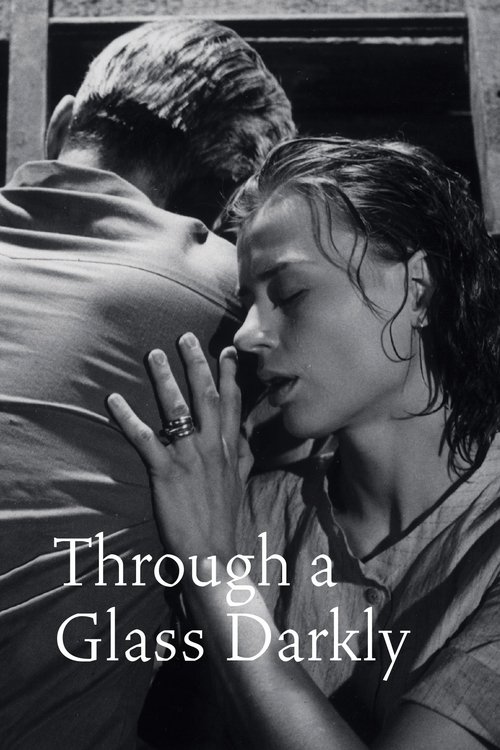
Through a Glass Darkly
1961 · Ingmar Bergman
For when you want to be shaken rather than soothed — a film to chew on for days, about faith, family, and what love owes to someone who is suffering. Demanding, short, and worth it; not one for a light evening.
What it's about
Karin, newly released from a mental hospital, spends a summer with her family on a tiny, bare Baltic island: the husband who cares for her but can't reach her, the teenage brother caught between confusion and devotion, and the novelist father whose detachment poisons everything. Over roughly a day, her grip loosens — she hears voices behind the wallpaper and believes something is coming for her — while the three men orbiting her fail her in three different ways.
The experience
Intensely intimate and quietly harrowing — four people, one island, and nowhere to hide from each other. It's slow, spare, and emotionally raw, the kind of film that gets under your skin through silence and faces rather than events.
Performances
Harriet Andersson's Karin is astonishing — she plays psychosis without a trace of showiness, moving between lucidity, ecstasy, and terror so believably it's hard to watch. Gunnar Björnstrand matches her as the father whose remoteness is its own kind of illness.
The craft
Bergman strips the film to four actors, one island, and 89 minutes, and the discipline pays off — every glance carries weight. Sven Nykvist's stark, gray-lit photography makes the Baltic light itself feel like judgment, and the sparseness rewards total quiet and attention.
Why it matters
It won the Academy Award for Best Foreign Language Film and opened the run of stripped-down chamber films about faith and doubt that defines Bergman's most celebrated period.
Snapshot
A schizophrenic young woman named Karin spends a summer on a remote Baltic island with her husband Martin, her younger brother Minus, and her emotionally withholding novelist father David. Over twenty-four hours she drifts deeper into psychosis, awaiting what she believes is the imminent arrival of God — and the God she finally encounters, in the attic wallpaper behind which voices call her, manifests as a spider attempting to rape her. Bergman strips the film down to four actors, one island, and relentless daylight, producing an 89-minute chamber work of almost unbearable intimacy. The title is drawn from 1 Corinthians 13:12 — "For now we see through a glass, darkly; but then face to face" — and the film treats that Pauline formulation not as consolation but as a condition of perpetual dread. It won the Academy Award for Best Foreign Language Film at the 34th ceremony in 1962 and is now recognized as the inaugural film of what Bergman himself called the "Silence of God" trilogy.
Industry & production
Through a Glass Darkly was produced by Svensk Filmindustri (SF), the Stockholm studio with which Bergman had worked since the late 1940s. SF provided the institutional infrastructure — modest budgets, distribution guarantees — that allowed Bergman to move between theatrical directing and filmmaking without commercial interruption. By 1961 he was the company's most prestige-generating asset internationally, having secured Cannes and Oscar recognition through the late 1950s. The film was shot on Fårö, the small limestone island in the northern Baltic to which Bergman had become deeply attached during location scouting for The Virgin Spring (1960) and where he would eventually settle permanently. Fårö's quality of light, its treeless shoreline, and its psychological remove from Stockholm became structural properties of the film rather than mere backdrop. The production was deliberately minimal: a small technical crew, a cast of four, and a short shooting schedule consistent with Bergman's increasingly disciplined studio practice. No extravagant costs are on record; the film's economy was itself a formal argument.
Technology
The film was shot in 35mm black-and-white on standard Agfa or Kodak negative stock typical of early-1960s Scandinavian production — the specific emulsion is not a matter of widely documented record. What is documented is Sven Nykvist's decision to exploit the particular quality of northern daylight on Fårö: overcast, diffuse, flat, without the strong directional shadows of Mediterranean sun. The island's luminosity avoided the need for heavy artificial fill and produced what Nykvist described as a "gray transparency" suited to interiority. Interior scenes relied on carefully controlled window light supplemented by minimal artificial sources, establishing the naturalistic chiaroscuro that would become the signature of the Bergman-Nykvist collaboration. The film's sound was recorded and mixed using the standard optical-soundtrack technology of the period; production dialogue was post-dubbed, as was conventional in Swedish studio practice of the era.
Technique
Cinematography
Sven Nykvist, in his earliest major collaboration with Bergman, established here what would remain their shared visual grammar for fifteen years: extreme proximity to the human face, shallow depth of field that isolates features against a dissolved background, and long takes that allow expression to develop and collapse in real time. Bergman and Nykvist were particularly interested in the close-up not as punctuation but as duration — holding on Harriet Andersson's face through states of waiting, recognition, and terror. The landscape of Fårö functions as a kind of counterpoint: wide shots of sea and rock introduce the island's indifferent scale before the camera returns, almost compulsively, to faces. Natural light creates consistency of mood across the film's single day-and-night span without the tonal interruptions that artificial lighting would impose.
Editing
Editor Ulla Ryghe, who worked with Bergman on several films of this period, cuts with restraint appropriate to the chamber-film premise. Scene transitions are unshowy; dissolves are rare. The editing rhythm is slow relative to Hollywood contemporaries, held in place by the performance durations Bergman required. The effect is that cuts, when they come, carry weight — especially the cut into and out of Karin's visionary sequences, where the surrounding mundane footage makes the intrusions of her hallucination feel violent rather than lyrical.
Mise-en-scène / staging
Bergman stages the film in three primary spaces: the exterior shoreline, the cottage interior, and the attic — each carrying a precise psychological register. The shoreline is where the family performs normalcy (a play Minus has written, swimming, domestic meals) with visible strain. The cottage interior is where the psychological pressure of proximity — four people in claustrophobic togetherness — generates friction. The attic is the space of psychosis: Karin goes there to listen through the wallpaper for voices, and Minus follows her there in the film's most transgressive scene. Bergman blocks figures to emphasize asymmetrical power; David is repeatedly placed at spatial distance from the others, framed in doorways or observed through windows, enacting his emotional unavailability architecturally. Karin's staging contrasts her moments of surface calm with sudden dislocation — she speaks lucidly, then abruptly leaves the frame or turns her back, registering the split within.
Sound
The film's score is almost entirely confined to Bach's Sarabande from the Cello Suite No. 2 in D minor, performed in fragments at intervals rather than as conventional background music. The choice is precisely calibrated: the Sarabande's modal gravity and its association with processional formality give Karin's deterioration an air of ritual inevitability. Silence is used equally deliberately — the film sustains long stretches without music, so that the Bach intrusions register as formal punctuation rather than atmospheric texture. Ambient sound (wind off the Baltic, water, the creak of the cottage) is present but never romantically amplified; Bergman wants the island's sounds as facts, not atmosphere.
Performance
Harriet Andersson's performance as Karin is the film's central achievement and one of the defining screen performances of European cinema of the period. Andersson moves between registers — ironic domesticity, erotic availability, mystic absorption, animal terror — without telegraphing transitions; the viewer is perpetually slightly behind her. Max von Sydow, as Martin, plays a man whose competent medical understanding of Karin's illness coexists with his incapacity to reach her as a husband; von Sydow keeps Martin sympathetic without letting him off the hook. Gunnar Björnstrand's David is one of Bergman's most carefully ambivalent father figures — intelligent, self-aware about his failures, and constitutively unable to correct them. Lars Passgård as Minus carries the film's emotional education: it is through him that the audience most directly registers what the family costs each of its members. Bergman's rehearsal practice was extensive; he required actors to work through psychological motivation before shooting and rarely accepted the first register they found.
Narrative & dramatic mode
The film operates in a compressed, Strindbergian dramatic mode — a single day and night, a handful of characters in sealed proximity, a situation that cannot be sustained without explosion. Bergman acknowledged the influence of August Strindberg's chamber plays directly; the film belongs to the tradition of the family-as-pressure-vessel that runs from Strindberg through O'Neill and into European art cinema. The narrative is structured around two revelations: Karin's discovery that her father has been recording her illness in his diary as material for a novel (a devastating form of aesthetic cannibalism), and her final vision of the spider-god. The first revelation concerns the misuse of love; the second the nature of the divine. The film refuses to separate these questions. David's closing statement to Minus — "God is love, and love is God" — has been read variously as genuine affirmation, ironic coda, and desperate improvisation; Bergman himself gave varying accounts of its intention, which suggests the ambivalence was functional rather than accidental.
Genre & cycle
Through a Glass Darkly belongs to the tradition of the European art-cinema chamber drama — a genre defined less by narrative formula than by formal constraint and thematic ambition. Its specific cycle is the Bergman chamber film of the early 1960s: Winter Light (1963) and The Silence (1963) complete the trilogy, each stripping further back from social context toward a more abstracted encounter with absence. The film also participates in a broader 1960s European interrogation of family dysfunction and mental illness as subjects for serious cinema, alongside the French New Wave's interest in unstable consciousness, though Bergman's mode is slower and more rigorously theatrical than Godard or Truffaut's.
Authorship & method
Bergman wrote the screenplay himself, as was his practice throughout this period. He described the script as emerging from anxieties about faith, artistic exploitation, and family obligation that he regarded as autobiographical in emotional if not literal fact. He was the film's sole author in the auteurist sense, but the collaboration with Sven Nykvist deserves full recognition as a co-creative relationship. Nykvist joined the Bergman repertory company with The Naked Night (as camera operator) and Through a Glass Darkly represents the beginning of their fully articulated shared visual style. Editor Ulla Ryghe provided the structural containment Bergman's method required. No composer was commissioned; Bach served, as he would again in subsequent Bergman films, as the inherited musical intelligence the director trusted to stand alongside his own.
Movement / national cinema
The film is a central work of Swedish cinema and a keystone of 1960s European art cinema more broadly. Swedish film of the postwar period was internationally legible above all through Bergman; his films were the primary form through which Swedish cinema was received in France, Britain, Italy, and the United States. Through a Glass Darkly reinforced the perception of Swedish cinema as philosophically serious, formally austere, and disinterested in genre entertainment. Within Sweden, Bergman's relationship to the national industry was that of a protected prestige asset rather than a commercial filmmaker; he operated with unusual creative latitude precisely because SF and the Swedish government-backed film institutions recognized the international cultural capital his films generated.
Era / period
The film belongs to the period of high international art cinema — roughly 1959 to 1968 — when a generation of European directors (Antonioni, Resnais, Godard, Fellini, Bergman) were producing work understood as competing with Hollywood on formal and philosophical rather than commercial grounds. The Academy Award Bergman received reflected American cultural institutions' willingness, in this moment, to legitimate a European aesthetic that was legibly "serious" — formally controlled, psychologically probing, and distant from genre formula. This was also the period in which Bergman's reputation as the preeminent filmmaker of existential crisis was consolidated, partly through the influence of critical writing — Susan Sontag's essays on Bergman were important in this regard, though they addressed the oeuvre broadly rather than this film specifically.
Themes
The film's dominant theme is the impossibility of adequate love: each character fails each other in ways that are structural rather than contingent. David cannot love his daughter more than he loves his novels; Martin cannot love Karin across the divide of her psychosis; Minus cannot love without desire troubling his protection; Karin cannot love without being consumed. This failure is not presented as individual moral weakness but as something closer to a condition — the film suggests that human love is always distorted by self-interest, need, and the limitations of consciousness. The theological dimension — God's presence or absence, the nature of the divine that reveals itself to Karin — is inseparable from the psychological: the film proposes that if God exists, the evidence is not reassuring. The spider-god is not a denial of transcendence but its most horrifying possible confirmation. Mental illness is treated with unusual seriousness and specificity for the period; Karin's schizophrenia is neither romanticized nor reduced to metaphor, even as the film uses her illness as the lens through which metaphysical questions are refracted.
Reception, canon & influence
Critical reception at release was strong across European critical culture and marked a turn in Bergman's international reputation from respected art filmmaker to canonical auteur. French critics associated with Cahiers du Cinéma were attentive, though the New Wave generation had a complex and sometimes resistant relationship to Bergman's theatricality. The Academy Award brought wider Anglophone visibility. Susan Sontag's 1960s writing on Bergman, particularly her essays collected in Against Interpretation, helped shape the terms in which his work was received by an educated American audience — though Sontag's emphasis on formal "style" over psychological content was contested.
Influences on the film (backward): Strindberg's chamber plays are the most direct theatrical antecedent — The Father and A Dream Play in particular. Carl Theodor Dreyer's close attention to the female face and to spiritual crisis (The Passion of Joan of Arc, Ordet) is legible in Bergman's method. Victor Sjöström's psychological intensity in Swedish silent cinema is a more distant but acknowledged forebear. The film's engagement with Pauline theology and with the experiential reality of divine absence places it in a tradition of Lutheran artistic seriousness that runs through Scandinavian modernism.
Legacy and forward influence: Through a Glass Darkly established the template for the psychological chamber film as a respectable and imitable form. Its influence on subsequent directors working in intimate domestic drama with minimal casts and non-urban settings is pervasive though often unacknowledged — the economy of means and the intensity of psychological focus it demonstrated made it a reference point for filmmakers as different as John Cassavetes (in his interest in family pathology and performance duration) and Andrei Tarkovsky (in his use of landscape as psychic register). The Fårö aesthetic — diffuse northern light, rocky shoreline, faces held in long close-up — entered the visual vocabulary of European art cinema. Within Bergman's own career, the film launched the chamber period that produced what many regard as his most concentrated work; the trilogy it initiates is the sequence through which his engagement with God's silence reached its most systematic formal expression.
A Deleuzian reading
Watch where the camera keeps going.
The full Deleuzian reading of Through a Glass Darkly →
Reception
It won Bergman his second consecutive Best Foreign Language Film Oscar, yet over time it's been slightly overshadowed by the two darker 'trilogy' films that followed — Bergman himself later cooled on it, admitting he found its hopeful coda unconvincing.
How Through a Glass Darkly was received, from release to now →
Influences: the films it descends from and the films it influenced
- La Passion de Jeanne d'Arc (1928) — Dreyer proved a feature could be built entirely from extreme close-ups sustained through long takes, establishing the formal grammar Nykvist and Bergman inherit directly: the close-up not as punctuation but as duration, the face as the film's primary dramatic unit.
- Day of Wrath (1943) — Dreyer's controlled interior window light in Nordic spaces and his slow-cut rhythm that refuses to resolve a performance before it has exhausted itself models the Bergman-Nykvist approach to naturalistic chiaroscuro and the editorial restraint of Through a Glass Darkly.
- Ordet (1955) — Dreyer stages a faith crisis in a confined farmhouse by blocking figures at spatial distances that map their theological positions—framed in doorways, observed through openings—demonstrating the architectural-emotional-distance device Bergman systematizes as his primary staging grammar.
- Miss Julie (1951) — Sjöberg's Strindberg adaptation compresses the two-character power struggle into tight framing and two-shot blocking that externalizes psychological force spatially, establishing the Swedish film grammar for Strindbergian chamber drama that Bergman directly inherits.
- Summer with Monika (1953) — Harriet Andersson's performance as Monika establishes her register of ungoverned sexuality and psychological dissolution on a Swedish island—the same actress, the same Baltic summer light, the same naturalistic performance mode that Through a Glass Darkly builds its entire architecture around.
- The Devil's Eye (1960) — The first Chamber Trilogy film using the same ensemble, including Bibi Andersson, with the comic register stripped and the theatricality internalized — The Devil's Eye functions as the tonal pivot from which this deliberate aesthetic reduction becomes legible as a purposeful move rather than a stylistic rupture.
- Repulsion (1965) — Polanski applies the Bergman chamber-drama method to female psychotic breakdown: the apartment's walls crack as Carol dissociates, mapping psychology directly onto architecture, while Gilbert Taylor's close-up cinematography documents her vacant face with the same sustained proximity Nykvist uses for Karin's hallucinatory episodes.
- Persona (1966) — Nykvist pushes the extreme close-up of Through a Glass Darkly to its formal limit, shooting two faces in superimposition as identities dissolve—the shallow DoF that isolated Karin's features now becomes a device for identity erasure, extending the psychological-dissolution grammar into outright rupture of the film's own surface.
- Faces (1968) — Cassavetes adopts extreme close-up as live-performance documentation, shooting 16mm handheld to track a marriage's psychological disintegration in real time—the American democratization of the Bergman-Nykvist conviction that truth lives in the face at maximum proximity and duration.
- My Night at Maud's (1969) — Rohmer applies the Strindbergian two-character chamber-drama grammar to French Catholic spiritual crisis: Néstor Almendros's close-ups of two people in a single room explore faith and desire through the same compressed-space, dialogue-as-existential-crisis structure Bergman derives from Strindberg.
- Cries and Whispers (1972) — Nykvist extends the extreme close-up and chamber-drama grammar of Through a Glass Darkly into color, his Oscar-winning work now using saturated crimson to inflect the same architectural emotional distance and sustained close-up performance of women in extremis that the 1961 film establishes in black-and-white.
- Come and See (1985) — Aleksei Rodionov's cinematography uses extreme close-up and shallow depth of field to document Flyora's face aging under atrocity across the film's duration, applying the Bergman-Nykvist method of sustained facial close-up as psychological autobiography to an entirely different historical register.
- Force Majeure (2014) — Östlund inherits Bergman's specific staging method: figures placed at precise architectural distances that enact emotional unavailability, the bourgeois family's psychological fracture made legible through blocking and framing rather than dialogue, deploying the Swedish chamber-drama tradition of spatial arrangement as moral exposure.
- Son of Saul (2015) — Mátyás Erdély maintains extreme shallow depth of field throughout the entire film, keeping Saul's face perpetually sharp against dissolved backgrounds of horror—extending the Nykvist formal argument that one face in focus against an obliterated world is sufficient visual grammar for a feature into its logical and ethical extreme.
- Breaking the Waves (1996) — Bergman's island-set chamber drama of religious delusion and ambiguous divine encounter—shot in spare Nordic Protestant light with sustained close-up psychological probing of a woman unraveling under a faith her family cannot hold—provides the immediate Scandinavian formal and thematic precedent for von Trier's register.
- Juliet of the Spirits (1965) — A female protagonist whose hallucinatory religious visions intrude into a realist domestic space through staging and performance rather than optical manipulation — the template Fellini scales up into full chromatic production design.
- Saint Maud (2020) — Bergman's chamber study of a woman who believes she perceives God while descending into psychosis is the precise dramatization of faith-as-madness left formally unresolved that Glass adopts.
- Intacto (2001) — Von Sydow's register of monumental stillness — a face held motionless under existential dread — is the performance grammar Fresnadillo reactivates for the casino-bunker survivor Samuel.
- L'Avventura (1960) — Released the same year, Antonioni independently arrives at the same formal solution: shallow-focus cinematography isolating figures against dissolved architectural backgrounds, a slow-cut rhythm refusing conventional resolution, and location-as-psychological-register—both films treat place as an active agent of emotional unavailability.
- Winter Light (1963) — The second Silence of God film shares Through a Glass Darkly's complete visual grammar—Nykvist's naturalistic window light, extreme close-ups held through a pastor's crisis of faith, minimal score, compressed spatial drama with a cast of four—the three films constitute one sustained formal experiment.
- The Silence (1963) — The third Silence of God film applies the same Nykvist grammar—extreme close-up, diffuse light, strategic silence broken by isolated musical fragments—to two sisters trapped in a foreign hotel, extending the chamber-drama method into near-wordless territory where silence becomes structural load-bearing material.
Similar films
- The Silence (1963) — influence & lineage · same viewing thread
- Cries and Whispers (1972) — influence & lineage · same viewing thread
- Persona (1966) — influence & lineage · same viewing thread
- Winter Light (1963) — influence & lineage
- Summer with Monika (1953) — influence & lineage
- Ordet (1955) — influence & lineage
- Face to Face (1976) — same viewing thread
- From the Life of the Marionettes (1980) — same viewing thread
All the films related to Through a Glass Darkly →
Watch it with: curated runs of related films
- The Fractured Self — A run of art films where identity, memory, and sanity refuse to stay solid — watch them near each other and the faces, silences, and doublings start to rhyme.