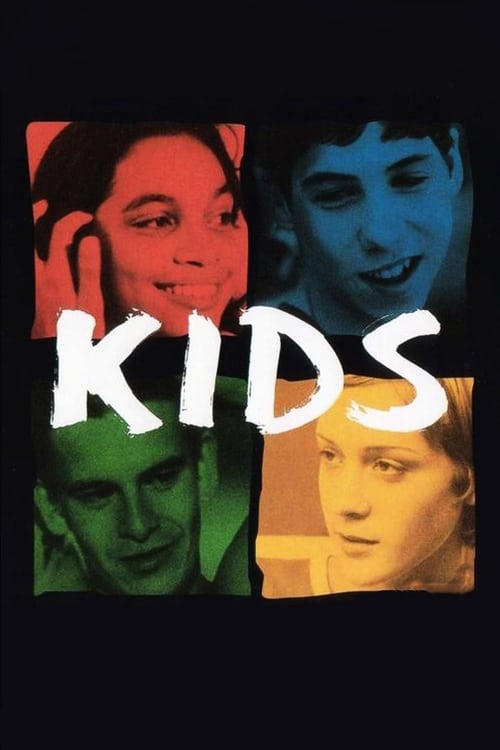
Kids
1995 · Larry Clark
For when you want to be shaken, not entertained — a confrontational time capsule to reach for when you're up for something bleak, honest, and argued-about, definitely not a comfort watch.
What it's about
One hot summer day in 1990s New York, a pack of unsupervised teenagers drifts through the city — skating, shoplifting, drinking, talking endlessly about sex. Telly, a boyish charmer who targets virgins, moves toward his next conquest while Jennie, a girl he slept with exactly once, crosses the city carrying devastating news she needs to reach him before nightfall.
The experience
It plays like documentary footage you weren't supposed to see — loose, profane, funny in flashes, and increasingly dread-soaked as the day wears on. You watch with a knot in your stomach, half fascinated, half wanting to look away.
Performances
Chloë Sevigny, in her first film role, gives Jennie's search a quiet, wounded gravity that anchors all the chaos around her, and a very young Rosario Dawson makes a vivid debut.
The craft
Photographer Larry Clark shot it with a fly-on-the-wall looseness that erases the line between fiction and documentary, casting real downtown skate kids and letting Harmony Korine's teenage-written dialogue sound genuinely overheard rather than scripted. The city itself — stoops, pools, parties, sidewalks — is captured with a texture no studio film of the era touched.
Why it matters
One of the most controversial American releases of the 1990s, denounced as exploitation and defended as a public-health wake-up call; it launched Korine, Sevigny, and Dawson and became the template for a generation of raw, street-cast youth films.
Snapshot
Kids is a single-day descent through a New York City summer, following a loose pack of adolescents — skaters, drinkers, drifters — whose lives unfold almost entirely outside adult supervision. Its narrative engine is brutally simple: Telly, a charismatic teenager who prides himself on seducing virgins, has unknowingly infected at least one partner with HIV, and Jennie, who slept with him exactly once, spends the day searching the city to warn him before he can claim his next conquest. The film was the feature debut of photographer Larry Clark, working from a screenplay by the teenage Harmony Korine, and it arrived in 1995 as one of the most divisive American releases of the decade — denounced as exploitation and child pornography by some, defended as an unflinching public-health parable and a vérité document of a real subculture by others. Its blend of nonprofessional skater-actors, handheld naturalism, and unsparing sexual and chemical candor made it a touchstone for a generation of independent filmmaking, and a launching pad for careers (Chloë Sevigny, Rosario Dawson, Korine himself) that would shape the next two decades of American cinema.
Industry & production
Kids emerged from the intersection of the New York downtown art world and the early-1990s independent film boom. Larry Clark, already notorious as the photographer behind Tulsa (1971) and Teenage Lust, had spent years among the skateboarders of Washington Square Park before deciding to make a film about them. He recruited Harmony Korine — then a teenager he had met skating — to write the script, reportedly produced quickly and drawn directly from the cadences and incidents of the scene Clark was photographing.
The production was financed independently and made cheaply; the budget is generally reported at roughly $1.5 million, though I would treat any single figure with caution. Cary Woods produced through his company Independent Pictures, and Gus Van Sant — then a leading figure of the new American independents — is credited as an executive producer, lending the project both credibility and connective tissue to that world.
The film's most consequential industrial story is its distribution. Miramax acquired Kids, but the Motion Picture Association rated it NC-17, and Miramax had by then been bought by the Walt Disney Company, which barred its subsidiaries from releasing NC-17 or unrated pictures. To get the film into theaters uncut, Harvey and Bob Weinstein created a one-off distribution entity, Shining Excalibur Films, which released Kids unrated in the summer of 1995. The maneuver became a widely cited case study in how the ratings system and corporate ownership shaped what could and could not reach American screens, and the controversy itself functioned as the film's primary marketing. It performed strongly for an unrated, no-stars independent — modest by studio standards but a clear arthouse success — though precise box-office totals should be regarded as approximate.
Technology
Kids was shot on 35mm film, but its entire technological posture is bent toward erasing the apparatus. The film leans on available and naturalistic lighting, lightweight handheld camerawork, and locations used more or less as found — apartments, pools, subway cars, parks, bodegas, the streets of Lower Manhattan. There is little reliance on the kind of visible technological intervention (elaborate rigs, optical effects, conspicuous coverage) that would announce a constructed film. The relevant "technology" here is closer to the photographic tradition Clark came from: the still camera's claim to have simply caught what was there. The result reads as a document captured rather than a fiction staged, even though it was carefully scripted and shot.
Technique
Cinematography
The cinematography, by Eric Alan Edwards, is the film's defining formal achievement and the principal source of its disturbing authority. Edwards (a frequent Van Sant collaborator) works in a loose, mobile, observational register: handheld framing that follows bodies through space, compositions that feel grabbed rather than designed, and a flatness of light that mimics documentary rather than fiction. The camera tends to sit close, at the eye level of the kids, refusing the distancing or moralizing angles that a more conventional treatment of the same material might use. This proximity is precisely what implicates the viewer — the lens neither condemns nor celebrates, and the absence of editorial framing forces the audience to supply the judgment the film withholds. The aesthetic is the argument: by photographing transgression as ordinary, Kids makes ordinariness the point.
Editing
The editing, by Christopher Tellefsen, organizes the film as a day-long drift rather than a tightly plotted chase, even though a ticking-clock structure (Jennie searching for Telly) runs underneath. Tellefsen — who would go on to a major career cutting films such as Capote and Moneyball — paces the picture with long, dwelling passages of talk and idleness punctuated by sudden eruptions of violence and sex. The rhythm reproduces the texture of unstructured adolescent time: stretches of boredom and braggadocio that abruptly tip into consequence. The cross-cutting between Telly's predatory progress and Jennie's increasingly desperate pursuit builds the dread that gives the loose material its dramatic spine.
Mise-en-scène / staging
The staging is governed by an aesthetic of authenticity. Real apartments, real skate spots, and real crowds are populated by performers who largely belong to the world depicted, dressed and behaving as they would off-camera. Clark stages scenes — the opening seduction, the boys' crude bedroom and stoop monologues, the climactic party — to feel overheard rather than performed, with overlapping talk and an absence of theatrical "blocking." The conspicuous, structuring absence in the mise-en-scène is adults: parents, teachers, and authority figures are almost entirely off-screen, and that vacancy is itself a staging decision, defining a world the young inhabit alone.
Sound
The soundtrack is one of the film's most celebrated elements. The score is associated above all with The Folk Implosion, the project of Lou Barlow (of Sebadoh) and John Davis, whose track "Natural One" became an unexpected hit single off the soundtrack — a rare case of an unrated independent film yielding a charting song. The musical sensibility is lo-fi and indie, of a piece with the film's downtown, anti-slick ethos. Diegetically, the sound design favors naturalism: ambient city noise, overlapping adolescent chatter, the scrape of skateboards. The contrast between the spare, almost hypnotic music and the harshness of the events gives several sequences their unsettling, dreamlike undertow.
Performance
Kids is built almost entirely on nonprofessional performers drawn from the New York skate and street scene, and the performances are central to its claim on the real. Leo Fitzpatrick plays Telly with a flat, unselfconscious menace; Justin Pierce plays his sidekick Casper; Harold Hunter, a well-known skater, appears as part of the crew. The film also marked the screen debuts of two future stars: Chloë Sevigny as Jennie, whose stricken, internalized performance anchors the film's conscience, and Rosario Dawson as Ruby. The acting style is deliberately unpolished — improvisational in feel, rooted in the performers' own idiom — and that rawness is precisely what makes the material land as testimony rather than melodrama. The human cost behind that authenticity is real: both Pierce and Hunter died young in the years after the film, facts that have inflected its later reception.
Narrative & dramatic mode
The film operates in a vérité-realist mode organized around the classical unity of a single day. Its structure is a braided one: Telly's episodic, picaresque progress across the city toward another seduction, set against Jennie's purposeful, dread-laden search to reach him with the truth about her HIV diagnosis. The dramatic irony is total and devastating — the audience knows what Telly does not, and the film's tension lies entirely in whether knowledge will arrive in time. It does not. The mode is anti-cathartic: there is no rescue, no lesson delivered from within the fiction, and the ending lands as a bleak of horror rather than a resolution, closing on Casper's bewildered morning-after incomprehension after a sexual assault. The refusal of conventional dramatic payoff is itself the statement.
Genre & cycle
Nominally a drama and crime film, Kids sits most precisely within the "social problem" tradition and the youth-in-crisis film, updated for the AIDS era. It belongs to a 1990s cycle of unsentimental, often vérité-inflected films about disaffected young people, and it helped crystallize a specifically American strain of that cycle rooted in subcultural authenticity. It can also be read against the long lineage of cinema that treats adolescence as a site of danger and abandonment, from social realism to the cautionary-tale tradition — but Kids strips out the consoling moral architecture those genres usually supply, leaving the cautionary content without the cautionary comfort.
Authorship & method
The film is the product of an unusual authorial pairing. Larry Clark, the director, brought a photographer's eye and a decades-long obsession with the lives of teenagers; his method was immersive and ethnographic, casting from the scene he had been documenting and shaping the film around its real textures. Critics have long debated whether Clark's gaze is diagnostic or complicit — a tension that runs through his still photography as well — and that ambivalence is inseparable from the film's effect. Harmony Korine, the screenwriter, was a teenager when he wrote it; the script's slang, rhythms, and casual cruelty derive from his proximity to the world depicted, and Kids launched his own directorial career (Gummo, Julien Donkey-Boy, and later work). Eric Alan Edwards supplied the observational cinematography; Christopher Tellefsen edited; and the musical identity was driven by Lou Barlow and John Davis (The Folk Implosion). The method throughout privileged authenticity over polish — real people, real places, naturalistic light and sound — so that the authorship is less about imposed style than about a curated, framed reality.
Movement / national cinema
Kids is firmly a product of American independent cinema in its 1990s ascendancy — the milieu of Sundance, Miramax acquisitions, and breakout auteur debuts. More specifically, it belongs to a New York downtown sensibility connecting the fine-art photography world, the indie-rock underground, and the skate subculture. Through Gus Van Sant's involvement and Edwards's camerawork it has a lineage to the Pacific Northwest/Van Sant strain of American independents, but its texture is distinctly that of Lower Manhattan. It can also be situated within a broader international current of 1990s realist filmmaking about youth and marginality, though Kids is American in its particular fusion of subcultural authenticity and tabloid controversy.
Era / period
The film is inseparable from its mid-1990s moment. It is an AIDS-era film at the point when HIV had become a defining shadow over sexuality, and its plot is, at bottom, a parable about transmission and the lethal gap between pleasure and knowledge. It is also a document of a specific pre-gentrification New York and of a skate culture that was then largely subterranean. And it is a product of a particular industrial era — the brief window in which an unrated, no-stars independent could become a national flashpoint, propelled by the ratings controversy and the rise of independent distribution. Watched today, it functions partly as a time capsule of 1995, in its music, its fashion, its streets, and its anxieties.
Themes
The film's central theme is the collision of adolescent sexuality with mortality: Telly's predation and the HIV plot turn teenage sex from rite of passage into potential death sentence. Around that core cluster several others — the absence and failure of adults, leaving children to raise and ruin one another; nihilism and consequence-blindness, the sense that these kids live without a future tense; the performance of masculinity, especially in the boys' boastful, dehumanizing talk about conquest; and the vulnerability of girls within that economy, embodied by Jennie and by the assault that closes the film. Beneath all of it runs the film's most contested theme: the ethics of looking — whether unflinching depiction is witness or exploitation, a question the film stages without resolving.
Reception, canon & influence
Reception. Kids was among the most controversial American films of its decade. It divided critics and commentators sharply: detractors attacked it as voyeuristic, exploitative, and bordering on pornography in its filming of minors, while defenders praised it as a fearless, necessary work of realism and a genuine AIDS-era warning. Much of the public conversation centered less on craft than on whether the film should exist at all, and on the ratings and distribution drama that surrounded it. That polarization has never fully settled; Kids remains a standard case study in debates about representation, the gaze, and the responsibilities of documentary-inflected fiction.
Influences on the film (backward). The most direct influence is Clark's own photographic career — Tulsa and his decades of images of teenagers in extremis supply the film's subject and its frontal, unsparing aesthetic. Beyond that lie the traditions of cinéma vérité and direct cinema, social realist filmmaking about troubled youth, and the New York independent and documentary sensibility. The film's authenticity-first method is a translation of still-photographic ethnography into narrative cinema.
Legacy (forward). Kids cast a long shadow. It launched the careers of Chloë Sevigny and Rosario Dawson, both of whom became major actors, and of Harmony Korine, whose subsequent films extended its raw, anti-conventional sensibility. The Folk Implosion's "Natural One" gave it an afterlife in music. More broadly, it became a foundational text for a wave of vérité-styled, nonprofessional-cast films about youth and subculture, and a perennial reference point in skate-culture cinema and fashion. It also entered the permanent literature on film and controversy — taught and cited in discussions of the ratings system, independent distribution, and the ethics of representing real young people on screen. Its legacy is shadowed, too, by the later deaths of cast members drawn from the world it portrayed, which have made Kids read, in retrospect, less as provocation than as elegy.
A Deleuzian reading
The film opens on a mouth.
The full Deleuzian reading of Kids →
Reception
A moral panic in 1995 — Disney-owned Miramax had to spin up a one-off shell company just to release it unrated — and hailed by some critics as a wake-up call. Today it's still canon, but the conversation has shifted to whether Larry Clark exploited the real teenagers in it, sharpened by the 2021 documentary 'The Kids' made by one of its own cast members.
How Kids was received, from release to now →
Influences: the films it descends from and the films it influenced
- The 400 Blows (1959) — Establishes the template Kids inherits — a nonprofessional adolescent followed in location-shot, eye-level observation across an episodic drift through the city, sealed by an anti-cathartic withheld ending rather than a redemptive arc.
- Shadows (1959) — Origin of Kids' method — improvised performance built from the actors' own milieu plus handheld, available-light shooting on real New York streets, prizing behavioral truth over scripted polish.
- The Cool World (1964) — Casts real Harlem teenagers to play near-versions of themselves and shoots their world in vérité location footage, the direct documentary-into-fiction translation Clark later performs on skate kids.
- Salesman (1969) — Direct-cinema fly-on-the-wall handheld and naturalistic sync sound — the observational, non-interventionist camera grammar Kids fictionalizes into its day-long drift.
- Los Olvidados (1950) — Social-problem realism of slum youth in extremis, refusing sentimental rescue, which licenses Kids' diagnostic-yet-unsparing gaze at adolescents destroying themselves.
- Killer of Sheep (1978) — Available-light, nonprofessional-cast episodic structure organized around children at play rather than plot — the loose day-drift editing logic Kids adopts.
- Pixote (1981) — Recruits actual street children to enact their own lived violence and sexuality with frontal, unflinching framing, the ethical-risk casting model Kids reproduces with New York skaters.
- Streetwise (1984) — Ethnographic documentary immersion in runaway teen subculture — the still-photographer-to-screen observational stance (echoing Clark's own Tulsa work) that Kids narrativizes.
- Over the Edge (1979) — Builds a youth social-problem film around the structuring absence of adults, leaving teens to enact their own unsupervised codes — Kids' staging premise.
- Drugstore Cowboy (1989) — Available-light, near-documentary naturalism observing a youth subculture's self-destruction with refusal to moralize — pushes Van Sant's compassionate-observation mode toward raw vérité.
- My Own Private Idaho (1991) — Carries forward the documentary-grain naturalism of drifting marginal youth performed by non-professionals, observed without moralizing judgment.
- Christiane F. (1981) — Non-professional teen cast filmed in available-light vérité of banal urban squalor, sustaining the flat, watchful youthful affect.
- Gummo (1997) — Korine, Kids' teenage screenwriter, directs the direct extension — nonprofessional locals and found textures pushed past narrative into anti-conventional tableaux, dissolving plot entirely.
- George Washington (2000) — Nonprofessional child cast wandering depopulated landscapes in available light and elliptical day-drift, inheriting Kids' observational poeticization of unsupervised youth.
- Raising Victor Vargas (2002) — Casts untrained Lower East Side teenagers improvising in their own vernacular and shoots them at proximate, eye-level naturalism — Kids' New York street verité minus its nihilism.
- Thirteen (2003) — Handheld, available-light chronicle of a teen girl's spiral co-written by its thirteen-year-old star, replicating Korine's insider-adolescent authorship as the guarantor of slang and texture.
- Elephant (2003) — Nonprofessional teens trailed through a high school in long observational takes toward an anti-cathartic, refusal-of-explanation climax — Kids' drift-then-detonate structure abstracted.
- The Florida Project (2017) — Nonprofessional child cast roaming in negligent-adult absence, available-light naturalism and a day-by-day episodic drift ending on an anti-cathartic rupture — Kids' ethics of observing real kids restated.
- Mid90s (2018) — Directly inherits Kids' skate-culture verité — casting real skaters as nonprofessional actors and staging an adult-absent boys' subculture through its authentic argot and rituals.
- L.I.E. (2001) — Documentary-naturalistic, available-light handling of endangered teenagers and predatory adult appetite, filmed on real locations without moralizing — the transgressive-realist lineage the dossier names explicitly.
- Mysterious Skin (2005) — Introduces the unflinching, non-judgmental documentary-adjacent gaze on teenage sexuality and endangerment that Araki inherits while trading Clark's grit for lyricism.
- Rap World (2024) — Handheld vérité tracking of a roving male peer group through real locations with naturalistic, improvised-feeling dialogue and a drifting, plotless day-in-the-life structure.
- American Honey (2016) — Clark and writer Harmony Korine's embedded, quasi-documentary portraiture of real teenagers behaving in near-real time, casting non-actors to erase the line between performance and lived youth.
- High Art (1998) — Clark's photographic method — flat frontal compositions holding young bodies mid-intoxication at close range without editorial comment — is the secondary visual reference beside Goldin, minus Clark's predatory proximity.
- La Haine (1995) — Same-year companion that compresses an underclass-youth ensemble into a single drifting day with a ticking, fatalistic clock and an anti-cathartic eruption instead of resolution.
- Fish Tank (2009) — Handheld, available-light social realism anchored by a first-time lead and proximate eye-level framing, extending Kids' verité-realism of a self-destructing adolescent into British kitchen-sink.
- Pusher (1996) — Clark's simultaneously developed 16mm guerrilla method — invasive close framings of non-professional bodies through a compressed urban day, ambient sound preserved, no-permit location shooting, practical lighting — is an essentially contemporaneous discovery of the same formal approach for rendering youth on the economic margin.
- Dazed and Confused (1993) — Single-day, plotless youth ensemble cast from non-professionals for raw naturalism — the same unity-of-time observational method pushed toward vérité.
- Nowhere (1997) — The same mid-90s move of compressing an entire teen sex-and-drug subculture into one drifting day — the realist inverse of Araki's pop-art single-day structure.
- Head-On (2004) — The 1990s transgressive art-cinema model of casting raw non-professional debut performers and filming bodies in genuinely lived-in, unglamorous spaces — the physical kin Sibel Kekilli's debut belongs to.
Similar films
- mid90s (2018) — influence & lineage
- Gummo (1997) — influence & lineage
- Elephant (2003) — influence & lineage · often watched together
- The Virgin Suicides (2000) — often watched together
- Dazed and Confused (1993) — often watched together
- Dogville (2003) — often watched together
- Fast Times at Ridgemont High (1982) — shared sensibility
- Tomboy (2011) — shared sensibility
All the films related to Kids →