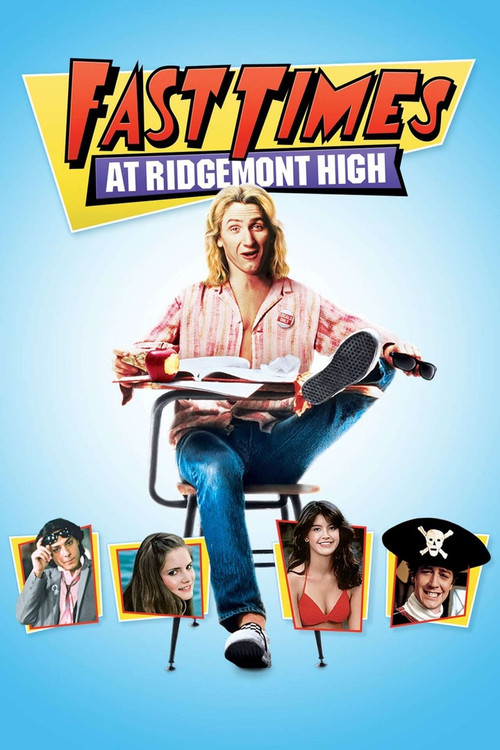
Fast Times at Ridgemont High
1982 · Amy Heckerling
For a hangout night when you want to laugh and feel eighteen again — comfort viewing with more truth in it than you remember. Great with friends who can quote along.
What it's about
A year at a Southern California high school, told as a mosaic rather than a single plot: kids juggling classes, mall jobs at the fast-food counter and the movie theater, first crushes, first cars, and first sexual fumbles. A sophomore navigates dating advice from her more experienced friend, a chronically stoned surfer wages a slow war with a hardline history teacher, and a scalper-philosopher big brother dispenses wisdom nobody asked for. It grew out of a journalist actually going undercover as a student for a year, and it shows.
The experience
Loose, funny, and sun-baked, but with a streak of unsentimental honesty that sneaks up on you — the awkward stuff is played awkward, not cute. It drifts like a school year does, then lands moments of real consequence without ever turning preachy.
Performances
Sean Penn's Jeff Spicoli is one of the great comic creations — a stoner so fully inhabited he became the template for every one since. Jennifer Jason Leigh gives the film its heart with a performance of startling, unguarded candor, and Ray Walston is perfect as the teacher who's met one Spicoli too many.
The craft
Amy Heckerling's debut direction keeps a documentary looseness under the jokes — Cameron Crowe's script came from real reporting, and the film trusts overheard texture over setups and punchlines. The mall-and-parking-lot geography and wall-to-wall early-'80s rock soundtrack make it a time capsule that still plays.
Why it matters
It launched Heckerling and Crowe, minted half a dozen careers, and quietly redefined the teen movie — proving the genre could be raunchy and honest at the same time, paving the way for the decade of teen films that followed.
Snapshot
A studio teen comedy that behaves, for long stretches, like an ethnography. Adapted by Cameron Crowe from his own 1981 nonfiction book — the product of a year spent posing as a student at Clairemont High School in San Diego — and directed by Amy Heckerling in her feature debut, Fast Times at Ridgemont High arrived inside the post-Porky's teen-sex-comedy boom and quietly declined to behave like one. Its narrative is a mosaic rather than a plot: a school year in the life of a Southern California suburb, organized around a mall, a fast-food counter, a pizza parlor, and a classroom presided over by a US-history teacher with a grudge. The film's durable reputation rests on a paradox. Marketed on the promise of nudity and stoner antics, it is remembered for the unsentimental candor of its sexual education plot, for a first-feature director's refusal to punish her fifteen-year-old heroine, and for a supporting performance — Sean Penn's Jeff Spicoli — that escaped the film entirely and became a permanent fixture of American vernacular. It was selected for the National Film Registry in 2005.
Industry & production
The film is a Universal picture, and that matters. Universal had discovered in National Lampoon's Animal House (1978) that an R-rated, low-budget, youth-targeted comedy could return sums out of all proportion to its cost, and the studio spent the following years looking for repeats. Fast Times was produced by Art Linson and Irving Azoff — Azoff a music-industry power broker (manager of the Eagles, later head of MCA's record division, which put him under the same corporate roof as the studio). That pairing tells you the commercial logic: a movie and a soundtrack album engineered as mutually promotional objects, released into the first full year of MTV's existence.
Crowe's source material gave the project an unusual provenance for a genre comedy. He had been a working rock journalist since his teens, a Rolling Stone writer while still a minor, and in his early twenties he re-enrolled — with the cooperation of a school administration, under a cover story — as a high school senior. The resulting book, Fast Times at Ridgemont High: A True Story (1981), is participant-observation reportage in the New Journalism mode, with composite figures and reconstructed dialogue. Crowe adapted it himself, his first screenplay.
Hiring Heckerling was the least predictable decision in the package. She was an NYU and AFI graduate whose student short Getting It Over With (1977) had circulated well; she had no feature credits, and in 1982 the number of women directing studio features in Hollywood could be counted without difficulty. The record of her working conditions on the picture is better documented in later interviews than in contemporaneous trade coverage, and accounts of the studio's interventions — pressure toward more conventional raunch, cuts made to secure an R rating rather than an X — are consistent across her retellings but thinly corroborated in primary sources. The film was shot in Los Angeles rather than San Diego, using Van Nuys and Canoga Park high schools and the Sherman Oaks Galleria, which stands in for the mall that functions as the film's true civic center.
Made cheaply and released in late summer 1982, it was profitable enough to be treated as a hit and to generate a loose companion film (The Wild Life, 1984, written by Crowe) and a short-lived 1986 CBS sitcom that brought back Ray Walston as Mr. Hand. Specific budget and grosses circulate widely but inconsistently; they are not reproduced here.
Technology
Technically the film is conservative — 35mm, 1.85:1, location shooting with available architecture — and its real relationship to technology is sociological. Fast Times is one of the first American films to take the enclosed suburban shopping mall seriously as a total environment: workplace, courtship arena, transit hub, and surveillance space all at once. The Galleria's escalators, food court, and storefront glass supply the film's connective tissue the way streets do in a city picture. Alongside the mall sit the other machines of adolescent life in 1982 — the car stereo, the arcade cabinet, the drive-through headset, the stereo showroom where Stacy meets the older man who becomes her first partner. Consumer audio is not incidental set dressing; it is the medium through which the characters conduct their emotional lives.
The film's own commercial technology was the soundtrack. Azoff assembled a double album of new and commissioned tracks — Jackson Browne's "Somebody's Baby" was its most successful single — and the record functioned as a semi-independent product, with several commissioned songs barely audible in the finished film. The picture's canonization, meanwhile, was substantially a function of distribution technology that postdated its release: heavy rotation on premium cable and constant availability on VHS through the 1980s turned a modest theatrical performer into a text that a generation encountered repeatedly, in fragments, at home.
Technique
Cinematography
Matthew F. Leonetti photographs the film in a bright, even, unfussy register that reads today as a deliberate refusal of style. Fluorescent institutional light in the classrooms and mall corridors; hard California sun in the parking lots; a slightly flattened, poster-colored palette in the retail interiors. The camera favors medium shots and lets ensembles breathe within the frame rather than carving them into shot-reverse-shot. Two departures from that baseline are consequential. The pool sequence — Phoebe Cates's Linda emerging from the water, staged as Brad's masturbatory fantasy — is shot in slow motion with a soft, advertisement-derived glamour that the rest of the film never permits, and it is immediately punctured by the bathroom-door gag. And Stacy's sexual encounters are shot flat, close, and uncomfortably: no soft light, no romantic distance, the camera staying on her face while the scene fails her.
Editing
Eric Jenkins cuts the film as a chronicle rather than a story. Chapter-like markers track the progress of the school year, and the picture braids five or six storylines that intersect only glancingly — a structure inherited from American Graffiti (1973) and, more distantly, from Altman's ensemble method. Individual scenes are cut short, often before their comic button; the film prefers accumulation to punchline. The consequence is a curious tonal permeability: an abortion appointment can sit two scenes from a stoner's van crash without either being tonally quarantined. Detractors read this as shapelessness. It is more accurately the formal signature of reportage, in which events are given equal weight because they happened.
Mise-en-scène / staging
The picture's authority comes from specificity of surface: the All-American Burger uniform and its humiliations, the Perry's Pizza name tag, the ticket-scalping economics of a Damone side hustle, the exact décor of a teenage girl's bedroom, the semiotics of who eats lunch where. Crowe's fieldwork survives translation into production design almost intact. Heckerling stages the classroom scenes as a running theatrical duel between Spicoli and Mr. Hand, with the rest of the class as audience, and stages the social scenes as a series of thresholds — counters, doorways, car windows — that mark who is permitted to cross into whose world.
Sound
There is effectively no conventional orchestral score. The film's emotional grammar is carried by pop needle drops whose diegetic status is frequently ambiguous: the Go-Go's over the opening mall survey, the Cars' "Moving in Stereo" over the pool fantasy, Jackson Browne over the courtship material. This is a strategy inherited from American Graffiti and refined here into something closer to how the characters would actually experience their own lives — as scored by whatever was on. Dialogue is recorded and mixed for overlap and mumble rather than clarity; Penn's Spicoli in particular is written and performed at the edge of intelligibility, which is precisely the joke.
Performance
The casting is the film's most durable asset. Sean Penn — already stage-trained, already committed to sustained in-character work — builds Spicoli out of physical rhythm and vocal drawl rather than gags, and gives what is essentially a piece of character acting in a comedy that did not require one. Jennifer Jason Leigh's Stacy is the film's actual center and its hardest performance: playing several years below her own age, she registers curiosity, embarrassment, and disappointment in the same close-up without ever asking for pity. Judge Reinhold plays Brad's serial job humiliations with a wounded dignity that keeps the character from becoming a punching bag. Ray Walston, a veteran of Billy Wilder and network television, supplies the film's only adult with real comic authority. Around them sits an extraordinary bench of near-debuts: Forest Whitaker, Eric Stoltz, Anthony Edwards, Phoebe Cates, Robert Romanus, Brian Backer, and Nicolas Cage in a bit part, billed under his birth name, Nicolas Coppola.
Narrative & dramatic mode
The film operates in what would later be called the hangout mode: episodic, ensemble-distributed, driven by social texture rather than by a goal. There is no antagonist, no climax, and the closest thing to a resolution is a set of end-title cards reporting where everyone ended up — a device borrowed from American Graffiti and, before that, from documentary. Within that loose structure, one storyline carries genuine dramatic weight. Stacy's education — an older man in a dugout, a betrayal by Damone, an abortion arranged and paid for alone, a brother who drives her without being told why — is dramatized with a matter-of-factness that was rare in a 1982 studio release and remains rare now. The film neither romanticizes nor punishes her; it simply declines to make her sexuality a moral event. That refusal is the picture's real formal innovation, and it survives largely because Heckerling shoots the sex from Stacy's discomfort rather than from an imagined viewer's appetite.
Genre & cycle
Fast Times was released into, and marketed as part of, the early-1980s teen sex comedy cycle — Porky's (1981–82), The Last American Virgin (1982), Private Lessons, Losin' It — a cycle descended from the American International juvenile pictures of the 1950s–60s and licensed commercially by Animal House. It fulfills the cycle's contractual obligations (nudity, a masturbation gag, adults as obstacles) while systematically inverting its premises: the boys' quests are humiliating rather than triumphant, the "score" is experienced from the girl's side, and the film's most sympathetic figure is a stoner with no ambitions whatsoever. In this it also belongs to the parallel 1982 lineage of ensemble youth naturalism — Diner, released the same year — and stands directly upstream of the John Hughes cycle that would dominate the rest of the decade.
Authorship & method
Authorship here is genuinely divided, and productively so. Crowe supplies the material and the method: participant observation, composite characters, an ear for how teenagers actually construct sentences, and a fundamental sympathy that would define his later work (Say Anything…, Singles, Jerry Maguire, Almost Famous). Heckerling supplies the point of view. Her contribution is legible in the choices that run against the screenplay's genre defaults — the tonal flatness of the sex scenes, the non-judgmental abortion sequence, the decision to let Stacy's disappointment sit unresolved — and it becomes retrospectively unmistakable in Clueless (1995), which returns to the same terrain with the same instinct for female interiority inside a comic frame. Leonetti's photography and Jenkins's editing both serve an aesthetic of plainness. Azoff's music supervision, in place of a composer, sets the template for the pop-compilation score as a studio commercial instrument. The absence of a traditional score is itself an authorial decision, and one widely imitated.
Movement / national cinema
The film sits on a seam in American cinema. Its naturalism, ensemble structure, and unresolved endings are inheritances from the New Hollywood of the previous decade; its packaging, soundtrack tie-in, and demographic targeting belong to the high-concept 1980s that was displacing it. It is also a document of a specific national geography — postwar Southern California suburbia in its mature phase, where the mall has replaced the main street and adolescent labor in the service sector is universal and degrading. Regionally it is a San Diego book filmed in the San Fernando Valley, and the substitution is invisible precisely because the landscape it describes had become generic.
Era / period
1982: the second year of the Reagan administration, the trough of a severe recession, MTV one year old, the mall economy at its zenith. The film registers all of this obliquely. Nearly every teenager in it works, and the jobs are bad; the adults are absent or ineffectual; the future arrives only as end-title text. Its treatment of abortion — legal, accessible, and dramatized without debate — is a period marker in itself, made at a moment when that consensus was already under organized political attack. The film does not argue the point. It simply presents the procedure as one thing that happens in a school year, which in 1982 was itself a position.
Reception, canon & influence
Contemporary reviews split, and the split was largely along the axis of whether a critic could see past the genre packaging. A number of major daily reviewers, Roger Ebert prominently among them, dismissed the film as another crude entry in the teen-exploitation cycle and objected to its treatment of its young women — a reading the film's advertising campaign actively encouraged. Others recognized the reportorial precision and Penn's performance immediately. Its reputation was then rebuilt from below, over roughly a decade, by cable and home video.
Backward, its debts are clear: American Graffiti for the mosaic structure, pop-song scoring, and epilogue cards; Animal House for the commercial permission; the AIP juvenile pictures and the earnest adolescent melodrama descending from Rebel Without a Cause for the raw genre materials; and, outside cinema entirely, the New Journalism of the 1970s for Crowe's method.
Forward, its influence is broad enough to be nearly invisible. Spicoli established the comic stoner as an American type — his cadence audible in Bill & Ted's Excellent Adventure, Wayne's World, and a long line of successors — and Penn's willingness to play him seriously licensed a certain quality of performance in youth comedy. The film's structural template of the school-year mosaic runs directly into Dazed and Confused, Freaks and Geeks, Superbad, and Booksmart. Its treatment of a teenage girl's sexual experience as legitimate dramatic material, neither titillating nor cautionary, is the ancestor of a strain that took decades to become common. And its most direct descendant is by the same hand: Clueless, which took the mall, the ensemble, the pop score, and the female point of view and reassembled them into the defining teen film of the following decade.
A Deleuzian reading
The film opens by casing a shopping mall.
The full Deleuzian reading of Fast Times at Ridgemont High →
Reception
Dismissed by many 1982 critics as just another teen sex romp — Roger Ebert gave it one star — it's since been reappraised as the smartest, most humane film of its genre and entered the National Film Registry in 2005.
How Fast Times at Ridgemont High was received, from release to now →
How to watch Fast Times at Ridgemont High: what to notice on a first viewing
- Notice how often scenes end before the laugh lands. Eric Jenkins cuts the film as a chronicle of one school year, braiding five or six storylines that barely touch each other. Scenes stop early. The picture prefers accumulation to punchlines. Nothing here causes anything else. Events sit next to each other the way days in a term do.
- Notice the flat fluorescent classrooms and the hard parking-lot sun. Matthew Leonetti shoots plain and even, in institutional light and California glare, using medium shots that let a whole group breathe in one frame instead of carving them into reverse angles. The style dresses nothing up. Ordinary hours get photographed at exactly the same size as the big ones.
- Watch the counters, doorways and car windows people talk across. The mall works as job, courtship arena and transit hub at once. Heckerling stages the social scenes on thresholds, since in a place with no center the only geography is who may cross into whose world. Status here is spatial. Who gets to come around the counter tells you where everybody ranks.
- Watch Sean Penn's slouch and listen to his drawl. Penn builds Spicoli out of physical rhythm and speech pitched right at the edge of intelligibility. The classroom scenes run as a standing duel with Mr. Hand, the rest of the class watching. The posture is his entire argument about school: a room where attendance is taken and time is served.
- Listen for whether a song is playing inside the scene. There is no composer on the picture. The Go-Go's open the mall survey, the Cars run under the pool sequence, and often you cannot say whether a track belongs to the room or to the film. The movie adopts how these kids hear their own lives, scored by whatever happened to be on.
The whole guide to watching Fast Times at Ridgemont High, with the keys for a rewatch →
Influences: the films it descends from and the films it influenced
- American Graffiti (1973) — The direct structural template: a leaderless ensemble mosaic cross-cut across a bounded stretch of time, scored entirely with licensed period pop in place of a composer, and closed with deadpan epilogue title cards assigning each character a fate.
- Cooley High (1975) — Ran the school year itself as the chronicle's clock — semester rhythms, classrooms, after-school jobs — with a wall-to-wall Motown jukebox standing in for score and end cards reporting where the kids landed, the same three devices Heckerling inherits wholesale.
- The Last Picture Show (1971) — Established the anti-erotic teen sex scene: adolescent first encounters shot in flat, unhurried wide-ish coverage with no score and no flattering light, so awkwardness and disappointment read as the actual content — the grammar of the Stacy/Damone poolhouse scene.
- National Lampoon's Animal House (1978) — Proved that an R-rated, plotless, gag-vignette ensemble built from magazine-derived reportage could be a studio blockbuster, which is the commercial permission Universal extended to Crowe's undercover notebook material.
- Rebel Without a Cause (1955) — Made adolescent interiority a subject worth CinemaScope and a serious lead performance rather than a juvenile-delinquent hook — the melodramatic license Penn draws on to play a stoner joke as a fully inhabited person.
- Saturday Night Fever (1977) — Codified music supervision as a studio commercial instrument — a pre-sold song package doubling as the film's score and its marketing — the model Irving Azoff replicates by stacking Ridgemont with label acts instead of hiring a composer.
- Over the Edge (1979) — Shot suburban teenagers with documentary flatness and cast for non-actorly slouch and vernacular rather than juvenile-lead polish, letting rock needle-drops carry the emotional register the absent score would have supplied.
- Risky Business (1983) — The counter-case on the same device: where Heckerling deploys the slow-motion fantasy insert once, ironically, and then punctures it, Brickman builds an entire film out of the male dream-logic register the Phoebe Cates pool shot briefly quotes.
- The Breakfast Club (1985) — Takes the archetype-ensemble-in-a-school-space structure and Ridgemont's premise that teen speech deserves verbatim attention, then reverses the method — sustained monologue and confessional articulacy in place of Crowe's clipped, evasive overheard talk.
- Say Anything… (1989) — Crowe directing his own participant-observation method: composite characters built from interview notes, sentences written with the hedges and restarts left in, and the same refusal to punish a girl for her sexual choices.
- Bill & Ted's Excellent Adventure (1989) — Runs Spicoli's specific vocal invention — flattened surfer prosody, sincerity delivered at half speed, the stoner as guileless rather than degenerate — as a whole film's comic engine, the first full inheritance of Penn's cadence.
- Dazed and Confused (1993) — Extends the school-year chronicle to its logical end: last day of classes, no protagonist, no score but licensed period rock, and scenes valued for behavioral observation rather than plot advancement.
- Clueless (1995) — Heckerling's own reassembly of the identical kit — mall staging, pop-compilation score, comic ensemble, and female interiority held inside the comedy — this time with the girl's voice-over granted narrational authority the earlier film withheld.
- Superbad (2007) — Built, like Crowe's script, from its writers' own transcribed adolescence, and keeps the Ridgemont bargain of playing teenage sexual bravado as bluff that the film quietly declines to reward.
- Lady Bird (2017) — The school-year chronicle rendered in short elliptical scenes with a girl's first sex staged as flat anticlimax — no score swell, no punishment, the disappointment simply allowed to sit — the exact tonal choice Heckerling made against her screenplay's genre defaults.
- Obvious Child (2014) — Direct descendant of the clinic sequence: an abortion filmed as logistics and cost rather than moral crisis, inside a comedy, with the procedure neither dramatized as trauma nor set up as a lesson.
- Jerry Maguire (1996) — Crowe's journalistic-immersion screenwriting — embedding in a subculture and transcribing its idiom — the same field-research method that produced the film's authentic agent culture.
- Mean Girls (2004) — Pioneers Fey's exact method — converting immersive nonfiction reportage (Cameron Crowe's undercover year) into an ensemble teen comedy, as Fey converted Wiseman's sociology.
- Diner (1982) — Same-year experiment in hangout mode: scenes with no plot function, held on overlapping, half-mumbled, digressive talk transcribed from remembered speech, where the drift of the conversation is the dramatic event.
- Valley Girl (1983) — A woman-directed LA teen picture that likewise stages the mall as the civic square, records regional teen vernacular as found dialect, and runs a new-wave compilation as its only score while granting the girl the point of view.
Similar films
- Dazed and Confused (1993) — influence & lineage · same viewing thread
- American Graffiti (1973) — influence & lineage · same viewing thread
- Rebel Without a Cause (1955) — influence & lineage · same viewing thread
- The Breakfast Club (1985) — influence & lineage
- Superbad (2007) — influence & lineage
- Almost Famous (2000) — same viewing thread
- mid90s (2018) — same viewing thread
- The Graduate (1967) — same viewing thread
All the films related to Fast Times at Ridgemont High →
Watch it with: curated runs of related films
- Restless Youth, Rigid Walls — Watch these as one long walk through the school years — the teachers who crack you open, the friends who pull you off the sidelines, the first loves and the institutions you push against — where a beloved tearjerker and a surreal boarding-school revolt turn out to be cousins.