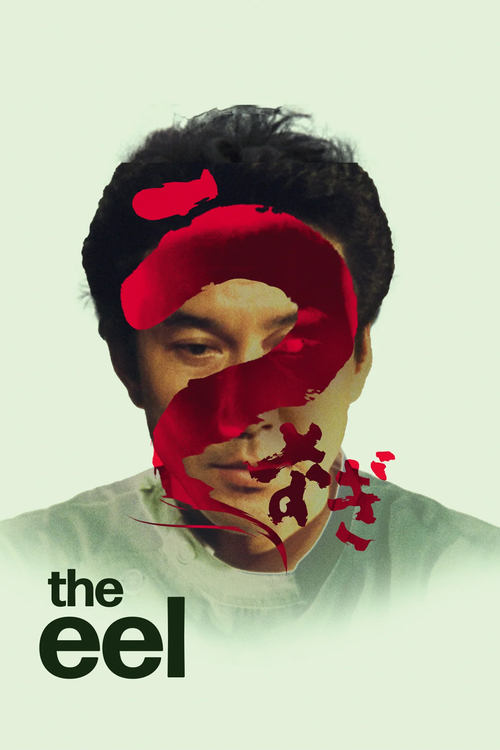
The Eel
1997 · Shōhei Imamura
For when you want a quiet, grown-up film about guilt and second chances — something contemplative to sit with, not a thriller. Best on an unhurried evening when you're open to an odd, gentle rhythm.
What it's about
A Tokyo salaryman kills his unfaithful wife, serves eight years, and comes out on parole determined to want nothing from anyone. He opens a small barbershop in a sleepy riverside town, where his only confidant is the pet eel he raised in prison — until a troubled young woman and a gallery of local eccentrics begin pulling him, against his will, back toward other people.
The experience
Slower and stranger than its lurid setup suggests: patient, dryly funny, and unexpectedly tender, with sudden flashes of the violence and desire the hero is trying to outrun. It leaves you with a humane, hard-earned calm rather than a jolt.
Performances
Kōji Yakusho is remarkable as the barber — closed-off, courteous, almost affectless, letting you read years of shame in the smallest hesitations.
The craft
Imamura frames a potentially sensational story with earthy humor and riverside stillness, mixing deadpan comedy, dream-touched imagery, and moments of raw violence without ever losing the film's tenderness. The confession-to-an-eel conceit sounds absurd and plays as genuinely moving.
Why it matters
It shared the Palme d'Or at Cannes in 1997, making Imamura one of the very few directors to win the prize twice and crowning a late-career comeback in his seventieth year.
Snapshot
The Eel (Unagi, うなぎ) is Shōhei Imamura's penultimate major feature and the film that returned the veteran director to the front rank of world cinema in his seventieth year. A study of a murderer's halting return to the human community, it follows Takurō Yamashita, a salaryman who stabs his adulterous wife to death, serves his sentence, and on parole opens a barbershop in a riverside town where his only confidant is the pet eel he raised in prison. From this lurid premise Imamura builds something unexpectedly tender — a comedy-inflected parable of guilt, isolation, and the slow, awkward labor of rejoining the living. The film shared the Palme d'Or at the 1997 Cannes Film Festival with Abbas Kiarostami's Taste of Cherry, making Imamura one of a small handful of directors to win the festival's top prize twice (after The Ballad of Narayama in 1983). It anchored a remarkable year for its star, Kōji Yakusho, who also appeared in Shall We Dance? and Kiyoshi Kurosawa's Cure in the same season.
Industry & production
The Eel was produced in the mid-1990s within the surviving infrastructure of Japanese auteur production — a coalition of companies including Imamura's own production base and partners associated with Kadokawa and satellite-television financing, the kind of mixed funding that kept ambitious non-blockbuster filmmaking alive after the collapse of the old studio system. Imamura had not directed a feature since Black Rain (1989), an interval lengthened by illness, so the project carried the weight of a comeback. He was also, by this point, an institution in his own right: founder of the Japan Academy of Visual Arts (the film school now known as the Japan Institute of the Moving Image), a teacher of a generation of younger directors, and a two-time Cannes competitor with deep festival standing.
The screenplay was adapted from a work of fiction by the novelist Akira Yoshimura; sources commonly cite a Yoshimura story as the basis, though accounts of the exact source text vary, and the specific title is one detail where the English-language record is not fully consistent. Imamura wrote the script in collaboration with Motofumi Tomikawa and Daisuke Tengan — the latter Imamura's son, who became a frequent screenwriting partner in the director's late period. The Cannes victory, and the prestige of a shared Palme with Kiarostami, secured the film international art-house distribution well beyond what its modest scale would otherwise have commanded. Reliable production-budget and box-office figures are not part of the well-documented record, and I will not invent them.
Technology
The Eel is a conventional 35mm color production of its era, and its technological interest lies less in apparatus than in restraint. Imamura, who had experimented across his career with documentary hybrids, anamorphic widescreen, and the textures of grainy reportage, here works in a relatively classical register. The film relies on natural and naturalistic lighting for its riverbank and small-town interiors, and the photography of water — the eel's tank, the river where Yamashita fishes and where the story's emotional currents literally flow — is achieved through patient location shooting rather than optical trickery. There is no conspicuous post-production manipulation; the period is pre-digital-grade in any prominent sense, and the film's surfaces are those of well-crafted photochemical cinema.
Technique
Cinematography
The cinematography (by Shigeru Komatsubara) favors a calm, observational distance that suits Imamura's lifelong "entomological" instinct — the impulse to watch human beings as a naturalist watches insects, without sentimental intrusion. The camera lingers on the riverside, on the quiet geometry of the barbershop, and on faces caught in the act of not-quite-speaking. The eel's tank recurs as a visual motif, the creature gliding in close-up while Yamashita murmurs to it, the glass and water giving these confessions an aquarium-like stillness. The opening murder, by contrast, is staged with sudden, almost documentary brutality — a jolt of violence that the rest of the film spends two hours metabolizing. The contrast between that eruption and the placid surfaces that follow is the photographic argument of the picture.
Editing
Cut by Hajime Okayasu, the film moves at the unhurried pace of a late-career master confident enough to let scenes breathe. The editing privileges duration over momentum: conversations are allowed their silences, the rhythms of small-town life accumulate, and the comedy of the ensemble (the parolees, eccentrics, and would-be suitors who orbit the barbershop) is built through patient accretion rather than punchy timing. The structure is essentially linear after the prologue, with the prison years elided so that the drama concentrates on the parole period — the test of whether a man who has cut himself off can be drawn back.
Mise-en-scène / staging
Imamura's staging is grounded in the textures of working-class and provincial Japanese life that were his enduring subject. The barbershop is rendered as a genuine social space; the riverbank carries both livelihood and symbolism; the cramped, lived-in interiors place the characters in concrete economic reality. The eel's tank is the organizing prop, a domestic shrine to Yamashita's withdrawal. Crucially, Imamura stages the human community as a loose, comic, slightly absurd organism — neighbors, ex-cons, a man who watches for UFOs — into which the protagonist must be reabsorbed. The film's late turn toward melodrama and violence is staged so that it feels less like genre payoff than like the irrational eruptions Imamura always insisted lurk beneath ordered Japanese surfaces.
Sound
Shinichirō Ikebe, a longtime Imamura collaborator (and a composer closely associated with late Kurosawa as well), provides a score that supports the film's tonal balancing act between gravity and gentle comedy without over-italicizing either. Equally important is the ambient sound design of water and provincial quiet — the lapping and trickling that surround the eel and the river, the hush of the barbershop, the small noises of a life lived mostly in silence. Sound underscores the film's central condition: a man who has chosen muteness, speaking only to a fish.
Performance
Kōji Yakusho's performance as Yamashita is the film's spine — an interior, withholding portrait of a man held together by routine and shame, whose flickers of feeling register as small disturbances in a composed surface. It is a study in suppression, and its restraint is what makes the eventual thaw moving. Misa Shimizu plays Keiko, the suicidal woman Yamashita rescues and who comes to work in the shop — a figure shadowed by her resemblance, in his mind, to the wife he killed. Shimizu carries the film's question of whether redemption can be earned through a second relationship rather than merely demanded. The supporting ensemble of parolees and townsfolk supplies the comic warmth that keeps the material from curdling into grimness.
Narrative & dramatic mode
The film's dramatic mode is the redemption parable filtered through Imamura's anti-sentimental sensibility. It opens with a transgression of operatic violence and then refuses the catharsis such a beginning usually promises, settling instead into the patient, episodic register of a recovery narrative. The eel functions as the central narrative device — confessor, surrogate, and mirror. Yamashita tells the eel what he can tell no person; the animal "listens" without judgment precisely because it cannot. As the human Keiko begins to occupy the role the eel has filled, the film dramatizes the difference between safe, mute communion and the riskier work of speaking to another person. The late intrusion of melodrama — jealousy, the return of the past, physical confrontation — is characteristic of Imamura's belief that the irrational and violent are never fully banished by civility. The resolution is ambivalent rather than triumphant: a gesture toward release and grace that stops short of tidy absolution.
Genre & cycle
Nominally a drama with a crime premise, The Eel sits athwart genre. It is a prison-aftermath and parole story; a redemption drama; a regional, almost pastoral ensemble comedy; and, in its final act, a melodrama. This generic restlessness is itself Imamura-esque — he distrusted clean categories as he distrusted clean surfaces. Within his own filmography the picture belongs to a late "humanist" cycle, gentler and more forgiving than the abrasive social satires of his 1960s heyday, a softening that continued into Dr. Akagi (1998) and Warm Water Under a Red Bridge (2001), the latter reuniting him with Yakusho and Shimizu. Critics have read these late films together as a culminating, more reconciled phase of his career-long study of the Japanese underclass and the human animal.
Authorship & method
Shōhei Imamura (1926–2006) is among the central figures of postwar Japanese cinema. He began as an assistant director under Yasujirō Ozu, against whose serene, ordered vision of Japanese family life he consciously rebelled, and emerged in the late 1950s and 1960s as a leading voice of the Japanese New Wave (nūberu bāgu). His abiding declared interest was in "the lower part of the human body and the lower part of the social structure" — the carnal, the superstitious, the marginal, the female, the irrational forces beneath official Japan. Films such as Pigs and Battleships, The Insect Woman, The Pornographers, Vengeance Is Mine, and the first Palme winner The Ballad of Narayama established his reputation for an unflinching, quasi-anthropological gaze, often centered on resilient women and on instinct over decorum. The Eel applies that sensibility to a quieter, more redemptive story without abandoning its core conviction that violence and desire lie just beneath the social skin.
His key collaborators on the film reflect long working relationships and family continuity: co-writer Daisuke Tengan (his son) and composer Shinichirō Ikebe were part of his late-career circle, with cinematographer Shigeru Komatsubara and editor Hajime Okayasu realizing the film's calm, observational surface. The method is recognizably Imamura's — location-grounded, ensemble-rich, patient, and alert to the comedy and absurdity of communal life.
Movement / national cinema
The film is a late work of the Japanese New Wave's foremost survivor, made decades after that movement's 1960s peak and after the dissolution of the studio system (notably Imamura's former home, Nikkatsu) that had both nurtured and constrained it. As such it represents the persistence of auteur cinema in 1990s Japan, sustained by festival prestige and mixed financing rather than studio assembly lines. Its Cannes triumph also belongs to a broader 1990s moment in which East Asian art cinema — Japanese, Iranian, Taiwanese, Chinese — commanded the major European festivals, the shared Palme with Kiarostami's Taste of Cherry standing as an emblem of that ascendancy.
Era / period
Set in a contemporary, recessionary 1990s Japan, the film registers the era's anxieties obliquely: the salaryman whose ordered life detonates, the provincial backwater where the dropouts and ex-convicts wash up, the sense of social machinery grinding on while individuals quietly fail or recover at its edges. It arrives at the close of Japan's "bubble" prosperity and reads, in retrospect, as a fable of a society learning to live with its own breakage. Imamura's choice to locate redemption in the margins — a riverside barbershop, a community of misfits — is consistent with his career-long conviction that the truth of a nation is found at its peripheries, not its center.
Themes
The film's governing themes are guilt and the possibility of atonement; isolation and the terror and necessity of human contact; and the persistence of instinct beneath the controlled surface of social life. The eel itself is the richest symbol — at once a safe, mute substitute for human intimacy, a phallic and primal image consonant with Imamura's lifelong interest in the body and base drives, and a mirror of Yamashita himself: slippery, hiding in mud, surfacing only with difficulty. Water runs through the film as a figure for both concealment and release. The pairing of Keiko with the murdered wife raises the theme of repetition and the question of whether a man can break a destructive pattern or is condemned to re-enact it. Against all this, the ensemble comedy insists on a counter-theme: community as the unglamorous, ridiculous, indispensable means of return.
Reception, canon & influence
The Eel was received as a major event chiefly through its Palme d'Or, the prize that confirmed Imamura's stature and reframed his career for a new generation of festival audiences. Critical response in the West tended to register surprise at the film's warmth and humor relative to his fierce earlier work, and to read it as the gentler statement of a master in his late phase; the prize was also discussed, then as now, partly as a recognition of a body of work. Within Japan the film consolidated Kōji Yakusho's emergence — alongside Shall We Dance? and Cure the same year — as the defining Japanese leading man of the era.
The influences on the film run backward through Imamura's own development: his apprenticeship to and reaction against Ozu, his formation in the Japanese New Wave, his documentary-inflected anthropology of the underclass, and the source fiction of Akira Yoshimura that supplied the premise. Its legacy forward is most visible within Imamura's own late cycle — Dr. Akagi and especially Warm Water Under a Red Bridge, which reunited his two leads and extended the redemptive, water-haunted mode. More broadly, the film stands as a touchstone of 1990s East Asian art cinema's festival prominence and as a study, much cited in discussions of the prison-aftermath and redemption film, in how to dramatize interior recovery through patience, ensemble, and a single resonant animal symbol. Specific, well-documented lines of direct influence on later filmmakers are harder to substantiate than the film's enduring critical reputation, and I note that limit rather than overstate the case.
A Deleuzian reading
Start with the fish.
The full Deleuzian reading of The Eel →
Reception
Its shared Palme d'Or at Cannes 1997 (with Kiarostami's Taste of Cherry) struck some critics at the time as a surprisingly modest choice for the top prize; today it's warmly regarded as gentle late-career Imamura, though it remains oddly under-seen for a Palme winner.
How The Eel was received, from release to now →
Influences: the films it descends from and the films it influenced
- Tokyo Story (1953) — The serene, low-angle tatami-level decorum of the bourgeois family that Imamura, Ozu's former assistant, inverts here into a frayed working-class milieu while retaining the patient duration-over-momentum pacing.
- The Pornographers (1966) — Establishes the literal aquarium/animal-confessor device — the protagonist confiding in a carp kept in a tank as a reincarnated spouse — that The Eel reworks into Yamashita's mute eel and its glass tank.
- The Insect Woman (1963) — Originates the entomological observational gaze, framing human behavior at a cool anthropological distance as if studying specimens, the exact 'entomological-distance' cinematography The Eel applies to Yamashita.
- Pigs and Battleships (1961) — Establishes Imamura's location-grounded, ensemble-rich anthropology of the underclass that supplies The Eel's bustling barbershop-and-river working-class community.
- Vengeance Is Mine (1979) — Provides the template of the unreadable killer observed without judgment, the suppressed-interiority performance mode Kōji Yakusho extends as the released murderer Yamashita.
- The Ballad of Narayama (1983) — Imamura's first Palme winner, intercutting human drama with insects, snakes and copulating animals to insist on instinct beneath the social skin — the 'instinct-beneath-surface' conviction The Eel carries into a gentler register.
- The Profound Desire of the Gods (1968) — Its near-documentary, myth-soaked immersion in a remote folk community models the patient ethnographic staging The Eel transposes to a riverside town.
- Au Hasard Balthazar (1966) — The silent animal as moral witness to human sin, paired with affectless suppressed performance, is the 'animal-confessor' grammar The Eel adopts through its impassive captive eel.
- Warm Water Under a Red Bridge (2001) — Directly reunites Yakusho and Misa Shimizu to extend the same water-haunted redemption parable, making it The Eel's explicit late-cycle continuation.
- Dr. Akagi (1998) — The immediately following late-Imamura film sustains the redemptive humanist tone and ensemble-comedy-of-community method while keeping the marginal-figure focus.
- Cure (1997) — Released the same year with Yakusho's other defining performance, it shares the recessionary-1990s-Japan setting and the same blank, withheld central performance staged at clinical distance.
- Shall We Dance? (1996) — Part of the Yakusho breakout trio, it shares the structure of an emotionally shut-down salaryman recovering interior life through a patient redemptive-comic arc in everyday working life.
Similar films
- Cure (1997) — influence & lineage
- Maborosi (1995) — influence & lineage
- Nobody Knows (2004) — influence & lineage
- Tokyo Story (1953) — influence & lineage
- Bright Future (2003) — influence & lineage
- Pale Flower (1964) — shared sensibility
- Fireworks (1997) — shared sensibility
- Confessions (2010) — shared sensibility