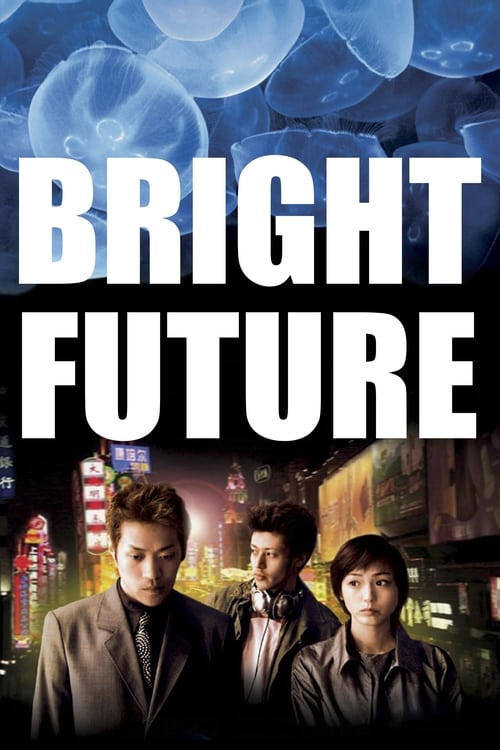
Bright Future
2003 · Kiyoshi Kurosawa
The J-horror master's prolific late run (Cloud at Venice, the Serpent's Path self-remake) fuels a "finally getting his flowers in the West" appreciation cycle among genre cinephiles.
For when you're feeling adrift yourself and want a film that takes aimlessness seriously instead of curing it. A challenge, not a comfort — but a strangely hopeful one by the end.
What it's about
Two young men fold towels at a Tokyo laundry factory and share a dead-end apartment, an unspoken current of rage, and one strange project: slowly acclimating a venomous jellyfish to freshwater. Mamoru is the older, unreadable one; Yuji drifts in his wake, prone to violent daydreams he can't explain. When something ruptures between them, Yuji falls into the orbit of an estranged father, and the jellyfish keeps quietly pursuing its own future.
The experience
Hushed, drifting, and faintly menacing — long stretches of dead time punctured by flashes of violence and eerie beauty. It moves at the pace of underemployment, then leaves you with images that glow in the dark of your head for days.
Performances
Tadanobu Asano and Joe Odagiri make an unforgettable pair — Asano all coiled stillness, Odagiri slack and volatile — while Tatsuya Fuji brings a battered warmth as the father trying to reach across a generation.
The craft
Kiyoshi Kurosawa shoots Tokyo as a city of fluorescent workrooms and murky canals, and turns a jellyfish into one of cinema's great special effects using little more than light and water. The digital-video texture is deliberately rough, which makes the moments of luminous beauty land harder. Watch it in a dark room; the glow matters.
Why it matters
A key film in the wave of Japanese cinema that captured millennial drift and generational deadlock after the economic bubble, and a landmark in Kurosawa's move from horror into something stranger and sadder.
Snapshot
Akarui Mirai (明るい未来) — literally "Bright Future" — is a film that earns its irony slowly. Two young men, Mamoru (Joe Odagiri) and Yuji (Tadanobu Asano), perform repetitive labor at an oshibori laundry and share an apartment and a single strange ambition: to acclimate a venomous jellyfish to freshwater so that it might one day survive in the rivers of Tokyo. When a violent rupture severs the pair — and Yuji's estranged father, Shin'ichirō (Tatsuya Fuji), enters Mamoru's orbit — the jellyfish continues on its own trajectory, multiplying and spreading luminously through the city's waterways. By the film's close, the creature has colonized the urban environment entirely. Whether this constitutes catastrophe, liberation, or simple indifference is left open. Bright Future is Kiyoshi Kurosawa working at the intersection of social fable and elliptical character study, producing one of the period's most searching meditations on Japanese youth adrift in the aftermath of the bubble economy's collapse.
Industry & production
The film was produced and released in 2003, screened in the Un Certain Regard section of the Cannes Film Festival that year, marking continued international recognition of Kurosawa as an auteur presence beyond his J-horror reputation. By this point Kurosawa had established a productive relationship with Japanese genre and art-cinema production circuits that allowed him unusual creative latitude. His genre work — particularly Cure (1997) and Kairo (2001) — had generated enough critical capital domestically and internationally that a more overtly contemplative project like Bright Future could be financed and released.
The specific production company financing and distributing the film, and its precise budget, are not details that have been prominently documented in English-language scholarship; this is a common gap in the record for mid-budget Japanese art films of the period. What is clear from the film itself is a production operating efficiently within limited means: the factory setting, the domestic apartment, and the Tokyo riverscapes make economic use of accessible locations while serving the story's thematic preoccupations precisely.
Kurosawa wrote the screenplay himself, consistent with his general practice. His scripts tend to begin from a governing image or situation — here, the jellyfish — and radiate outward into character and social observation rather than working from conventional dramatic architecture.
Technology
Bright Future was shot on 35mm film, situating it within Kurosawa's pre-digital period. The decision has formal consequences: the grain structure and the subtle latitude of celluloid contribute to the film's dreamlike, slightly unstable quality, particularly in the low-light sequences photographed around the rivers and underpasses where the jellyfish eventually proliferate. The bioluminescent glow of the creatures — rendered with practical lighting effects and some optical work rather than heavy digital compositing — registers differently on film than it would in a video or digital capture: softer, more ambient, bleeding into the surrounding darkness in ways that support the film's elegiac mood.
Kurosawa would move into digital acquisition in subsequent years, and the relative warmth and material density of the 35mm image in Bright Future gives it a slightly different textural character from his later work. The technology, while not foregrounded, quietly underpins the film's refusal of clinical precision.
Technique
Cinematography
The film's visual grammar is one of deliberate patience. Kurosawa favors long takes and static or very slowly tracking compositions that place characters within environmental contexts rather than isolating them through close-up. The factory sequences establish this early: the camera observes Mamoru and Yuji performing their labor from a middle distance, the mechanical repetition of their work finding visual counterpart in the fixed frame. This is not the vertiginous handheld grammar of social realism but something colder and more observational, inflected by Kurosawa's long engagement with the formal vocabulary of American B-cinema and Japanese studio filmmaking.
The jellyfish tank is the film's luminous exception: a point of concentrated visual beauty within otherwise drab interiors, a soft blue-purple radiance that the camera returns to with something approaching reverence. When the creatures eventually escape into the city's waterways, the contrast between their otherworldly glow and the nocturnal concrete and steel of Tokyo is managed with restraint — never overstating the surreal intrusion, allowing it to accumulate quietly.
The specific DP on Bright Future has not been as consistently documented in accessible English-language sources as, say, the cinematographers on Kurosawa's larger productions; readers seeking confirmed technical credits should consult Japanese-language production documentation or Cannes press materials from 2003.
Editing
Kurosawa's editing is elliptical in the strong sense: scenes end before their conventional emotional resolution, transitions elide exposition, and the film's chronological logic occasionally slips without announcement. The cut between the act of violence and its consequences is handled obliquely — we understand what has happened through inference and aftermath rather than direct presentation. This is a recurring Kurosawa strategy, rooted in his understanding that cinema's power to disturb lies in the imagination of the viewer as much as in what is shown.
The pacing is slow by commercial standards, but not empty. Each sustained sequence earns its duration by accumulating detail — a glance, a gesture, the sound of water — that accrues meaning retroactively.
Mise-en-scène / staging
Characters in Bright Future frequently inhabit space at oblique angles to one another, talking without quite facing each other, occupying the same frame without achieving connection. Kurosawa has discussed his interest in the Japanese theatrical tradition of actors expressing emotion through stillness and restraint, but his staging also reflects a Bressonian economy: the placement of a body in a room is a moral proposition. The relationship between Mamoru and Yuji is rendered largely through proximity and shared attention to the jellyfish rather than through dialogue or conventional dramatic confrontation. The bond is shown as real without being explained.
The Tokyo locations — riverbanks, concrete underpasses, anonymous residential districts — are used not as atmosphere but as social fact. This is the city after the bubble, its infrastructure intact but its promise evacuated.
Sound
Kurosawa's sound design throughout his career treats ambient noise as a carrier of menace: the hum of electrical systems, the drip of water, the specific silence of rooms where something is wrong. In Bright Future, the factory soundscape — the machinery, the wet snap of towels, the low hum of industrial process — establishes the dull rhythm of these young men's existence. The sound of the jellyfish tank is rendered almost inaudibly, a near-silence that frames the creatures as existing outside the film's otherwise oppressive acoustic environment.
The score — the specific composer is not reliably documented in the sources available to this account — leans toward ambient or electronic textures consistent with Kurosawa's characteristic refusal of emotionally signposting music. The film rarely tells you how to feel through its audio grammar; it refuses the manipulation of conventional scoring.
Performance
Joe Odagiri gives a performance of extraordinary interiority: Mamoru is present in every scene but emotionally opaque, his attention displaced onto the jellyfish, onto Yuji, onto small environmental details. Odagiri, who had already demonstrated considerable range in Japanese television and film, finds in Kurosawa's patient camera a space to perform in minimal increments. Tadanobu Asano — by 2003 already a significant international art-cinema presence through his work with Takashi Miike, Shinji Aoyama, and others — brings a quality of barely-contained, directionless intensity to Yuji: a character for whom violence is not malice but overflow.
The casting of Tatsuya Fuji as Shin'ichirō is pointed and historically freighted. Fuji had become internationally famous through Nagisa Oshima's Ai no Corrida (In the Realm of the Senses, 1976), a film about erotic extremity and the collapse of individual will into destructive desire. His presence in Bright Future brings a weight of Japanese cinematic history into dialogue with Kurosawa's younger generation of protagonists; his character's fumbling, belated attempt at connection with Mamoru is the film's most quietly devastating strand.
Narrative & dramatic mode
Bright Future proceeds by accumulation and displacement rather than through conventional cause-and-effect plotting. The narrative logic is closer to the dream — or to the essay — than to the thriller or the melodrama. An event occurs; its meaning is not adjudicated by the narrative but deferred, folded into the jellyfish metaphor, redistributed as social observation. The film's second half, which concentrates increasingly on the jellyfish as they spread through Tokyo's waterways, moves away from character psychology entirely and into something more like tableau or fable. This is a risk that the film earns through the precision of its earlier sequences.
The story resists the category of tragedy, though it contains tragic elements, and equally resists resolution or hope. Its ending — the jellyfish glowing in the rivers, Mamoru moving through the city among other young men who seem to carry the same displaced energy — is apocalyptic only in the original sense: a revelation, a pulling-back of the veil, without declaring what is to follow.
Genre & cycle
Kurosawa made his international reputation through J-horror, a cycle that ran from roughly the mid-1990s through the mid-2000s and included Ringu (Hideo Nakata, 1998), Ju-On (Takashi Shimizu, 2002), and Kurosawa's own Cure and Kairo. Bright Future is formally outside this cycle — it contains no supernatural horror, no genre mechanics of dread and revelation — but it shares J-horror's diagnostic interest in the social pathologies of contemporary Japan: alienation, technological mediation of human contact, the legibility of violence, the body as a site of ungovernable force.
The film is better classified within a parallel strand of Japanese art cinema in the late 1990s and early 2000s: the work of Shinji Aoyama (Eureka, 2000; Desert Moon, 2001), Nobuhiro Suwa, and to some extent early Sion Sono, directors whose films explored youth estrangement with elliptical formalism and an absence of narrative consolation. Bright Future sits comfortably in this company while maintaining Kurosawa's genre-derived instincts for uncanny staging.
Authorship & method
Kiyoshi Kurosawa (born 1955) studied film at Rikkyo University, where he encountered the critical writing and influence of Shigehiko Hasumi, the theorist and critic who shaped a generation of Japanese filmmakers toward a cinema of surface, gesture, and duration rather than psychological depth or narrative transparency. This influence is audible throughout Bright Future in the film's interest in what bodies do in space rather than what characters intend or feel. Kurosawa has also cited a deep formation in American genre cinema — Hawks, Ford, Siegel, Eastwood — whose influence is less immediately visible in a film like Bright Future than in his thrillers, but which underwrites his economy of means and his trust in the image over the word.
The collaborators on Bright Future — beyond the confirmed lead cast — are not as thoroughly documented in accessible scholarship as those on Kurosawa's better-known productions. This is a common feature of the record for his non-horror work of the period, and this account declines to attribute specific technical credits without verification.
Movement / national cinema
Bright Future is deeply embedded in the cultural moment of Japan's "Lost Decade" (roughly 1991–2001) and its social aftermath. The bubble economy's collapse had produced a generation of young Japanese — Mamoru and Yuji's generation — who had inherited a social contract their parents' prosperity never actually secured for them: the promise of stable employment, belonging, and purposeful futurity had been quietly voided. The hikikomori phenomenon — social withdrawal into domestic isolation — and the NEET (Not in Employment, Education or Training) discourse were both prominent in Japanese public life by the early 2000s, and the film's factory-laboring protagonists, with their displaced affect and their attachment to a creature no one else can safely approach, are of a piece with this social landscape.
The shadow of the 1995 Aum Shinrikyo sarin attacks also falls across this and related films. Kurosawa's Cure (1997) had been read, with his explicit acknowledgement, as working through the bewildering emergence of apparently motiveless violence in a society that had narrated itself as orderly and coherent. Bright Future's latent violence — Yuji's eruption, Mamoru's quiet intensity — belongs to the same cultural investigation, though displaced here from the register of horror into the register of social elegy.
Era / period
The film is a product of the early 2000s in Japanese cinema, a moment when art-cinema directors operating somewhat independently of the major studio system were producing some of the most formally ambitious work in world cinema. The era saw Japanese film gaining significant international festival presence (Cannes, Berlin, Venice) — Aoyama's Eureka, Naomi Kawase's work, and Kurosawa's own festival circulation all belong to this wave — while domestically the genre blockbuster and the anime-adjacent market dominated box office.
Themes
The jellyfish is Bright Future's master trope, and it sustains multiple simultaneous readings. As a biological entity that can be acclimated, with effort and care, to an environment alien to its nature, it figures the possibility of adaptation — but also the limits of belonging, the organism that survives by becoming invasive. The young men's attachment to it is a form of displaced tenderness: unable to connect meaningfully with the social world or with other people, they pour their care into something radically non-human and radically vulnerable.
The film is also preoccupied with generation and transmission: what fathers fail to pass to sons, what young men cannot receive, what is left when the bonds of continuity snap. Shin'ichirō's attempt to reconstitute a paternal relationship with Mamoru — to step into the void left by his own failure with Yuji — is the film's most overtly emotional thread, and it is rendered without sentimentality or false resolution. Connection is possible, perhaps, but partial; it doesn't heal the structural wound.
Finally, Bright Future meditates on futurity itself — on whether a "bright future" is available to, or desired by, its young protagonists. The title's irony is not simply sardonic: there is something genuinely unresolved in the film's relationship to what comes next. The final image of the glowing jellyfish in Tokyo's rivers is terrifying and beautiful in equal measure, a future that has arrived uninvited and is now simply there, pulsing.
Reception, canon & influence
Backward influences: Kurosawa's acknowledged formation in American genre cinema — particularly the B-thriller and the horror film as practiced by directors like Don Siegel and John Carpenter — informs his staging and his approach to dread even in a film that refuses genre mechanics. The influence of Hasumi's critical formalism is equally present. Internationally, the film's patient, elliptical duration and its interest in social alienation inscribed in landscape and architecture show an attentiveness to the European art cinema of Antonioni, Tati, and Bresson — directors who had also shaped the work of Aoyama and other contemporaries. Within Japanese cinema, the legacy of the Japanese New Wave — Oshima, Yoshida, Imamura — is filtered through Kurosawa's very different temperament: less aggressively confrontational, more quietly catastrophic.
Reception: The film's Cannes Un Certain Regard screening in 2003 brought it to international critical attention, and it was broadly received as evidence of Kurosawa's range beyond J-horror. Critics noted the performances — particularly Odagiri and Fuji — and the audacity of the jellyfish conceit as a sustained metaphor. Some found the film's pace and ellipsis frustrating; others identified it as among his most personal and formally accomplished works. In Japan, its domestic reception was more modest, consistent with the limited commercial appetite for the kind of slow, unresolved art cinema it exemplifies.
Legacy and forward influence: Bright Future has not been as frequently cited as Cure or Kairo in accounts of Kurosawa's influence on subsequent genre filmmaking, but its model of social-fable cinema — the naturalistic observation that opens onto the allegorical — has resonated in Japanese and wider Asian art cinema of the following decade. The film's treatment of youth alienation and displaced affect prefigures concerns that would run through Japanese independent cinema well into the 2010s. Odagiri's performance here was formative for his subsequent career as one of Japanese cinema's most interesting actors, and the film's casting of Tatsuya Fuji as intergenerational bridge is a conscious gesture toward the history of Japanese cinema that several later directors working with older stars have echoed.
Within Kurosawa's own trajectory, Bright Future represents a pivot point: a deliberate step away from genre that anticipates the more overtly humanist and contemplative register of later work like Tokyo Sonata (2008) and Journey to the Shore (2015), even as it retains the uncanny charge that marks all his cinema.
A Deleuzian reading
Start with the tank.
The full Deleuzian reading of Bright Future →
Reception
It landed at Cannes 2003 to shrugs and puzzlement — a drifty, lo-fi DV oddity from the guy who made Cure and Pulse. Two decades on, the Letterboxd generation has claimed it as one of Kurosawa's most quietly beloved films, a millennial-malaise touchstone that finally found its audience.
How Bright Future was received, from release to now →
Influences: the films it descends from and the films it influenced
- Pickpocket (1959) — Bresson's 'model' system — directing performers to execute precise behavioral sequences stripped of conscious expression — is the template for Kurosawa's staging of Odagiri's withdrawal as pure surface event, non-psychological and non-declarative.
- Diary of a Country Priest (1951) — Bresson's method of rendering spiritual crisis through posture, physical decline, and silence rather than dialogue or confession is the performance model Kurosawa adapts for the young men's affectless withdrawal as externalized social symptom.
- L'Avventura (1960) — Antonioni's structural device of an unresolved disappearance — narrative converted into ambient inquiry, characters moving through architecture that frames rather than explains their disconnection — supplies the elliptical editing grammar Kurosawa deploys throughout.
- Playtime (1967) — Tati's deployment of modernist architecture as ideological environment — characters geometrically arranged within grids of glass and concrete, their movements both comic and symptomatic — is the specific spatial vocabulary behind Kurosawa's oblique staging in the film's industrial periphery.
- Invasion of the Body Snatchers (1956) — Siegel's B-cinema conceit of a spreading alien organism as social-conformity critique — the biological agent as legible political allegory — is the genre template Kurosawa consciously invokes and dissolves, substituting jellyfish bioluminescence for pods as the film's central invasive figure.
- Halloween (1978) — Carpenter's synthesizer-drone non-diegetic scoring — ambient tonal dread operating below narrative event, generating unease independently of image content — is the direct sonic model for Kurosawa's ambient-menace sound practice.
- Intentions of Murder (1964) — Imamura's anthropological distance — observing a protagonist's survival of violence without psychological access or moral framing, treating behavior as social specimen — establishes the model of behavioral observation Kurosawa applies to his disaffected young male subjects.
- Tokyo Sonata (2008) — The direct formal descendant of Bright Future's social-fable pivot — the same elliptical editing and domestic behavioral observation now applied to middle-class unemployment, fully shed of genre premise, completing the turn toward humanist contemplative cinema begun in 2003.
- Linda Linda Linda (2005) — Yamashita extends Bright Future's interior-minimalist youth performance grammar and institutional-setting social container into J-indie school cinema, the low-affective observational staging Kurosawa helped codify becoming a template for Japanese independent film of the mid-2000s.
- Journey to the Shore (2015) — The terminus of the trajectory Bright Future initiated — ambient-scored long-takes and oblique spatial geometry now applied to an overtly fantastical conceit, confirming the dream-essay logic as Kurosawa's settled mature register rather than a period experiment.
- Eureka (2000) — Aoyama, formed by the same Hasumi critical formalism, constructs a three-hour 35mm social fable about post-traumatic national crisis using the identical formal apparatus — long-takes, elliptical duration, landscape as psychic state — applied to post-Aum Japan.
- Kairo (2001) — Sharing Bright Future's ambient-menace sound design and its use of a practical visual phenomenon — internet static versus bioluminescence — as sustained metaphor for social disconnection, Kairo and Bright Future bracket Kurosawa's peak allegorical period as paired formal experiments.
- Beau Travail (1999) — Denis applies Bressonian economy of male bodies — choreographed behavioral sequences stripped of psychological explanation, scored with non-diegetic ambient music — to a post-colonial social fable, producing the same surface-as-symptom staging grammar Kurosawa uses.
- Platform (2000) — Jia's 35mm long-take observation of Chinese youth adrift in economic transformation — elliptical duration structured around the gap between aspiration and historical constraint — parallels Bright Future's formal and thematic treatment of generational loss under late capitalism.
- Distance (2001) — Kore-eda uses elliptical editing and behavioral minimalism to observe characters unable to access their own grief, producing the same oblique emotional geometry and fragmented duration that Kurosawa applies to his young men's social estrangement.
- The Eel (1997) — Builds a whole redemption arc around a captive aquatic creature — luminous jellyfish in tanks — extending The Eel's aquarium-motif of an animal carrying a man's suppressed inner life.
- Ritual (2000) — Early-2000s Japanese DV art film that, like Ritual, stages alienation against an industrial waterfront using the texture of digital video itself.
Similar films
- Tokyo Sonata (2008) — influence & lineage
- Pulse (2001) — shared sensibility
- Ikiru (1952) — shared sensibility
- Perfect Days (2023) — shared sensibility
- Tokyo Story (1953) — shared sensibility
- Millennium Actress (2002) — shared sensibility
- Maborosi (1995) — shared sensibility
- Dolls (2002) — shared sensibility