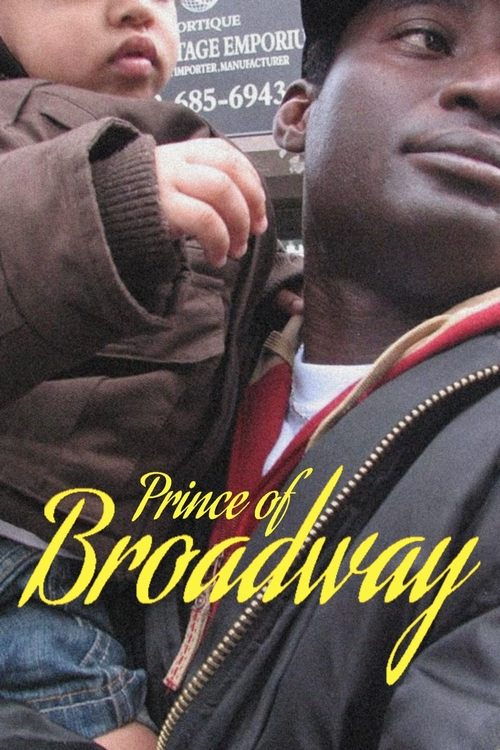
Prince of Broadway
2010 · Sean Baker
Anora's sweep (Palme d'Or plus five Oscars, four to Baker personally) crowned the iPhone-indie guy as establishment king, sparking discourse about sex-work representation and his all-timer speech defending theatrical moviegoing. The name to drop for "independent cinema still matters."
For when you want something raw and alive rather than polished — a scrappy, big-hearted film that earns its feelings the hard way.
What it's about
Lucky, an undocumented Ghanaian immigrant, works the Manhattan wholesale strip as a puller — charming tourists off the sidewalk and into a hidden back room full of counterfeit sneakers and designer knock-offs. His hustle is running smoothly until an ex-girlfriend appears, deposits a toddler in his arms with the claim that the boy is his, and walks away. A man who sells fakes for a living now has to figure out what, in his own life, is real.
The experience
Rough-edged, fast-talking, and unexpectedly tender — it has the jittery energy of the street it was shot on, then keeps ambushing you with warmth. The comedy and the desperation live in the same breath.
Performances
Prince Adu is magnetic as Lucky, all salesman's patter over real panic, and Karren Karagulian gives the counterfeit-shop owner a weary, lived-in decency; both feel less like performances than lives caught on camera.
The craft
Shot for around $45,000 inside a functioning black-market economy, with handheld cameras, real locations, and a cast of largely nonprofessional actors, the film blurs the line between fiction and documentary. Its improvisational looseness is the point — the texture of the street is the production design.
Why it matters
An early landmark in Sean Baker's career and a model for the micro-budget filmmaking he'd become famous for — embedding invented stories inside real, overlooked economies and communities.
Snapshot
Prince of Broadway is a hundred-minute, $45,000 fiction film shot inside a real black market. Lucky (Prince Adu), an undocumented Ghanaian immigrant, works as a "puller" on the Manhattan wholesale strip, steering tourists off the sidewalk and into a back room stocked with counterfeit sneakers and handbags. The room belongs to Levon (Karren Karagulian), a Lebanese-Armenian merchant whose marriage to Nadia (Victoria Tate) is coming apart and whose shop is exposed to police raids. Into this arrangement walks Linda (Kat Sanchez), an ex-girlfriend, who deposits an eighteen-month-old boy — named Prince (Aiden Noesi) — on Lucky's hands with the claim that the child is his, then leaves.
The film's engine is not the hustle but the audit. A man who makes his living selling things that are not what they say they are is handed a claim he cannot verify and does not want. Sean Baker directed, co-wrote (with Darren Dean), produced (with Dean), shot, and cut it. It premiered at the Los Angeles Film Festival on 22 June 2008 and did not reach American theaters until 2010 — a three-year lag Baker has attributed to a collapsed market for small independents. It is the film in which his method locked into place.
Industry & production
The production sits at the extreme low end of American independent finance. Take Out (2004), Baker's previous feature, co-directed with Shih-Ching Tsou, was made for roughly $3,000; Prince of Broadway multiplied that figure but remained, in Baker's own framing, modest. The company was Little Creature. Darren Dean served as co-writer and producer — the beginning of a working partnership that runs through The Florida Project. Victoria Tate appears as Nadia and worked as associate producer, the kind of doubled credit that indicates how few people were on the payroll.
Casting was inseparable from location scouting. Baker has described finding Prince Adu, a non-actor then working security, while researching the neighborhood, and Adu in turn offering to help cast the film and open doors. That is not an anecdote about serendipity; it is a production model. Access to the wholesale trade could not be bought or permitted into existence, so it was obtained through people who already belonged to it.
Distribution was the hard part. The film was completed into the 2008 credit crisis, when specialty acquisitions dried up. Lee Daniels came aboard as a presenting name, and Baker has credited that involvement with unlocking a release through New Video; the film reached theaters in 2010 under the Cinedigm banner. Reported U.S. box office is roughly $20,450 — a rounding error, and a fair index of how little a well-reviewed micro-budget film could convert critical goodwill into money in that window.
Technology
The film belongs to the prosumer HD moment. Technical records identify the Panasonic AG-HVX200 as the camera — a tapeless, P2-card, shoulder-or-hand-held body that in 2007–08 represented the cheapest credible route to a theatrically projectable image. What that camera bought Baker was not resolution but invisibility and stamina: a rig small enough to work a Manhattan sidewalk without announcing a film crew, sensitive enough to expose in the fluorescent wash of a back room and the sodium light of a night street without a lighting package, and cheap enough per minute of recorded material to sustain a very high shooting ratio.
That last point is the substantive one. Improvisation is a storage problem before it is an aesthetic one. Baker asks performers to render scripted lines in their own words and shoots multiple variations because, as he has put it, he likes to be entertained in the edit room. That practice is economically impossible on film stock and trivially affordable on solid-state media. The same economics let him cut the picture himself, on a desktop, over a long post period — the labor is his own time rather than a facility's day rate.
Criterion's 2025 4K digital restoration, supervised by Baker with Alex Coco, is a small landmark in its own right: an act of archival care applied to a standard-definition-era prosumer HD original, which is a different conservation problem from restoring a negative and an increasingly common one for films of this generation.
Technique
Cinematography
Baker operates his own camera, and the film's visual grammar follows from that. It is predominantly handheld, close, and reactive — the frame chases a performance rather than anticipating it, and reframes visibly when someone moves. Coverage is gathered rather than designed: the camera stays inside the scrum of bodies on the sidewalk, in the tight geometry of the hidden shop, in the narrow apartment where Lucky and the child are trapped together. There is little of the composed, tableau-forward image Baker would develop later with Alexis Zabe on The Florida Project; here the operating principle is proximity and available light, with the street's own signage and shopfront glare doing the work of a lighting plan.
The camera treats the trade documentarily and the domestic scenes dramatically, and the seam between those registers is where the film generates most of its texture. Sidewalk material has the scanning, slightly behind-the-action quality of reportage. Interiors settle, hold, and let performers work.
Editing
Baker cuts his own films, and Prince of Broadway is where his editorial signature emerges: a preference for the reactive cut over the anticipatory one, tolerance for scenes that run past their informational purpose, and a structural willingness to let two plots braid without forcing them to converge in the usual screenwriting sense. Lucky's story and Levon's story rhyme rather than intersect mechanically. The rhythm is accumulative — a working day, then another working day, with the child's presence progressively deforming the routine. Improvised takes are assembled for the best behavior rather than the cleanest line reading, which produces overlaps, stumbles, and dead air that a script-faithful cut would have removed.
Mise-en-scène / staging
The staging is a study in thresholds. The film is organized around the passage from public street to concealed room — the puller's whole function is to move a body across that boundary — and Baker keeps returning to doorways, back stairs, curtained partitions, and stockrooms. Merchandise is everywhere, stacked and boxed, and it doubles as set dressing and as argument: the frame is crowded with objects that look like something they are not.
Domestic space is the opposite: under-furnished, provisional, hostile to a toddler. The child is staged as an obstruction, physically in the way of every adult transaction, which is both a comic engine and the film's thesis about what care costs a person with no slack.
Sound
The soundtrack is location sound with the city left in — traffic, retail chatter, overlapping languages, the ambient hum of commerce. The film largely forgoes the cushion of continuous non-diegetic scoring, relying on source music and street noise, which keeps the register documentary and denies the audience the emotional cueing that would sentimentalize Lucky's predicament. Dialogue is often competitive and imperfectly intelligible; multilingual exchange is treated as ordinary rather than exotic. The 2025 restoration carries a 5.1 DTS-HD Master Audio track, which spatializes a mix originally captured under guerrilla conditions.
Performance
Prince Adu's Lucky is the film's discovery: a performance built from watchfulness and withheld reaction, funny in its exasperation and unshowy in its eventual tenderness. He is not playing a saint being tested; he is playing a competent man whose competence is useless against the situation.
Karren Karagulian's Levon is the other pole — voluble, harried, morally compromised without being a villain, comic in his self-justification. It is a template Karagulian and Baker would return to, most visibly in Toros in Anora (2024). The child performer, a genuine toddler, is directed as a toddler rather than as an actor, and much of the film's best material is Adu improvising against behavior he cannot control.
Narrative & dramatic mode
The mode is episodic realism with a soft deadline. Linda's departure sets a clock, but the film declines to make that clock tick melodramatically. Instead it proceeds through process: how you sell, how you hide, how you feed a child you did not plan for, how you talk your girlfriend into tolerating him. Karina (Keyali Mayaga) resists, credibly and without being written as a shrew.
The dual-protagonist structure gives the film its shape. Lucky's paternity claim and Levon's marriage are both questions of what a man is entitled to assume about his own household, and both are being adjudicated by forces — a vanished ex, a police raid — outside his control. The resolution is deliberately anti-climactic: Lucky moves toward accepting responsibility, and the film does not deliver the certification scene the genre trains you to expect. Whether the biological claim is true matters less, by the end, than the fact that Lucky has already begun behaving as though it is. That refusal is the film's central formal decision, and the one reviewers most often flagged — approvingly as honesty, occasionally as evasion.
Genre & cycle
This is American neorealism as revived in the late 2000s, the cycle A. O. Scott labeled "neo-neo realism" in a 2009 New York Times Magazine essay grouping Ramin Bahrani, Kelly Reichardt, and their contemporaries. Prince of Broadway belongs squarely to it: non-professional casting, real locations, working-class or immigrant protagonists, plots driven by money rather than psychology, endings that decline closure.
It also sits pointedly athwart mumblecore, the other dominant low-budget American formation of the same years. The tools are shared — DV, tiny crews, improvised dialogue — but the subject is not. Where mumblecore looked at educated white twenty-somethings, Baker looked at a Ghanaian street vendor and an Armenian counterfeiter. Secondarily, the film is a father-and-child picture and a New York street film, and it borrows the comic timing of neither genre's mainstream version.
Authorship & method
Baker's credits here — director, co-writer, producer, cinematographer, editor — describe an authorship of scarcity rather than of control fetishism. The method that consolidated on this film has four planks: cast from the world you are filming; write a script but hold it loosely, asking performers to translate it into their own idiom; shoot on location, small and fast, with the camera in the director's own hands; and cut it yourself over as long as it takes.
The collaborators matter as much as the auteur. Darren Dean, co-writer and producer, remained a central partner. Karren Karagulian has appeared in every Baker feature and is the through-line of the whole body of work. Shih-Ching Tsou, co-director of Take Out, is part of the same circle; Baker later co-wrote and edited her Left-Handed Girl (2025). Victoria Tate worked in front of and behind the camera. Alex Coco, who supervised the film's restoration with Baker, became a producer on his later work. There is no composer of note here and no cinematographer to credit but Baker himself, which is a genuine gap in the usual dossier apparatus: the film's crew list is thin because the crew was thin.
Movement / national cinema
The film is a New York picture in a specific lineage — the location-shot, portable-camera Manhattan of Morris Engel's Little Fugitive (1953), Lionel Rogosin's On the Bowery (1956), and Shirley Clarke's The Cool World (1963) — updated to a city whose informal economies had been pushed further underground by post-9/11 enforcement and Bloomberg-era redevelopment. It is also, importantly, an immigrant film about immigrants who are not from the same place: Ghanaian, Armenian, Lebanese, Latino characters negotiating with each other in English as a shared second language. That polyglot street-level New York is rarer on screen than the city's on-screen ubiquity suggests, and it connects Prince of Broadway directly to Take Out's Chinese delivery cyclist and forward to the Russian-American Brooklyn of Anora.
Era / period
Shot in 2007–08 and released in 2010, the film brackets the financial crisis without depicting it. Its world — a cash trade in counterfeits, conducted by people with precarious documentation, in retail space one raid away from closure — was already living in the conditions the crash would generalize. The three-year gap between premiere and release is itself a period artifact: the specialty distribution sector that would have picked up such a film in 2005 had substantially contracted by 2009.
Technologically, it belongs to the last moment before smartphones changed both filmmaking and street commerce, and to the first moment when prosumer HD plus digital projection made a $45,000 feature theatrically viable. Baker would take the logic further with Tangerine (2015), shot on iPhone 5S.
Themes
The organizing metaphor is authentication. Lucky sells fakes that are functionally indistinguishable from the real thing to buyers who know they are fakes and want them anyway; he is then asked to accept a child on an unverifiable claim. The film keeps asking what a certificate is worth — a label, a marriage, a green card, a DNA result — and keeps answering that documentation is a weaker basis for a life than conduct is. Kinship in this film is something you perform into existence, not something a test confirms.
Around that sit the film's other concerns: precarity as a permanent condition rather than a crisis; masculinity reorganized by unwanted care; the invisibility of the labor that supplies a consumer economy; solidarity and friction among immigrant communities that share a street but not a language or an interest. Baker's tonal signature — comedy and warmth extended to people the culture usually moralizes about — is fully present, and the film declines both pity and condemnation.
Reception, canon & influence
Critical reception was strong but small-scale: an 85% Rotten Tomatoes rating across roughly twenty reviews and a Metacritic score of 61 from eight critics indicate a picture that impressed the critics who saw it while barely registering commercially. Most notices singled out Prince Adu's performance and the film's documentary access to a trade rarely dramatized. Dissent existed — Dennis Schwartz, for instance, found the ending a false note — and it clustered predictably around the refusal of resolution. Institutionally, the film's most meaningful recognition was a 2009 Independent Spirit Award nomination for the John Cassavetes Award, alongside Baker's own belatedly released Take Out: two nominations in the same category for the same director, which likely split whatever support he had.
Its backward influences are legible without being imitative. Italian neorealism supplies the base grammar — Bicycle Thieves especially, for the man-and-child-adrift structure and the economics-as-plot logic. The Dardenne brothers are the closer contemporary model: La Promesse (1996) for immigrant labor and paternal complicity, L'Enfant (2005) for a young father who treats a child as a transactional object before learning otherwise. Cassavetes stands behind the performance-first, improvisation-tolerant method. And Ramin Bahrani's Man Push Cart (2005) and Chop Shop (2007) are the immediate American precedents — the same city's margins, the same non-professional casting, the same insistence that work is the real subject.
Forward, the film's principal legacy is internal: it is the hinge of Baker's career. The child-in-an-adult-economy structure leads directly to The Florida Project (2017); the sympathetic hustler leads to Red Rocket (2021) and Anora (2024); Karagulian's harried middleman is a first draft of Toros. Baker's Oscar sweep for Anora in 2025 — Picture, Director, Original Screenplay, and Editing — retroactively made the early films required viewing, and the canonization followed quickly: Criterion, which had already issued Take Out as Spine #1149, released Prince of Broadway as Spine #1258 on 29 April 2025, in a 4K restoration supervised by Baker and Alex Coco, with commentaries from Baker and from Dean, Tate, and Karagulian, and an essay by Robert Daniels.
Its wider influence is harder to trace than its lineage, as is usual for a film seen by very few people on first release. What can be said is that Prince of Broadway helped establish a durable proof of concept — that a feature made for the price of a used car, shot by its director on a prosumer camera inside a real economy with people who live in it, could be both formally serious and genuinely funny — and that a generation of American micro-budget filmmakers has worked in the space that proof opened.
A Deleuzian reading
Lucky works a sidewalk.
The full Deleuzian reading of Prince of Broadway →
Reception
It premiered on the 2008 festival circuit to warm reviews, then waited two years for a tiny 2010 theatrical run ('Lee Daniels presents'); after Tangerine, The Florida Project and Anora, it's been rediscovered as the Rosetta stone of Sean Baker's whole project.
How Prince of Broadway was received, from release to now →
How to watch Prince of Broadway: what to notice on a first viewing
- Notice the camera reframe every time someone moves. Baker operates his own handheld camera close to the actors, chasing a performance rather than anticipating it, so the frame visibly adjusts as bodies shift. You feel like you're catching this world rather than being shown a composed version of it.
- Watch Lucky steer a stranger toward a hidden door. Baker keeps returning to doorways, back stairs, and curtained partitions, the passage from open sidewalk to a concealed room stacked with counterfeit goods. A small gesture toward a doorway is standing in for a whole economy you never get to see directly.
- Notice how crowded every frame is with boxed goods. Stacked merchandise fills the shop and its stockroom in nearly every shot, sneakers and handbags that look exactly like something they are not. The objects double as set dressing and as an argument about what looks real and what isn't.
- Listen for the street left in on the soundtrack. Traffic, retail chatter, and overlapping languages fill the mix with almost no music laid over it, so the register stays documentary rather than cued. Without a score telling you how to feel, whatever sympathy you feel for Lucky you found yourself.
- Watch Lucky work the street with a toddler on his hip. Prince Adu plays a man who is fast and competent at his hustle, and none of that skill has any purchase once he's holding a child who cannot be managed. A man with a child on his hip simply cannot pull, and you watch that fact cost him in real time.
The whole guide to watching Prince of Broadway, with the keys for a rewatch →
Influences: the films it descends from and the films it influenced
- Bicycle Thieves (1948) — Supplies the base grammar Baker rebuilds: a non-professional lead (a factory worker) cast for his body and gait rather than his technique, a child bound to an adult's failing hustle, and a plot whose every beat is generated by an economic ledger — the object that makes work possible — instead of by psychology.
- Shadows (1959) — Establishes the performance-first method Baker adopts wholesale: a written situation handed to performers who translate it into their own idiom on location, with the camera positioned reactively to catch dialogue as it happens rather than blocking actors into pre-planned coverage.
- Killer of Sheep (1978) — Model for episodic realism built from labor: scenes accumulate as the texture of a working life among neighbors playing themselves, with children improvising in the margins of an adult economy and no third-act mechanism arriving to resolve anything.
- La Promesse (1996) — The closest structural template — a young man complicit in an undocumented-labor racket, shot with a shoulder-borne camera held at working height that trails the body through corridors and thresholds, no composed score, and a final beat that stops on unresolved moral admission.
- Rosetta (1999) — The nape-of-the-neck follow shot Baker uses on Lucky through Canal Street sidewalks: camera glued to a body in transit, framing dictated by the subject's speed, with the entire sound field built from location recording so that traffic and breath do the work a score would.
- L'Enfant (2005) — Direct precedent for the film's central premise — a young father who treats an infant as a transactable object within his hustle before the child's physical demands rewrite him — and for an ending that cuts on emotion rather than on resolution.
- Man Push Cart (2005) — The immediate American precedent: build a feature around the daily procedure of one informal trade, cast the lead from people who have actually worked it, and shoot the labor in real time in the real location so the job's rhythm becomes the film's structure.
- Chop Shop (2007) — Puts a child inside a functioning gray-market economy — filmed in working Willets Point body shops with actual mechanics as cast — establishing the exact staging problem Baker solves on Broadway: how to shoot a real business while it is doing business.
- Take Out (2004) — Baker's own prior draft of the method: prosumer digital video shot inside an operating restaurant during service, workers from that trade in the cast, and a debt clock supplying the only plot mechanism the film needs.
- Tangerine (2015) — The direct continuation of Baker's method under new constraints: cast from the corner economy being filmed, dual plot lines braided across a single day, Karagulian again as the harried connective middleman, and both strands converging in a threshold space — a donut shop instead of a shopfront.
- The Florida Project (2017) — Scales up the child-in-an-adult-economy structure: a kid running loose through the exterior walkways and lobbies of a motel that is really a rooming house, non-professionals in the adult roles, and an ending that refuses to close the case it has built.
- Uncut Gems (2019) — Takes merchandise-as-argument to its extreme — the drama is authentication, what an object is worth and whether it is what it claims — staged inside real Diamond District spaces with trade insiders in the cast and overlapping location sound as the dominant texture.
- Red Rocket (2021) — Perfects the sympathetic-hustler protagonist first sketched here: a charming operator whose patter is the film's engine, surrounded by locals cast from the town being shot, with needle-drops and ambience standing in for any composed score.
- Anora (2024) — Karagulian's harried middleman is drafted here and completed as Toros; the braided pursuit across a single night, the sex-work economy shot inside its actual rooms, and Baker's own editing of the material are the same four planks, funded.
- Left-Handed Girl (2025) — Baker co-wrote and cut it, transplanting the method to a Taipei night market: a family's stall filmed as a working business, a child moving through an adult trade economy, and a plot braided across generations rather than resolved.
- Ballast (2008) — The parallel 2008 American case for the same toolkit — a cast of non-professionals drawn from the region, available light only, no non-diegetic score, and a narrative that withholds the reconciliation scene the material seems to promise.
- Gimme the Loot (2012) — Extends the braided two-hander of small-time New York hustling: paired non-professional leads improvising within a scripted skeleton, shot guerrilla-style across real blocks over a compressed span, with the money-scheme structure never paying off cleanly.
- Heaven Knows What (2014) — Applies the same casting principle at its most literal — the lead found on the street and playing a version of her own life — and shoots the surrounding economy on real corners with real participants, sound taken raw from location.
Similar films
- The Florida Project (2017) — influence & lineage
- Anora (2024) — influence & lineage
- Left-Handed Girl (2025) — influence & lineage
- La Promesse (1996) — influence & lineage
- The Forty-Year-Old Version (2020) — shared sensibility
- Capernaum (2018) — shared sensibility
- Souleymane's Story (2024) — shared sensibility
- Synecdoche, New York (2008) — shared sensibility