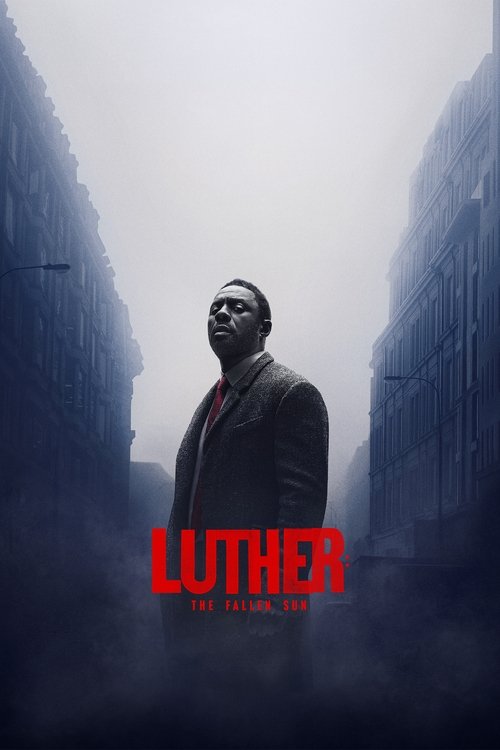
Luther: The Fallen Sun
2023 · Jamie Payne
For a night when you want a dark, twisty crime thriller you can devour on the couch without homework — familiar comfort-food tension with a nasty streak, especially if you like your detectives haunted.
What it's about
John Luther, London's brilliant and self-destructive detective, is finally behind bars — disgraced, exposed, and helpless while a flamboyant serial killer he'd been hunting terrorizes the city and taunts him personally. So Luther breaks out, hunting the killer as a fugitive while the police hunt him.
The experience
A fast, glossy, deliberately over-the-top thrill ride — grim in its details but propulsive in its pace, with big set pieces and a villain who enjoys his work far too much. It's pulpy rather than plausible, and it knows it.
Performances
Idris Elba wears Luther like a second skin — all wounded swagger and barely contained fury — and Andy Serkis has a ball as a preening, skin-crawling villain, with Cynthia Erivo bringing steel as the detective chasing them both.
The craft
It scales the TV series up to blockbuster size: rain-slicked London photographed like a gothic city, elaborate set pieces from Piccadilly Circus chaos to a frozen northern finale. The craft aims for grand pulp spectacle rather than gritty realism.
Why it matters
It carried a beloved British TV antihero onto the global streaming stage, proving the character could headline movie-scale storytelling and extending one of Idris Elba's signature roles.
Snapshot
Luther: The Fallen Sun is the feature-film continuation of the BBC television series Luther (2010–2019), created by Neil Cross and built around Idris Elba's DCI John Luther — a brilliant, self-destructive London homicide detective whose moral compass spins true even as his methods shatter every rule of policing. The film picks the character up where the series left him: disgraced, exposed, and imprisoned, his career and reputation in ruins. While Luther sits behind bars, a sadistic serial killer he had been pursuing — David Robey, played by Andy Serkis — escalates a campaign of murder across London, taunting Luther directly. Luther breaks out of prison to hunt him, operating as a fugitive while the Metropolitan Police, led by DCI Odette Raine (Cynthia Erivo), pursue both the killer and Luther himself. The film transposes the series' signature register — grand-guignol serial-killer horror, a haunted protagonist who absorbs the suffering of the city, rain-slicked nocturnal London — onto a larger canvas, expanding from the small-screen procedural into a glossier, more internationally scaled thriller that ultimately leaves the city for a snowbound climax. It is at once a fan-service capstone to a beloved television character and an attempt to relaunch Luther as a recurring cinematic property under Netflix. The result is a baroque, deliberately lurid manhunt picture whose interest lies less in mystery than in the spectacle of a wounded moral man set loose against an avatar of networked cruelty.
Industry & production
The film was produced for Netflix, the culmination of a long-gestating ambition — articulated by Elba and Cross across the show's run — to extend Luther beyond television into features. Elba is a producer as well as star, through his Green Door Pictures banner, and the project reflects his investment in the character as the defining role of his career. Neil Cross, sole creator and principal writer of the series, wrote the screenplay, preserving the continuity of authorship that had distinguished Luther from many showrunner-driven dramas: across five series, Cross wrote essentially every episode himself, an unusual degree of single-author control for British television. Jamie Payne, who had directed for the show — including episodes of its later run — was elevated to the feature, a choice that kept the production within the established creative family rather than importing an outside film director.
The move to Netflix is the central industrial fact. Luther had been a flagship BBC One drama, internationally distributed and a significant export of British public-service broadcasting. The feature relocates the franchise to a global streaming platform with a far larger budget, a theatrical window (a limited cinema release preceded its streaming premiere in March 2023), and the international scope that streaming economics encourage — hence a narrative that escalates beyond the BBC series' tightly bounded London. I won't cite specific budget or viewership figures I can't verify, but the production values — scale of set pieces, location work, and the casting of Serkis and Erivo alongside returning players such as Dermot Crowley as Martin Schenk — register the step up from television to event film. The casting itself bridges the two worlds: Crowley's Schenk supplies continuity with the series, while Serkis and Erivo are imported as feature-scale antagonist and foil.
Technology
The film was made in the contemporary digital-capture idiom standard for a 2023 streaming feature, and its technological interest is largely thematic rather than instrumental: Robey is conceived as a "cyber" predator who weaponizes the surveillance and data infrastructure of modern life. His method — harvesting people's private shames, intimate images, and secrets, then extorting and orchestrating them toward ruin — makes the film a horror story about the digital exposure of the self, in which the killer's power derives from the visibility that networked life imposes on everyone. This places The Fallen Sun within a broad cycle of screen thrillers preoccupied with the internet as an engine of blackmail, doxxing, and mass humiliation. On the production side, the film's later passages move into demanding cold-weather and large-scale set-piece environments, requiring the visual-effects and physical-production support of a feature rather than a television schedule; I'd flag that the precise division of practical and digital work in those sequences is best confirmed against production sources rather than inferred here.
Technique
Cinematography
The photography belongs to the Luther house style — nocturnal, saturated, and architectural — pushed toward feature-scale grandeur. The series had long rendered London as a city of sodium-lit rain, deep shadow, and pools of cold color; the film extends that palette across wider frames and more expansive locations, contrasting the murk of the metropolis with the blinding white of its snowbound finale. The cinematography (the credited director of photography is Larry Smith, whose background includes long collaboration in lighting with Stanley Kubrick and stylized work for Nicolas Winding Refn) leans into a heightened, almost operatic visual mode: strong color contrasts, expressionist lighting, and a sense of the city as a hostile, beautiful organism. The look is glossier and more controlled than gritty social realism would demand — appropriate to a thriller that trades in atmosphere and dread more than documentary texture. Visual emphasis falls on Robey's stage-managed atrocities, which are framed as spectacle, and on Luther's solitary figure moving through the dark.
Editing
The film is cut for propulsion, in the accelerated thriller grammar of contemporary streaming features: the manhunt structure demands momentum, and the editing drives the cross-cutting between Luther, Robey, and the pursuing police toward successive set pieces. The series had favored a tighter, more claustrophobic rhythm; the feature opens that out into a faster, more conventionally cinematic pace. Specific credited personnel in the cutting room are not something I can attest to without verification, so I'll leave the editor unnamed rather than guess.
Mise-en-scène / staging
Staging is where the film most fully inherits the series' grand-guignol sensibility. Luther always favored theatrically conceived crimes — killers as macabre artists, murder scenes arranged as tableaux meant to be discovered and decoded. The film amplifies this into outright horror-spectacle: Robey's crimes are designed as public performances of cruelty, culminating in set pieces staged for maximum dread and shock. The production design opposes two worlds — the dense, grimy, surveilled city against the isolated, fortress-like lair to which the narrative finally retreats — and dresses Luther himself in his iconic costume, the rumpled tweed overcoat that has become the character's visual signature and a piece of staging in its own right, marking him as a man out of step with, and outside, the institutions around him.
Sound
The series is indelibly associated with Massive Attack's "Teardrop" as its theme, and that trip-hop-inflected, melancholic sonic identity shaped Luther's mood across television. The feature works in a more conventional thriller-scoring mode, with music driving tension and scale; I am not able to confirm the film's credited composer with certainty and will not invent an attribution. Sound design foregrounds the oppressive ambience of the nocturnal city and the engineered horror of Robey's crimes, using silence, environmental noise, and sudden percussive shock in the genre's standard register.
Performance
The film rests on Idris Elba, whose John Luther is one of the defining television performances of the 2010s — a man of barely contained physical force and acute empathy, simultaneously the most dangerous and the most humane figure in any room. Elba carries the character's contradictions intact into the feature: the moral certainty fused with reckless rule-breaking, the tenderness toward victims and the menace toward the guilty, the perpetual sense of a man at the edge of collapse who keeps going by sheer will. Andy Serkis plays Robey as a flamboyant, theatrical sadist, a performance pitched toward heightened villainy in keeping with the franchise's tradition of baroque antagonists. Cynthia Erivo's DCI Odette Raine provides the counterweight of legitimate authority and personal stake, while Dermot Crowley's return as Schenk supplies continuity and ballast. The acting register throughout is elevated and genre-conscious rather than naturalistic — fitting for a film that operates as dark fairy tale as much as procedural.
Narrative & dramatic mode
The film's dramatic mode is the manhunt-thriller crossed with serial-killer horror, organized around a personal duel between detective and murderer. Its structure is a chase: Luther, imprisoned, must escape and operate as a fugitive, hunting Robey while himself being hunted — a doubling that the series had long exploited, with Luther repeatedly forced outside the law to serve justice. The narrative leans on the genre's familiar machinery of taunts, traps, and escalations, with the killer always seemingly a step ahead, and it builds toward a confrontation that removes the protagonists from the procedural world entirely into a more allegorical, isolated space. Mystery is secondary; the film reveals its villain early and stakes its tension on pursuit, threat, and the moral pressure on Luther rather than on whodunit suspense. The mode is melodramatic and mythic — Luther as a knight-errant figure, Robey as an embodiment of contemporary cruelty — and the film embraces its own excess rather than aiming for restraint.
Genre & cycle
The Fallen Sun is a crime-mystery-thriller in the serial-killer subgenre, an inheritor of the post–Silence of the Lambs tradition of the baroque, intellectually superior killer matched against a damaged investigator. The Luther franchise has always drawn explicitly on that lineage — the killer-as-dark-mirror, the detective who must think like his quarry — and the film extends it. It belongs simultaneously to a more recent cycle: the streaming-era expansion of established television crime properties into feature films, and the broader vogue for "elevated" serial-killer narratives that foreground the internet, surveillance, and digital exposure as the modern engines of predation. Robey's data-harvesting blackmail places the film alongside a body of contemporary thrillers anxious about online life. As a continuation film, it also participates in the franchise logic that dominates contemporary screen production — the attempt to convert a finite, author-driven series into an ongoing, scalable property.
Authorship & method
Authorship here is unusually concentrated in two figures. Neil Cross is the originating creative voice: as sole creator and near-sole writer of the television series and screenwriter of the film, he gives the franchise a consistency of vision rare in serialized drama — a sensibility drawn to extreme transgression, moral absolutism, and the figure of the good man who must do terrible things. Cross's background as a novelist informs the series' literary conception of its killers and its taste for high gothic horror within a police framework. Idris Elba is the second authorial center: not merely the star but a producer and the indispensable embodiment of the character, whose continued investment is the reason the film exists at all. Jamie Payne, promoted from directing within the series, supplies directorial continuity rather than a competing auteurist vision; his task is to scale the established style to feature dimensions.
Among key collaborators, the credited cinematographer Larry Smith brings a pedigree in stylized, expressionist lighting that suits the franchise's nocturnal palette. The film's editor and composer are roles I cannot attribute with confidence and will not invent; readers should confirm those credits against authoritative sources. The casting of Andy Serkis and Cynthia Erivo represents a deliberate feature-scale upgrade of the supporting roster, while Dermot Crowley's returning Schenk preserves the connective tissue to the series. The method, in sum, is continuation by core authorship — the same creator and star carrying the property across a change of medium and platform.
Movement / national cinema
The film is a product of British television culture transplanted into the global streaming economy. Luther was a signature work of the 2010s wave of high-end British crime drama exported worldwide — a tradition encompassing the prestige procedural and the psychological serial-killer series — and it carried, in Elba's casting, a significant cultural meaning as a major British drama led by a Black actor in a role written without racial determinism. The feature retains its London identity and its British creative team while answering to the imperatives of an American-headquartered streaming platform: larger scale, international locations, and a globally legible thriller form. It thus sits at the intersection of British national cinema/television and the placeless, market-driven mode of contemporary streaming features — a hybrid that is increasingly characteristic of how British screen talent and properties reach worldwide audiences.
Era / period
Released in 2023, the film is fully a work of the streaming era, both in its industrial origins and in its anxieties. Its villain's method — extortion through harvested digital secrets, the orchestration of shame and self-destruction at scale — speaks directly to a moment preoccupied with online exposure, data vulnerability, surveillance capitalism, and the weaponization of private information. The film translates the diffuse dread of networked life into the concentrated figure of a single sadistic mastermind, a characteristically genre-fiction move that personalizes structural anxieties. As a continuation of a series that began in 2010, it also reflects the period's franchise nostalgia — the reluctance to let a successful, completed property end, and the conversion of finite serialized stories into open-ended brands.
Themes
The film's central theme is justice outside the law — Luther as a man so committed to protecting the vulnerable that he will break out of prison, abandon his own freedom, and operate as a criminal to stop a worse one. This is the franchise's foundational tension: the good man whose goodness requires transgression, whose moral clarity coexists with lawlessness. Bound to it is guilt and self-punishment — Luther as a figure perpetually haunted by his failures and by the cost his vocation exacts on those around him, the "fallen" of the title gesturing toward his disgrace and his descent. A second major theme is digital cruelty and exposure: Robey embodies the terror of a world in which everyone's secrets are harvestable and shame can be engineered remotely and at scale, making private vulnerability into a weapon. Running through the franchise and into the film is the detective-killer doubling — the investigator who must inhabit the mind of the monster, and the fear that empathy with evil is itself a form of contamination. Finally, the film stages the city as a moral organism — London as a place of predatory darkness through which the protagonist moves as both protector and outsider.
Reception, canon & influence
Critical reception was mixed and is best characterized rather than quantified from memory. Broadly, reviewers welcomed Idris Elba's return and the undimmed force of his performance, and acknowledged the film's atmospheric command and the franchise's reliable capacity for lurid, propulsive thrills; criticism tended to fault the move to feature scale for diluting what made the series distinctive — its claustrophobic intensity and grounded London texture — in favor of a more conventional, occasionally implausible blockbuster-thriller structure, and to find the climax's escalation a departure from the show's grittier strengths. I'd note that the precise contours of the 2023 reviews should be verified against contemporary sources rather than taken solely from this summary, and I will not invent ratings or box-office or viewership figures.
Backward — influences on the film: The primary source is the Luther television series itself, whose characters, tone, and central relationships the film inherits wholesale, and behind that, Neil Cross's particular sensibility for gothic transgression within the police story. Generically, the film descends from the modern serial-killer thriller in the Silence of the Lambs lineage — the theatrical, intellectually superior killer and the damaged investigator locked in a personal duel — and from the British prestige-crime tradition the series helped define. Its preoccupation with online blackmail draws on the contemporary cycle of internet-horror thrillers.
Forward — its legacy: As a continuation film, The Fallen Sun was conceived less to influence other filmmakers than to extend a franchise — to prove that Luther could live as a recurring cinematic property and, by reports surrounding its release, to open the possibility of further films. Its significance is therefore largely industrial and franchise-bound: a case study in the streaming-era conversion of a completed, author-and-star-driven British television drama into a global feature event, and a vehicle for sustaining one of the most celebrated television characters of his era. Whether it founds an ongoing film series or stands as a one-off coda will determine the shape of its legacy; as of its release that question remained open, and I won't speculate beyond the record.
A Deleuzian reading
Start with the coat.
The full Deleuzian reading of Luther: The Fallen Sun →
Reception
Critics shrugged when it landed in 2023 — lukewarm reviews for a glossy Netflix-scale upgrade of a gritty BBC procedural — but audiences turned up in force and it went straight to the top of Netflix's global film chart. Three years on it's settled less as a film people revisit than as an artifact of a very specific discourse moment.
How Luther: The Fallen Sun was received, from release to now →
Influences: the films it descends from and the films it influenced
- M (1931) — Founds the citywide manhunt for a compulsive killer rendered in expressionist chiaroscuro, with the murderer marked and pursued through the metropolis rather than withheld for a reveal.
- The Long Good Friday (1980) — Sets the template for grounded London-texture crime realism — the prestige British crime drama's debt to a city rendered as a working, specific place rather than a backdrop.
- Manhunter (1986) — Establishes the profiler-versus-theatrical-killer duel and the 'villain known early' structure, photographed in cool, architectural nocturnal color that Luther's nocturnes echo.
- The Silence of the Lambs (1991) — The directly cited template: the intellectually superior, performatively theatrical killer locked in a personal, almost intimate duel with a haunted investigator.
- Se7en (1995) — Codifies the grand-guignol murder-as-tableau — corpses staged as elaborate set-pieces — within a rain-slick, sodium-lit nocturnal city of perpetual dread.
- Eyes Wide Shut (1999) — Larry Smith's practical sodium-and-tungsten nocturnal photography here defines the warm-amber-against-dark palette he carries directly into Luther's lighting design.
- Searching (2018) — Carries the digital-exposure/online-blackmail thriller forward, building the manhunt entirely out of screen-life surveillance and the threat of internet revelation.
- The Bone Collector (1999) — A wounded, constrained investigator tracking an elaborate serial killer through grimy nocturnal urban tableaux, the procedural built around staged crime-scene puzzles.
- Red Dragon (2002) — Extends the Lecter lineage's theatrical-killer-and-damaged-profiler structure with the murderer's identity exposed early and his crimes presented as performance.
- Collateral (2004) — Turns the night city into the subject itself — a predator moving through sodium-and-fluorescent nocturnal streets, the urban darkness lit as expressive landscape.
- Zodiac (2007) — The obsessive investigator consumed by an unsolvable serial case, advancing the procedural through meticulous, evidence-driven dread rather than action.
- Bronson (2008) — Larry Smith's cinematography stages a performer-villain in theatrical pools of expressionist light — the grand-guignol presentation kin to Serkis's showman antagonist.
- Prisoners (2013) — A grim abduction-manhunt thriller built on doubling between hunter and quarry, shot in Deakins's rain-soaked, near-monochrome nocturnal gloom.
- Only God Forgives (2013) — Larry Smith's saturated neon-and-sodium expressionist nocturnes, lighting as pure psychological color — the most extreme statement of the franchise's visual mode.
- Nightcrawler (2014) — Marries the sodium-lit nocturnal city to surveillance-and-media exposure as theme, the camera prowling night-time crime as commodified spectacle.
Similar films
- Se7en (1995) — influence & lineage
- Insomnia (1997) — shared sensibility
- Knives Out (2019) — shared sensibility
- The Running Man (2025) — shared sensibility
- The Girl with the Dragon Tattoo (2011) — shared sensibility
- The Bourne Ultimatum (2007) — shared sensibility
- The Batman (2022) — shared sensibility
- Wake Up Dead Man: A Knives Out Mystery (2025) — shared sensibility