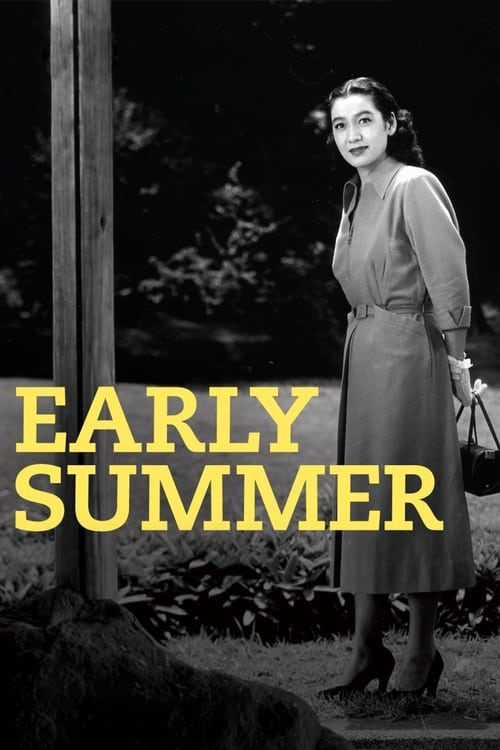
Early Summer
1951 · Yasujirō Ozu
For a calm, restorative evening when you want warmth with real depth — comfort viewing that also leaves you thinking about your own family for days. Perfect when loud movies feel like too much.
What it's about
In postwar Tokyo, 28-year-old Noriko lives contentedly with three generations of her family under one roof — she has a job she likes, close friends, and no particular hurry to marry. Her family feels otherwise. When a match with a well-off older business associate is arranged and the household begins gently closing in, Noriko's own heart starts pulling in a direction nobody planned for, and her choice will quietly reshape the whole family.
The experience
Gentle, funny, and deceptively light on its feet — much of it plays as warm domestic comedy — until you realize how much feeling has been gathering under the surface. It ends up profoundly moving about time, family, and the small decisions that change everything.
Performances
Setsuko Hara is luminous as Noriko — her famous smile doing wildly different work from scene to scene, radiating independence, mischief, and private resolve in a performance that anchors the whole film.
The craft
Ozu's signature style is in full flower: low, still camera positions, meticulously composed household spaces, and conversations filmed with such calm attention that ordinary meals become quietly momentous. The precision is invisible until it floors you.
Why it matters
The middle panel of what became known as Ozu's Noriko trilogy, it deepened his standing as cinema's great poet of family life and helped define the postwar Japanese home drama for generations of filmmakers who studied his stillness.
Snapshot
Early Summer (Japanese: Bakushū, 麦秋 — literally "barley harvest," an old seasonal name for early summer) is the second panel of what critics later named Yasujirō Ozu's "Noriko trilogy," bracketed by Late Spring (1949) and Tokyo Story (1953). In each, Setsuko Hara plays a woman named Noriko whose marriage — its timing, its terms, its refusals — becomes the still center around which a family reorganizes itself. Here the Mamiya household, three generations under one roof in the seaside suburb of Kamakura, gently pressures 28-year-old Noriko to accept a match with a well-off 40-year-old business associate. She instead chooses, almost offhandedly, to marry Kenkichi, a widowed neighbor with a small daughter who is about to be posted to distant Akita. The decision quietly dissolves the family: the elderly parents will move to the countryside, the household will scatter. The film is one of Ozu's largest ensemble works and one of his most tonally balanced — comic, elegiac, and unhurried — closing on the celebrated image of a wedding procession crossing a ripening barley field. It is widely regarded as among his finest achievements, though it has historically been overshadowed in Western reputation by Tokyo Story.
Industry & production
Early Summer was produced and distributed by Shochiku, the studio to which Ozu was bound for essentially his entire career, and shot at its Ōfuna facility outside Tokyo. By 1951 Ozu was a senior, prestige director within the studio system — a director whose slow, meticulous methods the studio tolerated because his films were reliable critical successes and modest commercial performers. The film was made during the final year of the Allied Occupation of Japan (which ended in April 1952), a period in which SCAP's Civil Information and Education oversight of Japanese cinema, though loosening, still shaped what stories could be told; Ozu's domestic dramas, with their inward focus on family and marriage rather than politics, sat comfortably within those constraints.
Production followed Ozu's famously deliberate routine: an extended scripting retreat with his co-writer Kōgo Noda, during which the screenplay was worked out in near-final detail (including, by Ozu's practice, precise dialogue and shot conceptions), followed by a controlled studio shoot with a long-standing crew. Reliable figures for the budget and box-office returns of Early Summer are not something the English-language record documents with any precision, and I will not invent them; what is well attested is that the film was a critical high point of Ozu's postwar output and was honored on the domestic awards circuit (it is generally cited as the Kinema Junpo best film of 1951 and a Mainichi Film Concours honoree, recognition consistent with Ozu's standing at the time).
Technology
The film was shot on 35mm black-and-white stock in the standard Academy ratio (roughly 1.37:1), the format Ozu used throughout his career. He was a conspicuous technological conservative: he resisted the industry's turn to color and widescreen for years, and would not make a color film until Equinox Flower in 1958, nor ever adopt anamorphic widescreen. Early Summer therefore belongs entirely to his mature black-and-white studio idiom. Its most distinctive technical apparatus is not on the screen but under the camera — the low mounting Ozu required, achieved with specially built low tripods and platforms that let cinematographer Yūharu Atsuta place the lens roughly a few feet off the ground. Ozu also standardized on a single focal length, working almost exclusively with a 50mm lens, which flattens depth relations and lends his interiors their characteristic even, frontal legibility.
Technique
Cinematography
Atsuta, Ozu's cameraman since the early 1930s, executed the director's by-now fully crystallized visual grammar. The camera sits low — near the height of a person kneeling on a tatami mat — and, by this stage of Ozu's career, does not move: no dollies, no pans, no crane shots. Compositions are frontal and geometrically ordered, exploiting the rectilinear architecture of the Japanese house (sliding screens, door frames, corridors) as a system of nested frames. The consistent 50mm lens and low angle produce a stable, contemplative regard, and the near-total absence of camera movement throws all dynamism onto the cut and onto the movement of figures within the frame.
Editing
Editing, handled by Ozu's regular cutter Yoshiyasu Hamamura under the director's tight control, is where Early Summer most visibly departs from Hollywood norms. Ozu builds scenes almost entirely from straight cuts — he had abandoned dissolves and fades — and cheerfully violates continuity conventions: the 180-degree rule is set aside for a 360-degree conception of space in which the camera may sit on the "wrong" side of a conversation, and eyeline matches are frequently "incorrect" by classical standards, with characters seeming to look past rather than at one another. In dialogue scenes this yields the famous effect of actors addressing the camera nearly head-on. Between and within scenes Ozu inserts his signature transitional shots of unpeopled spaces and still objects — corridors, rooftops, laundry, the sea, a hallway — the so-called "pillow shots" that punctuate the drama with intervals of stillness and give the film its measured, seasonal rhythm.
Mise-en-scène / staging
The staging is rigorously composed and often nearly symmetrical, with figures arranged in depth along the axes of the house. Ozu's control of graphic direction is exacting: characters and their movements are matched across cuts to preserve visual continuity even as spatial continuity is loosened. Recurring objects carry weight — a loaf of bread, a toy electric train the two young boys covet, balloons, a slice of shortcake shared by the women — small material motifs that thread comedy and pathos through the domestic routine. The famous barley field of the finale is the mise-en-scène's culminating image, converting the film's title into a visual statement about ripening, harvest, and the passage of generations.
Sound
Senji Itō's score — Itō composed for Ozu across this period, including the neighboring films of the trilogy — is used sparingly and lyrically, more as connective seasonal atmosphere than as dramatic underscoring. Ozu's soundscape favors quiet: the ambient texture of the household, the ticking of ordinary time. Music tends to enter over the transitional empty-space shots rather than under dialogue, reinforcing the film's tidal rhythm of activity and repose.
Performance
Ozu drew a distinctive, restrained register of acting from his ensemble, discouraging overt emotional display in favor of understatement, small gesture, and precise timing. Setsuko Hara's Noriko is the type-defining performance — luminous, faintly ironic, her celebrated smile masking a will that the film only gradually reveals. Chishū Ryū, Ozu's perennial everyman, plays her older brother Kōichi, a doctor, with characteristic gravity; Chieko Higashiyama and Ichirō Sugai anchor the parental generation, and Haruko Sugimura brings sharpness and warmth as Kenkichi's mother. Chikage Awashima's Aya, Noriko's unmarried friend, supplies much of the film's comic counterpoint. The performances cohere into one of Ozu's densest and most believable family portraits.
Narrative & dramatic mode
Early Summer is a domestic drama of the everyday — a shomin-geki (drama of ordinary people) — built not on plot mechanics but on the slow accumulation of routine, conversation, and small decision. The ostensible engine is the marriage question, but Ozu diffuses it across an unusually broad canvas of characters and subplots: office banter, the two boys' rebellion over the withheld toy train, the bickering and camaraderie of Noriko's married and unmarried friends, the parents' quiet stocktaking of their lives. The dramatic mode is elliptical and understated; major events (the proposal, even the decision to marry Kenkichi) arrive obliquely, often reported rather than staged, and the emotional climaxes are muted. The film's structure is seasonal and cyclical rather than climactic, moving toward not resolution but dispersal and acceptance — the sense, voiced in the closing passages, that life is fundamentally good even as it inevitably scatters what it gathers.
Genre & cycle
The film sits squarely in Ozu's mature cycle of postwar family dramas and in the broader Shochiku Ōfuna tradition of the shomin-geki, the studio's house style of gentle, humane lower-middle-class drama. Within Ozu's own work it belongs to the loosely linked group of marriage-and-family films of his last fifteen years, and specifically to the critics' "Noriko trilogy" — a retrospective grouping (Ozu did not conceive the three as a series) unified by Hara's presence and by variations on the theme of a daughter's marriage occasioning a family's transformation. Early Summer is the most ensemble-driven and arguably the most comic of the three.
Authorship & method
Early Summer is a paradigm of Ozu's authorship, in which a signature style and a stable creative family produce work of remarkable consistency. The screenplay was written with Kōgo Noda, Ozu's most important collaborator, during their customary long, sequestered writing sessions; the Ozu-Noda partnership is central to the trilogy's tone. Behind the camera, Yūharu Atsuta realized the low-angle, static, 50mm compositions he had helped Ozu develop over two decades. Yoshiyasu Hamamura cut the film to Ozu's specifications, and Senji Itō supplied the score. Art direction, in Ozu's exacting domestic interiors, was in the hands of his regular design collaborators of the period. What unifies this method is total pre-visualization and control: Ozu is said to have planned shots and even props with obsessive precision, treating the finished film as the execution of a fully imagined blueprint. The result is one of world cinema's most instantly recognizable directorial signatures — so much so that it has invited both reverent imitation and the charge (which admirers reject) of mannerism.
Movement / national cinema
Early Summer is a canonical work of the classical era of Japanese studio cinema, contemporaneous with but stylistically opposed to the more dynamic humanism of Kurosawa and the sweeping period aesthetics of Mizoguchi. Ozu came to stand, in later critical accounts, for a "most Japanese" cinema — an association encouraged by his attention to household ritual, seasonal feeling, and an aesthetic often linked (sometimes over-schematically) to traditions such as Zen and mono no aware, the pathos of transience. That framing was partly a Western construction: Ozu was long thought "too Japanese" to export, and Early Summer and its peers reached international audiences meaningfully only decades after their making. The film's postwar setting also ties it to a national-cinema preoccupation of the era — the strain between traditional family structure and modernizing, individualizing pressures in a defeated, occupied, rapidly changing Japan.
Era / period
Made in 1951, Early Summer is a document of Occupation-era Japan on the cusp of sovereignty. Its texture is emphatically postwar: an extended family compressed into shared housing, working women and salaried office life, wartime loss registered quietly at the margins (Noriko has an elder brother lost in the war; Kenkichi's status as a widower and Noriko's readiness to marry into hardship carry the memory of national grief). The generational tension the film dramatizes — dutiful arrangement versus personal choice, the multigenerational household versus its coming dispersal — is precisely the social transformation of early-1950s Japan, and the film registers that historical moment not through statement but through the ordinary business of a family deciding how one of its daughters will marry.
Themes
The film's governing subject is the dissolution and renewal of the family across generations — marriage as the event that both continues the family line and breaks up the household that produced it. Radiating from this are Ozu's abiding themes: the tension between social obligation and individual desire, dramatized in Noriko's quiet self-determination against a "good" arranged match; the condition of the unmarried woman and the social clock imposed on her; the loneliness of aging parents whose children move away; and the acceptance of impermanence — the seasonal, elegiac sense that everything ripens and passes. The barley harvest of the title gathers these into a single figure: fullness and reaping, the end of one cycle folded into the beginning of another. Loss and continuity are held in the same frame, without protest and without sentimentality.
Reception, canon & influence
Domestically, Early Summer was received as a major work and honored on the Japanese critical circuit of its year, consistent with Ozu's standing as one of the country's most respected directors. Internationally, however, its reputation developed slowly. Ozu's films circulated little in the West during his lifetime, and serious Anglophone engagement arrived mainly from the 1970s onward — through Donald Richie's foundational study of Ozu, Paul Schrader's account of Ozu within a "transcendental style," and later David Bordwell's rigorous formal analysis. Within that reassessment Early Summer has been consistently ranked among Ozu's best, even as Tokyo Story became the trilogy's most celebrated film and a fixture of "greatest films" polls; home-video canonization (notably through the Criterion Collection) has since secured Early Summer's availability and critical presence.
Looking backward, the film's influences are less a matter of specific sources than of Ozu's own long refinement: it distills a domestic-drama sensibility rooted in the Shochiku shomin-geki, in his silent and prewar comedies of family life, and in a distinctly Japanese attentiveness to seasonal and domestic ritual — an aesthetic Ozu built cumulatively rather than borrowed. Looking forward, its influence is broad and enduring. Ozu's static low camera, his patient rhythm, his pillow shots, and his ethic of understated domestic observation have been claimed as touchstones by a remarkable range of later filmmakers — among them Wim Wenders (whose Tokyo-Ga is an explicit homage), Hou Hsiao-hsien, Abbas Kiarostami, Claire Denis, Jim Jarmusch, Aki Kaurismäki, and, in a directly familial vein of Japanese cinema, Hirokazu Kore-eda. Through them, the quiet formal and emotional grammar crystallized in films like Early Summer became one of the durable alternative traditions of modern art cinema — proof that a drama of ordinary family life, told with rigorous restraint, could carry the full weight of time and loss.
A Deleuzian reading
A corridor with nobody in it.
The full Deleuzian reading of Early Summer →
Reception
A hit at home — Japanese critics voted it the best film of 1951 in the Kinema Junpo poll — but like most Ozu it barely reached the West until his rediscovery decades later; now it's cherished as the middle panel of the Noriko trilogy, and a vocal contingent calls it his finest.
How Early Summer was received, from release to now →
Influences: the films it descends from and the films it influenced
- Lady Windermere's Fan (1925) — Ozu named Lubitsch a favorite and absorbed his method of advancing narrative through telling objects and glances rather than exposition — the ellipsis-by-prop grammar Ozu turns into Early Summer's bread-loaf and balloon motifs.
- The Neighbor's Wife and Mine (1931) — Japan's first true talkie and a founding shomin-geki, it codified the lower-middle-class domestic comedy-drama register — everyday household friction observed with sympathy — that is Early Summer's native genre.
- I Was Born, But... (1932) — In his silent family comedies Ozu forged the tatami-level low camera and patient frontal staging of ordinary domestic life, the observational grammar Early Summer inherits wholesale.
- The Only Son (1936) — Ozu's first talkie, where the still transitional 'pillow shots' of empty spaces and the elliptical, understated family structure first cohere into the mature blueprint.
- Late Spring (1949) — The immediate template — same Hara/Noda/Atsuta unit, the daughter's-marriage plot, and the object-as-ellipsis device (the vase cutaway) that Early Summer directly extends and refines.
- Tokyo-Ga (1985) — An explicit essayistic pilgrimage to Ozu's Tokyo that interviews cameraman Yūharu Atsuta and reconstructs the low-angle setup, consciously adopting the master's contemplative stillness.
- Perfect Days (2023) — Wenders returns to Ozu's ethic directly: a restrained daily-ritual structure, komorebi as modern pillow shots, and quiet domestic framing built to let time and small change accumulate.
- Café Lumière (2003) — Commissioned for Ozu's centenary, it transposes his static long-take observation and daughter/parent domestic drama into contemporary Tokyo, keeping the fixed camera and elliptical understatement.
- Five Dedicated to Ozu (2003) — An explicit tribute distilling Ozu's pillow-shot principle to its limit — five sustained static takes of near-empty landscapes that make the transitional 'empty' shot the whole film.
- Still Walking (2008) — Kore-eda inherits the familial vein directly: a single-day family gathering observed at near-tatami height, structured by domestic ritual (cooking, corridors) and understated ellipsis over plot.
- Stranger Than Paradise (1984) — Jarmusch adopts Ozu's static frontal tableaux and refusal of camera movement, holding deadpan figures in fixed geometric frames and cutting flatly between them without coverage flourish.
- The Match Factory Girl (1990) — Kaurismäki's rigorously static compositions, restrained non-performances, and attentive framing of ordinary objects and routines extend Ozu's understated, undemonstrative domestic observation.
- Jeanne Dielman, 23 quai du Commerce, 1080 Bruxelles (1975) — Akerman radicalizes Ozu's ethic of domestic ritual and the fixed, low, frontal camera, letting household chores play in real time so that structure and repetition carry the emotional weight.
- 35 Shots of Rum (2008) — Denis explicitly models the film on Ozu's Late Spring/Early Summer father-and-daughter dynamic, using restrained domestic gesture and object motifs (the rice cooker) to voice a coming separation left largely unspoken.
- Repast (1951) — A contemporary Shochiku-lineage shomin-geki starring Setsuko Hara, working the same craft of restrained domestic disappointment conveyed through mundane household routine rather than dramatic incident.
- Tokyo Story (1953) — The trilogy's companion piece, deploying the identical formal system — 50mm static low angles, 360-degree cutting across matched eyelines, pillow shots, straight cuts — as a shared craft grammar.
- Our Little Sister (2015) — A marriage-decision plot dispersed across a multigenerational household staged in depth through sliding-door rooms — the domestic-ensemble blocking Kore-eda reuses for the Koda sisters' house.
Similar films
- Late Spring (1949) — influence & lineage
- Tokyo Story (1953) — influence & lineage
- Still Walking (2008) — influence & lineage
- Perfect Days (2023) — influence & lineage
- An Autumn Afternoon (1962) — shared sensibility
- Yearning (1964) — shared sensibility
- Tokyo Twilight (1957) — shared sensibility
- Good Morning (1959) — shared sensibility