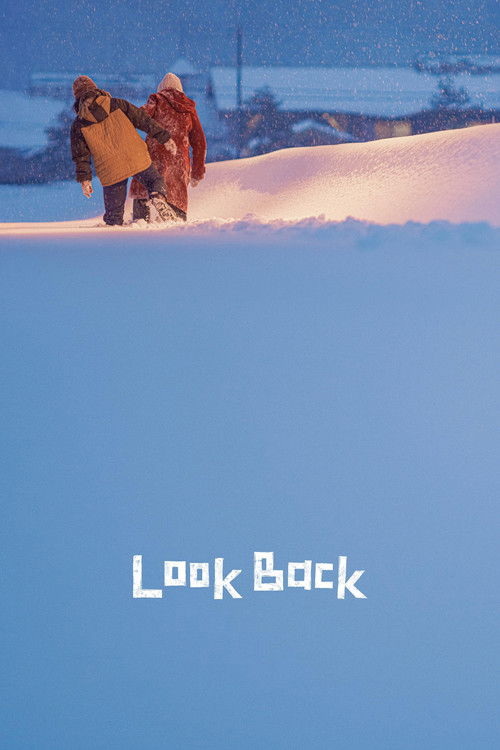
Look Back
2026 · Hirokazu Kore-eda
For a reflective night when you want to feel something real about friendship, ambition, and why we make things — comfort viewing with a serious emotional undertow. Reach for it when you'd rather be quietly devastated and uplifted than thrilled.
What it's about
In a small snowbound town in northern Japan, grade-schooler Fujino is the class star, beloved for the funny four-panel comics she draws for the school newspaper — until her teacher runs them beside the work of Kyomoto, a shut-in classmate whose drawings are startlingly better. Stung into obsessive practice, Fujino finds her jealousy turning into something else when the two girls discover they share the same consuming passion. The film follows their bond across roughly a decade, from rivalry to creative partnership to the diverging paths of early adulthood, all anchored in the physical labor of drawing: pencils, erasers, and growing stacks of pages.
The experience
Quiet, tender, and patiently observed, it moves with the seasons and lets small gestures — a comic slipped under a door, a word of praise — carry enormous weight. It's warm and often funny early on, then deepens into something aching; expect to come out moved and thinking about the people who first encouraged you.
Performances
The central quartet is the engine: Furi Nanase, in her acting debut at eleven, and Rokka Okada play the girls as children, with Natsuki Deguchi and Aju Makita carrying them into adulthood. All four spent months learning to draw manga before the shoot, and their hands-on-the-page conviction shows; Kore-eda's famous touch with child actors is on full display.
The craft
Kore-eda wrote, directed, and edited it himself, shooting on 35mm film across real seasons in the manga author's own hometown, which gives the snowfields and rice paddies a grainy, tactile weight. The boldest stroke is slipping rotoscoped animation — made with veteran Studio Ghibli background artists — inside the live-action frame, letting the girls' drawings come alive, while a lilting guitar score threads it all together. The pastel, almost mint-tinted photography is a real departure for Kore-eda and rewards a big screen.
Why it matters
Premiering in competition at Venice to warm reviews, it was widely hailed as a return to intimate form for the Palme d'Or-winning director, and it stands as a rare case of an auteur mounting a prestige live-action version of a manga already adapted into an acclaimed anime.
Snapshot
Look Back is Hirokazu Kore-eda's live-action adaptation of Tatsuki Fujimoto's 2021 one-shot manga. Fujino is a fourth-grader whose four-panel strips make her a small celebrity in her class; her teacher encourages her to reach out to Kyomoto, a reclusive classmate who also draws, and whose far more accomplished artwork first alarms and then galvanizes her. The film follows the two from that collision of rivalry into a shared practice of drawing, and onward from childhood into adulthood, with Natsuki Deguchi and Aju Makita taking over the roles as adults. Kore-eda wrote and edited the film as well as directing it. It was shot on 35mm in Fujimoto's hometown of Nikaho, Akita, and premiered in competition at the 83rd Venice International Film Festival on September 6, 2026; K2 Pictures released it in Japan five days later. It is the second Kore-eda feature of 2026, after Sheep in the Box, and the second screen version of the same source, following Kiyotaka Oshiyama's acclaimed 2024 anime. It therefore sits where three things meet: Kore-eda's long body of work on children and makeshift intimacy, the pull of manga properties on Japanese live-action production, and a story many readers take as a response to the 2019 Kyoto Animation arson attack. Venice reception was warm on balance but genuinely split, with the sharpest arguments turning on sentimentality and on comparison with the anime.
Industry & production
Daiju Koide produced for K2 Pictures, which also distributed in Japan. Goodfellas and Wild Bunch International handle international sales, GaragePlay released the film in Taiwan, and GKIDS has North America, with a limited release on December 30, 2026 and a wider one on January 15, 2027. GKIDS is best known as a distributor of animation, and its acquisition of a live-action title is notable. The project reportedly originated with a producer who settled on Kore-eda shortly after the manga appeared, and the live action was conceived independently of the anime rather than prompted by it.
Shooting ran from February to November 2025, mostly in Nikaho. The long window was deliberate: Kore-eda has said he wanted to capture the shared time among his four leads, the passage of the four seasons, and the changes in light. About 300 local residents appeared as extras, and the four lead actresses spent months before the shoot training in manga drawing. The film opened on 358 screens across Japan and Taiwan on September 11. Its first three days in Japan took ¥144 million (about $933,500) from 96,605 admissions, debuting at number five — a solid art-house-plus result, not a blockbuster one.
Technology
The film was shot photochemically on 35mm Kodak Vision3 stock with Arricam cameras. Choosing film is a statement here, and Kore-eda has made the reasoning explicit: he insisted on 35mm from the beginning because film forces everyone on set to concentrate on the moment in front of them, since mistakes cannot easily be repaired in postproduction. A story about the physical labor of drawing, with its pencils, paper, erasures and stacks of draft pages, gets a photographic surface with matching grain and material weight. Luke Hicks of Little White Lies observed that Ueno's 35mm images are the visual opposite of any anime or one-shot manga aesthetic — which makes the film's one exception the more striking.
That exception is the use of animation inside the live-action frame. Shin-Ei Animation produced rotoscoped material directed by Yōko Kuno, with background art by Yōichi Nishikawa. Hicks described a rotoscoped anime sequence as a sudden interruption that floods the film with a reality-shattering sense of wonder: the medium the story comes from, and the form of its previous adaptation, breaking into the photographic world.
Technique
Cinematography
Senzo Ueno shot the film, and his work drew some of the most consistent praise across the reviews. Hicks found the palette radiant, running from dainty pastels to electric tones — a lighter, more saturated look than the restrained naturalism of Kore-eda's family dramas from Still Walking (2008) to Shoplifters (2018). Alex Billington of FirstShowing called the visuals sublime, moving from static bedroom compositions to running sequences; Chris Connor of Flickering Myth found Ueno's work subtle but potent in its recording of changing seasons and the natural world; Tim Grierson of Screen Daily, otherwise the film's chief skeptic, granted the delicacy of the cinematography. The manga's recurring view of Fujino's back bent over her desk — the image that gives the work its title — is carried over directly: Alex Denney of AnOther singled out a deft montage of Fujino working with her back turned to the camera.
Editing
Kore-eda edits his own films as a matter of practice, and he did so here. The film runs over ninety minutes against the anime's just under an hour, and Kore-eda expanded the 143-page one-shot chiefly to develop the central relationship. Grierson described the result as an episodic structure resembling a string of honeyed memories; Connor welcomed the added intricacies and subtleties the longer running time allows, while judging the film faithful to the shape of Fujimoto's story. The handling of the story's later movements divided critics: Grierson felt the shifts carried less emotional weight than they do on the page, and Billington, who came to the film without knowing the manga or anime, found the third act's construction somewhat wobbly, even as he rated the film highly overall.
Mise-en-scène / staging
The production design (Shinsuke Kojima) and costume design (Sachiko Ito) are built around real places, not sets, a choice the location shooting in Nikaho reinforces. Rural Akita, with its snowfields, rice paddies and long walks between houses, is treated as more than backdrop: the distance between homes is what makes the isolation of a shut-in child, and the act of crossing to her door, physically readable. The girls' desks, tools and growing piles of manuscripts are the central props of a film whose action is mostly the act of drawing. Yasmine Kandil of DiscussingFilm argued that the meticulousness of the technique is precisely what lets a story of small bedrooms and sketchbooks feel sweeping. Mariona Borrull, comparing the two adaptations for JustWatch, noted a quieter staging pattern: Kyomoto tends to appear in the background of the frame, the composition itself keeping her at one remove.
Sound
Kore-eda has described the sound of the pen as the center of the design: the track follows the act of drawing from tentative scratches to confident strokes to the tapping of a digital pen, an aural biography of skill. Nicholas Bell of ionCinema, calling Kore-eda a master of the unstated, found him acutely focused this time on the sound design of creation itself. Yuta Bandoh's score divided opinion more than any other craft element. Grierson heard a string-laden score that underlines too much; Connor found it ethereal; Denney likened its sensibility to Studio Ghibli's; Kandil counted it among the things that give the small-scale story its sweep.
Performance
The casting splits each lead across two performers: Furi Nanase and Rokka Okada play Fujino and Kyomoto as children, Natsuki Deguchi and Aju Makita as adults. Grierson, in the most negative major review, still found the young leads especially endearing, with Nanase poised and Okada energetic. Rory O'Connor of The Film Stage praised the decision to stay close by Fujino's side in the early scenes, as she learns with some alarm that another artist has been pushing onto her territory. The reservations fell mostly on the writing around Kyomoto rather than the playing of her: Kandil found the script leaves too much unsaid about her background and reclusiveness, a missed chance to grow beyond the one-shot, and Siddhant Adlakha of TheWrap argued the character sits more naturally in manga and anime exaggeration than in live-action naturalism. The supporting cast includes Masaki Suda as Maeda, Kankurō Kudō as Tamai, and Kayo Noro. Deguchi went on to be named Best New Actress at the Tama Film Awards.
Narrative & dramatic mode
The film is a two-hander told largely from Fujino's point of view, and it moves through clearly marked dramatic registers. It starts as school-age comedy of envy, as Fujino's pride crumbles beside Kyomoto's skill; it becomes a story of creative partnership once drawing turns from competition into collaboration; and it darkens as the two grow up and their paths and ambitions pull apart. The later stretches shift the story's register again in ways reviewers largely declined to describe, and O'Connor cautioned that the turns will feel jarring to viewers who do not know Fujimoto's story in one of its earlier forms. Grierson, who did not share the general warmth, described the whole as episodic and finally too slight and too emphatic at once. What the film is about, across all its registers, is how small acts of recognition and encouragement between two children can decide the course of two lives — and the weight, later, of having been the one who encouraged.
Genre & cycle
Look Back belongs to several overlapping groups:
- Coming-of-age and friendship drama. O'Connor placed it in the lineage of Céline Sciamma, and specifically of Petite Maman, rather than alongside Kore-eda's recent larger-scale work.
- Stories about making manga. This lineage runs from Manga Michi to Bakuman (manga 2008–12, live-action film 2015) and includes this film's own source.
- Live-action adaptations of manga and anime. These now dominate Japanese studio production, though Look Back belongs to the prestige, auteur-led end of that range, not the franchise end.
It is also part of a recent wave of works about the toll and value of creative labor in Japan's content industries. And it is a rare case of a canonical anime adaptation being followed quickly, about two years later, by an auteur's live-action version of the same text — a doubling that shaped its reception from the first reviews on.
Authorship & method
Kore-eda (b. 1962) came from television documentary into fiction with Maborosi (1995). His reputation rests on understated, observant films about chosen and broken families, including After Life (1998), Nobody Knows (2004), Still Walking, Like Father, Like Son (2013), the Palme d'Or winner Shoplifters, and Monster (2023). Several critics framed Look Back against an uneven recent stretch: Hicks characterized his output since the 2018 Palme d'Or as alternating between bullseye and bunk, and Grierson noted that Sheep in the Box had been coolly received at Cannes earlier in 2026. The Film Stage, at the other pole, ranked Look Back among the best films of his career.
Adapting manga is not new for him — Air Doll (2009) came from Yoshiie Gōda, Our Little Sister (2015) from Akimi Yoshida's Umimachi Diary, and The Makanai (2023) from Aiko Koyama — but Look Back is his first adaptation of a story about manga itself, and his accounts of the project keep returning to that mirror. He has said that reading the one-shot by chance in a Tokyo bookstore came as a tremendous shock, and that it pushed him to ask why people write stories, why they create, and why he makes movies. He was drawn first to the cover image — the back of a child sitting and drawing — in which he saw an echo of his own Nobody Knows, and he has said that as a fellow creator he felt the desperate resolve behind Fujimoto's work. He took his usual credits for screenplay, editing and direction. His principal collaborators were:
- Senzo Ueno (cinematography)
- Yuta Bandoh (music)
- Shinsuke Kojima (production design)
- Sachiko Ito (costumes)
- Yōko Kuno (rotoscoped animation, with Shin-Ei Animation)
- Yōichi Nishikawa (animation backgrounds)
Fujimoto, the author of the source, is also the creator of Fire Punch and Chainsaw Man.
Movement / national cinema
The film belongs to contemporary Japanese art cinema as it now works internationally: an established auteur, a European festival premiere in competition, French-based international sales through Goodfellas and Wild Bunch, and a US release through a specialist distributor. It also reflects the industrial dominance of manga and anime as Japan's main sources of stories. Within that system, Kore-eda's version shows that manga material can carry the low-key humanism long linked to the home drama (shōshimin-eiga) tradition, a lineage reaching back through Kore-eda to Ozu and Naruse that critics have long traced. The choice of rural Akita as a setting, far from the Tokyo the characters dream of, also places the film within Japanese cinema's long interest in the gap between region and capital.
Era / period
The story spans its two characters' lives from grade school into adulthood; the film's production and release belong to the mid-2020s. It cannot be separated from the cultural memory of the Kyoto Animation studio arson of July 2019, which killed 36 people. Fujimoto's manga appeared on Shōnen Jump+ in July 2021, around the second anniversary, and was widely read as a response to the attack, though Fujimoto has not explicitly confirmed this. After publication the manga was revised following criticism of how the attacker was depicted in relation to mental illness, and that history is something any adaptation inherits. In Kore-eda's career, 2026 is unusually productive: Look Back followed Sheep in the Box, his Cannes feature of the same year, within months.
Themes
- Envy as the start of vocation. The film treats rivalry not as a flaw but as what first drives artistic seriousness. Fujino becomes an artist because someone else is better.
- Being seen and encouraged. Kyomoto's admiration and Fujino's coaxing her out of seclusion show recognition as something with the power to redirect a life — a power the film does not treat as innocent.
- The solitude of making. The recurring image of a back bent over a desk, and a sound design built from the scratch and tap of the pen, show creative labor as lonely, repetitive and physical.
- Guilt and loss. Critics consistently named these alongside friendship and creative drive as the film's territory; Bell noted that Kore-eda's version allows less escape than the source from the darkness it contains.
- Chosen kinship. In keeping with Kore-eda's long concern with families made outside blood ties, the two girls form a bond that their parents and schools neither create nor fully understand.
- Provincial life and the pull of the capital. Nikaho's snow and open land carry both safety and confinement.
Reception, canon & influence
Critical reception. The Venice premiere produced a genuine split rather than a consensus. On the warm side, The Film Stage called it a crystal-clear tale of friendship and creativity and placed it among Kore-eda's best films; FirstShowing scored it 8.5/10; Flickering Myth and DiscussingFilm each gave four stars, the latter praising its ability to find grandeur in the mundane moments of childhood; ionCinema was favorable at three and a half stars. The dissents were pointed. Grierson at Screen Daily argued that Kore-eda's typically restrained approach here reads as excessive and manipulative, and that the film succumbs to a nagging insubstantiality. Adlakha at TheWrap felt the tender translation loses the source's whimsy and childlike optimism, and that the film never fully blossoms — above all beside Oshiyama's hour-long anime, against which, in his view, it cannot help but suffer. That comparison is the sharpest fault line in the reception: Borrull likewise preferred the anime's extraordinary compression, while Connor took the opposite view, treating the live action as a companion piece whose extra length earns real additions. Aggregators recorded a strong overall picture: 90% positive on Rotten Tomatoes from 29 reviews with a 7.2/10 average, and a Metacritic score of 76, meaning generally favorable. The film competed for the Golden Lion; its Venice prizes came from collateral juries — the Cinema & Arts Award, the CinemaSarà Award, the SIGNIS Award, the UNIMED Award, and a special mention from the Fanheart3 Award. It went on to Toronto and the BFI London Film Festival, and Deguchi's Tama Film Awards win opened its domestic awards run.
Influences on the film (backward). The main source is Fujimoto's manga, with Oshiyama's 2024 anime as the inescapable intermediary every reviewer measured it against — even though the live action was initiated independently of it. The rotoscoped sequence and the anime-trained artists behind it acknowledge Japanese animation directly, inside a 35mm image built to be its opposite. Kore-eda's own earlier work, especially his films about children (Nobody Knows, I Wish), his film about the friendship of sisters (Our Little Sister) and his school-set study of shifting perspective, Monster, provides the tonal base, and Kore-eda himself has drawn the line back to Nobody Knows. Critics added Sciamma's Petite Maman. The seasonal structure and quiet observation of everyday life echo the home drama tradition.
Legacy (forward). The film is weeks into its life, and its influence cannot yet be assessed honestly. Some questions are already apparent. One is whether its festival standing and solid domestic opening help establish auteur-led live-action manga adaptation as a model alongside franchise production. Another is whether the 35mm-and-rotoscope hybrid is taken up by others. A third is how its reputation settles against the anime, which the first round of criticism has already made its permanent point of comparison. Its US release through GKIDS from December 30, 2026, and the awards season that follows, will be the first real test of its place in Kore-eda's body of work.
A Deleuzian reading
There is a girl at a desk, and we are behind her.
The full Deleuzian reading of Look Back →
Reception
Kore-eda premiered it in competition at Venice in September 2026 to a split but mostly warm press, with The Film Stage hailing one of his best films while Screen Daily and TheWrap pushed back, and it settled at a 76 on Metacritic; it opened in Japan and Taiwan on September 11 in 358 theaters, debuting at number 5 in Japan with ¥144 million (about $933,500) from 96,605 admissions in its opening weekend, ahead of a GKIDS US release starting December 30.
How Look Back was received, from release to now →
How to watch Look Back: what to notice on a first viewing
- Watch Fujino from behind, bent over her desk. The manga's title image, a girl's back at a desk, is carried straight over. Ueno films a montage of Fujino working with her back to the camera while the pages pile up around her. Seen from behind, drawing stops being a plot event and becomes the daily labor that shapes a person.
- Listen to the sound of the pen. Kore-eda put the pen at the center of the sound design. The track follows drawing from tentative scratches to confident strokes to the tapping of a digital pen, with Bandoh's strings around it. Nothing explains how the skill was built; you hear the years of practice in the noise.
- Notice where Kyomoto stands in the frame. Borrull observed that Kyomoto tends to appear in the background of the frame, the composition keeping her at one remove, while the camera stays close by Fujino's side early on. Fujino's whole attention is aimed at someone the frame keeps half out of reach.
- Watch the distance between the two girls' houses. Kore-eda shot in Fujimoto's hometown, Nikaho in Akita, in real places rather than sets. Snowfields, rice paddies and long walks between houses make the gap between Fujino and a shut-in classmate something you can measure. Crossing to Kyomoto's door covers real ground, so reaching her is work you can see.
- Notice the pastel and electric colors. Ueno's palette runs from dainty pastels to electric tones, a lighter and more saturated look than Kore-eda's family dramas from Still Walking to Shoplifters. Shooting ran from February to November so the seasons and their light are real. The look is warmer than Kore-eda's usual, and the real seasons keep count of time passing.
The whole guide to watching Look Back, with the keys for a rewatch →
Influences: the films it descends from and the films it influenced
- Look Back (2024) — Oshiyama's anime set up the shot the live-action film rebuilds: a fixed back-view of Fujino hunched at her desk while the window behind her changes through the seasons, compressing years of practice into one unmoving composition.
- I Was Born, But... (1932) — Ozu's silent shōshimin-eiga staged the hierarchies of a white-collar suburb at child eye-level, using rivalries between boys to expose adult status. That is the template for showing envy and rank through two children's competition.
- Early Summer (1951) — Ozu used seasonal titling and transitional 'pillow shots' of empty rooms and landscapes to measure time. Kore-eda's seasonal chaptering and his self-edited cutaways to empty interiors come straight from this grammar.
- Tokiwa: The Manga Apartment (1996) — Ichikawa dramatized the young mangaka of Tokiwa-sō in static, patient long takes of artists bent over their drawing boards. This set the live-action precedent for treating the physical labor of drawing manga as screen action.
- Only Yesterday (1991) — Takahata cut between washed-out pastel memory sequences, with their edges left blank, and dense realist backgrounds of rural Yamagata (Tohoku). It is the model both for the faded mint-and-lavender childhood palette and for using the Tohoku countryside as a place to remember in.
- Whisper of the Heart (1995) — Kondō built the drama of a creative vocation from late-night desk vigils, exhaustion and self-doubt measured against a gifted peer. Look Back uses the same structure, with envy as the engine of an artist's apprenticeship.
- Love Letter (1995) — Iwai turned a schoolchild's drawing, hidden on the back of a library card, into the object that carries grief across time. Look Back's four-panel strip slid under a door works the same way: a hand-made paper artifact that reopens the past.
- Blind Chance (1987) — Kieślowski branched a single contingent moment into parallel, fully played-out lives. This is the narrative device behind Look Back's 'what if they never met' counterfactual timeline.
- Waking Life (2001) — Linklater and Bob Sabiston's digital rotoscoping over live-action footage showed that traced animation could keep an actor's real gesture while shifting the film's reality. The rotoscoped inserts depend on this principle.
- Nobody Knows (2004) — Kore-eda withheld scripts from his child actors and fed them lines orally on set, shooting chronologically to capture unrehearsed reactions. He uses the same method with the drawing-trained young leads here.
- Still Walking (2008) — A death the film never shows hangs over ordinary domestic routine, carried by food, objects and small talk rather than confrontation. Look Back's turn from comedy to tragedy relies on the same restraint.
- I Wish (2011) — Shot on location in provincial Kyushu, it uses a child's magical-thinking 'wish' as a soft counterfactual. This pairing of regional location shooting with imagined alternate outcomes is refined in the Tohoku shoot.
- Bakuman (2015) — Ōne's live-action manga-making story trained its leads in pen technique and projected inked panels across the set. It is the commercial counterpart to Kore-eda's more austere, realist depiction of drawing as performance.
- The Case of Hana & Alice (2015) — Iwai rotoscoped live-action performances to tell a two-girl friendship story. It is the closest precedent for joining traced animation to naturalistic acting of adolescent female friendship.
- A Silent Voice (2016) — Kyoto Animation's Yamada framed schoolchildren through backs, feet and turned-away bodies to convey guilt and avoidance. That vocabulary of withheld faces echoes in the back-view desk motif and in the film's mourning of the KyoAni arson.
- Petite Maman (2021) — Sciamma's short, minimal-dialogue study of two girls uses a quiet, unexplained time-bend to work through grief. Critics paired it with Look Back for the same unforced child performances and the same matter-of-fact counterfactual.
Similar films
- Our Little Sister (2015) — influence & lineage · same viewing thread
- Nobody Knows (2004) — influence & lineage · same viewing thread
- Look Back (2024) — influence & lineage
- Monster (2023) — influence & lineage
- Only Yesterday (1991) — influence & lineage
- Still Walking (2008) — influence & lineage · same viewing thread
- Shoplifters (2018) — same viewing thread
- A Silent Voice: The Movie (2016) — shared sensibility
All the films related to Look Back →
Watch it with: curated runs of related films
- The Weight of the Unspoken — A run of quietly shattering films where the largest feelings never get said aloud — love that outlasts reason, grief that gathers over a single family dinner, a long marriage cracked open by one old letter.