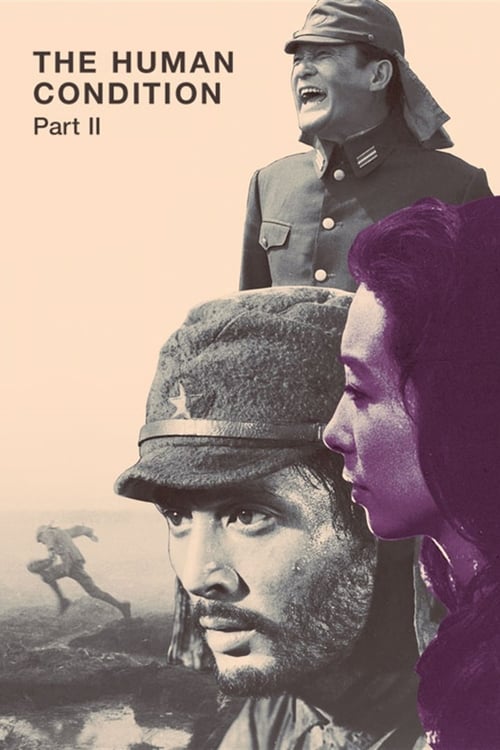
The Human Condition II: Road to Eternity
1959 · Masaki Kobayashi
For when you want to be challenged, not entertained — a long, demanding evening with one of cinema's great moral epics. Reach for it when you're ready to sit with something heavy and come out the other side changed.
What it's about
Kaji, a principled young idealist already marked as a political suspect, is conscripted into the Japanese army in Manchuria near the end of the Second World War. Flagged as a 'Red,' he endures basic training designed to break men — ritual beatings, humiliation, the persecution of the weakest recruits — while trying to hold onto his conscience and protect the soldiers under him. As the Soviet border looms and the war turns hopeless, his private struggle to stay decent collides with a military machine built to grind decency out.
The experience
Punishing, gripping, and morally serious in a way few war films attempt — three-plus hours that move with the weight of a great novel. It's less about combat than about how institutions crush individuals, and it leaves you shaken and thinking about what you'd have done.
Performances
Tatsuya Nakadai carries the entire film as Kaji, his intensity and physical endurance anchoring every scene; it's one of the defining performances of Japanese cinema, a man visibly fighting to keep his soul intact.
The craft
Kobayashi shoots the barracks and battlefields in stark, monumental widescreen black-and-white, with compositions that make the army feel like architecture designed to swallow men. The final battle sequence — infantry against tanks on an open plain — is staged with terrifying scale and clarity, and the film's unflinching depiction of the Imperial Army's cruelty was an act of real courage from a director who had lived it.
Why it matters
As the central panel of Kobayashi's nine-plus-hour trilogy, it stands among the most ambitious anti-war statements ever filmed and cemented both Kobayashi and Nakadai as major forces — a work of national self-examination almost without parallel.
Snapshot
Road to Eternity is the second panel of Masaki Kobayashi's monumental three-film, six-part adaptation of Junpei Gomikawa's novel Ningen no jōken — a work whose Japanese title, more precisely "the human condition" or "conditions of being human," names its true subject better than any war-picture label. Where the first film, No Greater Love (1959), followed the idealist Kaji as a labor supervisor at a Manchurian mine trying to humanize the treatment of Chinese prisoner-laborers, Road to Eternity strips him of that civilian buffer entirely: conscripted into the Kwantung Army and flagged as a political undesirable — a "Red" — he is thrown into the machinery he had until now only administered from the edges. The film traces basic training and its ritual sadism, the persecution and suicide of a weak recruit Kaji tries to shield, the defection of his sympathizer-friend Shinjō toward the Soviet border, and finally the annihilation of Kaji's unit under Soviet armor in the closing days of the war. It is the pivot of the trilogy — the stretch in which Kaji's conscience is tested not against an unjust institution he can argue with, but against death, and in which the humanist is forced, at last, to kill. Anchored by Tatsuya Nakadai in the role that made him a star, it stands with the whole Human Condition cycle as one of the towering achievements of postwar Japanese cinema and among the most sustained anti-war statements in world film.
Industry & production
The trilogy was produced through Shochiku, the studio where Kobayashi had trained and worked as an assistant to Keisuke Kinoshita. Mounting a roughly nine-and-a-half-hour adaptation of a best-selling anti-militarist novel was an unusually large and risky commitment, and the project was staged across two release years — Parts I and II (the two films that make up No Greater Love and Road to Eternity) arriving in 1959, and the concluding A Soldier's Prayer in 1961. Each "film" in fact comprises two feature-length parts, reflecting the novel's six-volume sprawl. The scale of the undertaking — long location shoots, large casts of soldiers and prisoners, brutal winter conditions — made it one of the more ambitious productions of its moment in the Japanese industry.
Gomikawa's source novel was widely read and carried real cultural charge in a Japan still working through the memory and moral accounting of the war barely a decade after defeat. Kobayashi's own biography gave the material extraordinary personal weight: a conscript himself, he had served in Manchuria, and, as a matter of conscience, refused promotion as a quiet protest against the war. That lived experience of the ranks — the arbitrary cruelty, the star-system hierarchy among enlisted men, the machinery of dehumanization — is the bedrock of Road to Eternity, which is set most fully inside the training camp and the enlisted world Kobayashi knew directly. I don't have reliable box-office figures to cite, so I won't assign numbers, but the cycle is generally understood to have been both a prestige and a popular success in Japan.
Technology
Road to Eternity was shot in black-and-white anamorphic widescreen using Shochiku's GrandScope process, the studio's answer to CinemaScope, yielding the roughly 2.35:1 frame that Kobayashi and his cinematographer exploit throughout. The choice is consequential: at a time when the wide frame was often associated with spectacle and color, Kobayashi used monochrome GrandScope for something closer to the opposite — a vast, cold horizontality suited to the Manchurian steppe, the parade ground, and the exposed battlefield, where the human figure is dwarfed by empty width. Much of the location work exploited the harsh landscapes and winters of Hokkaido as a stand-in for Manchuria, and the physical difficulty of that shooting — snow, wind, distance — is legible on screen as texture rather than backdrop. The final tank sequence required staging mechanized assault against infantry within the widescreen frame, a technical and logistical demand the production met with real armor-and-dust materiality rather than suggestion.
Technique
Cinematography
The photography is credited to Yoshio Miyajima, and it is central to the film's power. Miyajima and Kobayashi build the film out of a controlled tension between the wide, deep-focus long shot — bodies arranged small against snow, sky, and the geometry of the camp — and sudden, oppressive closeness during the scenes of abuse and interrogation. The monochrome is high-contrast and sculptural, using the anamorphic frame's width to isolate Kaji at one edge while the institutional world crowds the rest of the image. Kobayashi's compositional instinct — rigorous, frontal, architectural, the same sensibility that would later define Harakiri and Kwaidan — is already fully present here: the frame as a moral diagram, in which where a man is allowed to stand within the composition tells you his standing within the system.
Editing
The film's rhythm is deliberately long-breathed, matched to its epic length, favoring sustained scenes that let cruelty and endurance accumulate in real duration rather than being compressed into montage. The cutting tightens sharply in the crisis sequences — the persecution of the recruit Obara, the confrontations over discipline, and above all the closing battle, where the editing shifts from the film's characteristic patience into the chaos and abruptness of combat and death. I'm not able to confidently attribute the editor of record from memory, so I won't name one; what can be said with confidence is that the editorial strategy is one of patient accumulation punctuated by rupture.
Mise-en-scène / staging
Staging is where Kobayashi's authorship is most visible. The training camp is presented as a total environment of hierarchy — the ritual lineups, the "star" seniority among conscripts, the barracks as an arena where veteran soldiers exercise sanctioned brutality on new recruits. Kobayashi stages these rituals with a cold formality that makes their violence feel systemic rather than personal: the abuse is choreographed, institutional, repeatable. Against this, he stages Kaji's body and gaze as the site of resistance — a man trying to hold an upright, humane posture inside a structure designed to break it. The suicide of Obara and the defection of Shinjō are staged as the two escapes the system permits from within: death and flight.
Sound
The score is by Chūji Kinoshita (brother of Kobayashi's mentor Keisuke Kinoshita), used with restraint rather than saturation; the film leans heavily on the sounds of the environment — wind, drilling boots, the mechanical din of the final assault — to build its atmosphere of exposure. Silence and ambient harshness carry much of the film's dread, with music reserved for punctuation, so that the tank battle's noise lands as an overwhelming sensory collapse of the film's earlier quiet.
Performance
Tatsuya Nakadai's Kaji is one of the great sustained performances in Japanese cinema, and Road to Eternity is where the role deepens from idealistic protest into something harder and more haunted. Nakadai plays Kaji's decency as physical effort — a visible strain of keeping his humanity intact under pressure designed to erode it — and charts, across the film, the terrible cost of survival as Kaji is forced toward violence. The supporting playing, particularly in the recruit-and-veteran dynamics, is calibrated to make institutional cruelty feel like ordinary behavior, which is precisely what makes it disturbing. Michiyo Aratama, as Kaji's wife Michiko, anchors the film's thin but vital thread of the private world Kaji is fighting to remain worthy of.
Narrative & dramatic mode
The film's mode is the epic moral chronicle: a single conscience followed in near-continuous duration through escalating tests. Its dramaturgy is essentially that of tragedy filtered through humanist realism — Kaji is neither a passive victim nor a hero who prevails, but a man whose defining quality (his refusal to abandon his principles) is exactly what the world punishes. The narrative advances through a series of ethical set-pieces — the defense of a bullied recruit, the response to a comrade's defection, the reaction to combat — each forcing Kaji to translate belief into action at rising cost. The overarching movement is one of erosion: the film's engine is the gap between what Kaji believes a human being owes to others and what survival within the war machine will actually allow, and its power comes from watching that gap close.
Genre & cycle
On its surface it is a war film — training-camp drama giving way to combat picture — but Kobayashi uses the genre against itself. Where the conventional war film organizes experience around unit cohesion, mission, and sacrifice, Road to Eternity organizes it around the individual's alienation from all of those things. It belongs to the postwar Japanese cycle of anti-militarist and war-responsibility films that reckoned with the recent conflict from the standpoint of ordinary soldiers and civilians rather than commanders, a body of work that includes Kinoshita's own war films and Ichikawa's The Burmese Harp and Fires on the Plain. Within that cycle, The Human Condition is the most expansive and the most explicitly focused on the individual conscience versus the institution.
Authorship & method
This is Kobayashi's signature theme in its foundational form: the lone individual of conscience crushed by, but refusing to be morally absorbed into, an unjust hierarchy — the through-line that connects The Human Condition to Harakiri (1962) and Samurai Rebellion (1967). His method here is one of scale and rigor: long duration to make endurance felt, formal composition to make oppression visible as structure, and an unwavering identification with a single protagonist's ethical viewpoint. The key collaborators form a coherent authorial team — cinematographer Yoshio Miyajima, whose high-contrast widescreen monochrome gives Kobayashi's moral compositions their weight; composer Chūji Kinoshita, providing restrained scoring; and the screenplay by Kobayashi with Zenzō Matsuyama, adapting Gomikawa's novel. Above all there is Tatsuya Nakadai, whose collaboration with Kobayashi across this cycle launched one of the defining actor-director partnerships of the era.
Movement / national cinema
The film sits within the golden age of Japanese cinema and specifically within the postwar humanist tradition — distinct from, though contemporary with, the emerging Japanese New Wave of Oshima and others, which was often impatient with exactly this kind of earnest, epic humanism. Kobayashi is best understood as a bridge figure: formally classical, thematically dissident. The trilogy also belongs to a broader current of national self-examination in which Japanese artists confronted the country's wartime conduct, including — pointedly, in the first film — the treatment of Chinese laborers and prisoners, a subject many productions avoided.
Era / period
Made in 1959, the film speaks from a Japan roughly fourteen years past defeat, prosperous enough to fund an epic and unsettled enough to need one. It is set in the war's final phase in Manchuria, and Part II's climactic battle against Soviet armor places its ending in the collapse of August 1945, when the Soviet Union's entry into the Pacific war shattered the Kwantung Army. The film thus looks back at the war from within the reconstruction era, addressing an audience with direct memory of both conscription and defeat.
Themes
The governing theme is the survival of individual conscience under systems built to extinguish it. Radiating from that center: the mechanics of dehumanization within institutions — how ordinary men are trained to cruelty through hierarchy and ritual; the moral trap of complicity, since Kaji is always both victim and, by remaining inside the system, participant; the corrupting cost of survival, dramatized in Kaji's forced turn to violence; and the fragility of ideals under material pressure. Obara's suicide and Shinjō's defection frame the two exits the film examines from an intolerable order — self-destruction and flight — against which Kaji's stubborn endurance is the third, hardest, and most ambiguous path. Underlying all of it is the title's insistence: that these are not the conditions of war narrowly but of being human within any coercive order.
Reception, canon & influence
The Human Condition is widely regarded as a landmark of Japanese cinema and as Kobayashi's central achievement, and it established Tatsuya Nakadai as a leading figure of his generation — a standing consolidated by his subsequent work with Kobayashi and, later, Kurosawa. In the decades since, and particularly with its restoration and home-video circulation to international audiences, the cycle has been embraced by critics and cinephiles as one of the essential long-form works of the medium, routinely cited among the great humanist epics. I'll flag honestly that the granular contemporary-reception record — specific review texts, awards, and grosses — is not something I can reproduce reliably here, and I won't invent it.
Looking backward, the film's influences are legible: Gomikawa's novel as direct source; Kobayashi's own conscript experience as authenticating ground; and the postwar humanist and anti-militarist strain of Japanese filmmaking, including the sensibility of his mentor Keisuke Kinoshita. Looking forward, its legacy is felt first within Kobayashi's own filmography, where its formal rigor and its lone-man-against-the-system architecture crystallize into the jidaigeki masterpieces Harakiri and Samurai Rebellion. More broadly, the trilogy became a touchstone for the ambitious cinematic epic of moral endurance — the multi-hour film that earns its length through accumulated ethical weight rather than spectacle — and a durable reference point for anti-war filmmaking that locates its critique in the ordinary soldier's conscience rather than the battlefield's grandeur.
A Deleuzian reading
Watch where Kaji is allowed to stand.
The full Deleuzian reading of The Human Condition II: Road to Eternity →
Reception
A prestige event in Japan on release as the middle chapter of Kobayashi's nine-plus-hour adaptation, it went from arthouse endurance legend to firmly canonized classic in the West — Criterion's 2009 box set of the trilogy turbocharged its rediscovery for a new generation.
How The Human Condition II: Road to Eternity was received, from release to now →
How to watch The Human Condition II: Road to Eternity: what to notice on a first viewing
- Notice where Kaji stands inside the wide frame. Kobayashi shoots in a frame more than twice as wide as it is tall and keeps pushing Kaji to one edge, giving the rest of the image to the barracks and the officers around him. Where a man is allowed to stand in the shot tells you his standing inside the system.
- Watch the white snow against the black uniforms. Miyajima shoots in high-contrast monochrome, so bodies read as dark cutouts against bright snow and sky, sculptural rather than naturalistic. The stark black and white turns ordinary drilling into something closer to a diagram than a documentary.
- Listen for wind, boots, and drilling instead of music. Kobayashi and composer Chuji Kinoshita hold the score back for most of the film, letting wind, marching boots, and silence carry the atmosphere of the camp. The quiet makes the camp feel exposed and endless, with nothing to soften what you're hearing.
- Watch Nakadai hold his back straight under pressure to bend. Tatsuya Nakadai plays Kaji's decency as visible physical effort, an upright posture he has to keep choosing scene after scene inside a barracks built to break it. His posture is doing the arguing; the strain of staying decent is written on his body, not his lines.
- Watch the veteran soldiers line up the new recruits by rank. Kobayashi stages roll calls and seniority rituals with cold formality, so the abuse handed down the ranks looks choreographed and repeatable rather than personal. The cruelty isn't coming from one bad man; it's built into the structure itself, repeated by design.
The whole guide to watching The Human Condition II: Road to Eternity, with the keys for a rewatch →
Influences: the films it descends from and the films it influenced
- Twenty-Four Eyes (1954) — Kobayashi's mentor's method of anti-militarist indictment built through patient, longitudinal accumulation of ordinary lives quietly destroyed rather than battlefield spectacle — the humanist-chronicle template Kobayashi inherited directly as Kinoshita's assistant.
- Grand Illusion (1937) — Deep-focus staging that dramatizes camp confinement and hierarchy as spatial fact, locating its anti-war critique in the ethics of men inside an institution rather than in combat — the confinement-as-moral-architecture Kobayashi extends across the labor and POW sections.
- The Best Years of Our Lives (1946) — Gregg Toland's deep-focus long-take blocking that keeps figures and their institutional surroundings in simultaneous sharp legibility, the same deep-focus-long-shot grammar Miyajima deploys to hold Kaji inside the oppressive structures around him.
- All Quiet on the Western Front (1930) — Founding anti-war device of anchoring the entire critique in one ordinary conscript's progressive disillusionment, so the audience feels militarism as personal moral erosion — the conscience-of-the-soldier viewpoint Kobayashi structures the whole cycle around.
- Ugetsu (1953) — Long-take, architecturally composed framing that observes ordinary people ground down by war and greed from a patient contemplative distance, modeling the composed-observation-of-suffering register Kobayashi adopts.
- Seven Samurai (1954) — Established the long-duration Japanese epic that earns its runtime through accumulated incident and deep-staged, telephoto-flattened action, licensing Kobayashi's wager that ethical weight can justify extreme length.
- Harakiri (1962) — Reunites the exact team — Nakadai, cinematographer Yoshio Miyajima — to crystallize the cycle's technique: rigorously frontal, symmetrical architectural composition and patient accumulation detonating into sudden violent rupture, applied to a lone man's indictment of feudal hierarchy.
- Samurai Rebellion (1967) — Carries forward the lone-individual-defying-the-institution structure and the geometric, oppressive framing of clan authority, again with Nakadai, distilling The Human Condition's moral architecture into jidaigeki form.
- Kwaidan (1964) — Formalizes the frontal, painterly, architecturally rigid composition into stylized color tableaux, showing the same compositional instinct — space arranged to enclose and pressure the figure — pushed toward abstraction.
- Ran (1985) — Casts Nakadai as the tragic center of a vast moral chronicle, extending the actor-of-conscience persona the Kobayashi partnership launched into another director's epic of institutional collapse.
- Come and See (1985) — Locates its entire anti-war critique inside one ordinary youth's traumatized subjectivity and makes endurance felt through relentless duration rather than combat spectacle — Kobayashi's soldier's-conscience method taken to a subjective extreme.
- The Thin Red Line (1998) — Builds an anti-war epic whose critique resides in soldiers' interior moral consciousness and voiced ethical questioning rather than battlefield grandeur, extending the conscience-over-spectacle premise across epic length.
- Andrei Rublev (1966) — A long-form monochrome moral chronicle that earns its multi-hour length through accumulated ethical and spiritual weight rather than incident, sharing the patient-accumulation epic-of-endurance form Kobayashi pioneered.
- Fires on the Plain (1959) — Released the same year, it locates its anti-war argument in the starving soldier's bodily and moral degradation, rendered in stark high-contrast monochrome — the exact cost-of-survival thesis and tonal palette Kobayashi's second film shares.
- The Burmese Harp (1956) — Sites its critique of war entirely in a single soldier's awakening conscience and refusal to rejoin the machine, the same lone-man-of-conscience-inside-the-army architecture Kaji embodies.
- Paths of Glory (1957) — Contemporary study of the individual of conscience crushed by military hierarchy, using camera movement through rigidly architectural military spaces to make institutional oppression visible as structure — Kobayashi's frontal-architectural conscience-vs-institution project in parallel.
- Sword of Doom (1966) — Places Nakadai at the center of a high-contrast Grandscope monochrome frame, extending the Nakadai screen persona and the same anamorphic black-and-white idiom into nihilist territory.
Similar films
- Fires on the Plain (1959) — influence & lineage · same viewing thread
- The Burmese Harp (1956) — influence & lineage · same viewing thread
- Harakiri (1962) — influence & lineage · often watched together
- Seven Samurai (1954) — influence & lineage · often watched together
- Ran (1985) — influence & lineage · often watched together
- The Human Condition III: A Soldier's Prayer (1961) — same viewing thread · often watched together
- The Human Condition I: No Greater Love (1959) — same viewing thread · often watched together
- Samurai Rebellion (1967) — influence & lineage
All the films related to The Human Condition II: Road to Eternity →
Watch it with: curated runs of related films
- Japan's Long Reckoning With War — Watch these when you want Japanese cinema turning its unflinching gaze on its own war — the conscript's conscience, the retreat, the survivor who won't let the officers forget — each film picking up the moral wreckage the last one left.