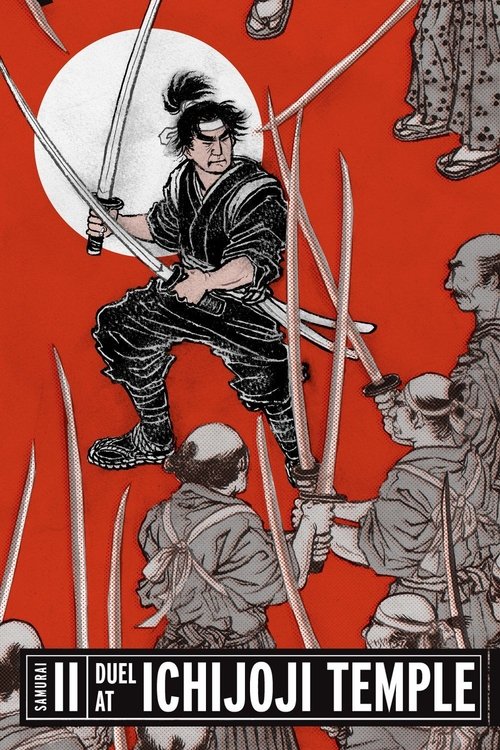
Samurai II: Duel at Ichijoji Temple
1955 · Hiroshi Inagaki
For when you're in the mood for a classic adventure with honor and heartbreak — a Sunday-afternoon epic that's comfortable to watch but leaves you chewing on its questions about pride. It stands alone fine, though it's richer after the first film.
What it's about
The middle chapter of the Samurai trilogy finds Miyamoto Musashi returned to Kyoto after years of wandering, now famous as a swordsman but still ruled by pride. He challenges the head of the city's most prestigious fencing school, whose followers respond with ambushes rather than fair duels, while Otsu — the woman who has waited years for him — hopes he has come back for her. It builds toward a night-time confrontation against overwhelming odds outside Ichijoji Temple.
The experience
Stately and handsomely mounted, with romantic longing threaded through the swordplay, it builds patiently toward one of the trilogy's great set pieces — a lone warrior against a small army. Old-fashioned in the best sense: sincere, sweeping, and morally serious about what skill costs.
Performances
Toshiro Mifune, at the height of his early powers, plays Musashi as a man visibly at war with himself — ferocious in combat, awkward and wounded everywhere else.
The craft
Hiroshi Inagaki shoots in rich color with a painter's eye for landscape, and the climactic battle on the night road near the temple is staged with sustained, legible precision — dozens of opponents, one sword, total clarity. It's the action highlight of the entire trilogy.
Why it matters
The trilogy helped define the samurai epic for international audiences in the 1950s and turned one of Japan's most beloved warrior legends into definitive screen mythology.
Snapshot
The second panel of Hiroshi Inagaki's Samurai trilogy finds Miyamoto Musashi no longer a raw outlaw but a deliberate, still-unfinished swordsman—famous enough to attract enemies, not yet wise enough to refuse them. Where the first film (Musashi Miyamoto, 1954) was a story of violent formation, Duel at Ichijoji Temple is a story of violent temptation: Musashi walks into an ambush he could avoid, driven by pride that his ascetic training has not yet burned away. The film's centerpiece—Musashi's single-handed battle against the massed Yoshioka school on the night road near Ichijoji Temple—condenses one of the most celebrated episodes in Japanese warrior mythology into a sustained, kinetically precise action sequence unlike anything else in the trilogy. Toshiro Mifune, at the height of his early-career magnetism, holds the screen with controlled ferocity. Released in Japan in 1955, the same year the first film received an Honorary Academy Award in the United States, Duel at Ichijoji Temple extended the trilogy's commercial and cultural reach at a pivotal moment for Japanese cinema's international standing.
Industry & production
Toho Company produced all three Samurai films in close succession—Musashi Miyamoto (1954), Duel at Ichijoji Temple (1955), and Duel at Ganryu Island (1956)—as a calculated prestige franchise. Toho in this period was simultaneously Japan's most internationally ambitious studio and its most commercially minded: it housed Kurosawa, sustained Godzilla, and produced the glossy period entertainments of which Inagaki was the undisputed master craftsman. The trilogy was conceived around Eiji Yoshikawa's enormously popular serialized novel Musashi (1935–1939), which had already generated a previous Inagaki adaptation in the 1940s and a manga serialization that reached millions of readers. The source material came pre-validated, and Toho marketed the films as national epics rather than mere chanbara programmers. By the time Duel at Ichijoji Temple reached theaters, the first film had won an Honorary Oscar at the 28th Academy Awards ceremony (March 1956, covering 1955 U.S. releases)—the first Japanese film to receive that distinction—which amplified the franchise's prestige domestically and opened export markets across Europe and North America. The middle-chapter structure made Duel at Ichijoji Temple the most dramatically challenging installment: it cannot deliver the catharsis of an origin story or a final confrontation, and Inagaki compensates by loading it with incident, mounting tension, and spectacular choreography.
Technology
The Samurai trilogy was shot in Eastmancolor, a choice that distinguished Inagaki's commercial spectacle from the black-and-white austerity associated with Kurosawa and art-cinema production. Color in Japanese studio filmmaking of this period was still far from routine; Toho used it as a prestige marker, most conspicuously in the elaborate reconstruction of Kyoto's historical streetscapes and in the nocturnal Ichijoji sequence, where torchlight and shadow become compositional elements. The widescreen format—the trilogy made use of aspect ratios approaching the newly popularized wide-gauge presentations—allowed Inagaki to stage crowd choreography with a spatial expansiveness unavailable to the Academy-ratio films of the previous decade. The studio's standing period sets at Toho and location shooting in and around the Kyoto basin furnished the trilogy with production values that rivaled anything in Japanese cinema at the time. Practical lighting rigs for the night battle sequence required careful coordination between the director, the cinematographer, and the special-effects crew; the result demonstrates sophisticated control of a technically demanding shoot.
Technique
Cinematography
The color cinematography exploits Japan's natural chromatic vocabulary—the deep greens of cedar and bamboo, the warm ochres of wooden architecture, the white of training clothes against bare earth—to ground the film in a tactile, authenticated physical world. The Ichijoji sequence deploys low torchlight against a dark field, isolating Mifune's figure in pools of amber while assailants materialize from the blackness: a classically theatrical use of chiaroscuro transposed to color. Exterior scenes in and around Kyoto make deliberate use of depth—characters placed against layered architectural or landscape recession—giving the film a sense of historical space that reinforces its period ambitions. The camera moves sparingly in the drama scenes, preferring held framings that push performance to the foreground, then becomes fluid and urgent during action. Establishing shots of the Yoshioka dojo, the inn where Otsu waits, and the road to Ichijoji all function as orienting documents of a world precisely imagined.
Editing
The cutting in the Ichijoji ambush sequence operates on principles closer to classical Hollywood action grammar than to the elliptical montage Kurosawa was developing contemporaneously. Inagaki and his editor build the battle through rapid intercutting of attack and counter, punctuated by brief pauses—Musashi catching his breath, opponents regrouping—that organize chaos into legible rhythm. The film as a whole is edited with a commercial confidence that prioritizes narrative propulsion; it runs at a tighter pace than either of its companions, reflecting the middle chapter's obligation to sustain momentum without settling into the deliberate atmosphere of an opening or the emotional finality of a close.
Mise-en-scène / staging
Inagaki's staging is grounded in theatrical convention drawn from kabuki and popular period drama, the jidai-geki tradition in which he had been working since the silent era. Emotional confrontations are staged in formal near-symmetry, figures placed at prescribed distances; the Yoshioka master is introduced in interior scenes that frame authority through architectural depth and hierarchical grouping. The Ichijoji road is staged as an ambush space—long, exposed, flanked by darkness—so that Musashi's decision to walk it anyway reads spatially as well as psychologically. Costume and prop design maintain a production-standard authenticity typical of Toho's period output; jidai-geki at this level of investment could draw on the studio's deep inventory of Edo-period wardrobe and weaponry.
Sound
The sound design reinforces the action-melodrama register: music swells punctuate emotional turning points, and the sword-clash foley in the battle sequences is crisp and emphatic. Composer Ikuma Dan, who scored all three Samurai films, works in a hybrid idiom that draws on Japanese modal scales and Western orchestral textures—a synthesis common to Japanese film scoring of the 1950s and broadly consonant with the films' own blending of national tradition and international commercial appeal. The score's emotional directness can read as schematic beside the more ambiguous musical landscapes of Kurosawa's collaborations with Fumio Hayasaka, but it is functionally well-calibrated to Inagaki's melodramatic mode.
Performance
Toshiro Mifune's performance as Musashi in the second film is the most physically athletic of the three: he has shed the bewildered violence of the first film and is already moving toward the controlled gravitas of the third, but here he occupies an intermediate register—capable, proud, and dangerously overextended. Mifune's physical gifts—the coiled stillness that erupts into motion, the eyes that communicate strategic calculation and emotional turmoil simultaneously—are used with particular economy in the Ichijoji sequence, where his body becomes the film's primary argument. The supporting cast includes Kaoru Yachigusa as Otsu, whose patient longing provides the film's sentimental counterweight, and Mariko Okada as Akemi, whose less legible attachment to Musashi adds thematic complexity about the costs his path exacts on those around him. Kuroemon Onoe brings imposing gravity to the Yoshioka master. The performances across the trilogy reflect the influence of kabuki's highly codified emotional vocabulary, domesticated for screen consumption without entirely abandoning the formal stylization that distinguishes the jidai-geki tradition.
Narrative & dramatic mode
Yoshikawa's source novel is an elaboration of the Miyamoto Musashi legend—itself partly historical, mostly mythologized—into a bildungsroman spanning decades. Inagaki and screenwriter Tokuhei Wakao compress the novel into three acts of two hours each, and Duel at Ichijoji Temple covers the period in which the young Musashi, already formidable, seeks the confrontation with the Yoshioka school that will either confirm or destroy him. The narrative mode is popular melodrama organized around competing female attachments—the devoted Otsu, the more ambiguous Akemi—interspersed with episodes of martial challenge. This structure, in which the samurai's emotional life is triangulated between two women while his spiritual and martial education proceeds through trial, is a Yoshikawa formula adapted from the jidai-geki theatrical tradition. The Ichijoji battle, in which the young Matashichiro of the Yoshioka line is killed by Musashi despite being surrounded by sixty or more retainers, is presented both as tactical brilliance and as morally troubling excess—the film is unusually willing to sit with the ethical weight of what its hero does, even as it stages the action as spectacle.
Genre & cycle
Duel at Ichijoji Temple belongs to the mainstream jidai-geki cycle of 1950s Toho production, a tradition descending through decades of period-drama filmmaking to the silent-era films of Daisuke Itō and Hiroshi Inagaki himself. Within that broad tradition it represents the prestige end: not the nihilist mugen-ryu (ambiguous, revisionist) strain that critics associated with postwar disillusionment, but a fundamentally affirmative narrative in which discipline, moral awakening, and martial skill are aligned rather than in tension. This distinguishes it sharply from the more philosophically complicated samurai films Kurosawa was producing in the same period—Seven Samurai appeared the same year as the first Inagaki film, and Yojimbo would come in 1961. Inagaki's trilogy belongs to a popular-patriotic genre cycle that saw Musashi as a figure of national character—stoic, perseverant, self-overcoming—at a moment when postwar Japan was reconstructing both its economy and its self-image. The trilogy preceded a wave of television jidai-geki that dominated Japanese screens through the late 1950s and 1960s, and Inagaki's visual formula fed directly into that format.
Authorship & method
Hiroshi Inagaki (1905–1980) was among the most prolific and commercially successful directors in Japanese studio history, with a career spanning from the early silent period through the 1970s. He is not the subject of an auteurist critical literature comparable to Kurosawa or Mizoguchi, and this comparative neglect reflects both critical fashion (the auteurist canon favored formal ambiguity and thematic density over popular entertainment craft) and the genuine difference in ambition: Inagaki was a master entertainer, not a radical formal innovator. His method was the studio craftsman's method—precise genre competence, superior production management, sensitivity to star performance, and a long-practiced fluency with the rhythms of period action drama. His collaboration with Toshiro Mifune was decisive for the trilogy's success; Mifune's energy gave Inagaki's formal control a volatile center.
Screenwriter Tokuhei Wakao had deep roots in the jidai-geki tradition and brought structural discipline to the adaptation of Yoshikawa's sprawling source. Composer Ikuma Dan (1924–2017) was one of the central figures in postwar Japanese concert music as well as a prolific film scorer; his work on the trilogy is functional and evocative without being particularly individuated. The cinematography for the trilogy—who specifically served as director of photography across the films is a point on which the available English-language record is thinner than one would wish, and precise attribution should be verified against Japanese production documentation rather than derived from secondary sources.
Movement / national cinema
The Samurai trilogy sits at the intersection of Japanese cinema's postwar domestic mass market and its first sustained international breakthrough. The Honorary Oscar for the first film was not simply an aesthetic judgment but a recognition of Japanese cinema as a legitimate participant in an emerging global art-film trade—the same recognition that Kurosawa's Rashomon (1950, Golden Lion at Venice) had inaugurated at the more prestigious end of the critical hierarchy. Inagaki's films were more accessible to international general audiences than Kurosawa's more formally demanding work, and they shaped the first generation of Western popular knowledge about samurai culture. Within Japan, the trilogy engaged a tradition of jidai-geki filmmaking that had been subject to censorship and suppression under the Allied Occupation (1945–1952), which had banned period films on the grounds that they promoted feudal values. The Occupation's end in 1952 permitted the full revival of the genre, and the Samurai trilogy was among the first major postwar statements of what that revival could look like at its most ambitious.
Era / period
The films are set in the early Edo period, approximately the first decade of the 1600s, a historical moment of transition from the fractured warfare of the Sengoku period to the consolidating Tokugawa order. The Ichijoji episode is set in 1604 by the Yoshikawa chronology, placing Musashi's career in the reign of Tokugawa Ieyasu, whose hegemony was still being consolidated following the decisive Battle of Sekigahara (1600). This historical setting has ideological resonance: the swordsman who disciplines himself in a time of peace, who must find a purpose for martial skill when large-scale warfare is receding, stands for a set of questions about violence, purpose, and national character that Japanese culture had periodically reactivated. The postwar relevance—how to redirect the martial energy and sacrifice of a generation after the defeat of 1945—need not be read as an explicit allegory; it was ambient, available to audiences and filmmakers alike.
Themes
The film's central thematic concern is the relation between discipline and pride—between the ascetic self-formation Musashi pursues and the ego-gratification that sabotages it. The walk into the Ichijoji ambush is motivated by pride as much as courage; Musashi knows the odds and goes anyway, in part because refusing would damage the reputation he has built and in part because he cannot yet separate genuine valor from the need for validation. The film does not sentimentalize this: Matashichiro, the young Yoshioka heir who leads the ambush, is not demonized, and his death carries weight. The parallel narrative of Otsu's fidelity counterpoints Musashi's violence with a kind of patient suffering that the film respects without condescending to; her love is not a prize Musashi will eventually collect but a moral fact about a person whose life is being shaped by his choices. The Akemi subplot introduces an element of desire and instability that the film allows to remain unresolved. Underlying all of this is the jidai-geki's persistent meditation on the meaning of the sword—as tool of death, symbol of personal integrity, source of social identity—in a culture simultaneously committed to martial values and to their transcendence.
Reception, canon & influence
Critical reception and canon: The Samurai trilogy was a major commercial success in Japan and became one of the best-known Japanese film exports of the 1950s. Critical reception in the West was warm but positioned the films firmly as popular entertainment rather than art cinema; reviewers who came to Japanese film through Kurosawa or Mizoguchi found Inagaki's work more accessible but thematically simpler. The Honorary Oscar for the first film created a cultural landmark, and the trilogy remains the most widely seen introduction to the jidai-geki tradition outside Japan. Within Japanese film scholarship, Inagaki has been modestly rehabilitated in recent decades as critics have become less exclusively attached to the auteurist canon and more interested in popular genre cinema.
Influences on the film (backward): Inagaki drew on a jidai-geki tradition extending from the silent-era masters Daisuke Itō (Oatsurae Jirokichi goshi, 1931) and Mansaku Itami. The theatrical stylizations of kabuki and shimpa melodrama shaped the performance conventions and staging grammar throughout. Yoshikawa's novel was itself a synthesis of earlier popular Musashi narratives and oral traditions. The color cinematography owed a broad debt to the advances in Eastmancolor processing that Western studios had pioneered in the early 1950s and that Japanese studios adopted and adapted with considerable technical facility.
Legacy (forward): The Samurai trilogy established the visual and narrative template through which Western audiences primarily encountered the samurai film for the better part of two decades—prior to Kurosawa's Yojimbo (1961) and Sanjuro (1962) completing his decisive influence on Western revisionist mythology. Mifune's physical characterization of Musashi fed into the global iconography of the samurai and influenced subsequent screen portrayals including Tomu Uchida's rival Musashi cycle (1961–1965) and the long-running television adaptations. More diffusely, the trilogy helped establish the chanbara action set-piece—the lone master against overwhelming numbers, resolved by speed and precision—as a genre convention that migrated into martial-arts cinema internationally. The Hong Kong wuxia films of the 1960s and 1970s, and eventually the American martial-arts film cycle, show structural debts to this template. In contemporary Japanese popular culture, the Yoshikawa-Inagaki-Mifune Musashi remains the default reference point: manga, anime, and video-game treatments of the legend consistently engage, if sometimes deliberately depart from, this foundational version.
A Deleuzian reading
Picture the night road below Ichijoji Temple.
The full Deleuzian reading of Samurai II: Duel at Ichijoji Temple →
Reception
Rode into the West on the coattails of Samurai I's honorary Oscar, when the trilogy was many viewers' first taste of samurai cinema; today it's seen as the handsome, romantic middle chapter of a beloved Technicolor trilogy that plays as the crowd-pleasing counterpoint to Kurosawa's grittier Mifune films.
How Samurai II: Duel at Ichijoji Temple was received, from release to now →
Influences: the films it descends from and the films it influenced
- Orochi (1925) — Futagawa's silent chanbara codified the genre's central set-piece grammar—lone swordsman, overwhelming numbers, spatial mastery resolving in lethal economy—establishing the template that Inagaki's Ichijoji Temple ambush sequence directly inherits.
- Oatsurae Jirokichi goshi (1931) — Explicitly cited in the dossier as ancestor, Itō's rapid low-angle intercutting—short percussive bursts of blade violence building to a single decisive stroke—pioneered the editing rhythm for jidai-geki action sequences that Inagaki absorbed as genre default.
- Genroku Chushingura (1941) — Mizoguchi's monumental prestige jidai-geki established the aesthetic conventions Inagaki works within: ceremonial tableau composition, shimpa emotional restraint, and kabuki-derived ritual staging that subordinates action to social formality.
- The Men Who Tread on the Tiger's Tail (1945) — Kurosawa's kabuki-adaptation demonstrated how theatrically codified movement, stylized entrances, and chorus-derived dramatic structure could be transposed into film staging—a direct model for the kabuki-formalism that defines Inagaki's performance and mise-en-scène grammar.
- Rashomon (1950) — Miyagawa's chiaroscuro torchlight compositions—shafts of light piercing deep shadow, faces illuminated against woodland darkness—established the cinematographic grammar for jidai-geki exterior and night-fire sequences that Inagaki's DP absorbed directly.
- Gate of Hell (1953) — As the first Japanese feature in Eastmancolor, Kinugasa's film established the color-processing conventions and saturated palette that Toho adopted for the Samurai trilogy, making it the direct technical model for Inagaki's prestige color cinematography.
- Samurai I: Musashi Miyamoto (1954) — The trilogy's first film established Mifune's performance template—explosive kinetic release preceded by absolute stillness—and the bildungsroman arc of pride tested by asceticism that Samurai II inherits as its central dramatic architecture.
- Samurai III: Duel at Ganryu Island (1956) — The trilogy's conclusion inherits and distills Samurai II's formal architecture—Mifune's stillness-before-violence reaching its most refined expression in the isolated beach duel—completing the bildungsroman arc that the Ichijoji crisis initiates.
- Musashi Miyamoto (1961) — Uchida's rival five-part Musashi cycle consciously responds to Inagaki's heroic visual template, employing darker tonal staging and psychologically conflicted performance framing as a deliberate corrective to Inagaki's idealized bildungsroman characterization.
- Yojimbo (1961) — Kurosawa recycles and ironizes Mifune's Inagaki-developed lone-samurai physicality—controlled ferocity, spatial mastery of the killing ground—using the Samurai trilogy's canonized action template as substrate for genre-revisionist self-awareness.
- The Tale of Zatoichi (1962) — The franchise-launching Zatoichi film inherits the chanbara action grammar the Samurai trilogy codified—lone expert, precision against superior numbers, mastery of spatial ambush—transposing it into a new character register while retaining the exact set-piece structure.
- Sword of Doom (1966) — Okamoto deploys the Toho chanbara production apparatus—widescreen depth staging, orchestral scoring, precision-against-numbers set-pieces—that Inagaki's trilogy established as prestige template, inverting its moral framework to produce nihilistic anti-hero study.
- Come Drink with Me (1966) — King Hu's foundational wuxia film transplants the chanbara's one-against-many spatial logic—outnumbered martial expert using architectural positioning to neutralize attackers—from the Japanese sword-film tradition Inagaki canonized into the Hong Kong swordsplay idiom.
- Lone Wolf and Cub: Sword of Vengeance (1972) — Misumi amplifies the chanbara killing geometry codified by the Samurai trilogy—precision strikes reducing multiple assailants through spatial choreography—into hyper-stylized blood-splash aesthetics that carried Inagaki's action template into international martial arts cinema.
- Seven Samurai (1954) — Produced simultaneously at Toho, Seven Samurai shares Samurai II's synthesis of classical Hollywood intercutting with widescreen spatial dramaturgy to orchestrate multi-participant combat, representing the same postwar moment when jidai-geki absorbed American action-editing grammar.
Similar films
- Samurai III: Duel at Ganryu Island (1956) — influence & lineage
- Samurai I: Musashi Miyamoto (1954) — influence & lineage
- Seven Samurai (1954) — influence & lineage
- Yojimbo (1961) — influence & lineage
- The Tale of Zatoichi (1962) — influence & lineage
- Rashomon (1950) — influence & lineage
- Gate of Hell (1953) — influence & lineage
- Samurai Rebellion (1967) — shared sensibility
All the films related to Samurai II: Duel at Ichijoji Temple →