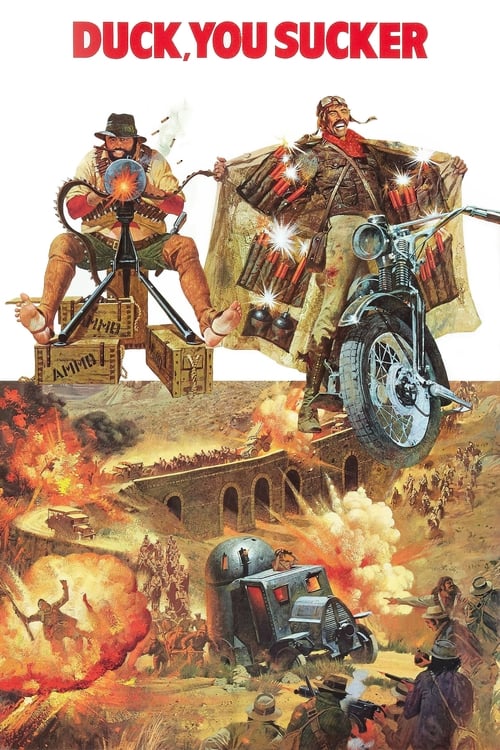
Duck, You Sucker
1971 · Sergio Leone
For when you want a sprawling Sunday-afternoon epic with explosions and swagger, but you'd like it to leave a bruise too. Comfort food with a conscience.
What it's about
Mexico, 1913, in the chaos of revolution: Juan, an illiterate bandit with a wagonload of sons, dreams only of robbing the great bank at Mesa Verde. He crosses paths with John, an Irish Republican explosives expert on the run from the British with a satchel of dynamite and a haunted past. Juan wants loot; the revolution wants both of them — and the bank turns out to hold something other than money.
The experience
It swings wildly and gloriously between broad comedy, huge action set pieces, and sudden gut-punch melancholy — a big, loud epic with a bitter aftertaste. The friendship at its center sneaks up on you.
Performances
Rod Steiger goes big and earthy as Juan while James Coburn underplays him beautifully as the dynamiter — their odd-couple chemistry, all needling and reluctant loyalty, is the engine of the whole film.
The craft
Sergio Leone's signature style is in full cry — vast widescreen compositions smash-cut against enormous close-ups, operatic slow motion, and set pieces staged on a staggering scale. Ennio Morricone's score, by turns absurd and heart-stopping, is one of his most haunting; see it big and loud if you ever can.
Why it matters
Leone's penultimate film and the most politically pointed of the spaghetti westerns, it turned the genre's revolutionary romance inside out — asking who actually pays for revolutions — and its skepticism echoed through the political westerns that followed.
Snapshot
Duck, You Sucker — released in Italy as Giù la testa ("Keep Your Head Down"), in France as Il était une fois la révolution ("Once Upon a Time... the Revolution"), and in some English-language markets as A Fistful of Dynamite — is Sergio Leone's penultimate film and the strangest, most politically fraught entry in his body of work. It yokes two archetypes: Rod Steiger's Juan Miranda, an illiterate, self-interested Mexican bandit who wants only to loot a bank, and James Coburn's John (Sean) H. Mallory, a disillusioned Irish Republican explosives man carrying his own history of revolutionary betrayal. Set against the 1913 upheavals of the Mexican Revolution, the film uses its bandit-and-dynamiter buddy dynamic to stage Leone's deeply skeptical meditation on revolution itself — who dies for it, who profits from it, and what it does to those who believe in it. It is at once a spectacle of exploding bridges and machine-gunned convoys and an unusually bitter, elegiac chamber piece about disillusionment. Tonally restless — comic, violent, sentimental, cynical — it has long been the most critically contested of Leone's mature films, and the one whose reputation has climbed most steeply in the decades since.
Industry & production
The film emerged from the peak of the Italian-Western boom and from Leone's own ascendancy following Once Upon a Time in the West (1968). Leone initially intended to serve as producer rather than director, having wanted to step back from the genre he had helped define. The record on the pre-production directorial history is clear on its broad outline but contested in its details: Peter Bogdanovich was attached at one stage and departed over creative differences, and Sam Peckinpah's name also circulated. By most accounts the decisive factor was Rod Steiger, who wanted Leone himself at the helm; Leone took over the direction. His longtime assistant director Giancarlo Santi worked on the production, and accounts of exactly how directorial authority was negotiated on set vary — this is one area where the historical record is genuinely uneven and should be treated with caution.
Production was mounted through Leone's associated Italian production entities with United Artists handling distribution, financing the film at a scale commensurate with its large-scale action set pieces. Principal photography took place largely in Spain — the Almería region and other Spanish locations standing in for revolutionary Mexico, as was standard for the cycle — with interior work associated with Italian studio facilities; the Irish-set flashbacks that punctuate Mallory's memory were realized as a distinct visual register. The shoot was demanding, involving extensive pyrotechnics, a full-scale bridge destruction, and staged massacres.
The film's release history is a study in fragmentation. Leone's preferred cut ran long, and the film circulated in the English-speaking world in significantly shortened and variously retitled versions, a situation that damaged its early reception; the confusion of titles alone (three principal ones across markets) blurred its identity. The American title Duck, You Sucker derived from a line of dialogue Leone reportedly believed to be common American slang — it was not, and the phrase struck English-speaking audiences as opaque. Home-video and restoration efforts in later decades reassembled fuller cuts, and the film is now generally viewable at or near its intended length.
Technology
Duck, You Sucker was shot on 35mm color film in the anamorphic widescreen format that had become Leone's native visual language — the extreme-wide vista set against the enormous close-up. The production made heavy use of practical special effects: real explosives, squibs, collapsing structures, and the destruction of a large bridge, executed in-camera rather than through optical trickery. This is a film whose spectacle is fundamentally photographic and physical rather than composited. Slow-motion cinematography is deployed pointedly in the flashback passages, a technological-aesthetic choice that separates memory from present action. The soundtrack was, per the era's Italian practice, entirely post-synchronized; the film was shot without usable location sound and dubbed afterward in multiple language versions, which is why no single "authentic" vocal track exists and why performances register slightly differently across the Italian and English editions.
Technique
Cinematography
Giuseppe Ruzzolini photographed the film, working within the Leone grammar established by Tonino Delli Colli and others but bringing his own textures. The visual scheme intensifies Leone's signature oppositions: the extreme close-up isolating eyes, sweat, and grimacing faces — Steiger's in particular — against panoramic compositions of landscape and massed figures. Where the earlier Dollars films kept faces weathered and iconic, here the close-ups are grotesque, almost caricatural, pushing the human face toward the monstrous and the comic simultaneously. The Irish flashbacks are shot in a softer, golden, romanticized key — often in slow motion, backlit and hazy — creating a lyrical counter-world against the dust and brown grit of the Mexican present. This bifurcation of visual register is one of the film's most deliberate formal statements.
Editing
Nino Baragli, Leone's regular editor, cut the film, and the editing carries much of its meaning. The flashback structure — Mallory's fragmentary, recurring memories of Ireland, betrayal, and a lost friendship/romance — is built through cross-cutting that withholds and gradually completes information, so that the emotional weight of the past accrues only in the film's final movements. Leone and Baragli's characteristic rhythm of protracted, dilated stillness suddenly punctured by violent compression is fully operative. The various shortened release versions, produced by others, disrupted precisely this architecture, which is why the film played as incoherent to some early audiences and reads as controlled and cumulative in its restored form.
Mise-en-scène / staging
Leone stages the Mexican Revolution as both epic and abattoir. The set pieces — the bank robbery that unexpectedly liberates political prisoners, the ambush of soldiers, the bridge demolition — are choreographed with operatic scale. But the film's most disturbing staging is its treatment of state violence: the sequence in which Juan descends into what he expects to be a bank vault and instead discovers walls of illegally detained, emaciated political prisoners transforms the genre's treasure-hunt logic into political horror. Mass executions and lines of corpses are staged with a directness unusual for Leone, and are strongly associated with his stated response to atrocities of the twentieth century. The interplay of grotesque foreground faces and deep-focus crowds keeps the individual and the historical mass in constant tension.
Sound
Ennio Morricone's score is inseparable from the film's design, discussed below under authorship. Beyond music, the post-synchronized soundscape leans into stylization — exaggerated effects, the roar and concussion of explosions, and dialogue tracks that differ between language versions. The film's sound is expressive rather than naturalistic throughout.
Performance
The two central performances are studies in contrast and were themselves a subject of debate. Rod Steiger, a Method-trained American actor, plays Juan in a broad, gesticulating, heavily accented register that some contemporaries found excessive; the performance is deliberately theatrical, oscillating between clownishness, greed, cunning, and — as the film darkens — genuine grief and rage. James Coburn's Mallory is its opposite: cool, ironic, physically economical, his Irishness rendered through a lighter touch and carried largely in the eyes and the recurring flashbacks. The chemistry between the mismatched pair — the earthy peasant and the elegant, doomed idealist — is the film's emotional engine, and the arc bends toward a tragic intimacy between them.
Narrative & dramatic mode
The film operates in a hybrid mode: picaresque buddy comedy grafted onto political tragedy. Its dramatic spine is the transformation of Juan from apolitical opportunist into a reluctant, ultimately grieving revolutionary hero — a hero "against his will," radicalized by loss rather than ideology. Running beneath the present-tense action is Mallory's buried narrative, delivered in fragmentary flashback, which reframes the whole film as a story about the cost of revolutionary commitment and betrayal among comrades. The dramaturgy repeatedly undercuts heroic expectation: revolution is presented not as liberation but as a machine that consumes the innocent and the poor. Juan's central monologue — his tirade about the educated men who read the books and give the speeches about revolution while it is the illiterate poor who do the killing and the dying — is the film's thesis stated aloud, and it inverts the conventional political adventure film from within.
Genre & cycle
Duck, You Sucker sits squarely within the "Zapata Western" — the politicized subcategory of the Italian Western set during the Mexican Revolution, in which a cynical outsider (often a European or gringo) and a Mexican peasant are drawn into revolutionary struggle. It shares this terrain with Damiano Damiani's A Bullet for the General (1966) and Sergio Corbucci's The Mercenary (1968) and Compañeros (1970), films frequently read through the lens of Third-Worldist and Marxist politics. Leone's contribution to the cycle is also its great skeptic's rebuttal: where many Zapata Westerns affirmed revolutionary solidarity, Leone's film interrogates and largely distrusts it. More broadly the film belongs to the Italian Western's later, self-aware, elegiac phase, when the genre had begun to reflect on its own myths and mortality.
Authorship & method
The film is unmistakably Leone's, and it forms the middle panel of what is often called his "Once Upon a Time" trilogy — flanked by Once Upon a Time in the West (1968) and Once Upon a Time in America (1984) — a grouping reinforced by the French title. Leone's authorial signatures are all present: the mythic-operatic scale, the fixation on faces and time, the fusion of childhood-fable structure ("once upon a time") with adult disillusionment, and the recurring theme of male friendship shadowed by betrayal.
His key collaborators were, characteristically, longstanding ones. Ennio Morricone composed the score, and it is among his most distinctive: the recurring, almost lullaby-like "Sean, Sean" theme — a wordless, sighing vocal motif tied to Mallory's memory — is one of the composer's signature creations, and Leone reportedly worked, as was his method, from Morricone's pre-recorded music, staging and cutting sequences to fit the score rather than scoring to picture. Giuseppe Ruzzolini served as cinematographer and Nino Baragli as editor. The screenplay is credited to Leone with Luciano Vincenzoni and Sergio Donati, writers embedded in the Italian-Western tradition and in Leone's own prior films; the collaboration was, by the accounts of those involved, contentious in the manner typical of Leone's productions. The film also opens with a title-card epigraph attributed to Mao Zedong on revolution as an act of violence rather than a genteel affair — a framing device whose inclusion and interpretation have been much discussed, and which signals the film's polemical intent from its first frames.
Movement / national cinema
The film is a product of the Italian popular-genre industry (Cinecittà-era commercial filmmaking) at the moment when that industry's Western cycle was at its height and beginning its decline. It belongs to the tradition of the spaghetti western and specifically to its politically engaged Zapata variant, which cannot be separated from the ferment of Italian left politics in the late 1960s and early 1970s. Yet Leone's stance within that national-political context is idiosyncratic and contrarian: rather than a militant endorsement of revolutionary action, the film voices a peasant's and a burned idealist's distrust of the intellectuals and vanguards who lead revolutions. It is thus both a representative Italian genre film and a pointed dissent from the political certainties of its milieu.
Era / period
Made in 1971, the film is legible as a work of its exact moment — the aftermath of 1968, the disillusionment following a wave of revolutionary hope, and a broader cultural reckoning with political violence. Its Mexican Revolution setting functions as historical displacement for contemporary anxieties about insurrection, martyrdom, and the betrayal of ideals. The imagery of mass executions has been connected to Leone's engagement with twentieth-century atrocity more generally. Within his own career it marks the passage from the pure genre mythmaking of the Dollars films toward the melancholic, memory-obsessed register that would culminate in Once Upon a Time in America over a decade later.
Themes
The film's governing theme is the disillusioned critique of revolution: its insistence that revolutions are conceived by the literate and paid for in the blood of the poor. Around this cluster its other concerns — male friendship and its betrayal (the Irish flashbacks reveal Mallory's defining wound); the corrosion of idealism into cynicism and back into a costly, involuntary heroism; the collision of personal greed with historical force; and the recurrent Leonean preoccupations with memory, loss, and the gap between mythic storytelling and brutal fact. Juan's transformation dramatizes the theme that political consciousness is born not from doctrine but from grief. The film refuses both the reactionary dismissal of revolution and its romantic glorification, landing in a bleak, humane middle: revolution happens, it is terrible, and the ordinary people caught in it deserve better than the slogans offered them.
Reception, canon & influence
Contemporary reception was mixed and hampered by the film's mutilated, retitled release versions and by the opacity of its American title. Steiger's broad performance drew criticism, the tonal shifts between comedy and massacre unsettled some viewers, and the film was long regarded as the "lesser" or most problematic of Leone's mature works — overshadowed by The Good, the Bad and the Ugly and Once Upon a Time in the West. The specific figures of its commercial performance vary across markets and the several release cuts, and I will not assign numbers to it here; the reliable through-line is simply that its reputation on release was uncertain and its early critical standing modest.
That standing has risen substantially. As fuller cuts became available and Leone's authorship was reassessed, Duck, You Sucker has been increasingly recognized as a major, if difficult, work — its political intelligence, Morricone's celebrated score, and its emotional force in the restored version drawing serious critical re-evaluation. It is now routinely discussed as an integral panel of the "Once Upon a Time" trilogy rather than a stumble between masterpieces.
Looking backward, the film draws on the Zapata-Western tradition (Damiani, Corbucci) that preceded it, on Leone's own established idiom, and on a broader lineage of revolutionary-set adventure narratives; its epigraph gestures toward the political-theoretical currents of its day. Looking forward, its influence runs both through the general afterlife of Leone's style — the operatic close-up, the memory-flashback structure, the Morricone-scored elegiac Western — and specifically through its skeptical, morally ambivalent treatment of political violence and its buddy-dynamic pairing of mismatched men bound by loyalty and betrayal, a template later filmmakers working in the elegiac and revisionist Western vein have drawn upon. Among directors who have openly championed Leone, the film's fingerprints — the reverence for the "once upon a time" fable frame, the fusion of spectacle and mournfulness — are part of the inheritance that shaped subsequent stylized genre cinema. Its most durable legacy, however, may be conceptual: it stands as one of the genre's few sustained arguments against the consolations of the revolutionary myth, made by the very filmmaker who had done the most to mythologize the West.
A Deleuzian reading
He goes down into the vault expecting gold.
The full Deleuzian reading of Duck, You Sucker →
Reception
Dismissed on release as 'minor Leone' and mangled by cuts and a title nobody could parse, it's since been restored and steadily reappraised — the standard take now is that it's the most underrated film Leone ever made.
How Duck, You Sucker was received, from release to now →
How to watch Duck, You Sucker: what to notice on a first viewing
- Watch faces pushed into extreme, sweaty, grotesque close-up. Ruzzolini alternates enormous landscape vistas with close-ups so tight on Steiger's face that it stops reading as merely iconic and starts reading as monstrous and comic at once. The camera keeps swinging between the size of history and the size of one man's face.
- Notice the flashbacks turn golden, soft, and slow. Mallory's memories of Ireland are shot backlit and hazy in slow motion, a lyrical world set directly against the dust and grit of the Mexican present. You can tell which country he is really living in just by the light.
- Listen for a wordless, sighing melody that keeps returning. Morricone's lullaby-like motif is tied specifically to Mallory's memory and recurs each time the flashbacks pull him back to Ireland. The music tells you exactly which character is carrying the weight of the past.
- Compare how much Steiger's face moves against Coburn's. Steiger plays Juan as broad, gesticulating, and constantly shifting between clownishness and rage, while Coburn's Mallory stays cool and economical, carried mostly in the eyes. One face can afford to hold still. The other one cannot.
- Watch Juan's face every time a door is forced open. Juan expects gold behind every barrier, and the film holds on his face as the doors give way. A small act, blowing a door, keeps disclosing a situation nobody knew was hidden.
The whole guide to watching Duck, You Sucker, with the keys for a rewatch →
Influences: the films it descends from and the films it influenced
- Once Upon a Time in the West (1968) — Establishes the pre-scored method Duck reuses — Morricone composes character leitmotifs before shooting, they're played on set, and Leone cuts and dilates scenes to fit the music rather than scoring to picture (here the 'Sean, Sean' theme).
- The Good, the Bad and the Ugly (1966) — Model for using a war (Civil War / Mexican Revolution) as an ironic backdrop that dwarfs the mercenary protagonists, plus the comic-to-massacre tonal oscillation and extreme telephoto grotesque close-up Duck extends.
- A Bullet for the General (Quién sabe?) (1966) — Founds the Zapata-Western template Duck inherits: the mismatched pairing of an apolitical Mexican bandit with a cold foreign ideologue whose politics culminate in betrayal — directly the Juan/Sean structure.
- The Mercenary (Il Mercenario) (1968) — Supplies the buddy dynamic of a Mexican peon radicalized alongside a cynical European gun-for-hire across the Revolution, scored by Morricone with the same operatic-ironic register.
- The Big Gundown (La resa dei conti) (1966) — Precedent for the class-conscious, Morricone-scored political Italian Western in which the manhunt structure carries an argument about who gets exploited — the politicized use of genre Duck sharpens.
- Vera Cruz (1954) — The mercenary-and-revolution adventure with a cynic/idealist duo crossing an insurgent Mexico for gold — the American blueprint the Zapata cycle Italianized into Duck's dynamite-and-loyalty pairing.
- Viva Zapata! (1952) — Rod Steiger himself appears here, and it supplies the disillusioned-revolution narrative — the thesis that revolutions devour and betray their believers — that Duck's Mao epigraph and prison-reveal invert.
- For a Few Dollars More (1965) — Leone extends FAFDM's expressionistic flashback technique—a character's concealed wound retroactively reframing all prior action—to a revolutionary-war context; John Mallory's fragmented Irish trauma sequences develop the Mortimer flashback grammar into a more formally disjointed, psychologically interior register, pushed further by the loss of linear backstory control.
- Once Upon a Time in America (1984) — Completes the 'Once Upon a Time' trilogy Duck belongs to, extending its fragmentary memory-flashback architecture and male-friendship-shadowed-by-betrayal into the gangster epic.
- Django Unchained (2012) — Directly repurposes Morricone's Duck cue 'Un Monumento' on its soundtrack, inheriting the pre-existing-spaghetti-score needle-drop as scoring method and the revenge-as-political-violence framing.
- Inglourious Basterds (2009) — Opens 'Once upon a time in Nazi-occupied France,' recycling Leone's fable frame and Morricone spaghetti-western cues, with chapter-titled tonal swings between farce and slaughter modeled on Duck's comedy/massacre shifts.
- The Hateful Eight (2015) — Stages an original Morricone score for anamorphic roadshow scale and confines a post-war political allegory to a single space — the operatic-widescreen-plus-Morricone spectacle inherited from Leone's mature idiom.
- Once Upon a Time in Hollywood (2019) — Adopts the literal 'once upon a time' fable frame as ironic elegy, the exact fusion of nostalgic myth and mournfulness Leone codified across the trilogy Duck anchors.
- The Assassination of Jesse James by the Coward Robert Ford (2007) — Extends Leone's elegiac register — mournful slow rhythm, memory-inflected voiceover, and a male friendship curdling into betrayal — as the revisionist-Western afterlife of Duck's operatic disillusionment.
- The Wild Bunch (1969) — Contemporaneous reworking of aging outlaws swept into revolutionary Mexico, sharing the slow-motion balletic-massacre editing and elegiac register that dilates then compresses violent time exactly as Duck does.
- The Great Silence (Il Grande Silenzio) (1968) — Kin in its refusal of genre consolation — it denies the heroic myth its payoff, prefiguring Duck's status as a sustained argument against the revolutionary/heroic fable.
- Compañeros (1970) — Near-simultaneous Zapata-Western pairing mismatched men across the Revolution with the same ironic comedy layered over mass killing and the peon-radicalized-by-a-foreigner arc.
Similar films
- Once Upon a Time in the West (1968) — influence & lineage · same viewing thread
- The Good, the Bad and the Ugly (1966) — influence & lineage · same viewing thread
- Django Unchained (2012) — influence & lineage · same viewing thread
- The Hateful Eight (2015) — influence & lineage · same viewing thread
- The Wild Bunch (1969) — influence & lineage
- Once Upon a Time in America (1984) — influence & lineage
- Django (1966) — same viewing thread
- A Fistful of Dollars (1964) — same viewing thread
All the films related to Duck, You Sucker →
Watch it with: curated runs of related films
- The Operatic West — A run of operatic gunfighter cinema — Leone's mythic widescreen scale, Corbucci's colder cruelty, and the Tarantino homages that quote both — best watched close together to hear the same Morricone-scaled myth mutate.