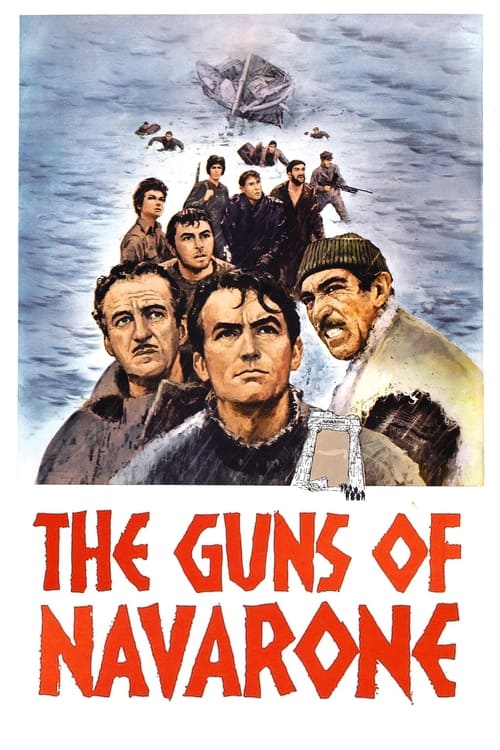
The Guns of Navarone
1961 · J. Lee Thompson
For when you want a grand Sunday-afternoon epic — stakes, spectacle, and heroes under pressure — comfort viewing on the largest scale.
What it's about
Two thousand British soldiers are trapped on an Aegean island, and the only rescue route is covered by a pair of massive German guns mounted inside a cliff fortress on Navarone. A small Allied sabotage team — led by a world-class mountaineer — is sent to do the impossible: scale a sheer cliff in a storm, cross the occupied island, and destroy the guns before the evacuation fleet sails into their range. Complicating the clockwork: the growing suspicion that someone in the team is a traitor.
The experience
Big, sweeping, old-school suspense — a mission movie that ratchets from one seemingly unsolvable obstacle to the next, with surprising room for moral argument about what the mission is costing the men who carry it out. It's a proper edge-of-your-seat adventure that still takes its characters seriously.
Performances
Gregory Peck anchors it with weary authority, David Niven supplies bite as the explosives man with a conscience, and Anthony Quinn smolders as a Greek fighter nursing an old grudge — a star trio whose friction gives the mission its human stakes.
The craft
Written and produced by Carl Foreman, working in exile after the Hollywood blacklist, it wraps real moral ambivalence — the burden of command, the cost of killing — inside a superbly engineered suspense machine. The cliff-climb sequence and the thunderous gun emplacement remain showpieces of pre-digital spectacle; this one genuinely earns a big screen and loud speakers.
Why it matters
One of the biggest worldwide hits of 1961, it codified the modern men-on-a-mission war picture — the template of the specialist team, the impossible objective, and the traitor within that action cinema still uses today.
Snapshot
The Guns of Navarone is the film that codified the modern "men-on-a-mission" war picture — a lavish, road-show-scaled commando adventure produced and written by the blacklist exile Carl Foreman, adapted from Alistair MacLean's 1957 bestseller. Its premise is a machine of pure suspense: a small allied sabotage team must scale an unclimbable cliff, cross a Nazi-held Aegean island, and silence two radar-directed coastal guns before the German battery annihilates a British evacuation fleet. Around that clockwork Foreman built something more ambivalent than a simple heroics narrative — a story preoccupied with the moral cost of killing, the burden of command, and the presence of a traitor within the group. Released by Columbia Pictures in 1961, it became one of the year's most commercially successful films worldwide and won the Academy Award for Best Special Effects while collecting a raft of further nominations, including Best Picture. It remains the template against which later ensemble war-adventures — The Dirty Dozen, Where Eagles Dare, Kelly's Heroes — are still measured.
Industry & production
The project was driven by Carl Foreman, the American screenwriter (High Noon) who had been blacklisted after refusing to name names before the House Un-American Activities Committee and had relocated to Britain. Working through his London-based production company, Open Road Films, in partnership with Columbia Pictures, Foreman both adapted MacLean's novel and produced the picture — a rare degree of author-producer control for the period, and a vehicle through which his own convictions about war and coercion could shape the material.
The film was mounted at a scale that reflected the early-1960s industry logic of the "event" picture: with television eroding the mass audience, studios answered with wide-screen color spectacle shot on international locations, and Navarone was engineered as exactly that kind of tent-pole. Principal photography used Greek locations — the island of Rhodes stood in for the fictional Navarone and its port town — combined with extensive studio work in Britain, where the interiors and the vast set of the gun emplacement in its rock cavern were built. The historically well-attested production drama is the change of director: Alexander Mackendrick, the gifted Ealing director, was originally attached and departed before or very near the start of shooting, with J. Lee Thompson brought in to helm the picture. The exact chronology and the reasons have been recounted variously; the settled point is that Thompson, not Mackendrick, directed the film as released.
The casting strategy was frankly international and commercial, mixing a top-billed American star with British and European talent: Gregory Peck as the mountaineer Captain Mallory, David Niven as the explosives expert Corporal Miller, Anthony Quinn as the Greek partisan Andrea Stavrou, plus Stanley Baker, Anthony Quayle, James Darren, and the Greek actresses Irene Papas and Gia Scala. This blend of nationalities suited both the story's allied-coalition premise and the film's aim at a global box office.
Technology
Navarone is a showcase of the wide-screen color toolkit that the studios were deploying against television. It was photographed in CinemaScope-format anamorphic wide-screen and in color (Eastmancolor-derived processing, released under Columbia's color branding of the era), designed for large-format road-show presentation with the immersive landscape scale that the format rewarded.
Its most consequential technological achievement, and its single Academy Award, was in special effects. The illusion of the enormous guns, the cliff face, the naval bombardment, and above all the climactic destruction of the emplacement depended on a combination of full-scale sets, large miniatures, matte work, and pyrotechnics. The visual-effects work was led by Bill Warrington, with audible/sound effects by Vivian Greenham; the Academy recognized the picture in the special-effects category. The finale — the guns firing, the rigged charges detonating, and the whole cavern collapsing into the sea — was the set-piece the entire production was built to deliver, and it stands as one of the more ambitious practical-effects sequences of its moment.
Technique
Cinematography
The cinematography (director of photography Oswald Morris, one of the leading British cameramen of the period) exploits the anamorphic frame for two distinct registers. In the exteriors it renders the Aegean seascape and the sheer cliff as an epic, hostile geography — the wide format turning rock and sea into an antagonist in their own right, most memorably in the storm-lashed sea approach and the vertical cliff climb, where the compositions emphasize smallness and exposure. In the interiors and the covert-movement passages through the town and the gun cavern, the same wide frame is used for confinement and tension, packing the ensemble into the anamorphic band and staging suspense in depth. The record on precise second-unit and additional-photography credits is more diffuse than the headline DP credit, and I won't attribute specific shots beyond what is securely established.
Editing
The editing (Alan Osbiston, who received an Academy Award nomination for the film) governs a long-form suspense structure — the picture runs well over two and a half hours — by organizing the narrative as a chain of discrete, escalating obstacles: the sea crossing, the cliff, capture and interrogation, the traitor's exposure, and the assault on the guns. The cutting sustains tension across this episodic architecture and builds to the intercut climax, where the sabotage below is crosscut with the arriving fleet above to wring maximum suspense from the ticking-clock premise. The Oscar nomination signals that the film's cutting was recognized as central to its effect, not incidental.
Mise-en-scène / staging
Production design is dominated by the two great constructed spaces — the cliff and the gun cavern — which function as the film's dramatic poles: the near-impossible ascent that opens the mission and the cathedral-like rock chamber that closes it. Thompson stages the ensemble movement through real and built environments to keep the mission legible: the audience always understands the geography of the objective, which is essential to the suspense. The staging of the guns themselves — monstrous barrels housed behind rolling steel doors deep in the rock — gives the abstract objective a physical, almost mythic presence that the finale then destroys.
Sound
Sound is integral to the suspense design, from the storm and surf of the approach to the concussive fire of the guns; the film's audible-effects work shared in the special-effects recognition, and the picture was also acknowledged in the sound category during awards season. Dimitri Tiomkin's score (see below) is the other dominant sonic element, its martial main theme functioning almost as a second narrator of the mission.
Performance
The performances are calibrated to type in a way that serves the ensemble machine. Gregory Peck brings his characteristic gravity and moral seriousness to Mallory, the reluctant leader forced into hard decisions. David Niven's Miller supplies the film's conscience and its friction — his confrontations over the ethics of killing, particularly regarding the wounded and the traitor, are the vehicle for Foreman's moral argument, and Niven plays them with a bitter articulacy that cuts against the adventure surface. Anthony Quinn's Andrea carries the weight of Greek suffering and personal vendetta. Irene Papas and Gia Scala, as the two partisan women, anchor the subplot on which the film's most disturbing moral turn depends.
Narrative & dramatic mode
The film operates in the mode of the suspense-driven mission narrative: a clearly stated, near-impossible objective; a countdown; a small, differentiated team; and a series of escalating setbacks. What distinguishes Foreman's treatment from pure adventure is its insistence on moral cost. The dramatic spine is less "will they succeed?" than "what will success require them to become?" Two crises make this explicit: the question of what to do with a badly injured comrade who slows the mission, and the discovery that one of their own party is an informer, forcing a decision about killing a woman in cold blood. These are staged as genuine ethical arguments among the characters — chiefly between the pragmatic leader and the disgusted explosives man — rather than as obstacles to be brushed past. The result is an adventure film with a persistent undertow of unease about the moral compromises of warfare, consistent with Foreman's authorial preoccupations.
Genre & cycle
Navarone sits at the head of the "men-on-a-mission" or commando-adventure strain of the war film. Its immediate lineage includes the British service pictures of the 1950s — The Dam Busters (1955), The Cockleshell Heroes (1955) — and, tonally and in prestige, David Lean's The Bridge on the River Kwai (1957), the earlier Foreman-associated blacklist-era war epic. But Navarone crystallized the specific formula — the assembled specialist team, the impregnable objective, the countdown, the internal conflict — into a repeatable commercial shape. It is best understood as the pivot between the earnest 1950s war-mission film and the harder, more cynical, star-studded mission spectacles of the mid-to-late 1960s that it directly enabled.
Authorship & method
The film is genuinely a producer-writer's picture as much as a director's. Carl Foreman (producer, screenwriter) is the controlling authorial intelligence: the moral seriousness, the anti-war undertow, and the emphasis on the ethics of killing are continuous with his other work and his own history as a blacklist casualty. J. Lee Thompson (director), who took over the production, proved adept at large-scale suspense staging; he would immediately follow Navarone with the very different but equally tension-driven Cape Fear (1962), and the two films together mark the peak of his craftsmanship with sustained dread. Oswald Morris (cinematography) supplied the wide-screen visual scale. Dimitri Tiomkin (composer), the veteran Hollywood-Russian émigré known for his big thematic scores, wrote the martial main theme that became one of the picture's signatures. Alan Osbiston (editor) shaped the long suspense architecture, earning an Oscar nomination. The source author, Alistair MacLean, supplied not only this plot but a whole vein of terse mission-thriller material that Foreman's adaptation elevated into prestige spectacle — a relationship MacLean would revisit on screen with Where Eagles Dare later in the decade.
Movement / national cinema
The picture is a hybrid of Hollywood financing (Columbia) and British production craft, made largely by British and European personnel and shot on Mediterranean locations — a characteristic "runaway" or transatlantic production of the period, in which American studios exploited British studios, talent, and European locations for large-scale films. It belongs less to any avant-garde movement than to the mainstream British-American commercial cinema of the early 1960s, though its authorship is inflected by the specifically transatlantic circumstance of the American blacklist, which had pushed figures like Foreman into the British industry and helped make London a hub for this kind of internationally financed spectacle.
Era / period
Navarone is a quintessential early-1960s road-show event film, produced in the moment when the studios were countering television with wide-screen color scale and long, intermission-length running times. It also arrives in a very specific reckoning-with-the-Second-World-War cycle: released sixteen years after V-E Day, it treats the war as heroic subject matter while — through Foreman — admitting a note of moral fatigue that anticipates the more disillusioned war films to come. It stands at the threshold between the reverent war cinema of the 1950s and the more skeptical, spectacle-forward war entertainments of the later 1960s.
Themes
The dominant theme is the moral cost of duty: the film repeatedly forces its characters to do terrible things in the name of the mission and refuses to let those choices pass unexamined. Closely related is the burden of command — the leader who must order or commit acts he finds abhorrent because success demands them. A third strand is betrayal and trust within the group, dramatized through the traitor subplot, which turns the team's greatest danger inward. Underneath runs an anti-war or war-weary current, the sense that even a just cause corrodes those who serve it — the thematic fingerprint of Foreman's authorship. Finally there is the older, simpler theme of the impossible task and human endurance against hostile nature, embodied by the cliff and the storm, which supplies the adventure pleasure that carries the heavier material.
Reception, canon & influence
On release the film was a major commercial success and an awards contender. It won the Academy Award for Best Special Effects and received multiple further nominations, including Best Picture, Best Director, Best Adapted Screenplay, Best Film Editing, Best Music Score, and Best Sound; it also won the Golden Globe for Best Motion Picture — Drama. Contemporary critical response was generally strong on its craftsmanship and suspense, with some reservations, then as now, about its length and about the tension between its adventure entertainment and its darker moral pretensions — a tension that is arguably the film's most interesting feature. I'll flag honestly that precise box-office figures and specific period reviews vary across sources and I won't quote numbers or critics I can't securely attribute.
Influences on the film (backward): MacLean's source novel; the 1950s British war-service film; the prestige of The Bridge on the River Kwai; and, formatively, Foreman's own blacklist experience and his established interest in the ethics of violence.
Legacy (forward): Navarone's influence is outsized. It effectively invented the commercial grammar of the ensemble commando mission that runs directly through The Dirty Dozen (1967), the MacLean-derived Where Eagles Dare (1968), and Kelly's Heroes (1970), and continues to echo in later heist-structured and squad-based action films far beyond the war genre. It generated its own direct sequel, Force 10 from Navarone (1978). And it helped establish the early-1960s model of the internationally cast, location-shot wide-screen adventure epic. For J. Lee Thompson it was a career high point, and for Foreman it was a vindication of an author-producer's ability to smuggle serious moral content inside a crowd-pleasing spectacle — perhaps its most enduring lesson for the films that followed.
A Deleuzian reading
A handful of men on a sheer rock face, with the sea working below them.
The full Deleuzian reading of The Guns of Navarone →
Reception
A monster hit in 1961 — among the year's top grossers, seven Oscar nominations including Best Picture — it has since settled from 'event movie' into comfortable dad-canon: the template WWII mission film everyone's seen on a Sunday afternoon, respected more than argued over.
How The Guns of Navarone was received, from release to now →
How to watch The Guns of Navarone: what to notice on a first viewing
- Notice how wide the frame gets on the cliff climb. Morris uses the same anamorphic width to make the team look tiny against open rock and sea, then packs the ensemble into it for cramped, tense interiors. The same wide screen does two opposite jobs: exposure outdoors, confinement indoors.
- Listen for the main theme returning across the mission. Tiomkin's martial theme recurs at key turns of the plan, functioning almost like a second narrator keeping track of where the mission stands. The music tells you how the mission is going before any character says a word about it.
- Notice how clearly you can always read the team's position. Thompson keeps the geography of the cliff and later the gun cavern legible at every point, so you always know where the objective sits relative to the men. Clear geography is what makes the suspense work. You are never lost, only worried.
- Watch David Niven argue back whenever an order turns brutal. Niven plays Miller's objections with a bitter, articulate edge that cuts against the adventure surface, making him the film's conscience rather than comic relief. The film keeps a dissenting voice inside the team instead of saving objections for outsiders.
The whole guide to watching The Guns of Navarone, with the keys for a rewatch →
Influences: the films it descends from and the films it influenced
- High Noon (1952) — Carl Foreman scripted it too, and its near-real-time ticking-clock architecture wedded to the moral-cost-of-duty theme — plus a Tiomkin martial theme — is the exact Foreman-Tiomkin machinery he re-fitted for Navarone.
- The Bridge on the River Kwai (1957) — The prestige model Navarone chases: a character-driven demolition-mission war epic that smuggles an anti-war moral undertow inside location-shot widescreen spectacle.
- The Wages of Fear (1953) — Its serialized obstacle-by-obstacle suspense over a lethal physical journey is the structural template for Navarone's chain of terrain hazards, each set-piece a discrete life-or-death problem.
- Ice Cold in Alex (1958) — Thompson's own prior war picture rehearsed his signature: building sustained dread from a sequence of terrain obstacles governed by a ticking survival clock.
- Objective, Burma! (1945) — Codified the small commando unit parachuted behind enemy lines to destroy one strategic objective, then exfiltrate across hostile ground.
- Sahara (1943) — Established the typed multinational ensemble whose contrasting national/temperamental types generate the drama as they are picked off across a punishing landscape.
- The Dam Busters (1955) — The British single-raid film built entirely toward one engineered demolition, deploying practical miniature and optical effects for the climactic destruction Navarone's Oscar-winning effects team echoes.
- The Dirty Dozen (1967) — Extends the typed-ensemble suicide-commando template into a fortress assault resolved by a cross-cut demolition climax — Navarone's grammar made even more expendable.
- Where Eagles Dare (1968) — MacLean's own next screen mission reprises the cliffside-infiltration set-piece and the betrayal-within-the-group reveal that Foreman foregrounded in Navarone.
- Kelly's Heroes (1970) — Repurposes the squad-mission structure as a gold heist, demonstrating that Navarone's episodic-obstacle grammar detaches cleanly from patriotic purpose.
- Force 10 from Navarone (1978) — The direct MacLean sequel that carries Mallory and Miller forward onto another bridge-demolition mission built on the same crosscut-climax mechanics.
- The Wild Geese (1978) — Assembles a mercenary ensemble by specialist type for a covert extraction, and turns on the same moral-cost betrayal — the men-on-a-mission film stripped of the flag.
- Aliens (1986) — Transplants the typed-squad-picked-off-one-by-one structure into science fiction, the clearest proof Navarone's ensemble-mission grammar outlived the war genre entirely.
- Inglourious Basterds (2009) — A self-conscious revival of the Navarone/Dirty Dozen commando-mission film, restaging the behind-the-lines demolition as a literal cinema-burning cross-cut climax.
- The Avengers (2012) — The all-star commando ensemble in which each marquee actor embodies one indispensable technical competency, and screen time is rationed to keep every specialist's expertise load-bearing to the mission.
- Rogue One: A Star Wars Story (2016) — Template for the infiltration-commando-destroys-an-impregnable-superweapon plot; Scarif transposes its saboteur-squad architecture whole.
- The Rock (1996) — Provides the briefing ritual: a scale model of an impregnable rock fortress, specialists assigned by discrete function, and the assault plotted as a vertical climb from waterline to gun emplacement — a beat The Rock reproduces almost function-for-function in the SEAL briefing.
- Ice Station Zebra (1968) — Another MacLean adaptation running the terse mission-thriller into a sealed-objective infiltration with an embedded traitor, sharing Navarone's roadshow widescreen scale.
- The Great Escape (1963) — Internationally cast ensemble caper using episodic obstacle structure and a multi-strand cross-cut climax at the same roadshow event-film scale.
- Cape Fear (1962) — Thompson's immediate follow-up applies the identical sustained-dread staging craft — patient escalation of threat toward a single confrontation — that made him the ideal Navarone hire.
- The Longest Day (1962) — A contemporaneous international all-star ensemble built around a single large military operation, sharing the runaway-European-production economics and big-cast war-epic packaging.
Similar films
- Where Eagles Dare (1968) — influence & lineage · same viewing thread
- The Dirty Dozen (1967) — influence & lineage
- The Bridge on the River Kwai (1957) — influence & lineage
- The Great Escape (1963) — influence & lineage
- Patton (1970) — same viewing thread
- Gallipoli (1981) — same viewing thread
- From Here to Eternity (1953) — shared sensibility
- The Longest Day (1962) — shared sensibility
All the films related to The Guns of Navarone →
Watch it with: curated runs of related films
- Against Overwhelming Force — A run for when you want scale and physical punishment — men set against armies, tanks, and the frozen wild, holding a line that by rights should have broken them.