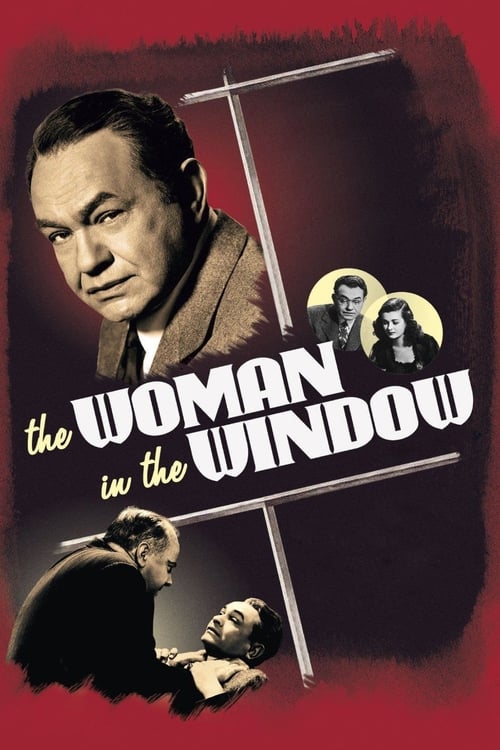
The Woman in the Window
1944 · Fritz Lang
For a rainy-night classic-thriller mood, when you want shadows, moral quicksand, and mounting dread rather than jump scares. A perfect entry point if you've been meaning to explore film noir.
What it's about
Richard Wanley, a mild criminology professor with his family away for the summer, lingers at a shop window admiring the portrait of a beautiful woman — and then meets the woman herself. One evening of harmless curiosity ends with a dead man on her floor, and Wanley, an expert on how crimes are solved, must try to cover up a killing while the investigation closes in using the very methods he teaches. A blackmailer soon makes everything worse.
The experience
A slow, exquisite tightening — the suspense comes from watching an intelligent, decent man make one small mistake and then feel the consequences accumulate. It's talky, dread-soaked, and darkly ironic, with a sting that people still argue about.
Performances
Edward G. Robinson is the engine — cast against his gangster image as a gentle, frightened everyman — while Joan Bennett brings ambiguous allure and Dan Duryea is deliciously slimy as the film's opportunist.
The craft
Fritz Lang directs with the precision of a trap being set: shadowy interiors, a camera that watches Wanley sweat through every procedural detail, and a script that turns crime-scene logic itself into the source of suspense. It's a masterclass in generating tension from conversation and consequence rather than action.
Why it matters
A foundational entry in the 1940s American film noir cycle — one of the films that defined the 'ordinary man undone by one transgression' template and paired Lang, Robinson, and Bennett for a celebrated follow-up.
Snapshot
The Woman in the Window is Fritz Lang's tense chamber thriller about a mild, middle-aged criminology professor who steps once "off guard" — the title of the J.H. Wallis novel it adapts — and finds himself dragged into homicide, blackmail, and the slow tightening of consequence. Edward G. Robinson plays Richard Wanley, a family man whose wife and children are away for the summer; lingering before a shop window at the portrait of a beautiful woman, he then meets the woman herself (Joan Bennett), and an evening of harmless curiosity ends with a dead man on her floor. What follows is a study in escalating dread as Wanley, an expert on crime, tries to dispose of a body and outwit the very investigative logic he understands better than anyone. The film is a foundational early entry in the American film noir cycle, prized for its economy, its moral claustrophobia, and a notorious final twist that has been argued over ever since. It is best understood alongside its darker companion, Scarlet Street (1945), which reunited Lang with the same three principal actors the following year.
Industry & production
The film was produced by Nunnally Johnson — who also wrote the screenplay — for International Pictures, the newly formed independent company Johnson had established with William Goetz, with distribution through RKO Radio Pictures. It thus sits in the mid-1940s wave of independent and semi-independent production that gave directors like Lang somewhat more latitude than the fully vertically integrated studio system, while still operating under the constraints of the Production Code. That Code context is important to the film's shape: crime, adultery, and suicide could not be seen to go unpunished or unresolved on screen, and the picture's much-discussed ending has often been read partly as a maneuver within — or against — those requirements.
The project drew on an established creative partnership. Lang and Joan Bennett had already worked together on Man Hunt (1941), and Bennett's husband, producer Walter Wanger, was a key figure in Lang's American career; the three would soon formalize their collaboration in the independent Diana Productions for Scarlet Street. Robinson, one of Warner Bros.' defining stars of the 1930s gangster cycle, was here cast strikingly against that type as a soft-spoken academic. Precise budget and box-office figures for the film are not something I can cite reliably, and I will not invent them; what the record clearly supports is that the film was a critically respected release that helped consolidate Lang's American reputation and set up the near-immediate follow-up with the same ensemble.
Technology
The Woman in the Window is a black-and-white, standard Academy-ratio production made with the conventional 35mm studio sound-film apparatus of the mid-1940s. Its technological interest lies less in any novelty of apparatus than in the mature command of Hollywood's monochrome craft at its height: panchromatic stock, incandescent lighting instruments capable of hard directional beams and deep shadow, and the optical printing and process work (rear projection, dissolves) that let a largely studio-bound production move fluidly between the professor's club, the woman's apartment, and the nocturnal exterior of the crime's aftermath. The film's power is built almost entirely from the disciplined deployment of these standard tools rather than from spectacle.
Technique
Cinematography
The cinematography is by Milton Krasner, a versatile studio craftsman who later won an Academy Award for Three Coins in the Fountain (1954). Here his work is central to the film's noir texture: low-key lighting, pooled illumination, and strong compositional use of the shop window, mirrors, and the framed portrait that recurs as a visual motif linking the "woman in the window" of the title to the flesh-and-blood woman Wanley meets. The camera favors controlled, often static or slowly reframing setups that keep the viewer locked inside Wanley's deteriorating composure, and the shadow-heavy interiors express the encroaching threat far more than any overt action does.
Editing
The cutting is unshowy and tension-forward, built to sustain the near-real-time dread of the body-disposal sequence and the subsequent cat-and-mouse of the investigation. The editing withholds and doles out information to keep the audience aligned with Wanley's calculations and his fear of the small telltale detail — a footprint, a scratch, a bloodstain. I am not able to confirm the individual editor's credit with certainty from memory, and I will not guess at a name; what can be said securely is that the film's rhythm is one of accumulating, procedural suspense rather than montage flourish.
Mise-en-scène / staging
Lang's staging is the film's signature. He confines much of the drama to a few interiors — the gentlemen's club, the apartment, the professor's study — and choreographs bodies and objects with the geometric precision that carries over from his German work. Doorways, staircases, telephones, and above all the recurring portrait are placed to trap the characters within the frame. The famous portrait/window conceit operates as a mise-en-scène thesis: desire glimpsed through glass, an image that becomes a person and then a snare. Everyday props — a pair of scissors, a monogrammed pencil, a wristwatch — are staged as instruments of fate, the ordinary detail that will betray the ordinary man.
Sound
The score is credited to musical director Arthur Lange; the film uses music sparingly and functionally, letting silence, ticking clocks, and the ordinary sounds of rooms carry much of the suspense. Dialogue is the dominant sonic register — Wanley's careful, professorial speech curdling into evasion, and Dan Duryea's insinuating blackmailer's patter. Where a lesser thriller might swamp its set pieces in orchestration, the film often lets the crime's aftermath play quietly, which sharpens the sense of a mind straining to stay calm.
Performance
Edward G. Robinson gives one of his most restrained performances, subverting his gangster persona to play a decent, intelligent man undone by a single lapse; the pleasure and the pathos come from watching an expert on crime fail at committing one. Joan Bennett's Alice Reed is knowing but not simply a femme fatale — more a fellow victim of circumstance than a schemer, a nuance the film deliberately preserves. Raymond Massey, as the district attorney who is also Wanley's friend, embodies the investigative machinery closing in, his unwitting proximity a masterstroke of dramatic irony. Dan Duryea, as the blackmailer, contributes the sneering, dangerous energy that would make him a noir fixture — a performance that helps explain why Lang immediately reused the Robinson–Bennett–Duryea triangle in Scarlet Street.
Narrative & dramatic mode
The dramatic mode is tragic irony in a suspense frame: the audience knows the killing was essentially self-defense and accident, and watches a fundamentally innocent man behave like a guilty one because the law will not distinguish the two in time. The narration is tightly restricted to Wanley's experience, generating suspense through dramatic irony (we, with him, know what the investigators do not) and through the agonizing gap between his intellect and his nerve. The most contested formal element is the ending: the film reveals that the entire ordeal has been a dream, Wanley waking safe in his club chair. Lang defended the device — in his later interviews, notably with Peter Bogdanovich — as a deliberate authorial choice rather than a studio-imposed cheat, arguing that the alternative, ending on the professor's suicide, would have been unbearably bleak and that the dream reframed the story as a cautionary fantasy about how easily a respectable man could be destroyed. Critics remain divided: some see the twist as a betrayal of the film's mounting fatalism, others as a characteristically Langian gesture about determinism, guilt, and the thin membrane between the safe life and catastrophe.
Genre & cycle
The film is a keystone of the emerging American film noir cycle of the early-to-mid 1940s, released the same year as Double Indemnity, Laura, and Murder, My Sweet — the cluster of pictures that critics (initially French) would soon name noir. Its DNA is quintessentially of that cycle: the ordinary man ensnared, the alluring woman, the blackmailer, the nocturnal city of guilt, and the sense that a single transgression sets an inexorable mechanism in motion. It belongs to the "wrong man" and "amateur criminal" strain of noir rather than the hardboiled-detective strain, and its close kinship with Scarlet Street — same director, same three leads, same theme of a mild man wrecked by desire — makes the two films a defining diptych of the cycle's mid-decade peak.
Authorship & method
This is centrally a Fritz Lang film, and it bears his enduring preoccupations: fate, the trap, the guilt of the ordinary citizen, and the machinery of law and chance grinding toward an unavoidable end. Lang's method — precise geometric staging, expressive shadow, objects as agents of destiny — carries directly from his German masterworks M (1931) and Dr. Mabuse into the American idiom. His key collaborators here shape the result: Nunnally Johnson as producer-screenwriter gives the film its literate, ironic structure and its adaptation of Wallis's novel Once Off Guard; Milton Krasner's cinematography supplies the noir chiaroscuro; and Arthur Lange as musical director provides the restrained score. The Robinson–Bennett–Duryea ensemble functions almost as an authorial unit in its own right, given how deliberately Lang reassembled it for Scarlet Street. The individual editor's credit I cannot confirm from memory and decline to invent.
Movement / national cinema
The film is a landmark instance of the transplantation of German Expressionism into Hollywood by émigré directors fleeing Nazism. Lang, whose Weimar career made him one of the giants of German silent and early sound cinema, brought to America a visual grammar of shadow, entrapment, and moral dread that fused with native American crime storytelling to help produce film noir. The Woman in the Window is therefore a document of a transatlantic cinematic migration — an Old World sensibility about guilt and fate reshaping a New World genre. It sits within the broader 1940s Hollywood studio system while carrying the unmistakable imprint of the Weimar tradition.
Era / period
Released in 1944, the film belongs to the wartime and immediate mid-1940s moment of American cinema, when domestic audiences were increasingly receptive to darker, more psychologically anxious storytelling. Made under the Production Code and within the studio-distribution system (here via RKO for the independent International Pictures), it reflects both the constraints of that era — hence the debate over its resolution — and the period's emergent taste for moral ambiguity, urban unease, and protagonists whose respectability offers no protection. It stands at the front edge of the classic noir period that would run through the following decade.
Themes
Its governing themes are the fragility of respectability and the terror of a single irreversible act — the idea, embedded in the source novel's title Once Off Guard, that a lifetime of decency can be undone in one unguarded hour. Related strands run through it: middle-aged male desire and its punishment; the gap between knowing about crime and being able to survive committing one; the indifferent machinery of law and chance; and guilt as a psychological condition as much as a legal one. The dream framing turns these into a meditation on fantasy and the return of the ordered life — whether read as reassurance or as an ironic underscoring of how close catastrophe always is. Doubling recurs throughout: the portrait and the woman, the professor and the criminal, the friend and the prosecutor.
Reception, canon & influence
The film was well received on release and has held a secure place in the noir canon, routinely cited among the cycle's important early works and frequently discussed in tandem with Scarlet Street. Much of its critical afterlife has centered on the ending, which remains one of the most analyzed twists in classical Hollywood — a touchstone in debates about the dream device, the pressures of the Production Code, and Lang's authorial intentions, the latter clarified in part by his own later interviews.
Influences on the film (backward): it draws on J.H. Wallis's novel Once Off Guard for its plot and its central conceit; on Lang's own Weimar Expressionist practice for its visual and thematic architecture; and on the broader hardboiled and crime-fiction currents feeding the nascent noir cycle.
Legacy (forward): most immediately, it seeded Scarlet Street (1945), Lang's darker reworking of the same premise and ensemble, with which it forms a canonical pair. More broadly, it helped establish noir's "ordinary man ensnared" template and the figure of the sympathetic, non-predatory woman caught in the same trap, and it consolidated Dan Duryea's blackmailer type and Robinson's capacity for playing vulnerability against his tough-guy image. Its dream-reveal has been an enduring reference point for later filmmakers and critics wrestling with unreliable framing and trick endings. As one of the defining Lang–Bennett collaborations and a cornerstone of 1944's noir breakthrough year, it remains a standard text in the study of how émigré European sensibility helped create the American crime film.
A Deleuzian reading
A man has dinner at his club.
The full Deleuzian reading of The Woman in the Window →
Reception
A solid hit in 1944 and one of the films French critics binged in 1946 when they coined the term 'film noir' — it's been load-bearing for the genre's very name ever since, even as it's slipped slightly behind its sister film Scarlet Street in cinephile affection.
How The Woman in the Window was received, from release to now →
Influences: the films it descends from and the films it influenced
- Das Cabinet des Dr. Caligari (1920) — Its framing device — the whole tale retroactively exposed as the fantasy of a disturbed mind — is the template for Lang's dream-reveal that dissolves the noir plot in the last reel.
- Dr. Mabuse, der Spieler (1922) — Establishes Lang's Expressionist grammar of crime as a deterministic machine, the visual and structural architecture he later naturalizes into the American noir idiom here.
- Sunrise (1927) — The respectable everyman lured toward murder by a seductive woman, staged in chiaroscuro and mobile expressive light that noir inherits as its low-key visual code.
- M (1931) — Perfects Lang's precise geometric staging and objects-as-fate motif (the balloon, the whistle) tracking an ordinary man's guilt through the parallel machineries of law and chance.
- Fury (1936) — Lang's first transplant of Weimar fatalism into American material — a decent citizen ground down by circumstance and the apparatus of justice — the 'ordinary man ensnared' engine this film runs on.
- You Only Live Once (1937) — An early Lang trap-narrative pairing sympathetic ordinariness with inexorable doom, rehearsing the fate-closes-in structure and shadow-drenched pursuit later refined in noir form.
- Scarlet Street (1945) — A direct darker reworking that reassembles the Robinson–Bennett–Duryea ensemble on the same entrapment premise — but strips out the exculpatory dream, letting the trap close for real.
- Secret Beyond the Door (1947) — Lang and Joan Bennett again, pushing subjective psychology into overtly Expressionist dream architecture and interior-monologue framing built on this film's blurring of reality and fantasy.
- Criss Cross (1949) — Consolidates Dan Duryea's oily blackmailer/heavy — the sneering predatory type this film crystallized — inside another chance-driven noir spiral.
- Too Late for Tears (1949) — Extends the Duryea blackmailer persona — the smiling extortionist working an ensnared civilian — directly descended from his Heidt in this film.
- The Blue Gardenia (1953) — Reworks the 'did I commit the murder?' blackout around Lang's sympathetic, non-predatory woman caught in the same guilt-trap, with the crime's reality kept provisional until the reveal.
- Stage Fright (1950) — Its notorious lying flashback — the film's images deceiving the viewer outright — belongs to the same lineage of trick, unreliable framing that Lang's dream-cheat ending provoked.
- Mulholland Drive (2001) — A dream-as-narrative structure whose diegetic 'reality' is retroactively exposed as fantasy, the far descendant of the Caligari–Lang device that reframes everything preceding the wake-up.
- The Big Heat (1953) — Lang develops both the domestic sphere as structural false sanctuary and the structural deception opening that recontextualizes the preceding narrative — formal devices The Big Heat inherits and deploys without the dream-alibi that lets Lang's earlier film escape their implications.
- Double Indemnity (1944) — The same 1944 wartime-noir breakthrough: chiaroscuro on suburban respectability, an ordinary professional lured into murder, and a retrospective narration steering toward foreknown doom.
- Ministry of Fear (1944) — Lang's other 1944 noir, extending his paranoiac use of ordinary objects as agents of fate and an innocent man swept into a mechanism he cannot see whole.
- Detour (1945) — The everyman swept to ruin by a chain of chance, told through unreliable first-person narration and poverty-row chiaroscuro — the same fatalist objects-and-circumstance grip on a passive protagonist.
- Laura (1944) — Lang's film deploys the same portrait-as-erotic-fetish mechanism at Laura's center: a male protagonist becomes fatally entangled with a woman who mirrors a portrait he has been gazing at, activating the identical logic by which McPherson falls in love with a painting before its subject walks through the door.
Similar films
- Scarlet Street (1945) — influence & lineage
- Double Indemnity (1944) — influence & lineage
- M (1931) — influence & lineage
- Laura (1944) — shared sensibility
- Rear Window (1954) — shared sensibility
- Murder, My Sweet (1944) — shared sensibility
- Psycho (1960) — shared sensibility
- The Stranger (1946) — shared sensibility