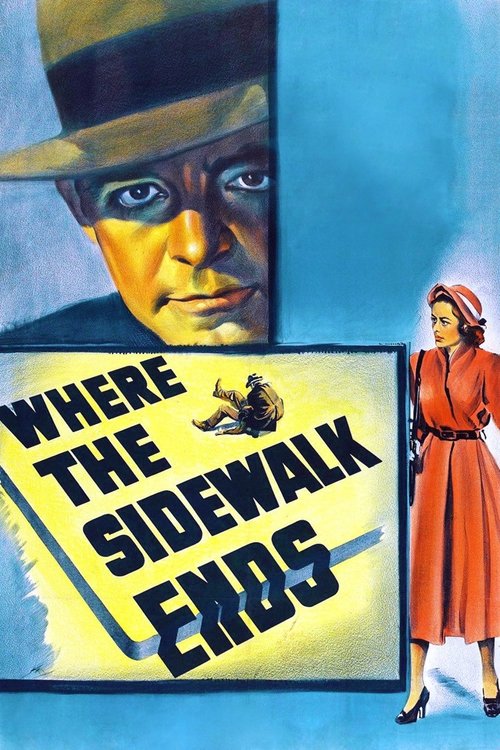
Where the Sidewalk Ends
1950 · Otto Preminger
For a late-night noir mood: when you want rain-slicked streets, terse dialogue, and a story about a compromised man digging himself deeper. A challenge dressed as a comfort — classic Hollywood craft around a genuinely dark center.
What it's about
A New York police detective with a brutal streak — and a chip on his shoulder about his criminal father — hits a suspect one time too many during a late-night interrogation. Instead of coming clean, he covers it up, and then has to work the resulting murder case himself while an innocent man drifts into the frame and he falls for a woman close to the dead man's world.
The experience
Tight, tense and morally queasy — you spend the film inside the sweat of a man investigating his own crime. It's fast and hard-boiled on the surface, with a current of guilt underneath that keeps twisting the screws.
Performances
Dana Andrews is remarkable precisely because he underplays it — a clenched, haunted stillness with violence right under the skin — while Gene Tierney brings warmth that makes his self-destruction hurt to watch.
The craft
Otto Preminger directs with cool, unblinking precision, reuniting his Laura team — including cinematographer Joseph LaShelle, whose shadowy New York interiors and night streets are textbook noir. The suspense comes from procedure itself: watching a cover-up assembled step by careful step, and watching it strain.
Why it matters
A high point of the 'rogue cop' cycle of postwar noir, it pushed the genre from crooked villains to compromised heroes and stands among Preminger's most admired studio-era films.
Snapshot
Where the Sidewalk Ends is Otto Preminger's dark, self-lacerating study of a police detective who kills a suspect with a single blow and spends the rest of the film trying to bury the act while an innocent man takes the blame. Produced and directed by Preminger for 20th Century-Fox, it reunited much of the creative team behind his breakthrough Laura (1944) — stars Dana Andrews and Gene Tierney, cinematographer Joseph LaShelle, and the Fox art and music departments — but redirected that glossy studio machinery toward a far bleaker vision. Where Laura was a romance embedded in a mystery, Sidewalk is a noir of conscience: its detective, Mark Dixon, is himself the criminal the plot pursues. The film belongs to the late-1940s/early-1950s wave of "rogue cop" and police-procedural noir, and it is among the most morally corrosive American crime films of its moment. It is frequently cited today as one of Preminger's strongest noirs and as a cornerstone of Dana Andrews's persona of hollowed-out, self-hating masculinity.
Industry & production
The film was made inside the 20th Century-Fox studio system at a point when Preminger held a director-producer position on the lot, giving him unusual control for a contract filmmaker. It was adapted from the novel Night Cry by William L. Stuart. The screenplay is credited to Ben Hecht — one of Hollywood's most prolific and highly paid screenwriters — with adaptation credited to Victor Trivas, Frank P. Rosenberg, and Robert E. Kent; Rosenberg is also associated with the production side. Hecht's involvement matters: his terse, cynical dialogue and his taste for characters trapped by their own compulsions suit the material, though the precise division of labor among the credited writers is, as with much studio-era screenwriting, difficult to reconstruct from the public record.
The production leaned on Fox's established craft departments — Lyle Wheeler's art direction, the studio's costume operation, and its music department under Alfred Newman's supervision. Preminger cast Dana Andrews and Gene Tierney as the leads, deliberately recalling Laura, and surrounded them with a strong character bench: Gary Merrill as the gangster Tommy Scalise, Karl Malden as a rival detective, and Tom Tully as the wronged cab driver Jiggs Taylor. The picture blends studio-built interiors with a semi-documentary interest in New York streetscapes characteristic of postwar Hollywood crime films, though the extent of genuine location shooting versus back-lot recreation should be treated with some caution absent detailed production records.
Technology
Technologically the film is a conventional late-studio-era black-and-white production: 35mm, Academy ratio (1.37:1), optical monaural sound. Its interest lies not in any novel apparatus but in the mature deployment of existing tools. By 1950 the American film industry had refined low-key black-and-white cinematography, faster panchromatic stocks, and compact lighting units to the point where the deep-shadow "noir look" could be achieved reliably on a studio schedule. Where the Sidewalk Ends is a product of that maturity — the expressive darkness on screen is a matter of lighting craft and film-stock latitude rather than experimental technique. The film predates the widescreen and color transformations that Fox itself would push only a few years later with CinemaScope; it is, in that sense, a late flowering of the classical monochrome idiom just before the industry's technological upheaval of the early-to-mid 1950s.
Technique
Cinematography
Joseph LaShelle, who had won the Academy Award for Laura, photographs the film in a hard, low-key register. Interiors are pooled with shadow, faces are frequently half-lit, and the nocturnal city is rendered as a maze of wet streets, doorways, and cheap rooms. LaShelle's camera favors deep, sculpted blacks and selective highlights rather than the softer glamour lighting of Laura, matching the descent of the material. The visual scheme repeatedly isolates Dixon within the frame — hemmed by architecture, caught in doorways and stairwells — so that the environment enacts his entrapment. This is classical noir photography executed at a high level of studio polish; its power comes from control and consistency rather than flamboyant camera movement.
Editing
Louis Loeffler, Preminger's frequent editor, cuts the film in the restrained, legible style that Preminger preferred. Preminger is well known for favoring the sustained take and fluid staging over aggressive montage, and the editing here serves that sensibility: scenes are allowed to play, and the cutting tightens principally around the film's violent turns and its procedural mechanics. The result is a picture whose tension accrues through dramatic situation and performance rather than through rapid cutting.
Mise-en-scène / staging
Staging is the film's signature strength, and it is where Preminger's authorship is most legible. He composes in depth, moving actors through the frame and letting the camera follow rather than chop the action into pieces. The apartments, precinct rooms, and gambling dens are dressed as lived-in, oppressive spaces, and Preminger uses the geography of these rooms — thresholds, corridors, the placement of a body — to dramatize Dixon's moral position. The single fatal punch, the concealment of the corpse, the movement of the investigation toward the wrong man: these are staged with a cool spatial clarity that makes the audience complicit in Dixon's calculations.
Sound
Cyril J. Mockridge composed the score (with Fox's music department under Alfred Newman). The scoring works in the idiom of period crime melodrama, underlining menace and the doomed romance without overwhelming the drama; Preminger generally preferred music used with restraint. Dialogue, in the Hecht mold, is clipped and hard. The soundscape of the nighttime city — traffic, rooms, the machinery of the precinct — contributes to the film's grounded, procedural texture.
Performance
Dana Andrews gives one of his defining performances as Mark Dixon: a coiled, inexpressive man whose violence is a symptom of self-hatred. Andrews's characteristic flatness — the sense of a face holding something back — is used to devastating effect, since Dixon spends the film performing innocence while carrying guilt. Gene Tierney, as Morgan Taylor, the estranged wife of the dead man and daughter of the accused, brings a wounded warmth that humanizes Dixon and gives the redemption arc its emotional stakes. Gary Merrill is genuinely threatening as the gangster Scalise, the object of Dixon's obsessive hatred; Tom Tully is sympathetic as the innocent cab driver; and Karl Malden, early in his screen career, registers strongly as a fellow detective. The ensemble sustains the film's tone of institutional realism shot through with private desperation.
Narrative & dramatic mode
The film's dramatic engine is dramatic irony sustained at feature length: the audience knows from early on that Dixon killed Ken Paine — a fact compounded by the detail that Paine, a war veteran, had a metal plate in his skull, so that a single blow proves fatal — and watches as the investigation, and Dixon himself, drive the accusation toward an innocent man. This inverts the classical detective structure. Instead of a sleuth pursuing an unknown killer, we have a killer pursuing (and manufacturing) a case against others while trying to escape his own act. The mode is confessional and fatalistic; the suspense is moral rather than merely procedural. The narrative resolves through confession and near-martyrdom: Dixon ultimately documents the truth and offers himself up, converting a story of concealment into one of expiation. That redemptive turn is characteristic of how Production Code–era noir reconciled transgression with moral accounting.
Genre & cycle
Where the Sidewalk Ends sits squarely within film noir and, more specifically, within the "rogue cop" or corrupt/violent-policeman cycle that gained force at the turn of the 1950s — a group of films preoccupied with brutality inside the law rather than outside it. It shares this territory with pictures built around detectives whose methods shade into criminality, and it anticipates the harder, more explicit police-corruption films of the decade. It also belongs to the postwar vogue for semi-documentary, city-set crime drama, with its precinct routines and location-flavored realism. Within Preminger's own filmography it forms part of a noir run that includes Laura, Fallen Angel (1945), Whirlpool (1949), and Angel Face (1953), and it is often paired specifically with Laura because of the shared personnel and the deliberate reunion of Andrews and Tierney.
Authorship & method
The dossier's clearest authorial signature is Preminger's. His method — objective, spatially fluid staging; long takes; a refusal to editorialize through overt technique; a cool moral ambivalence that lets the audience judge — is fully present here, in a more chastened key than his glossier work. Preminger's noirs tend to withhold easy sympathy, and Dixon is a textbook Preminger protagonist: neither hero nor simple villain, but a compromised man observed with detachment.
The key collaborators reinforce this: cinematographer Joseph LaShelle, whose low-key photography gives the film its oppressive surface and who links it visually to Laura; screenwriter Ben Hecht, whose hard, ironic sensibility shapes the dialogue and the fatalistic structure; editor Louis Loeffler, whose restrained cutting supports Preminger's preference for sustained scenes; and composer Cyril Mockridge, working within Fox's house style. The reunion of Andrews and Tierney is itself an authorial decision, using audience memory of Laura as an expressive resource — the romantic pairing now transposed into a far darker moral world.
Movement / national cinema
The film is a work of classical Hollywood, specifically of the American film noir tendency. Noir is best understood not as a formal movement with a manifesto but as a cycle or sensibility — a convergence of hard-boiled crime fiction, German Expressionist lighting traditions carried to Hollywood by émigré filmmakers, wartime and postwar disillusion, and studio economics. Preminger, himself a Central European émigré (Vienna-born, with roots in the Austro-German theater and the Hollywood studio system), embodies exactly the transatlantic lineage that gave noir its shadowed visual grammar. Where the Sidewalk Ends is thus a distinctly American picture inflected by European expressive traditions — a national cinema at its most self-critical, turning the crime film into a meditation on institutional violence.
Era / period
The film is a product of 1950, at the hinge between the wartime origins of noir and its bleaker, more institutional 1950s phase. Its concern with a veteran's fragility (Paine's war injury), with returning-soldier violence displaced onto a policeman, and with the machinery of urban law reflects the postwar American mood. It was made under the Production Code, whose requirement that crime be punished and moral order restored shapes the confessional ending. Industrially, it arrives just before the disruptions that would reorder Hollywood — the erosion of the studio system, the rise of television, and the shift to color and widescreen — making it a late, refined example of classical black-and-white studio filmmaking.
Themes
The film's central theme is the perilously thin line between the enforcer and the criminal. Dixon's defining wound is patrimonial: he is the son of a criminal and has built his identity on being the opposite of his father, only to discover that his rage makes him his father's heir. Guilt, inheritance, and the wish for expiation drive the narrative. Related themes include the corruption or brutality latent within institutions of law; the possibility (and the cost) of redemption through confession; and the redemptive, stabilizing role assigned to romantic love, embodied in Morgan. The film is unusually candid for its era about police violence as pathology rather than aberration, even as the Code-mandated resolution ultimately contains that critique within a framework of individual sin and atonement.
Reception, canon & influence
On its release the film was received as a competent, hard-edged Fox crime picture and a reunion of the Laura team; detailed contemporary box-office figures are not something I can reliably attest to here, and I will not invent them. Its critical stature has grown substantially over time. In later decades, as film noir was reassessed and canonized by critics and scholars, Where the Sidewalk Ends came to be regarded as one of Preminger's finest noirs and as a key entry in the corrupt-cop subgenre, valued for Dana Andrews's performance, LaShelle's photography, and its bleak moral vision.
Influences on the film (backward): it draws on hard-boiled American crime fiction (via the source novel and Hecht's sensibility), on the German Expressionist lighting tradition mediated through émigré Hollywood, on the postwar semi-documentary crime cycle, and on Preminger's own Laura, whose personnel, tone, and star pairing it consciously reworks.
Legacy (forward): the film helped consolidate the rogue-cop template — the officer whose violence makes him indistinguishable from the criminals he hunts — that recurs across subsequent decades of police thrillers. Its portrait of institutional brutality and guilt anticipates the harder police-corruption films of the 1950s and beyond, and it remains a touchstone in scholarship on Preminger, on Dana Andrews's screen persona, and on the moral pessimism of late classical noir. Its enduring reputation rests less on innovation than on the concentrated excellence with which it turns the machinery of the studio crime film against its own hero.
A Deleuzian reading
A man is hit once.
The full Deleuzian reading of Where the Sidewalk Ends →
Reception
In 1950 it landed as just another solid Fox crime picture — well-reviewed but overshadowed by Preminger's own Laura. Decades of noir scholarship have flipped that: it's now widely ranked among the great late-40s/early-50s noirs and often called one of Preminger's best films, full stop.
How Where the Sidewalk Ends was received, from release to now →
Influences: the films it descends from and the films it influenced
- Laura (1944) — The direct parent text: same Preminger–LaShelle–Andrews–Tierney unit, and Sidewalk deliberately reuses the Andrews/Tierney pairing and LaShelle's silken low-key key light as audience memory, transposing the romance into a darker register.
- Fallen Angel (1945) — Preminger's first pairing of Dana Andrews with LaShelle's oppressive low-key photography and his detached, non-editorializing camera observing a morally compromised protagonist — the template Sidewalk refines.
- M (1931) — The German Expressionist chiaroscuro and the structural conceit of blurring hunter and hunted — the police apparatus mirroring the criminal — that émigré Hollywood transmitted into Dixon's rogue-cop figure.
- Underworld (1927) — Ben Hecht's originating hard-boiled crime scenario, whose fatalistic underworld sensibility and ironic economy feed directly into the dialogue and doomed structure Hecht shapes here.
- Scarface (1932) — Hecht's clipped, ironic gangster idiom and his architecture of a violent man undone by his own nature — the writerly fingerprint carried into Sidewalk's fatalism.
- Double Indemnity (1944) — The inverted-detective / dramatic-irony machinery — the audience knows the crime and watches the guilty man conceal it while the net tightens — that governs Dixon's cover-up of an accidental killing.
- The Naked City (1948) — The postwar semi-documentary crime cycle's on-location New York realism and procedural texture that Sidewalk absorbs into its street-level milieu.
- Kiss of Death (1947) — Hecht's co-written Fox semi-documentary noir, sharing the studio, the location-shot procedural surface, and the ironic-fatalist voice that recur in Sidewalk.
- On Dangerous Ground (1951) — Extends the enforcer-criminal-line theme almost immediately after: a cop whose brutality makes him kin to the criminals he beats, structured around guilt and the possibility of expiation.
- The Big Heat (1953) — Consolidates the rogue-cop template Sidewalk helped set — the officer whose violence renders him indistinguishable from his prey — filtered through Lang's expressionist inheritance.
- Rogue Cop (1954) — A direct genre heir: the corrupt-cop noir foregrounding institutional brutality and the officer's slide across the line into criminality that Sidewalk dramatized.
- Touch of Evil (1958) — Pushes the corrupt-cop figure to its baroque limit — a policeman planting evidence and framing suspects — extending Dixon's evidence-manipulation and moral rot into full institutional decay.
- The French Connection (1971) — Marries the rogue-cop's sanctioned brutality to the semi-documentary location-shot New York realism, modernizing both craft strands Sidewalk fused.
- Dirty Harry (1971) — The late-classical distillation of the enforcer-criminal-line premise: a cop whose methods place him outside the law he enforces, the rogue-cop persona Andrews prototyped.
- Training Day (2001) — A contemporary terminus of the corrupt-cop lineage — the officer whose violence and evidence-tampering make him functionally a criminal — the moral machinery Sidewalk built turned on its own protagonist.
- Angel Face (1953) — Preminger applying the same cool, objective long-take staging and refusal of moral guidance to a guilt-and-death plot, withholding sympathy exactly as he does with Dixon.
- Panic in the Streets (1950) — A same-year noir built on the semi-documentary location-shooting method, pairing procedural realism with an expressionist night city in the manner Sidewalk shares.
- The Prowler (1951) — A policeman who kills and then abuses his badge to steer the investigation away from himself—the protector-as-predator manipulating official procedure—runs the same corrupt-cop mechanism a year before The Prowler.
Similar films
- Laura (1944) — influence & lineage · same viewing thread
- Touch of Evil (1958) — influence & lineage · same viewing thread
- The Big Heat (1953) — influence & lineage · same viewing thread
- Double Indemnity (1944) — influence & lineage
- The Naked City (1948) — influence & lineage
- Dirty Harry (1971) — influence & lineage
- The French Connection (1971) — influence & lineage
- M (1931) — influence & lineage · same viewing thread
All the films related to Where the Sidewalk Ends →
Watch it with: curated runs of related films
- The Long Shadow of M — A run from Lang's Weimar crime films through their noir and neo-noir children — killers, con men, masterminds, and manhunts — where you can watch expressionist menace mutate step by step into the modern thriller.