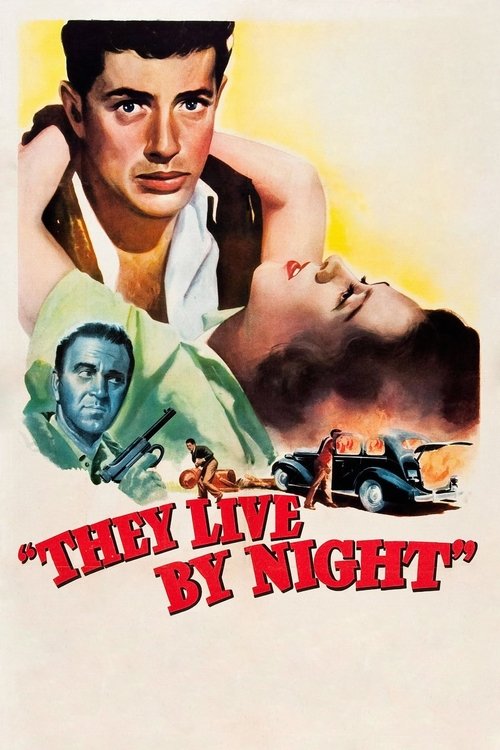
They Live by Night
1949 · Nicholas Ray
For a night when you want to feel something — a doomed romance to break your heart a little, best watched close and undistracted. More tender than tough, despite the guns.
What it's about
A young man who has been locked up since he was a teenager breaks out of a Southern prison with two older, harder career criminals. Hurt during a robbery, he's nursed back to health by Keechie, a gas-station girl as isolated and untried as he is, and the two fall into a first love neither has any map for. They marry and try to build an ordinary life — except the only money available to them comes from the very robberies that will keep them running.
The experience
Tender and doomed in equal measure — a love story where you feel the walls closing from the first scene, told with such intimacy that the crime picture around it almost disappears. It's quiet, aching, and it leaves a bruise.
Performances
Farley Granger and Cathy O'Donnell play the young couple with a rawness that feels almost painfully unguarded — two kids playacting at adulthood, and you believe every fumbling second of it.
The craft
Nicholas Ray's first feature announces a director instinctively on the side of his outcasts: the camera stays inside the fugitives' skin rather than watching them from a cop's distance, opening with a then-startling helicopter shot chasing the getaway car. Shadowy black-and-white photography turns motels and back roads into a whole hemmed-in world.
Why it matters
A foundational film of the lovers-on-the-run tradition that decades of outlaw-couple movies would draw from, and the debut that revealed Nicholas Ray as one of American cinema's great poets of the outsider.
Snapshot
Nicholas Ray's first feature is a fugitive romance told from inside the fugitives' skin. Adapted from Edward Anderson's 1937 Depression-era novel Thieves Like Us, it follows Arthur "Bowie" Bowers (Farley Granger), a young man imprisoned since adolescence for a killing he insists was not murder, who escapes a Southern penitentiary with two older career criminals, Chickamaw (Howard Da Silva) and T-Dub (Jay C. Flippen). Recuperating at a rural filling station, Bowie meets Keechie (Cathy O'Donnell), Chickamaw's niece; they marry, run, and try to establish a life on money that can only come from further robbery. The film's premise is romantic, its structure a slow closing of exits.
What distinguishes it is tone. Shot in 1947 at RKO under Dore Schary's regime, the film was withheld from American release until 1949 after Howard Hughes acquired the studio — reaching British screens first, in 1948, as The Twins Live by Night is sometimes misreported; the British release title was Your Red Wagon, taken from a song heard in the film. That delay is not incidental to its reputation: the picture arrived after the noir cycle's most concentrated years and after Ray's second and third features had been produced, so its status as a debut had to be reconstructed by later critics. Its influence, meanwhile, has been enormous relative to its modest first run: it inaugurated the American "lovers on the run" film as a distinct dramatic mode, and it announced the sensibility — tenderness toward the young, distrust of institutions, an architecture of doomed intimacy — that Ray would extend through In a Lonely Place, Johnny Guitar, and Rebel Without a Cause.
Industry & production
The project belongs to a specific and short-lived moment at RKO. Dore Schary, who came to the studio as head of production in 1947, favored socially conscious, moderately budgeted pictures made with new personnel, and it was under his auspices that Ray — a theater and radio man who had worked with Elia Kazan on A Tree Grows in Brooklyn — was given a feature. John Houseman produced. Houseman had known Ray since the Federal Theatre and Mercury Theatre orbit of the late 1930s, when Ray worked in the New York left-theater and folklore-collecting milieu around Alan Lomax; the Houseman connection is the concrete mechanism by which a director with no film-directing credit received one. Ray was in his mid-thirties, older than the typical first-timer, and arrived with a formed aesthetic rather than an apprenticeship in studio second units.
The Anderson novel had circulated in Hollywood before; RKO owned it under the working title Thieves Like Us, and the film was made under the title The Twisted Road before release as They Live by Night. Charles Schnee wrote the screenplay; Ray is credited with adaptation, and accounts of the production consistently describe him as closely involved in shaping the treatment, particularly in centering Bowie and Keechie's relationship rather than the gang's exploits. Anderson's novel is harder, more explicitly a proletarian document of the Depression Southwest; the film keeps the class fatalism but softens the criminality of its leads, in part under the constraints of the Production Code, which required that crime be seen to fail and that the couple's conduct be legible as innocent-in-essence. The marriage sequence — a fifteen-dollar ceremony performed by a justice of the peace who has clearly done this many times — is a Code-compatible way of making the couple's union sanctioned while remaining, socially, a transaction.
Then the industrial accident that defines the film's history: Howard Hughes purchased a controlling interest in RKO in 1948. Schary left; a large number of completed pictures were shelved, re-edited, or dumped. They Live by Night was among the casualties, sitting on the shelf and receiving its US release in 1949 with little promotional weight. The film's British release preceded it and, by most accounts, its critical reception there was warmer than the domestic response. The practical result is that Ray's debut was received in America as a minor programmer while his subsequent work was already in circulation — a sequencing that shaped decades of criticism, since the film could then be rediscovered as a key rather than absorbed as an announcement.
Budget and box-office figures for the picture are not securely documented in the standard sources; it was a modest RKO production and was not a commercial success, but precise numbers should not be asserted.
Technology
The film is a black-and-white 35mm Academy-ratio production of the late studio era, made with the standard RKO technical apparatus: nitrate stock, arc and incandescent lighting, optical printing for dissolves and titles, and post-synchronized dialogue where location or process work required it. Nothing in its manufacture is technologically exotic; what is notable is the use of a specific, then-recent capability — the helicopter-mounted camera.
The opening sequence, showing the escaped convicts' car fleeing across country, was shot from a helicopter, and this is the film's most frequently cited technical claim. It is often described as one of the earliest uses of helicopter aerial cinematography in an American fiction feature. The claim of absolute priority is not firmly established and should be treated with caution; what is defensible is that helicopter shooting was new to narrative features in 1947 and that Ray and cinematographer George E. Diskant exploited it for an effect that ordinary aerial platforms could not produce — a low, mobile, following shot that stays with a moving car at close range rather than surveying it from fixed-wing altitude.
The other relevant technology is negative: this is a studio picture that mostly declines location realism. Despite the semi-documentary vogue then running through crime films (The Naked City, Call Northside 777), They Live by Night is built substantially on sets and backlot, with process photography for driving. That choice matters aesthetically — the world outside the couple is deliberately somewhat unreal, a set of way stations rather than a mapped geography.
Technique
Cinematography
George E. Diskant, who would shoot On Dangerous Ground for Ray in 1951 and The Narrow Margin for Richard Fleischer, gives the film a chiaroscuro that is more romantic than punitive. The classic noir vocabulary is present — hard side-light, deep pools of shadow, faces half-erased — but Diskant and Ray apply it to lovers rather than to interrogations. Interiors in the cabins and tourist courts are lit as enclosures: light enters from a single practical source, the surrounding space falls away, and the couple is isolated in a small bright volume inside a dark room. The image itself performs the film's central idea, that the pair's world is very small and bounded by darkness on all sides.
The helicopter opening establishes the film's other visual register — motion across space, distance, pursuit. Between these two poles (enclosed intimacy and open flight) the film alternates almost schematically. Camera height is used expressively: Ray's later signature of low, wide compositions is already visible, and there are frequent frames in which the actors are placed low in the image with a heavy weight of ceiling, wall, or sky above them.
Editing
Sherman Todd's cutting is conventional in grammar and unconventional in emphasis. The robberies — the film's ostensible plot engine — are elided or truncated; the most significant heist is largely withheld, its violence registered afterward through consequence. The film instead spends its duration on waiting: on the intervals between crimes, in rooms, in cars, in the periods when nothing advances the plot but the relationship deepens. The result is a rhythm of long, becalmed passages punctuated by abrupt eruptions, which is precisely the temporal experience of the fugitive.
The film also opens with one of the most discussed devices in American cinema of the period: a prologue title superimposed over the couple, introducing Bowie and Keechie as "never properly introduced to the world we live in." The card functions as an editorial frame — it tells us the ending before the story begins, converting the film from suspense into elegy.
Mise-en-scène / staging
Ray's theatrical training shows in the blocking. Scenes are staged in depth with actors moving through and around furniture, and the physical relationship between bodies carries the dramatic information. The recurring motif is the enclosure: cabins, cars, motel rooms, a bus station, the back seats and front seats that separate the couple from their keepers. Ray repeatedly stages the two leads in postures of shelter — one curled toward the other, heads close, the frame tight — and then cuts to a wide shot that reveals how exposed the shelter is.
Objects do heavy work: the watch Bowie buys, the Christmas tree, the wedding certificate, the bus tickets. These are the props of a normal life being assembled out of stolen money, and Ray gives them the weight of ritual objects. The nightclub sequence where the marriage is transacted is staged as a small satire of commerce — neon, a canned ceremony, the pitiless efficiency of a business that sells sanctity.
Sound
Leigh Harline's score is romantic rather than nervous, a deliberate counterweight to the criminal material; it treats the couple lyrically and reserves dissonance for the outside world. The diegetic soundtrack does considerable narrative work — radio broadcasts, in particular, carry the outside world's version of Bowie into the couple's rooms, and the gap between the newspaper-and-radio "Bowie the Kid" and the young man on screen is one of the film's persistent ironies. The song "Your Red Wagon," heard in the nightclub sequence, was prominent enough to supply the British release title.
Performance
Farley Granger plays Bowie without hardness. He is boyish, easily hurt, and visibly out of his depth among the older criminals — a performance built on the absence of the qualities the genre usually demands of its leads. Cathy O'Donnell's Keechie is watchful, plain-spoken, and unsentimental; her flatness of affect reads as a defense rather than a limitation, and the film's tenderness is largely produced by the slow lowering of that guard. The two of them perform inexperience convincingly, which is the film's most necessary effect.
Around them, Howard Da Silva's Chickamaw and Jay C. Flippen's T-Dub supply weight and menace. Da Silva, playing a one-eyed alcoholic whose resentments are constantly on the edge of violence, gives the film its most conventionally noir presence, and his scenes with Granger are the sustained argument between the film's two possible futures for Bowie. Da Silva was among the performers later affected by the Hollywood blacklist, which contributed to his relative absence from screens in the following years.
Narrative & dramatic mode
The film is structured as a doomed idyll. The opening title forecloses the outcome; everything after is the audience watching two people build something they have been told will not last. This converts the ordinary machinery of the crime picture — will they get away with it? — into something closer to tragedy, where the interest lies not in outcome but in the quality of what is destroyed.
Narration is objective and largely restricted to the couple's knowledge, with the crucial exception of information that arrives via radio and newspaper — a device that lets the film show the couple learning what the world has decided about them. The dramatic mode is melodrama in the precise sense: a form organized around moral legibility and the suffering of the innocent, in which social forces are experienced as personal fate. Bowie's repeated insistence that he wants only to hire a lawyer and "square" himself is the film's tragic engine, because the audience understands from the first frame that no such legal route exists for him.
The film also declines the genre's usual moral accounting. Bowie is not punished for a crime we have watched him relish; the fatal information comes from a betrayal, and the ending arrives as a bureaucratic conclusion rather than a reckoning.
Genre & cycle
They Live by Night is a film noir by lighting and fatalism, but it belongs more precisely to two overlapping lineages. First, the Depression-outlaw-couple story, whose real-world referent is the Barrow gang and whose literary anchor is Anderson's novel — a strain also served by Fritz Lang's You Only Live Once (1937), which shares the premise of a man with a record who cannot escape it and a wife who runs with him. Second, the postwar noir cycle's turn toward youth and the socially determined criminal, which was running concurrently with the semi-documentary police procedural and against it.
Its distinctive contribution is the reorientation of the outlaw film around the couple's interiority rather than the gang's exploits. In most gangster and heist films of the period, romance is a subplot or a liability; here it is the subject and the crime is the subplot. This inversion is what later filmmakers took from it.
Authorship & method
Ray's authorship is legible in this first film to a degree that is unusual. The preoccupations that criticism would later organize into a career — sympathy for the young and unaccommodated, families that fail, institutions that offer no route back, architecture as emotional structure, an insistence on physical tenderness between characters — are all present. So is the working method: Ray came from theater and worked with actors on behavior and blocking rather than on line readings, and he had a documented interest, from his Lomax-adjacent folklore period, in vernacular American life and speech.
The collaborators matter. John Houseman as producer provided the institutional cover for a first-timer to work idiosyncratically; the two would work together again on On Dangerous Ground. Charles Schnee's screenplay is efficient and unshowy, and Schnee went on to a substantial career including The Bad and the Beautiful. George E. Diskant's photography is the film's most consequential technical contribution, and their reunion on On Dangerous Ground — another film alternating between hard urban dark and open landscape — suggests a genuine understanding. Leigh Harline, a Disney-trained composer, brings a melodic sweetness that a more conventional noir composer would not have supplied, and that sweetness is essential to the film's effect. Sherman Todd edited.
Movement / national cinema
The film sits inside classical Hollywood but with unmistakable outside inputs. Ray's formation in the Depression-era American left — theater collectives, the Federal Theatre Project, folk-music documentation — connects the picture to a 1930s social-realist tradition that had largely been driven out of overt expression by 1947. The film's sympathy is structurally leftist even where its content is Code-compliant: the criminals are products of poverty and prison, the banks are not sympathetic, and the institutions that pursue Bowie are impersonal rather than righteous.
At the same time, the visual style participates in the transatlantic exchange that produced film noir — German expressionist lighting practice mediated through émigré cinematographers and directors and combined with American hard-boiled material. Diskant was American, and the film's noir vocabulary is a native, thoroughly assimilated version of that inheritance rather than a direct import.
Era / period
The film is set in the Depression and made in the immediate postwar. That double dating matters. As a Depression story, it belongs to the era of bank robbery as folk narrative, of men made criminal by unemployment, of a South and Southwest of filling stations and tourist camps. As a 1947 production, it registers a different anxiety: the postwar return of young men who had been institutionalized (by prison here, by the military in its contemporaneous analogs) and who could not readily be reabsorbed into domestic life. Bowie has been inside since he was a teenager and has no experience of the ordinary world; the film's most persistent emotion is the disorientation of someone trying to learn adulthood from scratch, in flight.
Its release into 1949 placed it at the moment when the noir cycle was hardening and the blacklist was reshaping who could work — a context in which the film's uncomplicated sympathy for its outlaws reads as slightly out of time.
Themes
Innocence without a world to be innocent in. The prologue's framing — a young couple never properly introduced to the world — is the film's thesis. Bowie and Keechie are not corrupted; they are unassimilated. Their crime is less moral than social: they have no legitimate place to occupy.
The unavailability of ordinary life. Everything the couple wants is small and conventional: a house, a job, a lawyer, a Christmas tree. The film's cruelty is that these are precisely what cannot be purchased with the only currency available to them.
Institutions as impersonal machinery. Prison, the police, the law, and even the businesses the couple deals with (the marriage racket, the tourist courts, the used-car lots) are transactional and indifferent. There is no villain in the film who is not either a criminal driven by need or a system operating without malice.
Publicity as a second imprisonment. Radio and newspaper accounts create "Bowie the Kid," a figure the actual Bowie cannot escape or correct. The gap between the media persona and the young man is a recurring source of pathos and one of the film's most modern ideas.
Shelter and exposure. Formally and thematically, the film alternates between enclosure and flight, and it consistently shows enclosure as illusory. Every room is temporary.
Reception, canon & influence
Critical reception. The film's American release in 1949 was thin and its commercial performance poor; contemporary US notices were respectful but did not identify it as major. Its British reception, following the earlier UK release, was notably warmer, and British critical attention helped keep the film's reputation alive. The decisive shift came from French criticism in the 1950s: Ray became a central figure for the Cahiers du cinéma writers, and They Live by Night was read retrospectively as the origin point of a coherent authorial project. Jean-Luc Godard's admiration for Ray is well documented, and the general Cahiers elevation of Ray as an auteur is one of the clearest cases of the policy's effect on an American reputation. Subsequent Anglophone criticism — including the sustained attention Ray received in the 1970s and after, and the scholarly and archival work that culminated in restorations and a Criterion Collection edition — has consolidated the film's canonical standing.
Influences on the film (backward). Edward Anderson's novel is the direct source. Behind it stands the Bonnie-and-Clyde material of the early 1930s and the broader Depression outlaw folklore that Ray had encountered in his folk-song and left-theater years. Cinematically, Fritz Lang's You Only Live Once (1937) is the essential precursor — the same structure of a man who cannot escape his record, the same fugitive couple, the same fatalism — and Lang's film had already established the moral shape that Ray refined. The noir photographic idiom the film inherits comes from the mid-1940s crime cycle at RKO and elsewhere.
Legacy (forward). The film's influence runs in two channels. The first is direct: Anderson's novel was filmed again by Robert Altman as Thieves Like Us (1974), a version closer to the book's Depression texture and explicitly in dialogue with Ray's picture. The second is diffuse and much larger. They Live by Night is routinely identified as the founding American instance of the lovers-on-the-run film, and its structure — young couple, prologue of doom, alternation of tenderness and violence, romance as the subject rather than the ornament — underwrites Gun Crazy (1950), Bonnie and Clyde (1967), Badlands (1973), and a long subsequent line running through Sugarland Express, Wild at Heart, and True Romance. The New Hollywood generation's habit of building crime films around sympathetic, socially stranded young people is difficult to trace without passing through this film.
Its influence on Ray's own work is equally clear. Rebel Without a Cause (1955) is in many respects the same film relocated: the adolescent who cannot find a place in the adult world, the improvised family formed by outsiders, the tenderness that the surrounding society cannot accommodate. That continuity is the strongest argument for treating They Live by Night not as a promising debut but as a fully formed statement that its director spent a career elaborating.
A Deleuzian reading
The film opens in the air.
The full Deleuzian reading of They Live by Night →
Reception
RKO shelved it for nearly two years after Howard Hughes took over the studio, and it slipped out in the US in 1949 with little fanfare — but British critics had already championed it after its 1948 London opening, and the Cahiers du Cinéma crowd later made Nicholas Ray a cause. Godard's line 'Nicholas Ray is cinema' sealed the reappraisal, and it's now a Criterion-canonized debut.
How They Live by Night was received, from release to now →
How to watch They Live by Night: what to notice on a first viewing
- Watch the title card that appears before the story even begins. A written prologue introduces Bowie and Keechie as never properly introduced to the world, telling you their fate before the plot starts. You spend the whole film watching two people use up time you already know is limited.
- Watch for rooms lit by a single lamp, dark around the edges. Diskant lights the cabins and tourist courts from one practical source, so the couple sits in a small bright volume with the rest of the room falling into black. The light itself makes their world small and surrounded, before the story says so.
- Listen for radio broadcasts about Bowie playing inside their own rooms. News reports describe a "Bowie the Kid" that the couple hears alongside us, a public version of him neither Bowie nor Keechie recognizes. The radio shows how the outside world writes Bowie's story before he can.
- Notice how often the couple sits boxed inside cars or rooms. Ray keeps staging Bowie and Keechie inside enclosures, cabins, cars, motel rooms, a bus station, and then cuts to a wide shot revealing how exposed that shelter really is. Shelter in this film is always shown to be provisional, one cut away from being undone.
- Watch for the robbery you never actually see happen onscreen. The film's biggest heist is withheld entirely; its violence registers afterward only through what it costs the men involved. The crime that should be the plot's center is skipped, so what remains is only its human cost.
The whole guide to watching They Live by Night, with the keys for a rewatch →
Influences: the films it descends from and the films it influenced
- Man's Castle (1933) — Borzage's shack-as-sanctuary — poor lovers enclosed in a single lamp-lit room, their domestic props (stove, curtain, ring) treated as sacraments — is the template for Ray's motor-court and cabin interiors and his ritual objects, the $20 wedding and the watch.
- You Only Live Once (1937) — Lang withholds the bank robbery itself — rain, a gas mask, a newspaper front page — and fixes the couple's fate before the story starts; Ray takes both the elided-heist grammar and the fore-announced doom that his prologue title card makes explicit.
- The Grapes of Wrath (1940) — Gregg Toland's motivated single-source lighting (lantern, headlamp, bare bulb) at low camera height in cramped Depression interiors is the naturalist photographic template George E. Diskant adapts for the fugitives' rented rooms.
- Citizen Kane (1941) — Transmitted directly through producer John Houseman: the Mercury habit of staging in receding depth within ceilinged interiors, actors blocked across planes rather than covered in singles — the method Ray, also out of the theater, uses for the cabin and hotel scenes.
- Out of the Past (1947) — Nicholas Musuraca's RKO house idiom — chiaroscuro keyed to one visible practical lamp, with faces half-surrendered to black — plus the small-town idyll the past inevitably invades, is the exact romantic register Diskant inherits at the same studio a year later.
- Desperate (1947) — Shot by George E. Diskant a year before Ray hired him: the swinging-lamp beating scene proves Diskant's willingness to light strictly from sources inside the set, and its newlywed-couple-on-the-run structure is the immediate RKO dry run for Ray's film.
- The Postman Always Rings Twice (1946) — Carries forward the doomed-lovers-as-criminal-couple template Postman cemented, treating the romance itself as the tragic mechanism that drives them toward death.
- High Sierra (1941) — Ray extends the two-romances-as-futures device — an outlaw offered a domestic life he is structurally barred from entering — and keeps the fatalist coda in which the woman survives to pronounce the film's last word over the man's body.
- Gun Crazy (1950) — The opposite solution to the same problem: where Ray cuts away from every robbery, Lewis shoots the Hampton bank job in one unbroken take from the back seat of the getaway car — both films subordinating the crime to the couple who commit it.
- In a Lonely Place (1950) — Ray continues using architecture as emotional structure — the courtyard apartment's windows and thresholds stage the romance's weather — and keeps directing actors on behavior and blocking rather than line readings.
- Rebel Without a Cause (1955) — The same film relocated: the improvised family of outsiders, the temporary sanctuary (deserted mansion for motor court), and the low-wide composition scaled to CinemaScope so the young are staged horizontally in depth against adult space.
- Breathless (1960) — Godard, whose Cahiers circle canonized Ray, keeps the criminal act elliptical — the cop's shooting shredded by jump cuts — and gives the film's center to the couple's enclosed hotel room, Ray's proportion of tenderness over plot.
- Bonnie and Clyde (1967) — Opens with sepia stills and biographical title cards that foreclose the ending before the first scene — Ray's prologue-of-doom device — and keeps the romance, not the crime spree, as the actual subject of the film.
- Badlands (1973) — Sissy Spacek's affectless magazine-prose narration is the direct extension of Cathy O'Donnell's flat affect, and the treehouse interlude rebuilds Ray's enclosure idyll as a place the world will inevitably come to dismantle.
- Thieves Like Us (1974) — Same Edward Anderson novel, and Altman drops the orchestral score entirely in favor of period radio — Gangbusters, a Romeo and Juliet broadcast over the love scene — expanding Ray's diegetic radio bulletins into the film's whole sound design.
- The Sugarland Express (1974) — Vilmos Zsigmond's anamorphic car-interior two-shots hold the couple in a moving enclosure while aerial coverage tracks the convoy — Ray's pairing of confined intimacy with an omniscient overhead vantage, and the same fatality announced in advance.
- Wild at Heart (1990) — Lynch keeps the fugitive lovers in motel-room enclosures scored by diegetic radio and record players, and preserves Ray's alternation: sustained tender two-shots between abrupt, unornamented eruptions of violence.
- Ain't Them Bodies Saints (2013) — Bradford Young lights interiors from one window or lamp at magic hour in the Diskant/Musuraca manner, the robbery that sets the plot going is elided completely, and the outlaw's return is declared hopeless in the opening minutes.
- Johnny Guitar (1954) — Ray's own founding text of lyrical sympathy for doomed outsider lovers hunted by a respectable society, the authorial signature carried forward into Vienna and Johnny.
- Ariel (1988) — Ray's tender noir of a criminal couple fleeing on the road supplies the picaresque road-movie chassis and the sympathy-for-the-marginal that Ariel grafts onto its social realism.
- Side Street (1950) — MGM reunites Farley Granger and Cathy O'Donnell as the same doomed young couple and opens with a descending aerial over Manhattan — a direct appropriation of both Ray's casting chemistry and his helicopter prologue.
- On Dangerous Ground (1951) — Reunites Houseman as producer and Diskant as cinematographer; Diskant repeats the headlight-and-lantern single-source night work, and Ray repeats the movement from suffocating enclosure to open landscape as the shape of the whole picture.
- Dark Passage (1947) — Ray's aerial-shot opening observes the fugitive couple from a surveillance distance that registers their spatial vulnerability in real geography; the film shares Dark Passage's grammar of location-as-procedural-pressure rather than studio expressionism as the primary instrument of nocturnal anxiety.
- The Lusty Men (1952) — Ray's own earlier film establishes his method of building scenes from behavior and environment around an itinerant couple, privileging the outsider-longing-for-home undercurrent over plot mechanics.
Similar films
- In a Lonely Place (1950) — influence & lineage
- Out of the Past (1947) — influence & lineage
- Bonnie and Clyde (1967) — influence & lineage
- Leave Her to Heaven (1945) — shared sensibility
- Scarlet Street (1945) — shared sensibility
- Rear Window (1954) — shared sensibility
- Badlands (1974) — shared sensibility
- Daybreak (1939) — shared sensibility