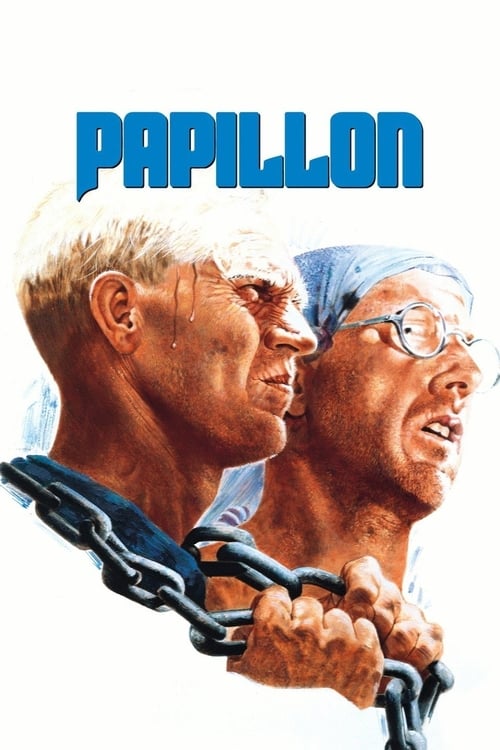
Papillon
1973 · Franklin J. Schaffner
For when you want a big, old-fashioned survival epic to sink into for an evening — something that tests its hero and leaves you moved by sheer human stubbornness. Settle in; it takes its time and rewards the commitment.
What it's about
Henri 'Papillon' Charrière, a Parisian safecracker convicted of a murder he swears he didn't commit, is shipped to the brutal penal colonies of French Guiana. There he forms an unlikely alliance with Louis Dega, a meek counterfeiter with money hidden on his person and enemies everywhere, trading protection for escape funds. Across years of hard labor, solitary confinement, and exile to the wave-battered Devil's Island, Papillon keeps doing the one thing the system is built to crush: trying to get out.
The experience
A long, physically punishing epic that makes you feel every year of confinement — grueling stretches of deprivation punctuated by surges of desperate hope. It's an endurance test that earns its emotion, and the friendship at its center sneaks up on you.
Performances
Steve McQueen gives one of his most committed performances, letting his star cool crack open into genuine physical and spiritual desperation, while Dustin Hoffman disappears into the myopic, calculating, quietly loyal Dega. Their odd-couple bond is the film's beating heart.
The craft
Franklin J. Schaffner directs on a massive physical scale — real jungles, real surf, real sweat — and Jerry Goldsmith's wistful score gives the brutality an unexpected tenderness. The location shooting has a tactile misery no soundstage could fake, and it plays best big, where the isolation of Devil's Island feels truly vast.
Why it matters
Adapted from Henri Charrière's blockbuster memoir at the peak of both stars' fame, it became a defining prison-escape epic and a touchstone for every survival story about the unbreakable will to be free.
Snapshot
Papillon is a two-and-a-half-hour epic of imprisonment and endurance, adapted from Henri Charrière's blockbuster 1969 memoir of the same name. It follows Henri "Papillon" Charrière (Steve McQueen), a Parisian safecracker transported to the French penal settlements of Guiana for a murder he insists he did not commit, and his repeated, escalating attempts to escape across years of hard labor, solitary confinement, and exile to the surf-battered Île du Diable (Devil's Island). His unlikely alliance with Louis Dega (Dustin Hoffman), a myopic, banknote-forging embezzler who buys protection with hidden money, forms the film's emotional spine. Directed by Franklin J. Schaffner at the height of his prestige — fresh from Patton (1970) — and scored by Jerry Goldsmith, the film is at once a star vehicle, a physically punishing survival drama, and a stoic meditation on freedom as an act of will. It sits in the early-1970s tradition of the serious, adult, location-shot Hollywood epic, and it is remembered above all for McQueen's near-wordless performance of physical deterioration and for its final image of defiance.
Industry & production
Papillon was a large, internationally financed production mounted around two of the most bankable American stars of the era. It was produced by Robert Dorfmann (a French producer with a strong European base) together with Schaffner himself, and released in the United States by Allied Artists, with Columbia handling much of the international distribution — a somewhat unusual arrangement that reflected the film's cross-border financing. The source material offered enormous pre-sold value: Charrière's memoir had been a publishing sensation in France and then internationally, selling in the millions, which gave the project both prestige and built-in recognition.
The production was expensive and logistically demanding by early-1970s standards, staged largely on location in Spain and in Jamaica, where full penal-colony sets — barracks, fortress walls, the isolation blocks — were constructed to stand in for French Guiana. The shoot was known to be arduous, with the cast subjected to heat, water work, and the physical demands of scenes depicting starvation and confinement. McQueen and Hoffman were both paid at the top of the market; contemporary reporting placed McQueen's fee among the highest of the day, though I would treat any single precise figure with caution rather than assert one as fact. The film's budget was widely described as one of the costlier undertakings of its moment; I won't attach a specific dollar figure, as the reported numbers vary. On release the film was a substantial commercial success, a point on which the historical record is consistent even where exact grosses are not worth stating with false precision here.
Technology
Papillon is a photochemical 35mm color production of its period, shot on location in widescreen and finished for large-format roadshow-style exhibition. It relies on the mature technologies of early-1970s Hollywood rather than any novel apparatus: color negative stock, location sound supplemented by extensive post-synchronization, and optical/mechanical effects for its set-piece moments (the storm surf, the leap from the cliff at the finale). The most demanding "technology" of the film is arguably its practical set construction and water work — the fortress and island environments were physically built and physically weathered rather than simulated. I'll note honestly that the specific camera and lens system is a detail I would want to verify before asserting; the film's compositions are handsomely widescreen, but I won't claim a particular anamorphic or spherical process without confirmation.
Technique
Cinematography
Fred J. Koenekamp's photography is the film's great sensory achievement. He renders the penal colony as a place of oppressive, sun-bleached openness — long horizons, hard tropical light, the ocean as both promise and wall — and then compresses that expanse into the crushing verticality and near-total darkness of the solitary cells. The contrast is thematic as much as pictorial: freedom is coded as light and distance, punishment as blackness and enclosure. Koenekamp shoots the isolation sequences so that a single shaft of light, or the small grille through which food arrives, becomes an event. In the exteriors he lets the environment dwarf the men, staging escape and pursuit against jungle, river, and surf so that nature itself reads as the true warden.
Editing
Cut by Robert Swink — a longtime collaborator of directors including William Wyler — the film moves with a deliberately unhurried, accumulative rhythm suited to a story measured in years rather than days. Time is the film's real subject, and the editing communicates duration: the solitary sequences in particular are structured to make the audience feel attrition, using ellipsis to jump across months while lingering on the physical toll. The escape set-pieces are cut for clarity and suspense rather than modish fragmentation, in keeping with Schaffner's classical instincts.
Mise-en-scène / staging
Schaffner stages Papillon as a series of enclosures that the protagonist must repeatedly test and breach: the transport ship, the labor gangs, the infirmary, the isolation block, the leper colony, the island. The production design emphasizes texture — stone, rust, sweat, rot — so that the settings register as lived-in and punishing. Blocking often isolates Papillon within the frame even when surrounded by men, underscoring the interiority of his resistance. The recurring motif of the butterfly (papillon) — tattooed on Charrière's chest, invoked in dream imagery — is woven visually into a film otherwise committed to grinding realism.
Sound
The soundscape alternates between the clamor of the colony (labor, surf, insects, the machinery of the prison) and the near-total silence of solitary, where the absence of sound becomes a form of torture. Against this, Jerry Goldsmith's score supplies the film's lyrical counterweight — see Authorship & method below — its melody recurring as a memory of a freedom the images rarely grant.
Performance
The film is anchored by a deliberate contrast of acting styles. McQueen, an actor famous for economy and stillness, delivers what is arguably his most physically committed performance: he registers years of deprivation through posture, gauntness, and diminishing vitality, carrying long stretches with minimal dialogue. His Papillon is defined not by eloquence but by an animal refusal to be broken. Hoffman, by contrast, works in a more mannered, detailed register — the stooped walk, the thick spectacles, the fastidious survivalism of Dega — creating a character whose cowardice and cunning slowly deepen into loyalty and, finally, resignation. The friendship between the two men is built almost entirely through performance and staging rather than expository dialogue.
Narrative & dramatic mode
Structurally, Papillon is episodic and cumulative: a survival-and-escape chronicle organized around successive confinements and breakouts rather than a single tight arc. Its dramatic mode is stoic and existential. The film withholds conventional catharsis; escape attempts fail, recaptures follow, and the passage of time is registered on the body. The central question is not whether Papillon is guilty (the film accepts his claim of innocence largely on his own terms) but whether he can preserve an inner freedom the state is determined to extinguish. The famous dream-tribunal — in which Papillon is charged not with murder but with "a wasted life" — makes the film's real theme explicit: survival as the one verdict he can refuse to accept. The ending, with its leap into the sea and its cry of persistence, resolves the film on an affirmation of will rather than a tidy triumph.
Genre & cycle
The film belongs to the prison and escape genre, and specifically to its more brutal, penal-colony variant — a lineage that runs through works about incarceration and human endurance under a total institution. It also functions as a survival drama and, in scale and ambition, as an adult prestige epic of the kind Hollywood still made in the early 1970s. It sits alongside the era's cycle of serious, star-driven, morally weighty pictures adapted from major books, and it can be read against the period's broader anti-authoritarian mood, in which institutions — here the French carceral state — are figured as machinery for grinding down the individual.
Authorship & method
Director — Franklin J. Schaffner. Schaffner was, by 1973, a director associated with large-canvas, intelligent spectacle: Planet of the Apes (1968), the Oscar-winning Patton (1970). His method favored classical clarity, physical location work, and a restrained handling of star performance — an approach well suited to a story that needed to feel endured rather than staged. Schaffner's authorial signature here is patience: he trusts duration, landscape, and the actors' bodies to carry meaning.
Screenwriters — Dalton Trumbo and Lorenzo Semple Jr. The screenplay adapts Charrière's memoir, with Semple (a versatile screenwriter of the period) and Trumbo credited. Trumbo — one of the formerly blacklisted "Hollywood Ten," by then fully rehabilitated — brings a humane, disillusioned sensibility to the material, and he appears on screen in a cameo as the penal colony's commandant, a small but pointed presence given his own history as a man persecuted by the state. The adaptation compresses and dramatizes the sprawling episodes of the book into a shaped two-man story.
Cinematographer — Fred J. Koenekamp. (See Cinematography.) His work on the film's light-and-dark scheme is central to its meaning.
Composer — Jerry Goldsmith. Goldsmith's score is among the film's most celebrated elements. Built around a plaintive, waltz-inflected principal theme, it supplies lyricism and memory against the harshness of the images, and it earned an Academy Award nomination — a fact I state with confidence, while noting I would verify the exact category and any win/loss before asserting outcomes. The theme has endured well beyond the film as one of Goldsmith's signature melodies.
Editor — Robert Swink. (See Editing.)
Movement / national cinema
Papillon is an American studio-era production in its craft and stars, but a genuinely transnational one in its financing, its French producer, and above all its subject: it is a story of the French penal system, drawn from a French memoir, filmed by an American director with American stars for a global audience. It belongs less to any avant-garde movement than to the mainstream of "New Hollywood"-adjacent prestige filmmaking — a cinema still fluent in the classical epic idiom even as the surrounding culture had turned skeptical of institutions and authority.
Era / period
The film is a product of the early 1970s, when Hollywood was balancing the ambitions of the New Hollywood generation against the durable appeal of star-driven, large-scale storytelling. Its unsentimental depiction of state cruelty, its refusal of easy heroism, and its interest in the individual crushed by a system all resonate with the post-1960s, post-Watergate-era distrust of institutions, even as its scale and craftsmanship look back to the roadshow epics of the preceding decade. The presence of Trumbo, both as writer and cameo, quietly threads the film to an earlier American trauma of political persecution.
Themes
The dominant theme is freedom as an interior condition that no institution can fully confiscate — the conviction that the self persists even when the body is starved and the years are stolen. Related to this is endurance and the will to survive, dramatized through Papillon's serial refusals to accept confinement. The film also explores loyalty and improbable friendship, in the Papillon–Dega bond that outlasts self-interest, and the corrosive machinery of punishment, presenting the penal colony as a system designed less to reform than to erase. The recurring dream-motif of a "wasted life" reframes the story as a trial of meaning: the one charge Papillon will not plead guilty to is the squandering of his own existence. The butterfly emblem gathers all of this into a single image — fragile, mobile, bent on flight.
Reception, canon & influence
Papillon was a major commercial release and remains one of the best-known prison films of its decade, sustained in popular memory by McQueen's performance, Goldsmith's theme, and its defiant closing image. Critical reception in its own time was, by most accounts, respectful but not uniformly rapturous — the film's length and grimness drew some resistance even as its ambition, craft, and central performances were widely praised. I'll flag candidly that the fine grain of individual period reviews is something I would confirm against the record rather than characterize too confidently; what is secure is that the film registered as a serious, high-profile release and that Goldsmith's score in particular was singled out for honor.
Its influences run backward to Charrière's memoir and the long literary and cinematic tradition of prison-escape and penal-colony narratives, and to Schaffner's own prior epics, which established his facility with scale and endurance-as-subject. It is worth noting that the historical authenticity of Charrière's account has been questioned by scholars and journalists, who have suggested he absorbed other prisoners' experiences into his first-person tale — a complication the film largely sets aside in favor of dramatic truth.
Forward, the film's legacy is threefold: it stands as a defining entry in the survival/escape genre and a touchstone for later prison dramas; it preserves one of McQueen's most respected performances, frequently cited in reassessments of his range beyond the "cool" star persona; and it kept Charrière's story in wide circulation, so much so that the property was revisited in a 2017 remake — evidence of the original's durable hold on the popular imagination. Goldsmith's theme, meanwhile, has had an independent afterlife in concert and recording, outlasting the specifics of the plot as a piece of enduring film music.
Reception
Critics in 1973 were lukewarm — many found it long and punishingly grim — but audiences made it one of the year's biggest hits, and it has since settled in as a towering prison-escape epic and one of Steve McQueen's most admired performances.
How Papillon was received, from release to now →
How to watch Papillon: what to notice on a first viewing
- Watch how the film lights the cells against the outdoors. Koenekamp shoots the colony in hard tropical sun with long horizons. Then he drops the solitary block into near-total darkness where a shaft of light or the grille that food arrives through becomes the only event in the frame. Freedom is coded as light and distance and punishment as blackness and stone, so you can read a man's situation from the exposure.
- Watch McQueen's posture and weight rather than his dialogue. He carries long stretches with almost nothing to say, and plays the years through stance, gauntness and a draining vitality. Hoffman works the opposite way, all detail, stooped walk and thick spectacles and fastidious calculation. Two acting methods carry the friendship, so the bond is built in bodies and never explained in a speech.
- Notice how the film marks months and years going by. Swink cuts for accumulation rather than pace. Ellipses jump across long stretches, and then the film slows to sit with the physical cost of what was skipped. The escape sequences stay classically clear. Time is the antagonist here, and the editing makes you feel attrition instead of telling you how long it has been.
- Listen to what you can hear inside the solitary block. Outside there is constant clamor, labor, surf, insects, machinery. Inside there is almost nothing. Goldsmith's waltz theme arrives against that quiet as the one lyrical thing in the film. Silence works as a punishment you can hear, and the melody keeps returning as a reminder of what the images will not give.
- Count the different enclosures the film moves him through. Transport ship, labor gang, infirmary, isolation block, leper colony, island. Schaffner builds the film as a series of containers to be tested, and blocks Papillon alone in the frame even when men surround him. The structure is architectural. Each new place is another wall, and his separateness inside a crowd is the shape of his resistance.
The whole guide to watching Papillon, with the keys for a rewatch →
Influences: the films it descends from and the films it influenced
- A Man Escaped (1956) — Established the ascetic escape-procedural where confinement is rendered through offscreen sound — scraping spoons, jangling keys, distant footsteps — a sound-as-cell grammar Papillon reworks in its silence-as-torture solitary sequences.
- Le Trou (1960) — Its patient, near-real-time attention to the physical mechanics of an escape — tunneling, timing, improvised tools shot in unbroken duration — models Papillon's editing that trusts process and endurance over montage compression.
- Grand Illusion (1937) — Codified the prison-escape film as a humanist study of contrasting captive temperaments (aristocrat vs. commoner), the dyadic-prisoner dynamic Papillon inherits in the McQueen/Hoffman pairing of survivor and fragile intellectual.
- I Am a Fugitive from a Chain Gang (1932) — Pioneered the penal-system-as-indictment escape chronicle with its unresolved, defiant fade-out on an unbroken man, a template Papillon echoes in its refusal-of-defeat closing image on the raft.
- The Bridge on the River Kwai (1957) — Supplied the widescreen tropical-labor-camp endurance epic where a single man's obstinacy structures the film, giving Schaffner the location-scale-plus-obsession model for the penal colony.
- Birdman of Alcatraz (1962) — Its study of decades of confinement dramatizing interior freedom through a contained, aging star performance directly anticipates Papillon's theme of the mind outlasting the cell across years in solitary.
- The Great Escape (1963) — Built the McQueen star-text of laconic, physical, unbreakable defiance and the episodic ensemble-escape structure that Papillon retools into a two-man survival chronicle.
- Cool Hand Luke (1967) — Fused existential-stoic defiance with visible bodily punishment and penal-labor imagery, establishing the unbreakable-individual-vs-institution register Papillon extends to physical deterioration as heroism.
- Spartacus (1960) — Dalton Trumbo's screenplay here forged the humane, state-defying prisoner-hero voice that he carries into Papillon, where the persecuted-by-the-state sensibility (and his commandant cameo) is a signature debt.
- Planet of the Apes (1968) — Schaffner's own prior film pairs location-widescreen endurance with a Jerry Goldsmith score and a bleak, image-driven final revelation — the exact craft package (Goldsmith, landscape, defiant closing shot) reassembled in Papillon.
- Patton (1970) — Reunited Schaffner with cinematographer Fred Koenekamp and composer Goldsmith on a classically-clear, patient one-man character epic, the immediate stylistic and collaborator blueprint carried directly into Papillon.
- Midnight Express (1978) — Extends Papillon's foreign-penal-hell and solitary-confinement horror, using silence, isolation and psychological breakdown as torture in a way that reads as a direct post-Papillon intensification.
- Escape from Alcatraz (1979) — Revives the meticulous, near-wordless escape procedural anchored by a contained star body (Eastwood), reasserting the process-and-patience craft Papillon shares with Bresson and Becker.
- The Shawshank Redemption (1994) — Carries forward the decades-spanning prison endurance chronicle built on interior freedom and a friendship of contrasting men, resolving on the same escape-into-open-water liberation image.
- Rescue Dawn (2006) — Pushes the jungle-captivity survival chronicle into extreme actor physical deterioration and location hardship, extending Papillon's use of the body's decline as the film's principal dramatic evidence.
- Papillon (2017) — A direct remake of the same Charrière memoir that re-stages the enclosure motif, solitary silence, and butterfly emblem, confirming the original's durable craft template.
- A Twelve-Year Night (2018) — Codifies the solitary-confinement endurance film in which sensory deprivation tips into subjective hallucination, the durational 'survival of self' architecture that structures each prisoner's isolated collapse and recovery.
- Hunger (2008) — Radicalizes silence-as-torture and the deteriorating body-in-the-cell as political statement, taking Papillon's enclosure motif and bodily-suffering-as-defiance to a formally austere extreme.
- The Revenant (2015) — Foregrounds the location-driven physical ordeal in which an actor's real bodily suffering in unforgiving landscape becomes the film's subject, sharing Papillon's endurance-as-cinema ethos.
Similar films
- Le Trou (1960) — influence & lineage · same viewing thread
- Escape from Alcatraz (1979) — influence & lineage · same viewing thread
- The Great Escape (1963) — influence & lineage
- Grand Illusion (1937) — influence & lineage
- Planet of the Apes (1968) — influence & lineage
- A Man Escaped (1956) — influence & lineage
- The Shawshank Redemption (1994) — influence & lineage
- The Day of the Jackal (1973) — same viewing thread
All the films related to Papillon →
Watch it with: curated runs of related films
- Cells, Vaults, and Codes of Honor — A run of methodical men — safecrackers, escapees, informers, resistants — filmed as pure process, where the suspense is less whether the job or the escape works than who honors the code and who breaks it first.