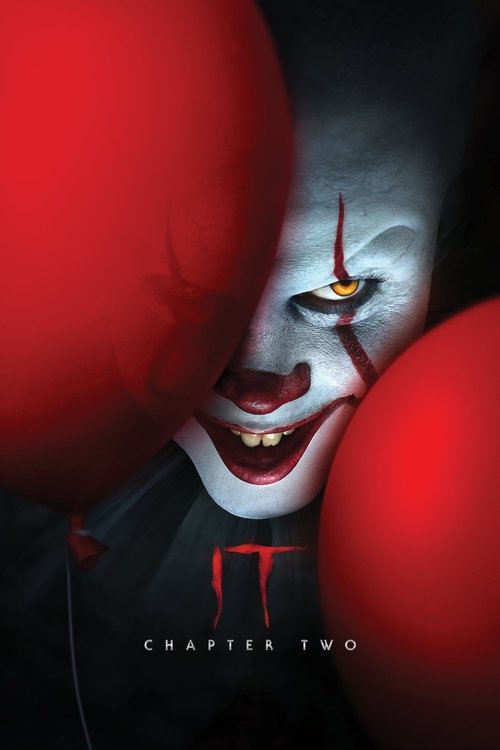
It Chapter Two
2019 · Andy Muschietti
For a big horror night when you want spectacle and heart along with the jump scares — and when you have the patience for a nearly three-hour epic. Better with friends and the first film fresh in mind.
What it's about
Twenty-seven years after they fought a shape-shifting evil as kids, the members of the Losers' Club — now scattered, successful, and strangely foggy about their childhoods — get the phone call they dreaded: it's back, and they swore an oath. Returning to the small Maine town of Derry as adults, they have to dig up memories they buried for a reason and face the clown-faced entity Pennywise one last time. It's a horror story that's equally about what growing up makes you forget.
The experience
A long, sprawling ride that swings between funhouse scares, surprisingly raw grief, and genuine laughs — often within the same scene. It's more melancholy than terrifying: the dread here is as much about memory and shame as about the monster.
Performances
Bill Hader is the revelation as the adult Richie, walking a tightrope between comic relief and the film's most affecting dramatic beats, while Bill Skarsgård's Pennywise remains a gleefully unnerving creation.
The craft
Andy Muschietti stages horror set pieces with carnival-ride inventiveness and scale, backed by lavish creature effects and uncanny casting that matches the adult actors to their young counterparts. At nearly 169 minutes it's one of the biggest swings a studio has taken on horror, and its funhouse visuals play best loud and large.
Why it matters
As the conclusion to one of the highest-grossing horror phenomena ever, it capped the wave of prestige-scaled Stephen King adaptations and proved studios would bankroll horror at genuine epic length and budget.
Horror · Creature feature · Teen horror · Horror comedy & camp. A sprawling three-hour return to a haunted hometown: funhouse jolts, raw grief and real laughs, with a shape-shifting clown at its center.
Snapshot
It Chapter Two is the concluding half of a two-part adaptation of Stephen King's 1986 novel It, following the surprise blockbuster success of It (2017). Where the first film isolated the novel's childhood timeline into a self-contained coming-of-age horror story set in 1988–89, the sequel takes up King's adult timeline: the members of the Losers' Club, now scattered and successful, are summoned back to the town of Derry, Maine by Mike Hanlon — the one who stayed — when the shape-shifting entity Pennywise resurfaces on its roughly twenty-seven-year cycle. Directed again by Andy Muschietti from a screenplay by Gary Dauberman, and running close to 169 minutes, it is one of the longest mainstream horror features ever released by a major studio. The film is at once a straightforward franchise capstone and a meditation on memory, repression, and the way adulthood buries childhood terror — a horror epic built on the melancholy premise that you cannot go home again without confronting what you left there.
Industry & production
The film was produced by New Line Cinema and distributed by Warner Bros., with a producing team including Barbara Muschietti (the director's sister and long-standing creative partner), Dan Lin, Roy Lee, Seth Grahame-Smith, and David Katzenberg. Its existence was effectively guaranteed by the extraordinary commercial performance of It (2017), which became the highest-grossing horror film to that point and reset studio expectations for the genre's ceiling. The 2017 film had always been conceived with a sequel in mind — its very subtitle, retroactively "Chapter One," signaled the split structure — but the second chapter was greenlit on the strength of the first's returns rather than pre-committed.
Reported budgets place Chapter Two around $79 million, a substantial increase over the first film, reflecting the larger star salaries, heavier visual-effects load, and expanded set-piece ambitions. Commercially it performed strongly but not at the record-setting level of its predecessor: it opened to a large September number and grossed on the order of $470 million worldwide against the first film's roughly $700 million. The falloff is consistent with a well-observed pattern in horror sequels — front-loaded openings driven by the original's goodwill, followed by steeper drops as word of mouth and the film's considerable length worked against repeat business. The two films together, however, cemented It as one of the most profitable horror properties of the era and are frequently credited alongside other late-2010s successes with sustaining the studio-horror boom.
Technology
It Chapter Two is a product of contemporary digital production, and its most conspicuous technological signature is its extensive use of computer-generated imagery. Pennywise's transformations — the entity manifests as a spectrum of nightmares, from a decrepit old woman to a spider-clown hybrid to the swelling "Deadlights" — depend on CG augmentation blended with practical prosthetics and Bill Skarsgård's physical performance. The film also leans on digital de-aging and compositing to reunite the younger cast from the first film in flashback sequences shot years later, when the child actors had visibly grown; software-assisted youthening was used to bridge that gap. This reliance on heavy digital effects became a recurring point in critical discussion: several reviewers argued the film's scares were blunted by over-rendered creatures, contrasting them unfavorably with the more restrained, practical-leaning menace of the first chapter. The observation reflects a real tension in the production's technological approach — the sequel's larger canvas and more baroque monster designs pushed it toward a CG-forward aesthetic that not everyone found frightening.
Technique
Cinematography
Cinematography is credited to Checco Varese (ASC), taking over from Chung-hoon Chung, who shot the 2017 film. The change of hands is notable: Chung's work on Chapter One had a burnished, storybook warmth, and Varese's task was to maintain visual continuity with that film's Derry while shifting the register toward the colder, more disenchanted world of adulthood. The result favors wide, architecturally imposing compositions for the town's landmarks and set-pieces — the Neibolt house, the quarry, the carnival, the Chinese-restaurant sequence — with the camera frequently mobile, sweeping through spaces to convey scale. Where the film is strongest photographically is in its handling of Derry as a place of scale and dread; where critics found it weaker is in the sheer volume of coverage the long runtime demanded, which diffuses tension across many discrete, individually staged scare sequences rather than concentrating it.
Editing
The film was edited by Jason Ballantine (ACE), who also cut the first film, providing continuity of rhythm across the two chapters. The central editorial challenge was structural: King's novel braids the child and adult timelines together, and the two-film split forced Chapter Two to reintegrate the childhood material as flashback within a present-day frame. Ballantine's cut threads these recovered memories through the adult narrative as each Loser is dispatched to retrieve a "token" from their past, a quest structure that gives the middle section its episodic shape. This episodic design is the film's most debated editorial feature — it produces a series of self-contained horror vignettes, effective in isolation but cumulatively taxing across nearly three hours, and it is the primary reason the runtime became such a persistent talking point in the film's reception.
Mise-en-scène / staging
Muschietti stages the film as a horror spectacle of set-pieces, each Loser's confrontation given its own distinct environment and visual conceit — Beverly's return to her childhood apartment and its elderly new tenant, Richie's encounter at the Paul Bunyan statue, the hall-of-mirrors funhouse climax. Derry itself is a carefully art-directed character, its Main Street, Barrens, and cursed house rendered with a period-inflected Americana that curdles into menace. The production design sustains the storybook-gone-wrong quality established in the first film while pushing it toward the grotesque. The staging is deliberately maximalist, favoring elaborate practical sets augmented with effects over restraint.
Sound
Benjamin Wallfisch returned to compose the score, carrying forward musical material from the first film, including its associations with the Losers and with Pennywise's cyclical menace. Wallfisch's writing mixes lush, elegiac themes for the friendship and loss at the story's emotional core with dissonant, aggressive textures for the horror sequences. The sound design is dense and dynamic, built around the sudden acoustic ruptures of the jump-scare — a technique the film deploys frequently and which some critics felt substituted volume for genuine dread. The score's more affecting mode is its melancholy one, underlining the film's preoccupation with memory and mortality.
Performance
Performance is widely regarded as the film's greatest strength. The adult Losers are cast with an eye toward resonance with their younger counterparts: Jessica Chastain as Beverly, James McAvoy as Bill, Bill Hader as Richie, Isaiah Mustafa as Mike, Jay Ryan as Ben, James Ransone as Eddie, and Andy Bean as Stanley. The standout, by near-critical consensus, is Bill Hader, whose Richie balances the character's compulsive comic deflection against a substrate of grief and buried longing; his performance was frequently singled out as the film's emotional and comic anchor, and Ransone's Eddie is often praised as its ideal foil. Bill Skarsgård reprises Pennywise, sustaining the unsettling, off-kilter physicality — the drifting eye, the childlike lilt curdling into predation — that made the character a cultural figure after the first film. The young cast (Sophia Lillis, Finn Wolfhard, Jaeden Martell, Jeremy Ray Taylor, Chosen Jacobs, Wyatt Oleff, Jack Dylan Grazer) returns in flashback, preserving the ensemble chemistry that grounded the original.
Narrative & dramatic mode
The film operates in the mode of the horror epic crossed with the reunion drama. Its governing structure is a quest: Mike, having stayed in Derry and studied the entity, calls the others home, and the group must each recover an artifact from their childhood and perform a ritual to destroy Pennywise. This device motivates the film's recursive movement between present and past, and it makes memory itself the narrative engine — the adult Losers have, tellingly, forgotten much of what happened, and the story is partly about the painful work of remembering. The dramatic register oscillates between broad comedy (the Losers' bickering rapport), genuine pathos (loss, estrangement, a suicide that shadows the reunion), and horror set-pieces. King's own novel resolves on themes of the fragility of adult memory and the covenant of childhood friendship, and the adaptation preserves this bittersweet frame, closing the two-film arc on elegy as much as triumph.
Genre & cycle
It Chapter Two belongs to the late-2010s wave of prestige-adjacent studio horror — big-budget, star-driven, and aimed at both genre audiences and general moviegoers — that the first It did much to inaugurate. It sits within several overlapping traditions: the Stephen King screen adaptation, one of the most durable pipelines in American genre cinema; the "monster returns after decades" horror sequel; and the reunion-of-a-group narrative common to both horror and drama. Its release coincided with a broader King revival on screen across the late 2010s. As a coda to a two-part event adaptation, it also participates in the era's franchise logic, in which pre-sold properties are split and expanded to maximize theatrical footprint.
Authorship & method
Andy Muschietti directs from a screenplay by Gary Dauberman, with the film reflecting the collaborative through-line of the two-part project. Muschietti, who came to attention with Mama (2013), works consistently with his sister and producing partner Barbara Muschietti, a partnership central to both It films; his sensibility favors the fusion of childhood-fear imagery with large-scale genre spectacle. Dauberman, a screenwriter closely associated with the Conjuring universe (Annabelle and its sequels, The Nun), brought franchise-horror craft to the adaptation and took sole screenplay credit here. Key collaborators — cinematographer Checco Varese, composer Benjamin Wallfisch (returning), and editor Jason Ballantine (returning) — provide varying degrees of continuity with Chapter One, with Wallfisch and Ballantine offering the strongest connective tissue and Varese marking the most significant departure. The production is best understood as authored by this producing-and-directing core rather than by a single auteur signature; its method is that of a large-scale studio genre production coordinating a returning creative team.
Movement / national cinema
The film is a work of mainstream American studio filmmaking, produced within the Hollywood system by New Line/Warner Bros., and does not belong to any art-cinema movement. It is worth noting, however, that Andy and Barbara Muschietti are Argentine filmmakers who broke through internationally, and their trajectory reflects the broader late-2010s pattern of Latin American genre directors — alongside figures such as Guillermo del Toro and Fede Álvarez — moving into major Hollywood horror productions. The film's national-cinema identity is thoroughly American in setting and idiom, drawn from King's mythologized small-town Maine, even as its authorship reflects the internationalization of Hollywood genre directing.
Era / period
It Chapter Two is a film of the late-2010s studio-horror boom, released in 2019 at what was arguably the peak of that cycle's commercial confidence. Its present-day scenes are set in the mid-2010s (a roughly twenty-seven-year jump from the first film's 1989), while its flashbacks return to that period-detailed late-1980s Derry. This dual temporality is thematically load-bearing: the film is explicitly about the distance between two eras of a life, and its production era — a moment of nostalgia-driven franchise filmmaking and 1980s-set genre revival — dovetails with its internal preoccupation with looking back. It arrived in the same cultural window that produced other King and 1980s-nostalgia properties, and shares their fascination with childhood-past as both refuge and wound.
Themes
The film's central themes are memory and forgetting, the persistence of childhood trauma into adult life, and the redemptive but costly power of confronting the past. Each Loser's arc dramatizes a specific wound — abuse, shame, grief, fear — that Pennywise weaponizes, and the entity functions as a literalized metaphor for repressed terror that returns when unexamined. Friendship and the covenant between the Losers stand as the counterforce, the film arguing that the fears of childhood can only be faced collectively. Belonging and estrangement, the impossibility and necessity of returning home, mortality, and the way trauma is inherited and re-encountered across a lifetime all run through the narrative. In keeping with King's source, the film treats Derry itself as complicit — a town whose ordinary cruelty and willful blindness feed the monster — giving its horror a sociological undertone about communal denial.
Reception, canon & influence
Critical reception was mixed-to-favorable but distinctly cooler than the first film's. Reviewers broadly praised the performances — Bill Hader most of all — and the emotional weight of the reunion, while criticizing the film's punishing length, its episodic structure, and a reliance on CGI-heavy monsters and jump scares that many felt diluted the dread of the original. The critical consensus positioned it as a solid but overstuffed conclusion that could not quite recapture the freshness of Chapter One.
Looking backward, the film's influences are layered: most directly Stephen King's 1986 novel, but also the long tradition of King screen adaptations, the 1990 television miniseries It (which fixed the character of Pennywise, as embodied by Tim Curry, in popular memory and which the films consciously reimagine), and the coming-of-age and reunion frameworks of American genre storytelling. Its immediate parent is of course It (2017), whose tone, cast framework, and creative team it inherits.
Looking forward, its legacy is bound to the It duology's outsized role in demonstrating the commercial ceiling of studio horror in the 2010s, encouraging further big-budget King adaptations and event-scale genre filmmaking. Bill Hader's performance contributed to his continued elevation as a dramatic actor. Andy and Barbara Muschietti's work on the two films raised their industry profile substantially, positioning them for subsequent major studio assignments. As a whole, the It films stand as a defining example of late-2010s prestige-scale horror; Chapter Two specifically is likely to be remembered less as a discrete achievement than as the concluding movement of that larger, culturally significant two-part work — and as a case study in the difficulty of sustaining a horror phenomenon across a sequel of epic length.
A Deleuzian reading
Beverly climbs the stairs of the apartment she grew up in and knocks.
The full Deleuzian reading of It Chapter Two →
Reception
Arrived on a tidal wave of goodwill from 2017's record-smashing Chapter One and landed with a shrug — reviews were mixed, the box office dropped hard, and the consensus quickly hardened into 'the first one was better.' Time hasn't reversed that verdict so much as narrowed it: it's now largely remembered as the Bill Hader movie trapped inside a bloated sequel.
How It Chapter Two was received, from release to now →
How to watch It Chapter Two: what to notice on a first viewing
- Watch each Loser sent alone into a room they used to know. Muschietti stages the film's middle hour as seven separate waits, not seven separate actions; each Loser mostly just stands there, trying to remember. The film asks you to watch someone remember, not solve, which is rarer in studio horror than it sounds.
- Watch Pennywise's eye and voice shift in small increments, not sudden jumps. Skarsgård builds the character by degrees, the drifting eye and childlike lilt souring toward predation across a scene rather than transforming all at once. The potisign, or icon of power, is a face that climbs toward a threshold instead of just holding one mood.
- Listen for Wallfisch's score turning from tender melody to dissonant noise. The same musical themes that carried the Losers' friendship in the first film return here, warping into aggressive textures whenever Pennywise appears. The score keeps friendship and dread as two sides of the same sound, not separate registers.
- Notice how wide and far back the camera holds on Derry's streets. Varese frames Main Street, the Barrens, and the Neibolt house as vast architectural spaces, the camera sweeping through rather than cutting close. Scale turns an ordinary town into something that dwarfs the people walking through it.
- Watch Richie crack a joke right after something painful happens. Hader plays Richie's humor as a reflex that fires exactly when the scene gets close to grief, then keeps firing. The joke is the character's defense system, not just comic relief.
The whole guide to watching It Chapter Two, with the keys for a rewatch →
Influences: the films it descends from and the films it influenced
- It (2017) — Direct parent: Chapter Two inherits the Loser's Club casting framework, Benjamin Wallfisch's returning leitmotif score, and Jason Ballantine's episodic scare-vignette cutting, transposing the same machinery into an adult register.
- It (1990) — The TV miniseries fixed the child/adult dual-timeline adaptation structure and Tim Curry's shapeshifting-Pennywise blueprint that Skarsgård's performance and the films consciously reimagine.
- The Shining (1980) — King-adaptation set-piece maximalism: cavernous, symmetrical dread-spaces and slow-swelling atmosphere model Chapter Two's grand haunted-architecture tableaux (Neibolt house, the funhouse hall of mirrors).
- Poltergeist (1982) — Fuses suburban childhood terror with big-budget optical-effects spectacle — the exact template for Muschietti's childhood-fear imagery weaponized through blockbuster VFX.
- A Nightmare on Elm Street (1984) — The protean dream-monster whose form warps to each victim's specific fear is directly ancestral to Pennywise's fear-tailored CGI metamorphoses (the leper, Mrs. Kersh, Paul Bunyan statue).
- Stand by Me (1986) — The founding King coming-of-age film: its small-town kids-on-a-quest ensemble and elegiac adult-narrator nostalgia frame the Losers' bond and its memory-haunted return.
- Once Upon a Time in America (1984) — Braids a childhood gang and their scarred adult reunion via memory-triggered flashbacks with an elegiac score — the structural and tonal template for Chapter Two's dual-timeline braiding.
- The Godfather Part II (1974) — Canonized parallel dual-timeline cross-cutting as prestige narrative architecture, establishing the braided-past/present editing grammar Chapter Two adopts for its reunion structure.
- The Goonies (1985) — The bickering-kid adventure ensemble and set-piece-per-obstacle quest rhythm feed the Losers' Club dynamic and the token-hunting artifact structure of the adults' return.
- The Thing (1982) — Its grotesque creature-metamorphosis body-horror — limbs, splitting mouths, spider-forms — is the design lineage Chapter Two's CGI monsters imitate, culminating in the Pennywise-spider finale.
- Pet Sematary (2019) — Part of the studio King-adaptation wave the It duology's box office greenlit, replicating the prestige-scale, jump-scare-forward King-adaptation formula.
- The Black Phone (2021) — Period-set childhood-terror horror riding the late-2010s nostalgia-horror boom the It films crystallized, pairing a supernatural child-hunter with 70s Americana.
- The Flash (2023) — The Muschietti siblings' subsequent CGI-spectacle-plus-de-aging tentpole, carrying their childhood-fear-meets-blockbuster-VFX method (and de-aging pipeline) into franchise filmmaking.
- It: Welcome to Derry (2025) — Direct franchise extension mining Derry's periodized backstory with the same producing-directing core, continuing the Wallfisch-scored, dual-era Pennywise mythology.
- Doctor Sleep (2019) — Same-year prestige King adaptation about an adult returning to confront a childhood supernatural trauma, extending the studio-scale King legacy-horror mode.
- The Irishman (2019) — Pushes the same-era digital de-aging technology — used on Chapter Two's flashback Losers — to feature length, a parallel experiment in VFX-aged performance across decades.
- Us (2019) — Same-year prestige studio horror built on a hall-of-mirrors funhouse trigger and the return of a repressed childhood trauma, a craft sibling in elevated-horror set-piece design.
- Stranger Things (2016) — The 80s-childhood-horror revival that runs parallel to the It films (sharing Finn Wolfhard): a period-nostalgia kids ensemble versus a shapeshifting monster, amplifying the same craft current.
Similar films
- It (2017) — influence & lineage · same viewing thread
- Us (2019) — influence & lineage
- Doctor Sleep (2019) — influence & lineage
- The Shining (1980) — influence & lineage
- It Follows (2015) — same viewing thread
- Terrifier 2 (2022) — shared sensibility
- The Conjuring: Last Rites (2025) — shared sensibility
- Scream (2022) — shared sensibility
All the films related to It Chapter Two →
Watch it with: curated runs of related films
- Growing Up Is the Monster — Watch these together for horror where adolescence is the curse: a werewolf bite that arrives with puberty, a cheerleader who comes back hungry, a thing that follows you after sex, a possession game played for social media, and childhood evils the kids have to face themselves.