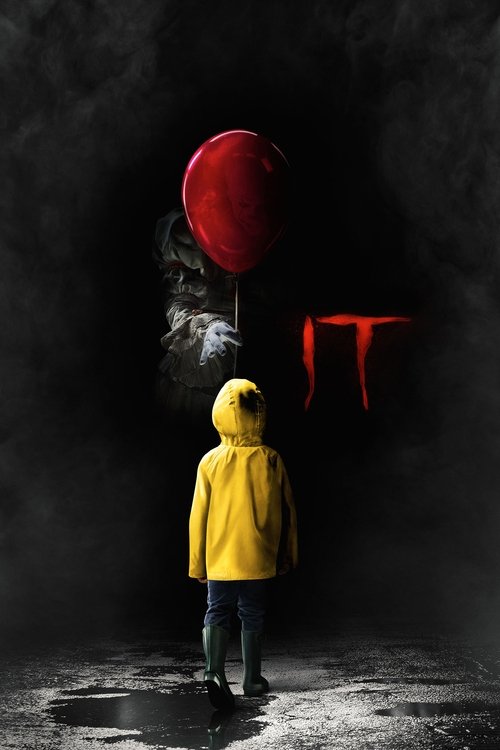
It
2017 · Andy Muschietti
When you're craving a real scare but want heart with it — ideal for a group watch with the lights off. Intense enough to make you jump, never so bleak it stops being fun.
What it's about
In the small town of Derry, Maine, kids have been going missing, and the adults don't seem to want to talk about it. Seven outcast kids — the self-named Losers Club — spend a late-1980s summer contending with bullies, bad homes, and each other, until they realize something is hunting the town's children: a shapeshifting thing that most often appears as a clown called Pennywise, and that only they seem able to face.
The experience
A jump-scare machine wrapped around a warm, foul-mouthed hangout movie — it swings between genuine dread and the loose, funny camaraderie of kids on bikes. The scares are loud and aggressive, but it's the friendship that keeps you watching.
Performances
Bill Skarsgård's Pennywise is a genuinely unnerving creation — a drooling, wrong-eyed predator playing at being a clown — and the young ensemble, especially Sophia Lillis as Beverly and Finn Wolfhard as motormouth Richie, feels like a real gang of friends.
The craft
Andy Muschietti stages horror set pieces with big, theatrical confidence — a slide-projector sequence and a certain rain-gutter encounter have become instant genre landmarks — while the summery small-town photography keeps the nostalgia glowing between frights. It rewards a dark room and good speakers; the sound design does a lot of the terrorizing.
Why it matters
It became one of the highest-grossing horror films ever made, proved R-rated horror could be event cinema, and supercharged both the Stephen King adaptation boom and the wave of '80s-kids nostalgia storytelling.
Horror · Creature feature · Teen horror. Seven misfit kids, one shapeshifting clown: loud jump-scare set pieces wrapped around a warm, foul-mouthed late-'80s summer friendship.
Snapshot
It is the first half of a two-part adaptation of Stephen King's 1,100-page 1986 novel, a studio horror film that recast one of the genre's most familiar properties as an ensemble coming-of-age story. Directed by Andy Muschietti for New Line Cinema and Warner Bros., it follows seven outcast children — the self-styled Losers Club — in the fictional town of Derry, Maine, as they are stalked by a shapeshifting predator that most often appears as Pennywise the Dancing Clown (Bill Skarsgård). The film made a decisive structural choice: where King's novel braids two timelines (the children in 1958, the adults in 1985), Muschietti's Chapter One extracts only the childhood half and relocates it to the late 1980s, reserving the adult story for a sequel. The result is both a monster movie and an Amblin-inflected boyhood adventure, and it became a commercial phenomenon — widely reported as the highest-grossing horror film of its era and the launchpad for a renewed wave of Stephen King adaptations. Its lasting significance lies less in formal innovation than in how effectively it fused nostalgia, ensemble youth drama, and jump-scare horror into a mainstream package.
Industry & production
It had an unusually long and public gestation. New Line acquired the rights early in the 2010s, and for several years the project was attached to Cary Joji Fukunaga, fresh off the first season of True Detective, who co-wrote the screenplay with Chase Palmer and intended to direct. Fukunaga departed in 2015 over what was widely reported as a combination of budgetary constraints and creative differences with the studio; his conception had been darker and more auteur-driven, and Will Poulter, whom he had cast as Pennywise, left with him. Andy Muschietti — whose 2013 feature Mama had been a profitable New Line horror release developed from his own short — took over, and Gary Dauberman revised the script. All three writers ultimately shared credit.
Muschietti's sister and longtime collaborator Barbara Muschietti produced, alongside Roy Lee, Dan Lin, Seth Grahame-Smith, and David Katzenberg, among others. The film was shot largely in Ontario, Canada, with the town of Port Hope standing in for Derry, and Toronto-area interiors and stages hosting the more elaborate set pieces (the Neibolt Street house, the sewers). Released in North America in September 2017, It upended industry assumptions about the calendar and the ceiling for horror: its opening weekend set a September record and the largest debut for a horror film, and its worldwide gross — reported at roughly $700 million against a budget in the mid-tens of millions — made it, by unadjusted figures, the top-earning horror feature to that point. That success guaranteed It Chapter Two (2019) and materially shifted studio appetite for R-rated horror at scale.
Technology
It was captured digitally, with cinematographer Chung-hoon Chung working in the widescreen, high-resolution digital idiom standard for major studio productions of the mid-2010s. (Precise camera-and-lens specifications are not something I can confirm from memory, so I note that as a gap rather than guess.) The film's most consequential technological dimension is its hybrid approach to the creature. Pennywise is fundamentally a performance — Skarsgård in prosthetic makeup and costume — but the character's transformations, the "deadlights," the distending jaw and multiplying teeth, and the fluid morphing between forms were realized through digital visual effects layered onto that practical base. Vendors including Rodeo FX contributed the creature and environment work. The production leaned on this practical-plus-digital blend deliberately: keeping a physical actor on set preserved eyeline and rhythm for the child performers, while CGI handled the anatomically impossible. Several of the film's signature images — the projector sequence in which a slide show accelerates into a looming apparition, the flooded sewer lair, the collage of floating bodies — depend on seamless integration of the two. The approach is representative of late-2010s studio horror, where restraint about when to deploy effects mattered as much as the effects themselves.
Technique
Cinematography
The hiring of Chung-hoon Chung is the film's most distinctive craft decision. Best known for his formally bold, saturated, elaborately choreographed work with Park Chan-wook (Oldboy, Stoker, The Handmaiden), Chung brought a mobile, expressive camera and a rich palette to material that could easily have been shot flatly. Derry in summer is warm and inviting, which sharpens the horror by contrast; the descents into Pennywise's world go cold, green, and subterranean. Chung favors deliberate camera movement — pushes, craning reveals, and roving Steadicam — that builds dread through motion rather than relying solely on cuts, and he stages the child-scaled world with a lush, slightly heightened quality that flatters the nostalgic register while leaving room for grotesquerie.
Editing
Editor Jason Ballantine cut the film, structuring a narrative that must service seven protagonists, an antagonist who appears in radically different guises, and a tone that oscillates between comedy, adventure, and terror. The editing carries much of the film's fear mechanics: the timing of Pennywise's appearances, the build-and-release rhythm of the set pieces, and the modulation between the ensemble's bantering camaraderie and sudden violence. The braided structure — cycling among the children as each confronts a personalized manifestation of fear — is largely an editorial achievement, keeping a large cast legible while sustaining momentum.
Mise-en-scène / staging
Production design renders Derry as a tactile late-1980s American small town — the Barrens, the Kissing Bridge, the derelict Neibolt house, the standing-water sewers — with period detail (bikes, arcade cabinets, New Kids on the Block posters) that grounds the nostalgia. The staging repeatedly exploits scale: children dwarfed by architecture, by Pennywise, by the town's indifferent adults. Each Loser's fear is externalized into a bespoke set piece — Beverly's blood-erupting bathroom, Eddie's leprous vagrant, Stanley's woman from the painting, Ben's headless historical horror — so that mise-en-scène does thematic work, literalizing private trauma as environment.
Sound
Sound design is central to the film's scare architecture: the wet acoustics of the sewers, the distorted carnival textures around Pennywise, and the abrupt dynamic swings that punctuate the jump scares. Benjamin Wallfisch's score threads a childlike, music-box and choral motif — fragile, nursery-rhyme innocence — against dissonant, percussive stingers, so that the same sonic world holds both the Losers' tenderness and the creature's menace. The interplay of near-silence and sudden loudness organizes many of the film's most effective moments.
Performance
The film rests on its child ensemble, and the casting is its greatest asset. Jaeden Lieberher (later Jaeden Martell) plays the stammering, grief-stricken leader Bill Denbrough; Sophia Lillis gives the standout turn as Beverly Marsh, carrying the film's most adult and painful material; Finn Wolfhard supplies profane comic energy as Richie Tozier; Jack Dylan Grazer (hypochondriac Eddie), Jeremy Ray Taylor (bookish new-kid Ben), Wyatt Oleff (anxious Stanley), and Chosen Jacobs (homeschooled outsider Mike) round out the club, with Nicholas Hamilton as the sadistic bully Henry Bowers. Their naturalistic, overlapping, improvisational-feeling rapport is what elevates the film above genre routine. Against them, Bill Skarsgård builds a Pennywise defined by unnervingly childlike affect — a high, drifting voice, a wandering eye, a smile that curdles — a deliberate departure from Tim Curry's more vaudevillian menace in the 1990 miniseries.
Narrative & dramatic mode
It operates in an ensemble coming-of-age mode grafted onto episodic horror. Its dramatic engine is not a single quest but the gradual coalescence of a friend group, each member introduced through a fear the creature weaponizes against them. The structure is roughly cumulative: isolated encounters, mounting recognition that the children share an enemy, a decision to fight collectively, and a climactic confrontation in the lair. Fear is the film's explicit subject and mechanism — Pennywise feeds on terror and manifests as whatever each child dreads — which makes the coming-of-age arc and the horror arc the same movement: to defeat It, the Losers must refuse to be afraid, so growing up and surviving are dramatized as identical acts of courage. The braided, multi-protagonist form owes an obvious debt to King's own structural habits and to the boyhood-ensemble tradition.
Genre & cycle
The film sits squarely within the mid-2010s resurgence of prestige-adjacent and commercially muscular horror — the years of The Conjuring universe, The Babadook, It Follows, Get Out, and the streaming-era ubiquity of Stranger Things. It belongs specifically to two overlapping cycles: nostalgia horror, mining 1980s Americana and Amblin iconography, and the studio Stephen King revival. 2017 was a banner King year — The Dark Tower, Netflix's Gerald's Game and 1922, the Mr. Mercedes series — and It's runaway success reframed King adaptation as reliable, large-scale business rather than niche. It is also a clear instance of the "kids on bikes confront the monster" subgenre whose modern template Stranger Things had freshly popularized, a lineage the film both draws on and, through shared cast member Finn Wolfhard, visibly embodies.
Authorship & method
Andy Muschietti approaches horror as an emotional and character-driven form rather than a purely mechanical one; his prior feature Mama likewise fused domestic tenderness with a supernatural threat, and he has spoken of horror as a vehicle for childhood fear and family trauma. His method on It prioritized the child ensemble — cultivating genuine chemistry and giving the young actors latitude — and treated Pennywise as a shapeshifting embodiment of each Loser's psychology rather than a stable villain. His creative partnership with producer Barbara Muschietti is a defining feature of his career.
The key collaborators shape the film decisively. Cinematographer Chung-hoon Chung imports a formalist, richly colored, mobile visual language from art-house auteur cinema. Composer Benjamin Wallfisch — who in the same period co-composed Blade Runner 2049 with Hans Zimmer and scored other New Line horror — supplies the innocence-versus-menace tonal architecture. Editor Jason Ballantine manages the ensemble braid and scare timing. The screenplay's authorship is genuinely layered: Chase Palmer and Cary Joji Fukunaga carried the early, more auteur-driven conception, and Gary Dauberman revised it toward the released version; the tension between those visions is part of the film's production history, though the finished script is more crowd-pleasing than Fukunaga's reported intentions.
Movement / national cinema
It is a mainstream American studio production and does not belong to a defined film movement. Its most interesting national-cinema dimension is transnational craft: an Argentine-born director, an acclaimed South Korean cinematographer, and an Australian editor working within the Hollywood horror system. That importation of international art-cinema talent into a commercial genre picture is characteristic of 2010s studio filmmaking, where distinctive visual authorship was increasingly sought for franchise-scale projects.
Era / period
The film is doubly period-marked. Diegetically, it relocates the novel's 1950s childhood to 1988–89, a shift that lets the film trade on 1980s nostalgia and align with the Stranger Things zeitgeist while preserving the "27-year cycle" that the sequel needs (moving the adult story to the present). Industrially, it is a product of the late-2010s theatrical horror boom and the streaming era's appetite for 1980s retro, arriving at a moment when horror had regained both critical respect and blockbuster economics. The period setting is not incidental decoration but a marketing and tonal strategy that the film executes with unusual polish.
Themes
The film's governing theme is fear itself — its manufacture, its private shapes, and the possibility of collective resistance. Pennywise literalizes the idea that terror is personal: grief for Bill, sexualized menace and paternal abuse for Beverly, illness and maternal control for Eddie, historical and racial violence for Mike, religious guilt for Stanley. Around this radiate the film's other concerns: childhood as a period of vulnerability that adults fail to protect; the town of Derry as a place complicit in and shaped by cyclical evil, its grown-ups oblivious or predatory; bullying and abuse as human horrors that rhyme with the supernatural one; grief and the refusal to let go (Bill and the raincoat-clad Georgie); and solidarity — the Losers Club — as the only durable defense. The film insists that the monster's power is precisely the isolation of fear, and that friendship, by refusing that isolation, is what breaks it.
Reception, canon & influence
Critical reception was broadly positive. Reviewers singled out the child ensemble — Sophia Lillis and Finn Wolfhard especially — and Skarsgård's unsettling reinvention of Pennywise, while praising Muschietti's balance of humor, heart, and scares; the most common reservations concerned reliance on loud jump scares and CGI over sustained dread, and some critics found the reworked material less frightening than the novel's slow menace. Commercially it was a landmark, widely reported as the highest-grossing horror film of its time and a record-setter for September and horror openings, results that reshaped studio expectations for the genre.
The influences on the film are legible: Stephen King's novel and the King boyhood tradition of Stand By Me; Steven Spielberg / Amblin adventure cinema (E.T., The Goonies) with its bicycle-riding suburban children; Wes Craven's A Nightmare on Elm Street in the logic of a predator who manifests as personalized fear; and the 1990 Tommy Lee Wallace miniseries with Tim Curry, which established the property's television-era iconography and which Skarsgård's performance consciously answers. There is also a reciprocal relationship with Stranger Things, which had itself drawn on King and Spielberg — the two works cross-pollinated the "kids versus the monster" revival, a link made literal by Wolfhard's presence in both.
Its forward legacy is substantial. It validated the theatrical viability of large-budget, R-rated, non-franchise horror and directly accelerated the ongoing Stephen King adaptation boom. It produced It Chapter Two (2019), completing the novel's adult timeline, and kept Andy and Barbara Muschietti in demand within studio filmmaking. More broadly, it cemented nostalgia-driven, ensemble-child horror as a bankable mode and reintroduced Pennywise to a new generation as a durable pop-culture figure. Whether the film endures as a canonical horror text or primarily as a commercial and cultural inflection point remains an open question, but its role in redefining the economics and ambitions of mainstream horror in the late 2010s is not in doubt.
A Deleuzian reading
A projector clicks through family slides in a garage.
The full Deleuzian reading of It →
Reception
A genuine 2017 phenomenon — it shattered September records and became the highest-grossing horror film ever — and unlike most event-horror it's aged well, though its reputation now carries the asterisk of Chapter Two, which almost everyone agrees dropped the ball.
How It was received, from release to now →
How to watch It: what to notice on a first viewing
- Notice how adults get cropped at the top of the frame. Muschietti and Chung shoot mostly from kid height, so grown-ups appear as legs, waists, or don't appear at all. This shows the adult world as present but never actually helpful to the kids.
- Watch Derry turn cold and green whenever Pennywise's world opens up. Chung-hoon Chung keeps the town's summer scenes warm and honeyed, then drains the color to green and blue below ground. The palette itself tells you which world you're in before anything scary happens.
- Listen for the music-box motif right before something goes wrong. Wallfisch's childlike, nursery-rhyme theme keeps returning just ahead of dissonant, percussive stingers, pairing innocence with menace in the same phrase. The score itself becomes the mechanism of dread, training your ear to expect danger.
- Track how the seven kids talk over each other constantly. The Losers Club rarely gets solo scenes; they interrupt, joke, and bicker in overlapping dialogue that defines each kid by rhythm, not speech. Their bond is built from banter, so the friendship feels lived-in rather than stated.
- Watch Pennywise's eye and smile; they never quite match. Skarsgård gives Pennywise a wandering eye and a smile that curdles a beat after it forms, instead of one settled expression. The face reads as pure hunger rather than a personality, which is scarier than a villain.
The whole guide to watching It, with the keys for a rewatch →
Influences: the films it descends from and the films it influenced
- Stand By Me (1986) — Establishes the King template It braids from: a summer child ensemble whose bond is built through overlapping banter and walking-and-talking blocking, with adolescence framed as the last stand against encroaching mortality.
- The Goonies (1985) — Supplies the kids-on-bikes overlapping-dialogue ensemble grammar — a pack of squabbling suburban children shot at their own eye level, individuated through cross-talk rather than solo scenes.
- E.T. the Extra-Terrestrial (1982) — Amblin's low, child-height camera and suburban-cul-de-sac bicycle staging that It reproduces, keeping adults framed out or waist-cropped so the world is scaled to the children.
- A Nightmare on Elm Street (1984) — Codifies the predator who manifests as each victim's personalized fear, licensing Pennywise's shapeshifting set-pieces where the monster is dream-logic tailored to an individual psychology.
- It (1990) — The Tim Curry miniseries fixes the property's dual-timeline cross-cutting and the greasepaint clown iconography that Skarsgård's performance deliberately answers and distorts.
- The Shining (1980) — Model for the gliding, mobile-expressive camera stalking children through architecture and the elevator-blood scale set-piece, plus the dissonant score puncturing quiet with sudden volume.
- Poltergeist (1982) — Blueprint for the suburban-domestic haunting that weaponizes a child's private fears via practical creature effects escalated with opticals — the toolkit It updates as practical-plus-CGI.
- Oldboy (2003) — Chung-hoon Chung's breakout: the saturated, formalist palette and restless mobile camera he later imports to It, treating genre violence with art-house compositional rigor.
- Stoker (2013) — Chung's clearest rehearsal for It's warm-vs-cold color scheme and coming-of-age menace, using precise color temperature shifts to mark a child's crossing into fear.
- Mama (2013) — Muschietti's own prior feature establishes his method of fusing domestic tenderness with a supernatural threat and directing children as the emotional center rather than victims.
- It Chapter Two (2019) — Direct continuation completing the dual-timeline structure, extending the same shapeshifting-fear set-piece design and Wallfisch's innocence-versus-menace scoring into the adult register.
- Doctor Sleep (2019) — Product of the King-adaptation boom It accelerated, marrying coming-of-age trauma to horror while reconciling Kubrick's imagery with King's text — the prestige-King mode It made bankable.
- Super 8 (2011) — Parallel Amblin revival that pairs a bickering kid ensemble with a creature reveal, pursuing the same nostalgia-adventure-plus-monster tonal blend on a period small-town canvas.
- It Follows (2014) — Contemporary take on the Craven premise of an inexorable entity tuned to personal dread, using synth-dissonance swings and slow lateral camera to build the sustained-dread mode It is often faulted for shortcutting.
- The Conjuring (2013) — Defines the New Line house style of engineered jump-scare timing — silence stretched then broken by a synchronized sting and reveal — the grammar Ballantine's cutting deploys throughout It.
- Annabelle: Creation (2017) — Same-year New Line horror scripted by Gary Dauberman, sharing It's screenwriting hand and its innocence-imperiled staging of children menaced by a possessing figure.
- Stranger Things (2016) — Cross-pollinating kids-versus-monster revival drawing on the same King/Spielberg sources, sharing cast (Wolfhard) and the 1980s period-relocation, ensemble-braid, warm-nostalgia-vs-cold-threat formula.
- Fear Street: 1978 (2021) — Franchise-scaled period-nostalgia horror built on a teen ensemble and needle-drop-driven era reconstruction, the immediate industrial model for Fear Street's doubly-period design and young-cast commitment.
Similar films
- It Chapter Two (2019) — influence & lineage · same viewing thread
- Stand by Me (1986) — influence & lineage · often watched together
- The Shining (1980) — influence & lineage
- It Follows (2015) — same viewing thread
- Us (2019) — same viewing thread
- The Black Phone (2022) — same viewing thread
- Terrifier 2 (2022) — shared sensibility
- Cloverfield (2008) — shared sensibility
Watch it with: curated runs of related films
- Whatever's Wearing That Face — A run of horror-thrillers where the real terror is that you can't trust what a person appears to be — a double, a shapeshifter, a smiling stranger, the one you desire.
- Growing Up Is the Monster — Watch these together for horror where adolescence is the curse: a werewolf bite that arrives with puberty, a cheerleader who comes back hungry, a thing that follows you after sex, a possession game played for social media, and childhood evils the kids have to face themselves.