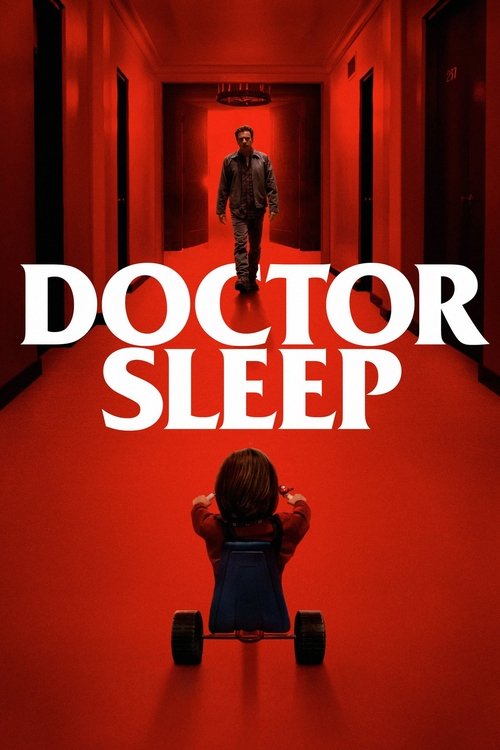
Doctor Sleep
2019 · Mike Flanagan
For a night when you want horror with a heart — something scary that's really about addiction, trauma, and recovery, and that you can sit with afterward. More a heavy, absorbing evening than a jump-scare party.
What it's about
Dan Torrance, the little boy who survived the Overlook Hotel, has grown into a drifting alcoholic trying to drink his gift away. When he finally scrapes together a sober life in a small New Hampshire town, a teenager named Abra reaches out to him psychically — her 'shine' is far stronger than his ever was, and it has attracted the True Knot, a caravan of near-immortal predators who feed on children like her. What follows is part recovery story, part supernatural manhunt, with Dan forced to face the hotel-shaped hole in his past.
The experience
Slower and sadder than you'd expect from a horror sequel — it moves like a novel, building dread in long, quiet scenes, then hits hard when the violence comes. It's genuinely frightening in places, but the feeling that lingers is grief, and a surprising warmth about people helping each other stay alive.
Performances
Rebecca Ferguson is magnetic as Rose the Hat, a villain who's all seductive calm until she isn't; Ewan McGregor plays Dan's shame and hard-won sobriety with real tenderness, and young Kyliegh Curran holds the screen opposite both of them.
The craft
Mike Flanagan pulls off a near-impossible balancing act, honoring both Stephen King's novel and Kubrick's film while telling his own patient, empathetic story. The recreations of the Overlook are eerie in their precision, the sound design uses silence and a heartbeat-like pulse to keep you unsettled, and the widescreen images reward a dark room and good speakers.
Why it matters
It reconciled a forty-year feud between King's vision and Kubrick's, and cemented Flanagan's standing as the leading voice of emotionally driven, character-first horror.
Horror · Psychological horror · Haunted house & ghost story · Vampire. A sober drifter guards a gifted girl from soul-eating nomads: patient, grief-soaked dread that turns brutal when it hits, with a warm heart.
Snapshot
Doctor Sleep is Mike Flanagan's adaptation of Stephen King's 2013 novel of the same name, itself a sequel to King's The Shining (1977). The film performs an unusual act of double allegiance: it dramatizes King's continuation of Danny Torrance's story while also serving as an explicit sequel to Stanley Kubrick's 1980 film of The Shining — a movie King himself famously disliked. Flanagan's central creative problem was to reconcile two visions of the same material that had been at odds for four decades, and the film is best understood as a mediation between them. Ewan McGregor plays the adult Dan Torrance, a recovering alcoholic haunted by the Overlook; Kyliegh Curran plays Abra Stone, a teenager whose "shine" is extraordinarily powerful; and Rebecca Ferguson plays Rose the Hat, leader of the True Knot, a nomadic cult that feeds on the psychic essence of gifted, dying children. It is at once a horror film, a road narrative, and a study of trauma and recovery.
Industry & production
Doctor Sleep was produced and distributed by Warner Bros., the studio that held the film rights to The Shining, which gave Flanagan the practical latitude to recreate Kubrick's imagery — a right that would have been far harder to secure otherwise. The picture arrived on the strength of Flanagan's rising reputation: after independent horror successes (Oculus, Hush) and a well-received Netflix adaptation of King's Gerald's Game (2017), plus the breakout of The Haunting of Hill House (2018), he had become one of the most trusted directors in contemporary horror. Crucially, Flanagan secured King's own blessing for the project, including for the delicate task of engaging Kubrick's version — a reconciliation the author had long resisted.
Commercially, the film underperformed relative to expectations. It opened in November 2019 to a soft domestic debut and did not recover its combined production-and-marketing costs in theaters, a result widely attributed to the difficult positioning of a slow-burn, adult-skewing horror sequel to a canonical art film. (I am stating this qualitatively; precise budget and gross figures vary across trade sources and I will not invent exact numbers.) A longer director's cut, running roughly three hours, was released subsequently and is generally regarded as the fuller realization of Flanagan's intentions, restoring character texture trimmed for theatrical pacing.
Technology
The film was shot digitally by cinematographer Michael Fimognari, Flanagan's frequent collaborator. (My confidence on the specific camera system is moderate; I will not name a model I cannot verify.) The more consequential technological dimension is one of reconstruction rather than capture: the production rebuilt Kubrick's Overlook Hotel interiors — the Colorado Lounge, the Gold Room, the hedge maze approach, Room 237, the blood-gushing elevators — as physical sets, working from surviving documentation of the 1980 production. Where earlier eras might have leaned on optical trickery, Doctor Sleep combines built environments with restrained digital compositing for its astral-projection and "steam" effects, keeping the supernatural legible as an extension of physical space rather than a spectacle detached from it.
Technique
Cinematography
Fimognari's camerawork consciously braids two grammars. For the film's own present-tense material — Dan's recovery in New Hampshire, Abra's suburban life, the True Knot's travels — the style is warm, mobile, and character-centered. When the film enters Overlook territory, it shifts toward Kubrick's vocabulary: symmetrical framing, corridor-tracking steadicam movement, wide-angle deep-focus compositions, and the cold, even institutional light of the 1980 film. This is not pastiche for its own sake; the visual register signals the return of a repressed past, so that the formal difference between "Flanagan's world" and "Kubrick's world" becomes a dramatic device. The astral and telepathic sequences use floating, unmoored camera positions to externalize the shine.
Editing
Flanagan edited the film himself, as is his practice, and the cutting is patient by contemporary horror standards, favoring duration and dread over the shock-cut economy of studio genre product. The editing's most distinctive maneuver is its recreation of specific Kubrick shots with recast actors, then its intercutting of these with new material — a strategy that asks the cut to carry the film's thesis about memory and inheritance. The longer director's cut reveals how much the theatrical edit compressed; the extended version lets scenes breathe and clarifies the True Knot's mechanics and Dan's arc.
Mise-en-scène / staging
Production design (by Maher Ahmad) is the film's most visible achievement, above all in the third-act return to the Overlook, where the recreated sets function as a haunted archive of cinema history. Elsewhere, the staging emphasizes ordinary American spaces — church-basement AA meetings, hospice rooms, roadside campgrounds — grounding the supernatural in the mundane. The "lockbox" imagery Dan uses to imprison the Overlook's ghosts is realized as a concrete mental architecture, an example of Flanagan's tendency to give abstract psychological states physical form.
Sound
The score by The Newton Brothers (Flanagan's regular composers) directly engages the sonic legacy of Kubrick's film. The original Shining was scored with Wendy Carlos and Rachel Elkind's electronics alongside modernist concert works by Ligeti, Penderecki, and Bartók, and a menacing main-title motif adapting the Dies Irae. The Newton Brothers quote and reinterpret that pulsing, heartbeat-like main-title figure, so that the sound design itself becomes a bridge to 1980. Sound is also central to the shine's representation: whispered voices, spatial distortions, and the visceral audio of the True Knot's feeding.
Performance
McGregor's Dan is a study in weary control — a man managing addiction and psychic gift as parallel burdens — and the performance is deliberately internalized. Kyliegh Curran, in her feature debut, gives Abra both adolescent ordinariness and formidable power. Rebecca Ferguson's Rose the Hat is the film's charismatic engine: seductive, cruel, and self-possessed. The supporting ensemble includes Cliff Curtis, Zahn McClarnon, Emily Alyn Lind, Bruce Greenwood, and Carl Lumbly (as a figure carrying the memory of the Overlook's Dick Hallorann). A distinctive layer is the recast recreation of Kubrick's characters — including Alex Essoe evoking Shelley Duvall's Wendy — performances that must channel iconic prior work rather than originate roles.
Narrative & dramatic mode
The film operates in a hybrid mode: part supernatural horror, part recovery drama, part road-movie thriller. Its structure braids three lines — Dan's slow rehabilitation and belated adoption of the shine as a gift rather than a curse; Abra's coming into power; and the True Knot's predation — that converge and then drive back toward the Overlook. Dramatically, the film privileges character and theme over sustained fright; the horror is often diffuse dread punctuated by discrete atrocities (most notoriously the Knot's murder of a child), rather than a relentless scare engine. This measured, elegiac mode is characteristic of Flanagan and was both praised as maturity and criticized as slackness.
Genre & cycle
Doctor Sleep sits within several overlapping cycles: the long tradition of Stephen King screen adaptations; the late-2010s wave of "elevated" or auteur-driven horror that prized theme, grief, and atmosphere; and the particular sub-category of legacy sequels that reckon with revered originals. Its psychic-vampire premise connects it to a lineage of stories about predatory immortals who consume the young, while its recovery narrative aligns it with addiction dramas. The film's genre identity is genuinely split — too somber and slow for pure horror audiences, too generically supernatural for the arthouse — which partly explains its difficult reception and market.
Authorship & method
The film is thoroughly a Flanagan work. As writer-director-editor he exercises the near-total authorship that defines his career, and Doctor Sleep extends his signature preoccupations: trauma, addiction, grief, family, and the possibility of grace. His method here is one of synthesis — honoring King's text while incorporating Kubrick's iconography — an act of authorial diplomacy as much as adaptation. His key collaborators are a recurring repertory: cinematographer Michael Fimognari, composers The Newton Brothers, and a stable of actors he uses across projects. That continuity of crew and cast is central to Flanagan's method; he builds films as an ongoing ensemble practice rather than assembling fresh teams per project. His self-editing means the film's pacing and its structural juxtapositions are directly his authorial decisions, not the product of a separate cutting sensibility.
Movement / national cinema
Doctor Sleep is an American studio film, and its most meaningful "movement" affiliation is to the contemporary American horror renaissance associated with directors such as Ari Aster, Jordan Peele, and Robert Eggers, and with the production culture that made horror a prestige-adjacent genre in the 2010s. Flanagan stands somewhat apart from that group by working within more traditional studio and streaming structures and by his overtly humanist, therapeutic register. The film also belongs to a distinctly American strand of gothic — King's regional New England landscapes and the mythos of the haunted American interior — that the film both inherits and literalizes through the Overlook.
Era / period
Released in 2019, the film is a product of a transitional moment in the industry: theatrical horror was commercially robust, yet mid-budget, adult-oriented studio films were increasingly squeezed, and streaming (where Flanagan's Hill House had thrived) was ascendant. Doctor Sleep's theatrical struggle and its subsequent life via a longer home-format cut reflect that transition. Its subject matter — recovery culture, the language of trauma and self-help, the "lockbox" of managed pain — is also legibly of its late-2010s moment, when therapeutic discourse had become mainstream.
Themes
The film's governing theme is trauma and its inheritance: the wound Danny suffered as a child at the Overlook shapes his adult life, and the film asks whether such damage can be metabolized rather than merely survived. Addiction is its close companion — Dan's alcoholism explicitly rhymes with his father Jack's, and King's own recovery informs the material — so that sobriety and the mastery of the shine become parallel disciplines of self-control. Predation and consumption structure the antagonist plot: the True Knot literally feed on the suffering of the young, a metaphor for how the powerful extend their lives at the expense of the vulnerable. Mortality and legacy pervade the film, from Dan's hospice work (his "Doctor Sleep" nickname) to the question of what he passes to Abra. Finally, the film thematizes memory itself — the past as a place one can be dragged back to — which its formal return to the Overlook makes concrete.
Reception, canon & influence
Critically, Doctor Sleep was received with respect more than enthusiasm. Reviewers widely praised Ferguson's performance, the ambition of reconciling King and Kubrick, and the film's emotional seriousness, while a recurring reservation held that its length and deliberate pace blunted its horror and that its climactic fan-service return to the Overlook, however accomplished, risked overwhelming the film's own identity. It was generally regarded as a strong entry in Flanagan's filmography and a cut above most King adaptations, if not a commercial success.
Influences on the film (backward): The two determining sources are King's novel and Kubrick's film — the latter's production design, camera grammar, and score furnishing the film's entire third-act vocabulary. Behind Kubrick lie the modernist composers his soundtrack drew upon. Within Flanagan's own corpus, Gerald's Game established his facility with King and with trauma-as-horror, and The Haunting of Hill House refined the elegiac, family-centered mode he brings here. The psychic-vampire mythology draws on a broad tradition of stories about parasitic immortals.
Legacy / what it shaped (forward): Doctor Sleep consolidated Flanagan's standing as the preeminent modern interpreter of King and of literary horror, feeding directly into his subsequent Netflix work (Midnight Mass, The Fall of the House of Usher) and his continued association with King properties. Its most discussed contribution to film culture is as a case study in the "legacy sequel" that must negotiate a beloved original — a problem it addressed through faithful reconstruction rather than reinvention, offering a template (and a cautionary example about box office) for later reckonings with canonical films. Its critical rehabilitation via the longer director's cut has also made it a frequent reference point in debates about theatrical versus extended versions. Because the film is recent, its long-term canonical standing remains genuinely unsettled, and I will not overstate a legacy still forming.
Reception
A box-office bomb in November 2019 despite solid reviews — but the flop narrative aged badly. It's since been reappraised as one of the best Stephen King adaptations, with the three-hour Director's Cut doing most of the heavy lifting in its redemption.
How Doctor Sleep was received, from release to now →
How to watch Doctor Sleep: what to notice on a first viewing
- Notice how warm and close the camera stays around Dan. Michael Fimognari shoots the present-day material mobile and character-centered, with soft available-looking light in New Hampshire, in Abra's suburb, and on the road with the True Knot. It stays near faces. Learn how this film looks when it is being itself.
- Listen for the pulsing heartbeat figure under the opening. The Newton Brothers quote and rework the main-title motif from the 1980 film, the one built on the Dies Irae. It returns at intervals, and the shine itself arrives as whispers and spatial distortion. The soundtrack keeps a line open to a film made forty years earlier before the story ever goes there.
- Look at the church basements and the hospice rooms. Folding chairs, coffee urns, roadside campgrounds, a bed with someone dying in it. Flanagan grounds a story about psychic predators in the most ordinary American rooms available. Dan's work and his recovery happen in plain places, which keeps the supernatural attached to something with weight.
- Watch how calm Rebecca Ferguson stays while doing harm. Rose the Hat is played seductive, self-possessed, and entirely unhurried. Nothing in the performance signals villainy. Against her, McGregor keeps Dan internalized, a man managing two burdens by staying very controlled. The film's engine is a person who is completely comfortable, which makes the atrocities land colder than any snarl would.
- Track the three separate stories the film keeps cutting between. Dan getting sober, Abra discovering how strong she is, and the True Knot hunting across the country. For a long stretch none of the three lines know about each other. The braid is what gives the film its length and its patience. You are waiting for three things to meet.
The whole guide to watching Doctor Sleep, with the keys for a rewatch →
Influences: the films it descends from and the films it influenced
- The Shining (1980) — Furnishes the entire third act: the Overlook's production design, the wide-angle symmetrical corridor Steadicam glide, and the Dies Irae/Wendy Carlos motif are reconstructed and directly intercut with recreated shots.
- Barry Lyndon (1975) — The source of Kubrick's one-point-perspective symmetrical framing that Fimognari adopts as the film's 'Overlook grammar,' visually distinct from Flanagan's own handheld naturalism elsewhere.
- Gerald's Game (2017) — Established Flanagan's method for adapting King as trauma-as-horror in near-single-setting confinement, proving he could dramatize interior psychology and abuse memory as literal on-screen presence.
- Oculus (2013) — Introduced his director-as-editor signature of braiding past and present timelines through match-cut intercutting, the structural technique underpinning Doctor Sleep's three interleaved lines.
- The Haunting of Hill House (2018) — Refined the elegiac, family-centered grief mode and long-take emotional staging Flanagan carries into Doctor Sleep, along with the repertory ensemble (Newton Brothers, recurring cast).
- The Hunger (1983) — Model for the psychic-vampire premise of elegant parasitic immortals who feed on a life-essence to sustain agelessness, the mythology behind the True Knot's harvesting of 'steam.'
- Near Dark (1987) — Template for a nomadic clan of immortal predators roaming American backroads as a surrogate family, mirrored in Rose the Hat's caravan of RV-dwelling feeders.
- Psycho (1998) — Precedent for the shot-for-shot recreation of a canonical film's iconography as a deliberate act of reconstruction rather than reinvention — the exact strategy of Doctor Sleep's recast Overlook sequences.
- IT (2017) — Prestige King adaptation of the same box-office King renaissance, treating childhood trauma seriously and building horror from a predatory immortal that feeds on children.
- Midnight Mass (2021) — Extends Doctor Sleep's fusion of addiction-recovery and the possibility of grace, with a psychic-vampire mythology and the same Newton Brothers/repertory ensemble practice.
- The Fall of the House of Usher (2023) — Consolidates his standing as the preeminent adapter of literary horror through the same writer-director-editor near-total authorship and continuing repertory-cast method.
- Blade Runner 2049 (2017) — A legacy sequel that negotiates a beloved original by meticulously rebuilding its production design and visual grammar decades on while grafting a new authorial sensibility over it.
- Halloween (2018) — Contemporary horror legacy sequel that returns an aged protagonist to the original's iconic locations and score cues, wrestling with the same fan-service-versus-identity problem.
- Star Wars: The Force Awakens (2015) — Codified the legacy-sequel template of reverent iconographic callback and recast-icon reunion that Doctor Sleep applies to the Overlook's returning figures.
- Hereditary (2018) — Peak American elevated-horror craft that builds dread from inherited family trauma passed down bloodlines, the movement's mode Flanagan works in with his addiction/inheritance themes.
- Midsommar (2019) — Same 2019 elevated-horror wave, using deliberate slow-burn pacing and grief-processing as structure over jump-scare economy, the tempo choice critics debated in Doctor Sleep.
- It Chapter Two (2019) — Same-year prestige King adaptation about an adult returning to confront a childhood supernatural trauma, extending the studio-scale King legacy-horror mode.
Similar films
- The Shining (1980) — influence & lineage
- Midsommar (2019) — influence & lineage
- Hereditary (2018) — influence & lineage
- Goodnight Mommy (2015) — shared sensibility
- Hokum (2026) — shared sensibility
- The Ritual (2017) — shared sensibility
- Smile (2022) — shared sensibility
- Nosferatu (2024) — shared sensibility