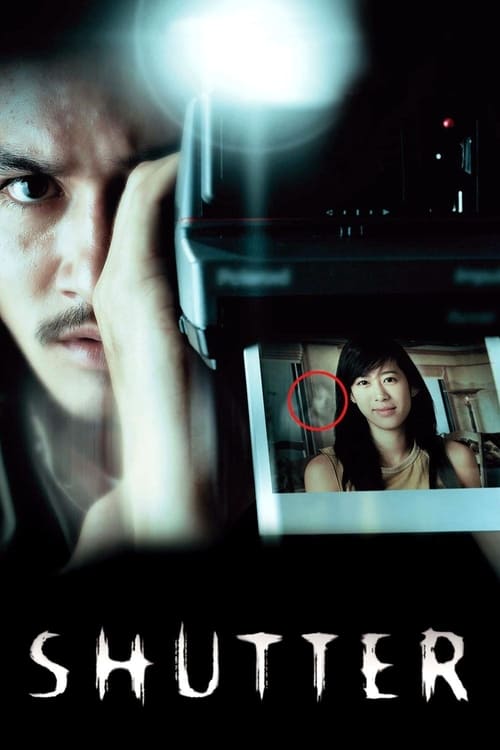
Shutter
2004 · Parkpoom Wongpoom
When you're craving a real scare — the classic kind, with a vengeful ghost and images you'll carry to bed. Best with the lights off and someone to grab; this is a horror night done properly.
What it's about
A young Bangkok photographer and his girlfriend hit a woman with their car on a dark road and drive away without stopping. Afterward, pale streaks and blurred figures begin appearing in his photographs, and the couple's attempt to explain them leads back into the photographer's past — to a withdrawn student he knew in college and a history he has never told anyone.
The experience
Patient, clammy dread punctuated by some of the most effective jump scares in horror — the film understands that a shape glimpsed in a developing photo is scarier than anything shown outright. It tightens steadily toward an ending people still talk about, and the guilt at its core makes the scares actually hurt.
Performances
Ananda Everingham carries the film as the photographer whose composure erodes frame by frame, letting you read the secret in him long before it's spoken.
The craft
The central device — photography itself as the haunted medium — gives the directors endless tools: light leaks, long exposures, Polaroids snapped in the dark to see what the eye can't. The scares are built with meticulous framing and sound design rather than gore, and the final image is an all-timer of visual storytelling.
Why it matters
The film that put Thai horror on the world map, a massive domestic hit that spread across Asia, spawned remakes including a Hollywood version, and became a touchstone for the vengeful-ghost cycle of 2000s Asian horror.
Snapshot
Shutter (Thai: ชัตเตอร์ กดติดวิญญาณ) is a Thai supernatural horror film co-written and co-directed by Banjong Pisanthanakun and Parkpoom Wongpoom. It is credited here to Parkpoom, but the film was a two-director debut, and nearly every account treats it as a shared work. A young photographer, Tun (Ananda Everingham), and his girlfriend Jane (Natthaweeranuch Thongmee) hit a young woman with their car on a dark road and drive away. Soon afterwards, pale streaks and blurred figures start appearing in Tun's photographs. Jane's investigation leads to Natre (Achita Sikamana), a withdrawn student from Tun's college years. Tun has hidden his history with her, and that history involves betrayal and sexual violence carried out by his friends while he did nothing to stop it.
The film was a major domestic hit and travelled widely across Asia and beyond. It became one of the defining titles of the Asian horror boom of the early 2000s, and probably the Thai film that did the most to give that wave a Southeast Asian accent. It was remade several times, most visibly in Hollywood in 2008. Its best-known image, revealed only at the end, is Tun's burden shown literally: the ghost has been riding on his shoulders all along, caught by a Polaroid camera. That image is widely remembered as one of the genre's most effective final reveals.
Industry & production
Shutter belongs to a turning point in Thai commercial cinema. In the late 1990s and early 2000s, Thai film moved out of a long period of low-budget domestic production and into a more polished, export-minded industry. Signposts of that change include Nonzee Nimibutr's Nang Nak (1999), Wisit Sasanatieng's Tears of the Black Tiger (2000), and Prachya Pinkaew's Ong-Bak (2003). The film is usually identified with GTH (GMM Tai Hub), a studio formed in 2004 from GMM Pictures, Tai Entertainment and Hub Ho Hin. GTH became the dominant producer of mainstream Thai genre and youth films for the next decade. The exact production and distribution credits in the film's early release materials are not fully consistent in the English-language sources, and readers should check them against Thai-language records.
Banjong and Parkpoom were young directors with backgrounds in short films and commercial work. The pair had been involved in the collective youth-nostalgia project Fan Chan (My Girl, 2003), which several young filmmakers made together for the companies that later merged into GTH. Shutter was the feature that established both men as directors in their own right. Reliable figures for the budget and box office are not consistently documented in English-language scholarship and are not given here. What is well attested is that the film was among the year's top domestic earners, did strong business in other Asian markets, and was picked up for international distribution and remake rights.
Technology
Shutter is a 35mm production. Technologically, its main interest is not its own capture format but the photographic technologies it puts on screen. Tun works mostly with film cameras and darkroom processes. The plot depends on chemical prints and on the instant Polaroid, both media with a physical, indexical tie to the moment they record. The film draws on the nineteenth-century history of "spirit photography," in which double exposures and processing artefacts were sold as proof of the dead among the living. The ghost appears as a light leak, a smear, or a figure behind the sitter. The film makes those artefacts its main language of dread.
The release came just as consumer photography was moving decisively to digital. In hindsight that gives Shutter's darkroom scenes a valedictory quality. The film's fear depends on images that develop slowly and that cannot easily be manipulated or checked on the spot. Digital visual effects are used sparingly, mostly for compositing the ghost into frames and for a few apparitions. Compared with Hollywood horror of the same years, the effects work is modest. The film relies more on timing and framing than on spectacle.
Technique
Cinematography
The cinematography, credited to Niramon Ross, uses a palette of cold blues, greys and sodium-tinged night exteriors. The images are clean and fairly naturalistic. They are not expressionist. That plainness makes the intrusions into the photographs more disturbing. Much of the film's suspense depends on the viewer studying a still image: a contact sheet, an enlargement, a framed print. Camera movement over these photographs, and slow pushes into empty corners of the frame, train the audience to search negative space for something that does not belong.
The camera is often placed at a distance from the characters, which leaves room in the frame for things to appear behind them. This strategy is common to the J-horror tradition. The film's best-remembered set-pieces come from it, including the stairwell sequence and the encounter in the photo lab.
Editing
The editing alternates between slow investigative passages and sharply timed scares. Some of those scares are true jump-scares backed by sound stings. Others are slower reveals that let an image settle before the viewer notices what is wrong with it. The structure keeps back the key piece of the past, what happened to Natre at college, and releases it in flashback fragments that recast Tun's earlier behaviour. The final reveal is withheld until after the apparent resolution of the mystery. The editing places it as a coda that reframes everything before it, including Tun's repeated complaints of neck pain and the scales that show him impossibly heavy.
Mise-en-scène / staging
The settings are drawn from contemporary middle-class Bangkok: apartments, a university, a photographic studio, a darkroom, hospital corridors, and the rural house where Natre's mother lives. The ordinariness of these spaces is deliberate. The film stages its haunting in the places where young urban professionals live and work. It does not use the temples, forests or villages of older Thai ghost films.
Natre's design follows the long-haired, pale female ghost familiar from Ringu (1998) and Ju-on (2002). The film adapts that figure rather than simply copying it. In the climax the ghost has been positioned physically on top of the protagonist. That turns a bodily metaphor of guilt "weighing" on someone into staging, and the film has prepared it through small physical details.
Sound
The film's sound design and score (the music is credited to Chatchai Pongprapapan) favour low drones, near-silence, and abrupt sound stings at moments of revelation. Small diegetic sounds carry much of the tension: the click of a shutter, the whine of a flash charging, footsteps in a stairwell. The shutter-click works as a recurring sound motif that links the act of looking to the act of summoning. Detailed scholarly analysis of the score is scarce in English.
Performance
Ananda Everingham was then emerging as one of Thai cinema's most bankable young leads. He plays Tun as evasive and steadily disintegrating, and the performance lets the audience suspect his account long before the film confirms that he is lying. Natthaweeranuch Thongmee's Jane is the film's investigator and moral centre. Her slow move from loyal partner to horrified witness gives the narrative its ethical charge. Achita Sikamana plays Natre in flashback as fragile and isolated, and in death as an almost wordless presence. The film depends on the contrast between the two to make the haunting read as grievance rather than random malice.
Narrative & dramatic mode
Shutter is built as a supernatural mystery with an investigative structure. Jane questions the photographs, finds out about Natre, visits Natre's mother, and gradually reconstructs a crime. Running alongside this is a guilt narrative. Tun's college friends, who took part in Natre's abuse, die one after another by apparent suicide, so the past arrives as a series of retributions.
The dramatic mode is moral retribution in the form of a ghost story. As in many Asian ghost narratives, the dead woman haunts the living because a wrong has gone unacknowledged. The film refuses to let Tun's passive complicity stand as innocence. The ending denies him resolution: he falls from a height and ends up institutionalised, with Natre still clinging to him. That ending is typical of the cycle's taste for bleak conclusions. It also makes an argument: confession and partial knowledge do not discharge the debt.
Genre & cycle
The film sits inside the pan-Asian horror cycle that followed Ringu: Japanese films such as Ju-on and Dark Water (2002), Korean films such as A Tale of Two Sisters (2003), and the Hong Kong–Thai co-production The Eye (2002) by the Pang brothers. These films share the vengeful female ghost, the use of everyday technologies as conduits for the supernatural (videotape, telephones, and here photography), and an interest in the slow reveal of buried trauma.
Within Thailand, Shutter sits alongside a domestic tradition of ghost cinema that stretches back through the many versions of the Mae Nak legend. In the years after the film, Thai horror production surged. GTH and other studios pursued horror as a dependable genre for both domestic and export markets, and Shutter is generally seen as having shown how commercially strong the formula could be.
Authorship & method
Directors and writers. Banjong Pisanthanakun and Parkpoom Wongpoom co-directed and co-wrote the film. Sopon Sukdapisit is generally credited as a co-writer; he later became a horror director himself. The co-directing partnership continued with Alone (Faet, 2007), another supernatural story about guilt and a shared past. Both men then contributed segments to the GTH anthologies 4bia (Phobia, 2008) and Phobia 2 (2009). After that their paths diverged. Banjong became one of Thailand's most commercially successful directors with the horror-comedy Pee Mak (2013), a reworking of the Mae Nak legend, and later directed The Medium (2021), produced with Korean filmmaker Na Hong-jin. Parkpoom's later directing output has been less extensive, and English-language documentation of it is thin.
Method. The early Banjong–Parkpoom films share a method: tightly plotted genre stories that end with a twist; contemporary settings; young professional protagonists; and a deliberate use of everyday objects (the camera, a mirror, a photograph) as sources of fear. Their films are mainstream entertainment and have been accepted as such. Critics have also noted how carefully they set up their reveals.
Key collaborators. Cinematography is credited to Niramon Ross, and music to Chatchai Pongprapapan. Editing credits are not consistently reported in the English-language sources consulted here and are left unattributed rather than guessed.
Movement / national cinema
Shutter is part of the Thai "new wave" of commercial filmmaking that began in the late 1990s. That movement had two strands. One was a commercially ambitious, genre-literate mainstream: Nonzee Nimibutr, Pen-Ek Ratanaruang's early work, Wisit Sasanatieng, Prachya Pinkaew, and the GTH directors. The other was an art-cinema strand, best represented by Apichatpong Weerasethakul.
Shutter belongs firmly to the first strand. It was part of the evidence that Thai genre film could compete regionally with Japanese, Korean and Hong Kong output. Its success helped build GTH's identity as a youth-oriented studio able to work in horror, romantic comedy and nostalgia. It also gave Thai horror an international visibility it had not had before.
Era / period
The film came out at the height of the Asian horror boom and of Hollywood's appetite for remaking it. The Ring (2002), The Grudge (2004) and Dark Water (2005) had shown that Hollywood studios would pay for East Asian horror properties. Shutter's remake rights were sold within this period.
Domestically, the film reflects a Bangkok middle class shaped by the economic recovery after 1997, along with the professionalisation of Thai media work. Tun is a commercial photographer, and the film's world of studios and agencies matches that milieu. As noted under Technology, it also stands just before photography's digital transition. That partly explains why its central conceit has aged into a period piece about analogue media.
Themes
- Guilt and complicity. The central moral question is whether Tun's failure to step in, and his part in covering up the assault, make him responsible. The film's answer is yes. The friends' deaths and Tun's final punishment present bystander passivity as a form of participation.
- Gendered violence and the vengeful woman. Natre belongs to the long line of wronged women in Asian ghost stories, such as the onryō in Japan and Mae Nak in Thailand, whose haunting answers male violence and social indifference. The film puts sexual violence among university men at the centre and treats it as the original crime.
- Photography as witness. The camera records what the living refuse to see. The film draws directly on the folklore of spirit photography, and it turns the medium's evidential claim against the photographer: Tun's own pictures testify against him.
- The burden of the past. The literal weight of the ghost on Tun's shoulders, set up through neck pain and the weighing-scale scene, is the film's governing metaphor. Unconfessed history becomes a bodily load.
- Hit-and-run and flight. The opening accident, and the couple's choice to drive off, make the theme of evasion visible right away. Everything after it follows from a refusal to stop and face what happened.
Reception, canon & influence
Critical reception. On release, Shutter was a substantial commercial success in Thailand and did well across Asia. International festival and genre-press coverage generally praised its scares, its construction and its ending. Some critics noted that it drew heavily on the J-horror template, especially in the look of its ghost and in some of its set-pieces. The film has kept a strong reputation among horror audiences, and it often appears in critics' and fans' lists of the best Asian horror films of its era. It is commonly remembered as the Thai horror film international audiences are most likely to have seen.
Influences on the film (backward).
- Ringu (Hideo Nakata, 1998) and Ju-on (Takashi Shimizu, 2002): the long-haired female ghost, technology as a channel for the supernatural, and a ghost driven by grievance.
- The Eye (Pang brothers, 2002): a Thai–Hong Kong ghost film that had already shown regional horror could reach audiences abroad.
- The Thai Mae Nak tradition, and Nonzee Nimibutr's Nang Nak (1999) in particular, which had revived Thai ghost cinema as a prestige popular form.
- The visual and folkloric history of Victorian spirit photography, which the film quotes directly.
Legacy (forward).
- Remakes. Shutter was remade in the United States as Shutter (2008), directed by Masayuki Ochiai, starring Joshua Jackson and Rachael Taylor, and set in Japan. That remake was poorly received critically. It was also adapted in India, including the Tamil Sivi (2007) and the Hindi Click (2010). Other regional versions have been reported, and their details should be checked individually.
- Thai horror production. Its success encouraged a sustained run of Thai horror from GTH and its competitors, including the directors' own Alone and the 4bia/Phobia 2 anthologies. It helped make horror one of the most reliable export genres of Thai commercial cinema.
- The directors' careers. It launched Banjong Pisanthanakun's career, which led to Pee Mak, one of the highest-grossing Thai films, and to the internationally acclaimed The Medium. The ghost-and-guilt preoccupations of Shutter carry through that body of work.
- The photographic ghost. Its central conceit, the camera that sees what the eye cannot, became a reference point for later horror built on recording technologies. The final shoulder-ghost reveal is often cited as one of the cycle's defining images.
Shutter is not a formally radical film. Its place in an atlas of influence comes from timing and precision. It arrived when the Asian horror wave had the world's attention, it took that wave's grammar and gave it a sharp moral structure about male complicity, and it showed that a Thai studio could produce a horror film that both domestic and international audiences would treat as a reference point.
Influences: the films it descends from and the films it influenced
- Ringu (1998) — Shutter takes two things from Ringu: a domestic recording format (VHS there, film photography here) as the ghost's channel, and Sadako's long-haired, face-hidden ghost with her jerky, unnatural movement, which Shutter copies in Natre's look and slow approach.
- Ju-on: The Grudge (2002) — Shimizu made scares out of ordinary rooms and a ghost who appears where the frame offers nothing to look at: behind a character, under bedding, on a stairwell. Shutter builds its apartment and office scares the same way.
- The Eye (2002) — This Hong Kong–Thai co-production, partly shot in Thailand, is about a ghost seen through a damaged way of seeing (a transplanted cornea). It ends in an investigation that uncovers a dead woman's past. Shutter swaps the cornea for the camera lens.
- Nang Nak (1999) — Nonzee made the Mae Nak legend a polished, serious form again: a wronged woman who refuses to let her man go. Shutter moves that pattern into modern Bangkok, with Natre clinging to Tun's body.
- Kairo (Pulse) (2001) — Kurosawa used empty, unbalanced frames and ghosts half-visible through technology. Shutter's wide shots that leave dead space around Tun, waiting for something to fill it, come from this style.
- Blow-Up (1966) — Blow-Up's key scene has a photographer enlarging prints in his darkroom until a hidden figure, and a crime, appear in the grain. Shutter repeats that scene with supernatural evidence.
- The Sixth Sense (1999) — Both films end with a twist that cuts back to earlier scenes in quick flashes so the audience re-reads them. Shutter's late reveal of Natre on Tun's shoulders, and his neck pain, works the same way.
- Ring (1998) — Thai cursed-media variant that transposes Ring's cursed-image conceit from videotape to photographs, with the long-haired onryo manifesting through developed prints.
- Alone (Faet) (2007) — The co-directors' next film uses the same structure: a guilty secret about a woman from the main character's past, a ghost tied to that guilt, and a final twist that changes who the main character is.
- 4bia (Phobia) (2008) — This GTH anthology came out of Shutter's success. It splits Shutter's twist-led ghost story into short episodes, each built on an everyday object or space: a phone, a tent, a plane.
- Shutter (2008) — The Hollywood remake moves the story to Japan and recreates the spirit-photo set pieces and the shoulder-ghost ending almost shot for shot. It shows those devices can be copied directly.
- Sivi (2007) — This Tamil remake keeps the camera that sees the ghost and the friends' guilt over the woman they abandoned. It recasts these as Indian melodrama, which shows the plot structure travels well.
- Click (2010) — This Hindi version keeps the photographic structure: blurs and double exposures in the protagonist's prints are the clues that drive the investigation.
- Coming Soon (2008) — Shutter's co-writer moves the haunted recording from photographs to a film print. A projectionist is stalked by a ghost who crosses from the screen into the cinema.
- Sinister (2012) — It turns Shutter's camera that sees what the eye cannot into a horror of studying footage. A writer goes through home-movie reels frame by frame and finds a figure hidden at the edges of each one.
- Pee Mak (2013) — Banjong goes back to the Mae Nak story behind Natre and uses it for horror-comedy. The gags work because Shutter trained Thai audiences to watch the background for a ghost.
- The Medium (2021) — The scares in the second half come from night-vision CCTV footage, which shows a possession the characters cannot see in the room. It updates Shutter's recording device that sees for us.
- A Useful Ghost (2025) — Shows a Thai ghost living inside a consumer technology (the camera and its developed prints), the industrial model behind a spirit that possesses an everyday device.
Similar films
- Ju-on: The Grudge (2002) — influence & lineage
- The Medium (2021) — influence & lineage
- Grave Torture (2024) — shared sensibility
- A Tale of Two Sisters (2003) — shared sensibility
- Saw (2004) — shared sensibility
- Séance (2004) — shared sensibility
- Gonjiam: Haunted Asylum (2018) — shared sensibility
- Oddity (2024) — shared sensibility