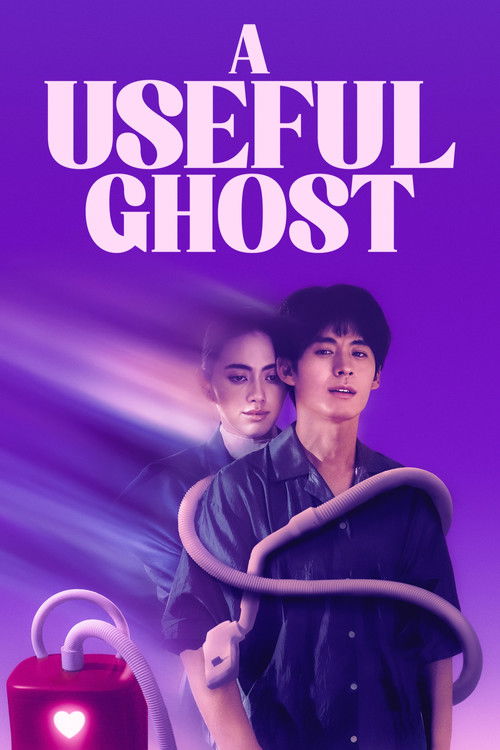
A Useful Ghost
2025 · Ratchapoom Boonbunchachoke
For when you want something genuinely unlike anything you've seen — funny and strange on the surface, with real feeling and real anger underneath. A comfort watch and a challenge at once; great for a night when you're open to being surprised.
What it's about
Nat has just died of a respiratory illness, but she isn't ready to leave her husband behind — worried that dust will harm him, she returns as a ghost inhabiting a vacuum cleaner to keep their house clean. From that absurd setup grows a deadpan Thai comedy about love after death, a family that would rather certain ghosts stay forgotten, and a society that decides which of its dead get to be remembered at all.
The experience
It plays like a sketch that keeps deepening: you laugh at the vacuum-cleaner romance, then realize the film has quietly become a love story and a political satire at the same time. Playful, mischievous, and sneakily moving, with a sting under the silliness.
The craft
Ratchapoom Boonbunchachoke's first feature commits totally to its absurd premise, playing the supernatural with a straight face so the comedy and the grief land together. The tonal control is the trick: romance, satire, and ghost story braided so smoothly you stop noticing the seams.
Why it matters
It won the Grand Prize of Cannes Critics' Week in 2025, instantly making it one of the most internationally visible Thai films in years and announcing its director as a major new voice.
Snapshot
A Useful Ghost (Thai: ผีใช้ได้ค่ะ) is the first feature by Ratchapoom Boonbunchachoke. It starts from a premise that sounds like a sketch. Nat, a young woman, has died of a respiratory illness linked to industrial dust. She comes back to the house she shared with her husband, March, as a ghost living inside a vacuum cleaner. She is worried that the dust will harm him, so she sets out to keep the house clean. From this the film builds a deadpan, layered comedy. It is also a love story, a family satire and, most pointedly, a political allegory about which dead a society lets remain and which ones it erases.
The film premiered in the Critics' Week (Semaine de la Critique) at the 2025 Cannes Film Festival and won that section's Grand Prize. That made it one of the most visible Thai films on the international circuit since Apichatpong Weerasethakul's major works. Thailand later selected it as its submission for the Best International Feature Film category of the 98th Academy Awards. It is a key text for anyone tracing how Thai cinema keeps returning to the ghost as a figure for history, class and political memory.
Industry & production
The film comes out of Thailand's small independent and festival-oriented sector, not the commercial studio system that produces most Thai horror-comedies. Like much Thai art cinema since the 2000s, it appears to have been financed through a mix of local independent production and international co-production and support funds. That is the usual route for Southeast Asian auteur features aimed at European festivals. The publicly available record of its exact production partners, budget and shooting schedule is thin, and this dossier does not try to reconstruct it.
The festival launch matters. Critics' Week is reserved for first and second features, and a Grand Prize there gives a debut film immediate standing with distributors and programmers. Thailand's Oscar submission then pushed the film into a second circuit. It also signalled that national selectors were willing to endorse a work whose allegorical politics are sharply critical of state power, which is notable given the country's censorship climate.
Technology
Nothing in the record suggests the film is technologically innovative in its capture or delivery. It is a digitally shot, contemporary art-house production. What is notable is how it handles technology as a subject. The central conceit makes a domestic appliance the body of a ghost. The film's special effects are mostly modest. The vacuum cleaner "speaks", moves and expresses emotion through sound, staging and the performance of the actors around it, not through spectacular digital effects. This low-fi approach is part of the joke. It recalls a Thai popular-cinema tradition in which the supernatural is presented matter-of-factly instead of being dressed up as spectacle.
Technique
Cinematography
Critics generally described the images as composed and controlled. Static or slow-moving frames suit the film's deadpan register, and domestic and industrial interiors are treated with a cool, observational eye. Restraint is the main principle: the camera seldom underlines a gag or a supernatural event, so the absurd and the sincere sit in the same flat, even light. The cinematographer's name and specific technical choices (format, lenses, aspect ratio) are not documented well enough in the sources available here to discuss with confidence.
Editing
The film is built from nested stories. It is a tale told within a frame, and its episodes shift tone between romance, domestic comedy and political satire. The editing therefore has two jobs: to manage the transitions between narrative layers, and to hold comic timing within scenes. The deadpan effect depends on letting shots run slightly long. Absurd situations are held until they turn uncomfortable or unexpectedly moving.
Mise-en-scène / staging
The house and the factory are the two poles of the film's world. Domestic interiors, ordinary furniture and the everyday labour of cleaning are staged with near-documentary plainness. That plainness makes the presence of a ghost-appliance both funnier and stranger. The film also keeps returning to dust: it is in the air, on surfaces and in lungs. Dust connects Nat's private devotion to a wider picture of pollution and of the workers who breathe it. The staging treats the vacuum cleaner with full seriousness, as a romantic partner and a member of the household. That is the core of the film's comic method.
Sound
Sound carries much of the fantasy. Because Nat lives in a machine, her presence is largely heard: the motor's hum and whine, plus the voice the film gives her. Sound design does the work that visual effects do in a conventional ghost film. Information about the score and its composer is limited in the record available here.
Performance
Davika Hoorne plays Nat. Her casting carries a deliberate charge. Davika played Nak in Pee Mak (2013), Banjong Pisanthanakun's hugely successful comic retelling of the Mae Nak legend. In A Useful Ghost she once again plays a dead wife who returns to her husband, which makes the film a knowing variation on the most famous ghost story in Thai culture. The performances are pitched in a dry, sincere register. Characters react to absurd circumstances with straight faces, and the film's emotional effects grow out of that lack of irony. The supporting cast's details are not covered here because the sourcing is thin.
Narrative & dramatic mode
The film works as a framed, multi-part fable. Its central romance follows Nat and March as they try to continue their marriage across the line between living and dead, against the resistance of March's family. In the family's eyes a ghost is acceptable only on conditions, and the main condition is that she be useful. The story widens from there. Other ghosts appear, in particular the dead tied to the family's factory and to histories of state violence. Nat's acceptance turns out to depend on her willingness to take part in getting rid of ghosts that are less convenient.
The mode moves between deadpan comedy, melodrama and political allegory without settling into any one of them. The tonal mix is the argument. The film's humour comes from treating an absurd premise literally, and that literalism exposes the logic of a society that values the dead, and by extension the living, only for their usefulness.
Genre & cycle
A Useful Ghost sits within, and comments on, the Thai ghost film, one of the most productive popular genres in Southeast Asian cinema. Its closest ancestors are the many versions of the Mae Nak Phra Khanong legend. These include Nonzee Nimibutr's Nang Nak (1999), a landmark of the Thai New Wave, and Pee Mak (2013), which turned the legend into a comedy and a box-office phenomenon. The film borrows the dead-wife-returns template and the horror-comedy register that Thai audiences know well. It then empties out the scares and replaces them with satire.
It also belongs to the international art-house "absurdist allegory" cycle: festival films that use one strange, literal premise to explore social or political problems. In that cycle it can be compared with the deadpan fantasies of Yorgos Lanthimos's Greek period or Roy Andersson's tableau comedies, though its cultural sources are distinctly Thai.
Authorship & method
Ratchapoom Boonbunchachoke came to features after working as a film critic and making short films that circulated at international festivals. The best known of these is Red Aninsri; Or, Tiptoeing on the Still Trembling Berlin Wall (2020). It reworked a Thai pulp spy figure into a queer, politically pointed pastiche, and it already showed his interest in mining Thai popular culture for political critique. A Useful Ghost carries that method into a feature. It takes a beloved popular form, the ghost-wife story, and reworks it with critical distance and deadpan humour, while also holding on to its sincerity.
Ratchapoom wrote and directed the film. Details of his key collaborators (cinematographer, editor, composer, producers) are not reliably established in the sources available for this dossier, and they are not named here so as to avoid misattribution. His critic's background is visible in the film's dense awareness of film history and genre convention.
Movement / national cinema
The film belongs to a generation of Thai independent filmmakers working in the wake of Apichatpong Weerasethakul. Apichatpong made ghosts, reincarnation and the coexistence of living and dead central subjects of Thai art cinema in films such as Uncle Boonmee Who Can Recall His Past Lives (2010) and Cemetery of Splendour (2015). In those films, too, the spirits hint at suppressed political histories, from the anti-communist violence in the Northeast to military rule. A Useful Ghost takes up that inheritance but trades Apichatpong's meditative slowness for comedy and narrative play.
It also connects to the politically engaged Thai independent cinema that emerged after the 2006 and 2014 coups and the 2010 crackdown on Red Shirt protesters in Bangkok. Filmmakers in this current have often had to speak through allegory because of censorship and lèse-majesté laws. Allegory is a structural necessity in this film, not just a style: ghosts let the film point to deaths and erasures that cannot easily be named directly.
Era / period
The film reflects the Thailand of the 2020s. The 2020–21 youth-led protest movement, the trials that followed and the continuing debate over political memory form its implicit backdrop. The film's concern with which dead may be remembered and which must be "cleaned away" lines up with real disputes over commemorating state violence in modern Thai history, including the 1976 Thammasat University massacre and the 2010 crackdown. Its attention to industrial dust and air pollution also places it in a period when PM2.5 pollution has become a constant public-health issue in Bangkok and northern Thailand.
Internationally, the film arrived during a wider festival interest in Southeast Asian cinema in the mid-2020s, as programmers and critics looked beyond the established names to a new generation of directors from the region.
Themes
- Usefulness and the conditions of belonging. The title names the central idea. Nat is tolerated by her husband's family, and by extension by the social order, only as long as she is productive. The film carries this logic of usefulness from the domestic sphere into politics and labour, where people are valued only for what they provide.
- Memory and erasure. Ghosts in Thai culture are memories that refuse to leave. The film imagines a society that wants to purge its inconvenient dead, and it asks what it costs a ghost, or a citizen, to join in that purge so as to be accepted.
- Labour and pollution. Dust links the intimate story to industrial exploitation. Nat's illness and the factory's history make bodily harm part of class relations.
- Love across boundaries. Beneath the satire, the film takes its love story seriously. It follows the romance between a man and a ghost-appliance with real feeling and asks how far devotion can survive social disapproval. Critics also noted the film's queer readings and its interest in desires that do not fit normative family structures, which continues a thread from Ratchapoom's short films.
- Domesticity and gender. A dead wife coming back to clean the house is a pointed image of feminized domestic labour, and the film's humour sharpens the critique.
Reception, canon & influence
Critical reception. The film was widely praised at its Cannes premiere for its originality, its control of tone and its confident blend of comedy and political allegory. The Critics' Week Grand Prize confirmed that response. Reviewers often singled out the audacity of the premise and the way the film pulls real emotion and political weight out of material that sounds ridiculous. Some critics found the layered structure and the late shift into sharper allegory demanding. Even so, the dominant view placed Ratchapoom among the most promising new directors in world cinema. The specifics of commercial performance in Thailand and abroad are not documented well enough here to quote.
Influences on the film (backward). The clearest lineage is the Mae Nak tradition, especially Nang Nak (1999) and Pee Mak (2013). Davika Hoorne's casting makes the connection explicit. Apichatpong Weerasethakul's ghost-haunted political cinema is the major art-house precedent. The Thai horror-comedy tradition supplies the popular register that the film turns into satire. Further back, the film draws on the wider practice of political allegory in cinemas working under censorship, and on deadpan absurdist comedy in international art film.
Legacy (forward). As a 2025 release, the film's long-term influence cannot yet be measured, and any claim about what it has shaped would be premature. What can be said is this: its Cannes prize and Thailand's Oscar submission establish it as a reference point for Thai cinema of the mid-2020s. It shows that the national ghost genre can still carry new political and formal ambitions, and that a Thai debut can reach international audiences through comedy as well as contemplation. Within Sightlines, it is a node where the popular Mae Nak lineage and the Apichatpong art-cinema lineage meet and are reworked for a new generation.
Influences: the films it descends from and the films it influenced
- Ugetsu (1953) — Establishes the Asian ghost-wife fable's central formal move: the dead spouse is staged in the same unbroken, matter-of-fact long takes as the living, so the haunting reads as domestic intimacy rather than shock.
- Nang Nak (1999) — Recast the Mae Nak legend as a solemn, devotional romance in which the ghost-wife's love is played with total sincerity; A Useful Ghost borrows that sincerity and turns it against the absurd premise.
- Pee Mak (2013) — Moved Mae Nak into mainstream horror-comedy, building scares and gags on the gap between what the husband knows and what the audience knows; casting its Nak, Davika Hoorne, puts that whole popular register inside Ratchapoom's satire.
- Tears of the Black Tiger (2000) — Founding example of the Thai popular-genre pastiche: it takes over the look of old Thai melodrama and westerns (hand-tinted colour, painted sets) and plays it straight-faced, so the artifice itself becomes the commentary.
- Tropical Malady (2004) — Its break into two halves, with the second turning into a folk tale of a shape-shifting spirit, sets the precedent for a Thai feature built as a framed, multi-part fable that changes register partway through.
- Uncle Boonmee Who Can Recall His Past Lives (2010) — Brings ghosts to the dinner table in static, evenly lit frames, using deliberately cheap effects (a red-eyed monkey suit, a double-exposed dead wife), and uses the haunting to call up the army's violence in the Nabua region.
- Cemetery of Splendor (2015) — A post-coup allegory staged in a hospital: sleeping soldiers, colour-cycling medical lamps, and spirits who speak through a medium show how state history gets buried under ordinary everyday routine.
- Shutter (2004) — Shows a Thai ghost living inside a consumer technology (the camera and its developed prints), the industrial model behind a spirit that possesses an everyday device.
- Pulse (Kairo) (2001) — Ghosts that pass through household machines are announced by degraded sound and electronic static, a template for the vacuum cleaner's motor drone serving as the ghost's body.
- House (Hausu) (1977) — Its knowingly handmade effects, with possessed household objects (a piano, a lampshade, a futon) attacking, are the precedent for treating a domestic appliance as a ghost and enjoying how cheap the trick looks.
- Songs from the Second Floor (2000) — Its locked-off, pale, deep-staged tableaux, held past the point of comfort, became the international art-film grammar for deadpan political satire that the seed's static observational frames draw on.
- Red Aninsri; Or, Tiptoeing on the Still Trembling Berlin Wall (2020) — The director's own short that tested his method: a Cold War Thai pulp spy figure reworked as queer, politically pointed pastiche, played completely straight-faced.
- The Edge of Daybreak (2021) — Extends the post-coup Thai haunted-house allegory through dense, oppressive sound design, letting off-screen noise stand in for political trauma that the images refuse to show.
- By the Time It Gets Dark (2016) — A post-coup Thai feature built in fragmented, nested parts that circles the erased memory of the 1976 Thammasat massacre and keeps changing frame and genre to show how official history is put together.
- Manta Ray (2018) — A near-silent, still-framed parable in which one man quietly takes over another's life, addressing a state-erased population (Rohingya refugees) through allegory rather than statement, the same evasive method the seed uses under censorship.
- A Ghost Story (2017) — A bedsheet ghost made with the simplest possible costume and held in long static shots that turn its stillness into deadpan pathos; the seed's appliance-ghost relies on the same minimal-effects idea.
- Rubber (2010) — Gives a sentient household object (a tyre) a full inner life through deadpan, straight-faced staging and a meta framing device, the same structure as the absurd-object premise that carries the seed's allegory.
- The Lobster (2015) — A dystopian premise in which people are allowed to stay only if they meet a social requirement, delivered in flat, affectless line readings; it matches the seed's satire of usefulness as the price of belonging.
Similar films
- Uncle Boonmee Who Can Recall His Past Lives (2010) — influence & lineage
- Cemetery of Splendor (2015) — influence & lineage
- How to Make Millions Before Grandma Dies (2024) — same viewing thread
- Rental Family (2025) — same viewing thread
- Falling in Love Like in Movies (2023) — often watched together
- House (1977) — shared sensibility
- On Becoming a Guinea Fowl (2024) — shared sensibility
- Grave Torture (2024) — shared sensibility
All the films related to A Useful Ghost →
Watch it with: curated runs of related films
- Funny Because It Aches — A run of tender, deadpan dramedies where love, grief, and the panic of becoming yourself all get metabolized through jokes — watch these when you want to laugh and cry in the same scene.