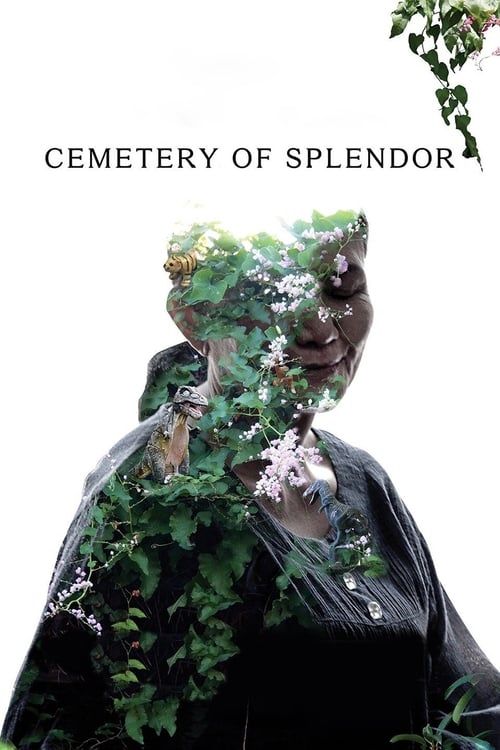
Cemetery of Splendor
2015 · Apichatpong Weerasethakul
Memoria's "one screen at a time, never streaming" release turned distribution itself into an artwork and a permanent debate about access versus aura. The name that signals deepest-end cinephilia.
For when you want to slow all the way down — a film to surrender to on a quiet night, not one to multitask through. Challenging if you need momentum; deeply restorative if you're in the mood to drift.
What it's about
In a converted schoolhouse in northeastern Thailand, a platoon of soldiers lies afflicted by a mysterious sleeping sickness no one can cure. Jenjira, a middle-aged volunteer, keeps watch over one sleeping patient and — with help from a young psychic who can channel the dreamers' minds — begins a strange, tender relationship with a man who is almost never awake. Goddesses drop by like neighbors, and the ground beneath the clinic holds old kings and older wars.
The experience
Slow, serene, and gently uncanny — less a plot than a state you enter. Scenes drift between the everyday and the miraculous without ever announcing the switch, and the effect is hypnotic: you come out feeling like you've been somewhere, half-dreaming, for two hours.
The craft
Apichatpong Weerasethakul builds the film from long, patient takes where documentary-plain observation and the supernatural share the same unbroken frame — no effects fanfare, just a shift in what you accept. The sound design of fans, insects, and murmured conversation does half the work; it rewards a dark room, good speakers, and zero distractions.
Why it matters
A festival-circuit landmark that cemented its director's standing as one of world cinema's singular voices, and a touchstone for slow, dream-logic filmmaking with quiet political undercurrents.
Snapshot
Cemetery of Splendor (Thai title Rak ti Khon Kaen, "Love in Khon Kaen") is Apichatpong Weerasethakul's sixth narrative feature, set in his childhood city of Khon Kaen in Thailand's northeastern Isan region. A makeshift clinic — a former schoolhouse — houses a platoon of soldiers afflicted by an inexplicable sleeping sickness. Jenjira, a middle-aged volunteer with a malformed leg, attaches herself to one slumbering patient, Itt, and learns from two goddesses, manifesting as ordinary women, that the clinic sits atop the buried palace and cemetery of ancient kings who are siphoning the soldiers' vitality to wage their long-dead wars. With the aid of a young psychic, Keng, who channels the sleepers' minds, Jen forms a tender, displaced intimacy with the unconscious Itt. The film fuses near-documentary observation with matter-of-fact enchantment, and it doubles, with great quietness, as an allegory of a Thailand sedated by military rule. It premiered in the Un Certain Regard section at the 2015 Cannes Film Festival and was widely received as a culminating statement of Apichatpong's Thai period — the director openly suggested it might be the last feature he would shoot in his home country.
Industry & production
The film is a hallmark of the dispersed, multi-territory financing on which contemporary art cinema depends. It was produced through Apichatpong's own Bangkok company, Kick the Machine Films, in coordination with Illuminations Films (the UK outfit of producer Keith Griffiths) and a constellation of European and Asian partners — French, German, Malaysian, South Korean, and other co-producers, with backing typical of the festival-funded circuit (sources including the Doha and regional film funds). The exact capitalization is not transparently documented in the public record, and I will not assign figures; what is clear is that the budget was modest by any commercial standard and that the picture was assembled, as Apichatpong's films characteristically are, from small grants, broadcaster and fund contributions, and co-production equity rather than from a single national industry.
This mode of production is inseparable from the film's politics. Made in the immediate aftermath of the May 2014 military coup, and by a director with a long, public history of conflict with Thai censorship — most famously the 2007 dispute over Syndromes and a Century, which galvanized the Free Thai Cinema Movement — Cemetery of Splendor was conceived under conditions that made domestic exhibition fraught. Apichatpong has long worked outside Thailand's mainstream distribution apparatus, and the film's primary life was on the international festival and arthouse circuit; in the United States it was handled by Strand Releasing. The director's stated sense that he could no longer film freely in Thailand pointed forward to his subsequent relocation of production to Colombia for Memoria (2021).
Technology
Technically the film is unostentatious, and deliberately so. It was shot digitally in widescreen, a continuation of Apichatpong's move away from celluloid; the image privileges available and practical light over engineered spectacle. The single most conspicuous piece of technology within the frame is a real-world therapeutic device installed beside the soldiers' beds: banks of fluorescent tubes that cycle slowly through saturated colors — magenta, cyan, amber, green — ostensibly to regulate the sleepers' rest and grant them gentler dreams. These color-shifting columns are both a diegetic apparatus and the film's defining lighting instrument, transforming the ward into a chromatic, almost aquarium-like space. The choice exemplifies Apichatpong's tendency to let a found object or a piece of vernacular machinery (here a sleep-therapy lamp) carry the film's visual signature rather than imposing effects in post-production.
Technique
Cinematography
The cinematography is by the Mexican cinematographer Diego García — a notable shift, since Apichatpong's earlier features (including Uncle Boonmee and Syndromes and a Century) had been shot by Sayombhu Mukdeeprom. García sustains the director's established grammar: a predominantly static or barely mobile camera, long takes held well past conventional cutting points, and frontal, frieze-like compositions in which figures sit, lie, or converse in real time. Natural light and the practical glow of the therapy tubes dominate; daylight scenes in the Isan landscape are flat and humid, lending the supernatural episodes a documentary plainness. The framing repeatedly stages depth — a foreground sleeper, a mid-ground caretaker, a window onto the world beyond — so that the ordinary and the spectral occupy the same continuous, undivided space.
Editing
Editing is by Lee Chatametikool, Apichatpong's longtime collaborator and one of the most significant figures in contemporary Thai cinema. The cutting is sparse and patient, organized around the duration of gesture and conversation rather than dramatic beats. Scenes are allowed to begin before and end after their nominal "content," and the film's structure is associative and reposeful, drifting between waking and sleeping, the living and the buried, without marked transitions. The famous mid-film passage in which Jen and Keng (channeling Itt) walk through an empty park that Keng narrates as a vanished royal palace is built almost entirely from sustained, unbroken movement, trusting the spectator to hold two realities — bare field and invisible palace — simultaneously.
Mise-en-scène / staging
The staging is the film's deepest expressive resource. The converted school, with its rows of beds and luminous tubes, becomes a charged threshold between institution and shrine. Apichatpong stages the miraculous with deadpan domesticity: two goddesses appear to Jen not in a vision but across a table, eating; spirits and mortals share furniture and small talk. Recurrent locations — the ward, a small shrine where Jen leaves offerings, a lakeside, a cinema, and a public excavation site where mechanical diggers churn the earth — accrete into a quiet topography of memory and disinterment. The literal digging of the ground in the final stretch externalizes the film's governing idea: that the present rests, uneasily, on top of an unexcavated past.
Sound
Sound is, as throughout Apichatpong's work, a primary rather than supporting element, designed by Akritchalerm Kalayanamitr. The film largely forgoes a conventional non-diegetic score, building instead from dense ambient texture — insects, wind, the hum of the ward, distant machinery, water — punctuated by occasional source music. This immersive, near-tactile soundscape sustains the film's hypnagogic register, blurring the boundary between the documentary surface and the dream-life pulsing beneath it, and making the act of listening feel continuous with the soldiers' uncanny sleep.
Performance
The performances favor non-professional naturalism and a register of gentle, lived-in presence. Jenjira Pongpas Widner — Jen — is the film's anchor; a recurring Apichatpong collaborator, she plays a character closely modeled on herself, including her real physical condition (one leg shorter than the other, supported by a built-up shoe) and her marriage to an American husband. Her performance is unhurried and emotionally exact, carrying the film's tenderness and its political weight at once. Banlop Lomnoi, as Itt, performs largely in sleep, his stillness becoming a kind of acting. Jarinpattra Rueangram, as the medium Keng, must embody the displacement of a man's consciousness into a young woman's body, which she does with disarming plainness. The ensemble's affectless, intimate style is essential to the film's refusal of melodrama.
Narrative & dramatic mode
The narrative mode is contemplative and elliptical, organized less by plot than by states of consciousness. Causation is loosened; explanation (the kings draining the soldiers) is delivered calmly and accepted without crisis. The film operates in what might be called a magical-realist or animist register, though those Western labels sit uneasily on a worldview rooted in Thai and Isan belief, where reincarnation, spirit mediums, and the continuing presence of the dead are unremarkable. Dramatic tension is replaced by mood, repetition, and quiet revelation; the closest thing to a climax is an act of attention — Jen, in the final image, keeping her eyes wide open as if willing herself to stay awake to a reality the country has been lulled into sleeping through.
Genre & cycle
Nominally classified as drama and fantasy, the film belongs more precisely to the international tendency often termed "slow cinema" or contemplative cinema — the lineage of long takes, real-time duration, and metaphysical patience associated with Tsai Ming-liang, Lav Diaz, Pedro Costa, and Béla Tarr. Within Apichatpong's own corpus it forms part of a continuing cycle of films about the porousness between this world and others, about hospitals and illness (extending the autobiographical hospital material of Syndromes and a Century), and about the Isan landscape as a site of haunting. It is at once a ghost story, a sickbed romance, and a political allegory, holding all three modes in suspension without resolving them into one.
Authorship & method
Apichatpong Weerasethakul (born 1970, Bangkok; raised in Khon Kaen, the son of two physicians) trained first in architecture at Khon Kaen University and then took an MFA in filmmaking at the School of the Art Institute of Chicago, where he absorbed the American avant-garde and structural film traditions. He works simultaneously as a gallery and installation artist, and his cinema bears the marks of both an experimental sensibility and a deep rootedness in Thai vernacular belief. His method is personal and accretive: recurring non-professional performers (above all Jenjira Pongpas Widner), autobiographical material drawn from his medical-family upbringing and his region, and a process that leaves room for improvisation and the documentary capture of place. The hospital, the dream, the double, and the buried past are his persistent figures, and Cemetery of Splendor gathers them into one of his most direct works.
His key collaborators here are integral to the authorship: cinematographer Diego García, who translated the director's static grammar into a new visual partnership; editor Lee Chatametikool, who shaped the film's drifting temporality; and sound designer Akritchalerm Kalayanamitr, whose ambient construction is as authorial as the images. The film is comparatively light on conventional scoring, and I will not attribute a traditional composer's role it does not foreground.
Movement / national cinema
The film stands at the apex of the post-2000 Thai art-cinema breakthrough, of which Apichatpong is the central international figure. It is regional cinema in a pointed sense — its language, locations, and sympathies are Isan, the marginalized, agrarian northeast, rather than Bangkok — and it consciously foregrounds Isan identity, dialect, and belief. Internationally it is read within the global slow-cinema movement and the festival auteur tradition. Crucially, it is also a work of national cinema under duress: produced in a Thailand governed by military junta, shadowed by lèse-majesté law and censorship, and self-consciously aware of the limits on what could be said and shown at home.
Era / period
Cemetery of Splendor is profoundly a film of its moment: 2015, the year after the 2014 coup that installed military rule. Its central image — soldiers rendered literally unconscious, the population tending them, the dead conscripting the living — is legible as a parable of a nation anesthetized by authoritarian power, and of a history (royal, military) that drains the present to refight its old battles. The film never states this directly; its caution is itself a document of the period's constraints. It also belongs to the mid-2010s maturation of digital art cinema and to a turning point in its director's career, after the Palme d'Or for Uncle Boonmee Who Can Recall His Past Lives (2010) and before his self-imposed exile of production to Colombia.
Themes
The governing themes are sleep, dream, and memory as shared rather than private conditions; the continuity between the living and the dead; and the persistence of buried history beneath ordinary ground. Illness and the hospital serve, as in his earlier work, as thresholds to the metaphysical. The film meditates on attention and consciousness — on the political and spiritual labor of staying awake. It is suffused with tenderness toward the aging, the disabled, and the marginalized, embodied in Jen, and with a melancholy ecology of place: the Isan landscape as palimpsest of palaces, cemeteries, schools, and clinics layered atop one another. Reincarnation and the casual co-presence of gods give the film its serenity; the political subtext gives it its ache.
Reception, canon & influence
Critical reception was strongly favorable. Premiering in Un Certain Regard at Cannes 2015, the film was embraced by international critics as a major, if characteristically demanding, work, and it appeared on numerous year-end and decade's-best lists in the years following; it consolidated Apichatpong's standing as one of world cinema's essential living auteurs. As with all his films, a minority of viewers found its slowness and opacity resistant, and its domestic Thai exposure was limited — a function of both its form and its political climate. (Specific awards beyond its festival placements and exact commercial figures are not something I will assign here; the film's value was always understood in critical and canonical rather than box-office terms.)
The influences on the film run backward into Apichatpong's own architecture training and avant-garde education, into the slow-cinema and structural-film traditions, into the documentary impulse of regional Thai life, and into Isan animist belief and the autobiographical world of his physician parents. Its legacy forward is twofold. Within his career it is the pivot to Memoria (2021), which transplanted his concerns with sound, sleep, and the geological memory of place to Colombia and to an international star, Tilda Swinton. More broadly, Cemetery of Splendor has become a touchstone for a generation of filmmakers and artists working at the seam of cinema and the gallery, of documentary and the supernatural, and of the personal and the political — a model for how slow, contemplative form can carry urgent national meaning precisely by declining to raise its voice.
A Deleuzian reading
The thing you remember is the light.
The full Deleuzian reading of Cemetery of Splendor →
Reception
Rapturously received at Cannes 2015 (though fans grumbled it was 'relegated' to Un Certain Regard after Apichatpong's Palme d'Or), it topped critics' year-end lists and has since settled in near the summit of best-of-the-2010s polls as a slow-cinema landmark.
How Cemetery of Splendor was received, from release to now →
Influences: the films it descends from and the films it influenced
- Blissfully Yours (2002) — Establishes the durational real-time observation of bodies at rest in the open air with nonprofessional performers that Cemetery extends to the sleeping soldiers' beds.
- Syndromes and a Century (2006) — Inaugurates the hospital/clinic cycle explicitly cited here, with deep-staged frontal compositions of medical interiors and a doubled, mirrored structure drawn from his physician parents' world.
- Uncle Boonmee Who Can Recall His Past Lives (2010) — Treats ghosts and reincarnation as matter-of-fact visitors within unhurried tableaux, the same deadpan magical-realist register Cemetery applies to its color-bathed sleep ward.
- Mirror (1975) — Models the elliptical dream-and-memory logic—where sleep dissolves the boundary between personal past and buried collective history—that structures Cemetery's drifting temporality.
- Jeanne Dielman, 23 quai du Commerce, 1080 Bruxelles (1975) — Pioneers the fixed frontal camera holding on duration itself as the organizing principle, the structural-film discipline Apichatpong absorbed in Chicago and applies to the soldiers' stillness.
- Sleep (1964) — The foundational avant-garde gesture of training a static camera on a sleeping body for unbroken duration, literalized in Cemetery's ward of dreaming soldiers.
- Flowers of Shanghai (1998) — Perfects the deep-staged static long take lit by warm practical sources, where action recedes into the depth of the frame—the deep-staging Cemetery uses across its dormitory rows.
- Close-Up (1990) — Erases the seam between documentary and fiction using nonprofessionals re-enacting their own lives, the naturalist authenticity underpinning Cemetery's performances.
- The Turin Horse (2011) — Extended duration organized around a cyclical structure of sleep and waking, with bodies in states of suspended animation filmed in long still takes that make temporal suspension itself the subject — extending Turin Horse's formal exploration of entropy and cessation as structural principles.
- India Song (1975) — Tropical languor and sleeping, silent bodies haunted by off-screen voices and colonial history — the soundtrack carrying spectral memory over slow, near-still images, India Song's sound-as-haunting transposed to Thailand.
- City of Pirates (1984) — Sleeping soldiers bathed in slowly cycling colored light tubes, performances pitched in a flat somnambulist register, and a structure that drifts through episodes with no conflict to resolve — the anti-central-conflict poetics Ruiz argued for, practiced.
- Memoria (2021) — Transplants Cemetery's preoccupation with sleep, ambient sound design, and the geological memory buried in a place to Colombia, carrying the static-camera contemplative method to an international star.
- By the Time It Gets Dark (2016) — Carries the Thai art-cinema mode of encoding buried national trauma (the Thammasat massacre) within elliptical, doubled, contemplative form directly downstream from Apichatpong's coup-era allegory.
- Inside the Yellow Cocoon Shell (2023) — Extends the slow, ambient-sound-driven contemplation of sleep, spirit, and rural memory through patient long takes, inheriting Apichatpong's Southeast Asian slow-cinema lineage.
- Thirteen Lives (2022) — Mukdeeprom's tropical color work here — muted, humid, desaturated by available light rather than corrected toward saturation — is the direct precursor of his palette for Thirteen Lives's exterior Thai locations and the environmental sound design both films share.
- Wildlife (2018) — Diego García's own formation: the locked-off, non-POV observational camera that stays at a fixed civil distance from bodies for the full duration of an event, imported directly into 1960 Montana.
- Tropical Malady (2004) — Fuses documentary capture of rural Isan daily life with deadpan animist supernature inside the same static long-take grammar, the template Cemetery deploys for its goddesses and dreaming soldiers.
- Goodbye, Dragon Inn (2003) — Holds static long takes on a near-empty decaying public interior, mining deadpan emptiness and ambient room-tone—Cemetery's school-turned-hospital shares this haunted-architecture stillness.
- Stray Dogs (2013) — Extends slow-cinema duration to extreme fixed-frame endurance with nonprofessional bodies, a contemporaneous answer to the same durational contemplation Cemetery pursues.
- Colossal Youth (2006) — Builds fixed, painterly frames from available natural and practical light around nonprofessional performers playing versions of themselves, the documentary-portrait method Cemetery applies to Jenjira.
- Silent Light (2007) — Stages transcendental everyday miracle through long takes in natural light with a nonprofessional cast and deadpan calm, paralleling Cemetery's quiet supernatural realism.
- Kaili Blues (2016) — Made the year before Kaili Blues, Weerasethakul's film works the identical lyric-cinema mode: natural diffuse light in a specific regional Thai landscape carries the weight of suppressed historical memory, and the associative structure refuses narrative causality in favor of sensory accumulation anchored by a folk-cultural spatial logic.
- Long Day's Journey Into Night (2018) — Both films treat a specific national landscape as a haunted psychic space where sleeping and waking states interpenetrate without clearly marked boundaries, using slow cinema's temporal dilation and a local geography of provincial towns as the means by which national and personal history leak into the present.
- Dry Leaf (2026) — Apichatpong embeds a single matter-of-fact supernatural event inside patient, naturalistic long takes, never breaking the calm realist surface — the 'one quiet miracle in a slow frame' method Koberidze shares.
Similar films
- Syndromes and a Century (2006) — influence & lineage
- Tropical Malady (2004) — influence & lineage
- Uncle Boonmee Who Can Recall His Past Lives (2010) — influence & lineage
- Memoria (2021) — influence & lineage
- Resurrection (2025) — shared sensibility
- The Assassin (2015) — shared sensibility
- Winter Sleep (2014) — shared sensibility
- Petrov's Flu (2021) — shared sensibility
All the films related to Cemetery of Splendor →