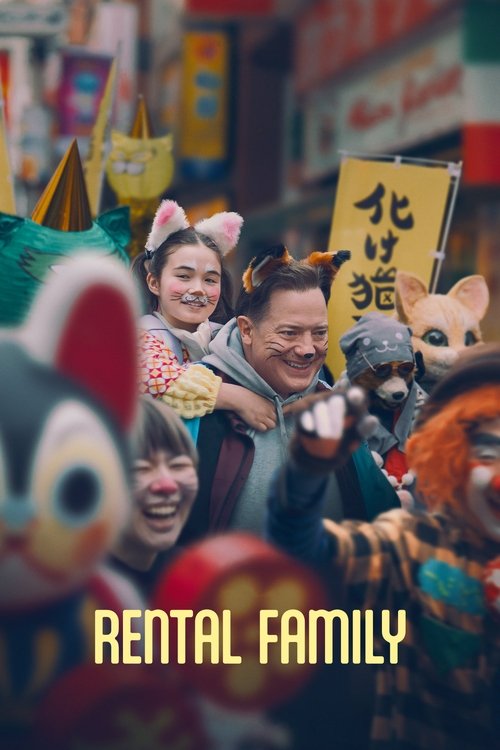
Rental Family
2025 · Hikari
For a night when you want to feel connected to people — something hopeful and humane that earns its lump-in-the-throat moments without punishing you. Comfort viewing with an emotional payload, not a challenge.
What it's about
A struggling American actor in Tokyo takes the only steady work he can find: a job with a 'rental family' agency, where he's hired to play stand-in roles in strangers' lives — a mourner here, an absent parent there. It's a real Japanese industry, and the film follows him into his clients' worlds as the bonds he's paid to fake start turning into something he can't bill for. What begins as an odd gig becomes a question about who he actually is when the performance ends.
The experience
Warm and gently funny, with a persistent ache underneath — it moves at an unhurried pace and keeps catching you off guard with moments of real tenderness. You come out of it thinking about loneliness, and about how much of ordinary kindness is a kind of performance anyway.
Performances
Brendan Fraser leads with the open-hearted, slightly bruised quality he does better than almost anyone — a man whose eagerness to be useful is both funny and quietly devastating.
The craft
Director Hikari, a Japanese American filmmaker, shoots Tokyo from the inside rather than as an exotic backdrop, and the film's smartest choice is tonal: it plays a premise that could be satire as an earnest inquiry into whether performed care can become real care. The writing keeps a light touch, letting the strangeness of the rental-family business speak for itself.
Why it matters
It brought a genuinely odd corner of Japanese service culture to a wide Western audience and extended Brendan Fraser's late-career resurgence into gentler, character-driven territory.
Snapshot
Rental Family is a Tokyo-set comedy-drama directed by the Japanese American filmmaker Hikari, built around a premise drawn from an actual Japanese service industry: agencies that rent out actors to stand in as family members, mourners, wedding guests, or absent parents. Brendan Fraser plays a floundering American actor who takes work with one such agency and finds that the roles he is paid to fake begin to generate real attachment. The film belongs to a recognizable lineage of expatriate-in-Japan character studies and to a smaller, stranger cluster of works fascinated by Japan's commodification of intimacy, but its distinguishing move is tonal: it treats the rental-family conceit less as satire of a peculiar culture than as an earnest inquiry into whether performed care can become actual care. Produced and released by Searchlight Pictures and premiered on the fall-festival circuit in 2025, it arrived as a mid-budget, star-anchored humanist drama of a kind the studio specializes in, positioned as an awards-season prestige release rather than a genre or commercial play.
Industry & production
The film sits squarely in the Searchlight model: a specialty label operating inside a major (Disney) that finances director-driven dramas at a scale between independent film and studio tentpole, then shepherds them through festivals toward critical and awards attention. Casting Brendan Fraser — in the wake of his 2022 Best Actor win for The Whale — gave the project a bankable, sympathetic lead whose own public narrative of comeback and vulnerability maps onto the character's arc of a stalled performer seeking purpose. That resonance between star persona and role is a deliberate production asset of the kind Searchlight has long exploited.
The production was shot on location in Tokyo and is bilingual, moving between English and Japanese, which places practical demands on financing, crewing, and casting across two national industries. The supporting ensemble draws on established Japanese screen actors, giving the film a genuinely binational cast rather than a Western production merely using Japan as backdrop. Beyond these broad contours, granular production data — budget, precise shooting schedule, exact release-date sequencing, and box-office performance — is not something I can state reliably here, and I will not invent figures; the film is recent enough that its full commercial record was still settling at the time of writing.
Technology
On available evidence the film is a conventionally captured contemporary digital production; I have no reliable record of a signature format choice (celluloid, anamorphic large-format, or otherwise) that would mark it as a technological statement, and I will not manufacture one. Its more meaningful "technology" is thematic rather than infrastructural: the rental-family industry the film dramatizes is itself a social technology — a market mechanism engineered to supply, on demand, the emotional labor that families, communities, and rituals traditionally provided for free. The screenplay's real subject is this apparatus of manufactured presence: scripts handed to actors, briefs on how a "father" should behave, the choreography of a hired guest at a wedding. In that sense the film is about a technology of feeling, and its dramatic tension comes from watching an engineered service repeatedly overflow its own specifications.
Technique
Cinematography
The visual approach that the film's premise invites — and that its festival-drama positioning implies — is observational and character-forward: framing that keeps the actor-protagonist legible in Tokyo's dense environments, alternating the anonymity of the city with the enforced intimacy of clients' homes. The dramatic engine of the material is the gap between a performed role and a felt one, which rewards a camera attentive to faces, to micro-shifts between "acting" and sincerity. I cannot, however, reliably attribute the film to a specific cinematographer or cite a documented lensing strategy, and rather than fabricate technical credits I flag the record as thin on this point; the analysis above describes what the material calls for, not verified camera decisions.
Editing
Structurally the film is episodic by design: a rental actor moves from client to client, each gig a self-contained playlet with its own emotional register, and the cumulative arc emerges from how these discrete performances accrete into a life. That structure implies editing that can hold each vignette as a small complete unit while threading the protagonist's deepening entanglement across them — cross-cutting between "jobs" and their unpaid emotional aftershocks. Specific editorial credits and any distinctive cutting signature are not something I can verify, and I decline to invent them.
Mise-en-scène / staging
Here the material is richest and most legible even without frame-by-frame documentation, because the rental-family concept is fundamentally a staging problem. Every assignment is a set-dressed fiction: a home arranged to imply a family that isn't there, a hired mourner placed among real ones, a stand-in father positioned within a child's life. The film's central irony is theatrical — characters who are literally blocking and performing domestic scenes — so the staging necessarily foregrounds the seam between authentic space and constructed one. The contrast between Tokyo's public surfaces and the private interiors where the paid intimacies occur is the film's core visual grammar, and the recurring image is a performer stepping into a space that has been dressed to receive an emotion he is being paid to supply.
Sound
As a bilingual film, its sound design carries an unusual burden: the protagonist is an outsider navigating Japanese in which he is only partly fluent, so language itself becomes a barrier and a texture, and the audience's alignment with him is partly built through what he can and cannot understand. Beyond this structural role for language, I have no reliable documentation of the score's authorship or of a distinctive sound-design strategy, and will not fabricate composer credits; the honest statement is that music and sound are underdocumented in the material available to me.
Performance
Performance is the film's true subject and its central technical achievement, because the movie is, at bottom, about acting — the ethics and cost of it. Fraser's role demands a double register: he must perform a man performing, letting the audience watch a mediocre or unmoored actor become unexpectedly good at the one job that asks him to counterfeit love, and then track the moment counterfeit tips into feeling. The role exploits Fraser's established screen quality — a large, open, easily wounded warmth — and turns it into the film's thesis, since the whole premise depends on us believing that this man's fake affection would be indistinguishable from, and eventually inseparable from, the real thing. The Japanese ensemble surrounding him supplies the clients and colleagues whose needs give each assignment its stakes, and the film's success rests on those supporting performances reading as genuinely needy rather than as objects of a cross-cultural curiosity.
Narrative & dramatic mode
The film operates in the register of humanist tragicomedy: a fish-out-of-water setup that resists the easy payoffs of both farce and melodrama. Its dramatic mode is accretive and episodic rather than plot-driven — a series of assignments, each a moral test, that gradually implicate the protagonist emotionally beyond the terms of his contract. The governing question is a philosophical one dressed as a comedy of manners: if you perform kindness convincingly enough, and it is received as real, is it real? The narrative's recurring pattern is the breach of professional boundary — the hired stand-in who cannot keep the role from becoming a relationship — and the drama lives in the ethical hazard this creates for clients who may be deceiving themselves and for a performer who may be deceiving them. This places the film closer to the bittersweet, character-first tradition of festival drama than to broad comedy, even as its premise supplies steady comic friction.
Genre & cycle
Rental Family participates in several cycles at once. Most obviously it is an entry in the long tradition of the Westerner-adrift-in-Tokyo film, whose most cited modern touchstone is Sofia Coppola's Lost in Translation (2003) — the alienated American, the neon city, the search for connection across a language gap. It equally belongs to a niche cycle preoccupied specifically with Japan's rental-companion industry, whose direct precursors include Werner Herzog's Family Romance, LLC (2019), a fiction feature built around the real agency of that name, and the documentary Rent-a-Family Inc. (2012), directed by Kaspar Astrup Schröder. Against those cooler, more essayistic treatments, Hikari's film reads as the warmer, more conventionally dramatic version of the same subject — a studio-specialty humanist drama where the earlier works were art-film provocations. It also intersects the broader contemporary cycle of films about loneliness, surrogacy, and manufactured intimacy in late-capitalist life.
Authorship & method
Hikari (the professional name of Mitsuyo Miyazaki) is the film's decisive authorial signature and the reason its cross-cultural material feels lived rather than touristic. A Japanese filmmaker who trained and built her career largely in the United States, she is a genuinely binational artist, and her prior work established both her subject matter and her method. Her feature debut, 37 Seconds (2019), a Tokyo-set drama about a young woman with cerebral palsy seeking independence and sexual autonomy, won the Panorama Audience Award at the Berlin International Film Festival and marked her as a director drawn to marginalized figures negotiating a rigid society with empathy rather than sentimentality. She subsequently directed for prestige American television, including episodes of the acclaimed A24/Netflix series Beef (2023), which sharpened her handling of tonal shifts between comedy and anguish — precisely the balance Rental Family requires. Her authorial through-line is an outsider's-insider view of Japan: intimate with the culture, but attuned to how its social codes isolate people, and committed to characters who seek connection against those codes.
On the specific collaborators, I can responsibly note that the screenplay is credited to Hikari with a co-writer, and that the film is a Searchlight production; the co-writing credit reflects a developed script rather than a solo-auteur project. The identities and signatures of the key below-the-line collaborators — cinematographer, composer, editor — are not something I can verify from reliable record here, and consistent with the rules of this dossier I decline to attribute those roles speculatively. This is a genuine thinness in the available documentation for a very recent release, not an oversight.
Movement / national cinema
The film is best understood as a work of transnational cinema rather than as belonging to any single national movement. It is neither straightforwardly a Japanese film nor an American one: it is financed and distributed through a Hollywood specialty pipeline, shot in Japan with a Japanese cast and a bilingual script, and authored by a director who bridges both industries. In this it reflects a broader contemporary condition in which festival-oriented dramas increasingly originate across national film cultures — capital and distribution from one, setting, language, and creative sensibility from another. Within Japanese-cinema terms, its humanist attention to family, obligation, and the quiet management of loneliness places it in dialogue with the domestic-drama tradition associated with Yasujirō Ozu and, more recently, Hirokazu Kore-eda, whose films (Shoplifters, 2018, most pointedly) also interrogate what constitutes a "real" family versus a chosen or improvised one. Hikari's film effectively imports that Japanese question about the constructedness of family into a transnational, star-driven frame.
Era / period
As a 2025 release, the film is a product of its moment in several ways. It emerges from a period of acute cultural attention to loneliness and social isolation — an "epidemic" widely discussed across the developed world and especially associated with Japan's aging society, low birth rate, and phenomena like social withdrawal. The rental-family industry it depicts is a real symptom of that condition, and the film's timeliness lies in dramatizing a market response to a widespread emotional deficit. It also arrives in an era preoccupied with authenticity and performance in everyday life — the sense, intensified by social media and by anxieties about artificial substitutes for human contact, that presence and feeling can be simulated, curated, and sold. Industrially, it reflects the mid-2020s survival strategy of specialty distributors betting on modestly budgeted, star-led, humanist dramas as counterprogramming to franchise cinema.
Themes
The film's central theme is the porous boundary between performed and authentic emotion — whether love, grief, and family are diminished when they are staged and paid for, or whether the performance can itself become the genuine article. Braided through this are loneliness and the market's colonization of intimacy: a society so short of connection that connection is bought and sold, and the quiet indictment such a market implies. A further theme is purpose and identity through role-play, embodied in a protagonist who is a failing actor precisely until he finds the one job where his acting matters to someone; the film asks what it means to become a better person by pretending. Finally, it treats belonging and chosen family — the possibility that the improvised, contractual bonds of the rental agency might be as sustaining as biological ones — a preoccupation it shares with the Kore-eda tradition. Underlying all of these is an ethical unease: every fabricated intimacy risks a real deception, and the film keeps the cost of the lie in view even as it honors the tenderness the lie produces.
Reception, canon & influence
Backward, the film's clearest influences are the expatriate-Tokyo drama epitomized by Lost in Translation, the specific rental-companion works of Herzog's Family Romance, LLC and Schröder's documentary Rent-a-Family Inc., and the Japanese domestic-drama lineage of Ozu and Kore-eda that interrogates the meaning of family; the real-world rental-family industry itself is a documented phenomenon that has drawn recurrent international press coverage, providing the film's factual foundation. Its authorship connects backward to Hikari's own 37 Seconds and her television work, which supply both the empathetic method and the comedy-drama tonal control.
Forward, and in terms of contemporaneous reception, I must be candid about the limits of the record: as a 2025 release the film's critical consensus, festival trajectory, awards outcomes, and any commercial performance were still forming or incompletely documented at the time of writing, and I will not invent review quotations, ratings, box-office numbers, or prize results to fill that gap. What can be stated with confidence is structural rather than evaluative: the film's pairing of a recently Oscar-lauded lead with a rising binational auteur, released through a prestige specialty label on the fall circuit, positioned it as a serious awards-season contender and as a high-visibility example of transnational humanist filmmaking. Its likely legacy is best assessed as part of the ongoing cycle of films that treat manufactured intimacy as the defining social condition of the era — a cycle it advances by choosing warmth and moral seriousness over irony. A fuller account of its reception and influence will require the historical distance the film has not yet had.
Reception
Landed at TIFF 2025 as a feel-good crowd-pleaser and the next chapter of the Brendan Fraser comeback, then hit theaters to a warm-but-split reception — critics charmed by its gentleness or allergic to its sentimentality, with little consensus yet.
How Rental Family was received, from release to now →
How to watch Rental Family: what to notice on a first viewing
- Notice how carefully each client's home is arranged for him. Every assignment is staged like a small set, a room dressed to imply a family that isn't actually there before he ever walks into it. You are watching a constructed scene inside the story's own reality, which blurs where the performance actually starts.
- Watch Fraser play a man who is bad at acting, at first. He is asked to be visibly unconvincing early on, then to grow believable within the same performance, so you watch competence arrive inside the character rather than just in him. The improvement you see is the plot; his acting getting better is literally the story moving forward.
- Listen for moments he clearly does not understand the Japanese around him. The film keeps you aligned with him partly through language, letting you share exactly what he can and cannot follow in a given scene. Not understanding becomes a shared experience between you and him, not just a fact about his character.
- Notice how each new client starts an entirely self-contained scene. The film moves job to job, each assignment functioning almost like its own short story, before the accumulation of them starts to shape his life outside work. You watch a life get built out of separate performances, one paid role at a time, rather than out of a single continuous plot.
The whole guide to watching Rental Family, with the keys for a rewatch →
Influences: the films it descends from and the films it influenced
- Tokyo Story (1953) — Establishes the Japanese domestic-drama grammar of familial obligation rendered through restrained, low-static staging that Rental Family inherits when it frames the rented relatives against real ones.
- Close-Up (1990) — Pioneers the docufiction of a person impersonating a role inside a real family, the same performed-identity-meets-real-household mechanism the rental service dramatizes.
- After Life (1998) — Depicts salaried workers who set-dress and stage emotional reconstructions for clients — the direct precursor to staffers paid to enact fabricated intimacies on a built set.
- Lost in Translation (2003) — Codifies the expat-in-Tokyo register — mood-driven elliptical editing, ambient dislocation, and comedy mined from the bilingual language barrier — that shapes Fraser's foreigner's-eye Tokyo.
- Lars and the Real Girl (2007) — Models a whole community collectively performing a therapeutic fiction with a straight face, and the exact comedy-to-pathos tonal calibration that keeps the conceit from tipping into ridicule.
- Synecdoche, New York (2008) — Builds its drama on hiring actors to inhabit real people's roles until performed and authentic emotion become indistinguishable — the philosophical engine of the rental-family premise.
- Certified Copy (2010) — Stages two strangers performing a marriage that bleeds into felt truth, the performed-vs-authentic-emotion ambiguity Rental Family turns into its central device.
- Rent-a-Family Inc. (2012) — The documentary that mapped the actual Japanese rental-relative industry, supplying the factual, procedural foundation the fiction dramatizes.
- Shoplifters (2018) — Interrogates chosen versus blood family through warm ensemble domestic staging that chooses tenderness over irony — the named tonal and moral template.
- Family Romance, LLC (2019) — Directly dramatizes a Tokyo rental-relative agency and a man hired to play a father, the closest single subject-matter antecedent.
- 37 Seconds (2019) — Hikari's own debut establishes the outsider's-insider method — empathy for a marginalized figure negotiating Japan's rigid social codes without sentimentality — carried directly into this film.
- The Whale (2022) — Reintroduces Fraser's vulnerable, open-faced late-career register — the wounded gentleness weaponized here as the actor-hired-to-feel casts against his own comeback persona.
- Her (2013) — Extends the same cycle of treating manufactured, purchased companionship with moral seriousness rather than satire, warmth chosen over the easy irony the premise invites.
- Drive My Car (2021) — Uses rehearsal and multilingual performance as the conduit to authentic grief, foregrounding the actor's craft and language barrier as emotional instruments the same way.
- Perfect Days (2023) — A transnational director's episodic day-structure that dignifies quotidian Tokyo labor with humanist warmth, the same vignette rhythm and outsider's tenderness toward the city.
- Beef (2023) — Hikari's own directed episodes sharpen the whiplash tonal control between comedy and anguish that Rental Family's humanist tragicomedy requires.
Similar films
- Shoplifters (2018) — influence & lineage
- Perfect Days (2023) — influence & lineage
- Tokyo Story (1953) — influence & lineage
- Ghostlight (2024) — same viewing thread
- How to Make Millions Before Grandma Dies (2024) — same viewing thread
- Blue Heron (2026) — same viewing thread
- Jay Kelly (2025) — same viewing thread
- Twinless (2025) — same viewing thread
All the films related to Rental Family →
Watch it with: curated runs of related films
- Funny Because It Aches — A run of tender, deadpan dramedies where love, grief, and the panic of becoming yourself all get metabolized through jokes — watch these when you want to laugh and cry in the same scene.