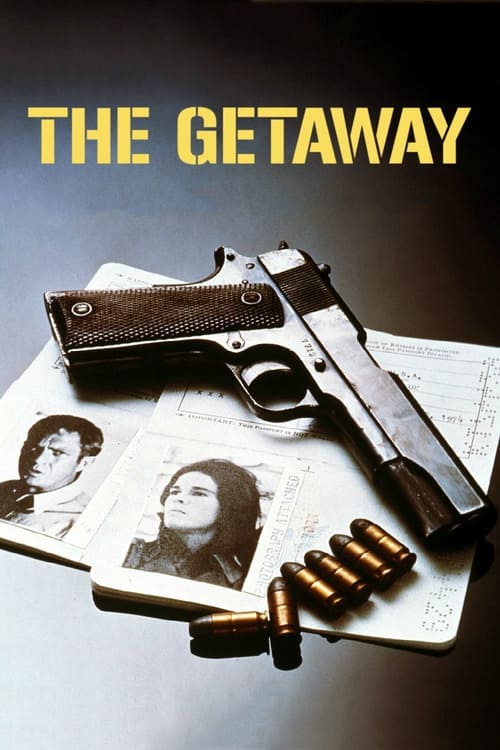
The Getaway
1972 · Sam Peckinpah
For when you want a no-nonsense, old-school thriller — cool professionals, real stakes, no filler. A great pick when you're craving pure genre satisfaction with some grit under its fingernails.
What it's about
Doc McCoy, a professional thief, is sprung from a Texas prison through a corrupt bargain that obliges him to pull one more bank job. When the heist curdles into a double-cross, Doc and his wife Carol go on the run toward the Mexican border with a bag of money, pursued by the mob and the law — their marriage tested as brutally as their nerve.
The experience
Lean, hard, and relentlessly propulsive — a chase film that keeps tightening the screws, with bursts of violence and a mean streak of black humor. What sticks is the tension inside the getaway car: two people who have to trust each other to survive, and aren't sure they can.
Performances
Steve McQueen at the apex of his stardom, doing his defining minimal-cool thing: watchful, economical, dangerous — a masterclass in doing less on camera.
The craft
Sam Peckinpah directs with the violent precision he was famous for, channeled here into a streamlined commercial thriller — taut editing, hard-edged action staging, and an eye for sun-blasted Texas locations. Walter Hill's adaptation of Jim Thompson's pulp novel keeps things fast and unsentimental.
Why it matters
A major box-office hit that proved Peckinpah could deliver mainstream entertainment without losing his bite, and a template for the couple-on-the-run thriller that action cinema has been remaking ever since.
Snapshot
The Getaway is Sam Peckinpah's lean, commercially triumphant heist thriller — the picture that proved the director of The Wild Bunch could deliver a mainstream hit without wholly sacrificing his sensibility. Adapted by Walter Hill from Jim Thompson's 1958 pulp novel and vehicled by Steve McQueen at the apex of his stardom, it follows Doc McCoy, a professional thief sprung from a Texas prison through a corrupt bargain, and his wife Carol, as a bank job curdles into double-cross and a running battle south toward the Mexican border. The film sits at an interesting fault line in Peckinpah's career: made in the same busy stretch as Straw Dogs (1971) and Junior Bonner (1972), it channels his obsessions with violence, professionalism, and the testing of a couple under pressure into a comparatively streamlined genre package. It is also famous offscreen — the production that ignited the romance between McQueen and co-star Ali MacGraw, and a case study in how star power (McQueen held contractual cut approval through First Artists) could override a director's authority. The result is a film admired for craft and momentum, dogged by debate over its performances and its softened ending, and steadily revalued as a key entry in the outlaw-couple and heist traditions.
Industry & production
The Getaway was produced under McQueen's own Solar Productions banner in concert with First Artists, the actor-owned company McQueen had joined alongside Barbra Streisand, Paul Newman, and Sidney Poitier — an arrangement that granted its principals unusual control over their projects, including cut approval. Producers David Foster and Mitchell Brower shepherded the picture. Crucially, this structure meant the film's final authority rested with McQueen rather than its director, a fact that shaped the finished work.
Peckinpah was not the first director attached; by most accounts Peter Bogdanovich was involved early and departed amid disagreements before Peckinpah came aboard. The material's route to the screen was itself contested: Jim Thompson, author of the source novel, wrote a screenplay draft that was set aside in favor of a script by Walter Hill — then a young writer for whom The Getaway was among his first produced credits, well before his own directing career (Hard Times, The Warriors, 48 Hrs.). Thompson's exclusion from the final screen credit became a sore point in accounts of the production.
Shooting took place largely on location in Texas — El Paso, San Antonio, San Marcos, Huntsville and environs — lending the film its arid, sun-flattened authenticity. The most consequential production drama, beyond the shoot itself, was the widely reported affair between McQueen and Ali MacGraw, who was then married to Paramount chief Robert Evans; MacGraw ultimately left Evans for McQueen, and the two married in 1973. Commercially, the gamble paid off handsomely: The Getaway became one of Peckinpah's biggest box-office successes, a mainstream hit that stood in contrast to the more divisive reception of his prior work. (Precise grosses vary across sources, so no single figure is asserted here.)
Technology
The film was shot in anamorphic widescreen (Panavision) and color, the format Peckinpah and cinematographer Lucien Ballard had exploited to landscape-filling effect on earlier collaborations. Technologically, the picture's most characteristic apparatus is Peckinpah's by-then-established multi-camera methodology: staging violent set pieces with several cameras running at varied frame rates so that action could be captured simultaneously at normal speed and in overcranked slow motion, then assembled in the cutting room. This dependence on high-speed cinematography and on the montage possibilities it opened is less a novelty here than a refined deployment of tools Peckinpah had pioneered on The Wild Bunch. Long telephoto lenses — compressing space, isolating figures against heat-hazed Texas backgrounds — are another signature instrument. The film does not break technical ground so much as apply a mature Peckinpah toolkit to a tighter genre frame.
Technique
Cinematography
Lucien Ballard, one of Peckinpah's most important collaborators (Ride the High Country, The Wild Bunch), shot The Getaway, and his contribution is central to its texture. Ballard renders Texas as a bleached, hard-edged expanse — dusty highways, motel forecourts, small-town main streets — with a naturalism that grounds the film's bursts of violence in an ordinary, sweltering world. His widescreen compositions favor depth and lateral movement, tracking the McCoys' flight across open country, while telephoto work flattens and abstracts crowds and pursuers into hostile masses. The photography's restraint — few showy angles, a preference for available-feeling light — is exactly what lets the choreographed action sequences register as ruptures.
Editing
Editing is where Peckinpah's authorship is most legible. The film's celebrated opening — Doc's psychological erosion inside prison — is built as an associative montage: fragmented, repetitive images of machinery, routine, and confinement, overlapping and accelerating to convey the deadening of time and mind rather than narrate it literally. Cut by Robert L. Wolfe, the picture elsewhere alternates propulsive, kinetic action assembly (the bank robbery, the climactic hotel shootout) with the elliptical, rhythm-driven approach Peckinpah favored. The action set pieces exploit the multi-camera slow-motion coverage through rapid intercutting of speeds and vantage points, extending and fracturing moments of impact. The much-noted garbage-truck sequence — the McCoys hiding in refuse and nearly crushed in a compactor — is a masterclass in escalating tension through cutting.
Mise-en-scène / staging
Peckinpah stages the film around a landscape of transit and disposability: motels, gas stations, train stations, a junkyard, the trash truck itself. The production design and location work insist on a grubby, functional America through which the couple must claw their way. Violence is blocked with characteristic precision — the shotgun-heavy bank job, the pump-action confrontations — and set against mundane surroundings that heighten the shock. The border-town hotel finale concentrates the film's spatial logic into a single besieged building, corridors and rooms turned into a shooting gallery.
Sound
The film's soundscape emphasizes the concussive: the report of shotguns, the mechanical grind of the compactor, the rush of highway and rail. The score is by Quincy Jones, whose jazz-inflected, harmonica-tinged music (reportedly featuring the harmonica of Toots Thielemans) gives the picture a cool, contemporary pulse quite unlike the orchestral idiom of Peckinpah's usual composer. That substitution is itself a production story: Jerry Fielding, Peckinpah's regular collaborator, wrote a score that McQueen — exercising his cut approval — had rejected and replaced with Jones's. The change reportedly strained the Peckinpah–Fielding relationship, and it stands as an audible marker of where final authority on this film actually lay.
Performance
McQueen's Doc McCoy is the film's anchor: a study in the actor's signature economy — watchful, terse, competent, radiating controlled menace and wounded pride. It is one of the definitive McQueen "professional" performances. Ali MacGraw's Carol drew the sharpest contemporary criticism; many reviewers found her range insufficient to the role's demands, and the disparity between the two leads became a recurring note in the film's reception. Around them, the supporting cast supplies much of the film's grit: Ben Johnson as the corrupt fixer Benyon; Al Lettieri as the sadistic double-crosser Rudy Butler, whose menace curdles the film's midsection; Sally Struthers and Jack Dodson as the couple Rudy terrorizes in a queasy subplot; and Slim Pickens, whose brief turn as the old cowboy who ferries the McCoys to the border lends the ending its unexpected grace note.
Narrative & dramatic mode
The narrative is a linear chase built on a heist's aftermath: a bargained release, a robbery, a betrayal, and a flight in which allies become predators and money becomes both goal and liability. Its dramatic mode is that of the hard-boiled crime thriller, but Peckinpah threads it with a marital drama. The central strain is Carol's having slept with Benyon to secure Doc's freedom — a transaction that poisons the couple's trust and must be worked through even as they run for their lives. This interior conflict runs parallel to a disturbing counter-plot: Rudy's abduction and psychological domination of a veterinarian and his wife, a sequence of humiliation and sexual power that mirrors and darkens the film's concerns with loyalty and degradation. The film's dramatic engine, then, is less "will they escape?" than "will the marriage survive what the escape reveals?" Notably, Hill's screenplay discards the novel's surreal, morally damning conclusion — Thompson's descent into "El Rey," a hellish kingdom of thieves — in favor of a comparatively upbeat getaway across the border, a softening that critics have long weighed against the source.
Genre & cycle
The Getaway belongs to two intertwined lineages. As a heist-gone-wrong crime picture, it descends from the caper tradition in which the job is the easy part and the split, the double-cross, and the flight are where men destroy one another. As a lovers-on-the-run film, it participates in the outlaw-couple cycle stretching from Gun Crazy (1950) through Bonnie and Clyde (1967) — though it pointedly revises that cycle: the McCoys are married rather than doomed young lovers, professionals rather than romantic amateurs, and they are permitted to survive. Arriving in the early-1970s wave of morally ambivalent, violence-forward American crime cinema, it also reflects the post-Bonnie and Clyde, post-Wild Bunch license for graphic, stylized bloodshed, while packaging that sensibility inside a movie-star vehicle designed for broad appeal.
Authorship & method
The film is a genuine hybrid of authorities. Peckinpah brings the recognizable signature — montage-driven violence, multi-camera slow motion, telephoto landscapes, an obsession with professionalism and with couples forged or broken under duress — and his key collaborators reinforce it: cinematographer Lucien Ballard and editor Robert L. Wolfe were part of his working ensemble. Yet The Getaway is equally a McQueen production, and where the star's contractual power intervened — most visibly in replacing Jerry Fielding's score with Quincy Jones's — the film bends away from Peckinpah's preferences. Walter Hill's screenplay supplies a taut, forward-driving structure and hard, functional dialogue that suit both men. The authorship question here is unusually live: the picture is Peckinpah's in craft and worldview but was finally shaped, at the level of cut and score, by a star who held the last word. That tension — auteur method inside a star-controlled apparatus — is much of what makes the film's place in Peckinpah's oeuvre debated.
Movement / national cinema
The film is a product of New Hollywood in its transitional, commercial phase: an American picture made when studio power was ebbing, star-owned production companies (First Artists, Solar) were ascendant, and directors of the "movie brat" and maverick generation were being handed genre material with newly loosened content standards. It reflects the era's appetite for violence and moral grayness while stopping short of the counterculture's more radical gestures. As national cinema, it is deeply American in setting and myth — Texas highways, prisons, border crossings, the frontier reflex of flight into Mexico — extending the Western's iconography into a contemporary crime frame, consistent with Peckinpah's career-long dialogue with the Western.
Era / period
Nineteen seventy-two places the film squarely in the high New Hollywood moment — the year of The Godfather — and within Peckinpah's most productive run: it followed Straw Dogs (1971) and appeared the same year as Junior Bonner, his other, gentler McQueen collaboration, before Pat Garrett and Billy the Kid (1973). The period's permissiveness around screen violence, its vogue for antiheroes, and the leverage of bankable stars over their vehicles are all legible in the picture. Set in a sun-worn present-day Texas, it captures an early-1970s America of motels, freeways, and small-town commerce with documentary plainness.
Themes
At its core the film is about professionalism and competence — Doc's calm mastery as the measure of the man — set against the fragility of trust, particularly within marriage. The wound of Carol's bargain with Benyon drives the film's emotional argument: that survival demands not just skill but the painful renegotiation of loyalty. Money functions as a moral solvent, testing every relationship it touches. Violence is treated, as ever in Peckinpah, as both spectacle and revelation of character, while the parallel Rudy subplot foregrounds domination, humiliation, and sexual power as the dark underside of the film's concern with couples. Running beneath is a flight-and-frontier motif — escape south, across the border, toward a provisional freedom — that ties the crime story back to the Western's mythology of the open country as refuge.
Reception, canon & influence
Critically, The Getaway met a divided response. It was recognized as a supremely well-made, propulsive entertainment and a commercial vindication for Peckinpah, but a number of critics regarded it as a lesser, more compromised effort than The Wild Bunch or Straw Dogs — slicker, thematically thinner, and softened in its ending relative to Thompson's bleak novel. Ali MacGraw's performance was a frequent target, and the film's box-office success sat somewhat awkwardly against its middling notices. Over subsequent decades its reputation has firmed, with reassessment crediting the craft of its action construction, the coolness of McQueen's star turn, and its assured genre engineering.
Its lines of influence run in both directions. Backward, the film draws on Jim Thompson's mid-century pulp fiction, on the outlaw-couple tradition from Gun Crazy to Bonnie and Clyde, on the caper film's anatomy of the double-cross, and on Peckinpah's own prior innovations in filmed violence. Forward, it stands as a template for the professional-criminal-on-the-run thriller and helped cement a screen grammar — kinetic, multi-camera, slow-motion-inflected action cutting — that reverberated through later crime cinema; Walter Hill would carry a related hard-boiled, motion-forward sensibility into his own directing career. The film's durability is underscored by its 1994 remake, directed by Roger Donaldson with Alec Baldwin and Kim Basinger and again working from Hill's screenplay — a reminder of how sturdy the underlying construction proved. Today The Getaway is best understood as the point where Peckinpah's auteur violence met the machinery of the star vehicle, a collision that produced one of the most efficient and enduring crime thrillers of its decade.
A Deleuzian reading
A machine turns over.
The full Deleuzian reading of The Getaway →
Reception
A big commercial hit in 1972 — one of Peckinpah's most profitable films — but critics sniffed at it as a director-for-hire job; today it's warmly regarded as prime McQueen-cool and top-tier Walter Hill-scripted genre craft, even if it still gets filed under 'minor Peckinpah.'
How The Getaway was received, from release to now →
Influences: the films it descends from and the films it influenced
- You Only Live Once (1937) — Established the fatalist outlaw-couple-on-the-run template — sympathetic doomed lovers fleeing the law across an unforgiving landscape — that The Getaway restages with Doc and Carol.
- High Sierra (1941) — Codified the aging professional criminal pulling one last job and fleeing into rugged terrain with a woman at his side, treating criminal competence as a personal code — the professionalism ethic McQueen's Doc inherits.
- Gun Crazy (1949) — Pioneered the criminally-bonded outlaw couple and the in-car, unbroken subjective getaway shot staged from the back seat, the front-seat flight grammar Peckinpah's road sequences descend from.
- Rififi (1955) — Fixed the caper's real subject as the post-heist double-cross and its violent unraveling rather than the robbery itself — the heist-aftermath-chase anatomy The Getaway is built on.
- The Killing (1956) — The racetrack heist whose loot literally scatters to the wind — a betrayal-and-collapse structure scripted with dialogue by Jim Thompson, the very novelist whose book The Getaway adapts.
- Ride the High Country (1962) — Peckinpah's own foundational grammar of elegiac professionalism and western iconography — men judged by their competence and their word — carried forward into a modern crime frame.
- Bonnie and Clyde (1967) — Dede Allen's rhythmic intercutting of violent impacts at varied frame rates produced the slow-motion death-ballet that Peckinpah systematized into his overcranked montage.
- The Wild Bunch (1969) — Peckinpah's own multi-camera overcranked squib montage and associative slow-motion violence — the exact editing grammar (Ballard/Wolfe ensemble) The Getaway's action inherits directly.
- The Driver (1978) — Getaway screenwriter Walter Hill's own directing debut extends its hard-boiled, motion-forward minimalism — a near-wordless professional wheelman defined purely by functional dialogue and getaway craft.
- Thief (1981) — Distills the lone professional's meticulous craft-code and existential ethic into a loner protagonist whose identity is his competence — the professionalism theme pushed to its purest expression.
- Reservoir Dogs (1992) — Dwells entirely on the post-heist double-cross fallout while eliding the robbery itself — the heist-aftermath structure The Getaway and Rififi pioneered, taken to its formal extreme.
- The Getaway (1994) — Direct remake reusing Walter Hill's original screenplay verbatim in structure, proving the sturdiness of the underlying professional-couple-on-the-run construction.
- Heat (1995) — Builds its whole moral universe on the professional's code and stages a heist-gone-wrong through kinetic multi-camera action cutting descended from Peckinpah's motion-forward grammar.
- The Way of the Gun (2000) — An explicit Peckinpah homage — amoral professional criminals, overcranked slow-motion squib violence, and a fatalist getaway that consciously recreates The Wild Bunch/Getaway action montage.
- Drive (2011) — The laconic getaway wheelman as pure craftsman, inherited through Hill's The Driver — professional-driver minimalism where identity is expressed entirely through wheel-work, not words.
- True Romance (1993) — Peckinpah's staging of the heterosexual criminal couple as a structural unit — pursued simultaneously by law enforcement and a competing criminal, culminating in a hotel siege — provides the basic narrative geometry of True Romance's third act.
- The Grifters (1990) — An earlier adaptation drawn directly from a Jim Thompson novel, part of the source-fidelity-to-Thompson lineage Westlake's screenplay honors.
- Revenge (1990) — Supplies the plot skeleton Harrison and Scott inherit — the powerful criminal's woman running with the man who crossed him, pursued by salaried killers toward the border — plus the convention that the couple's flight is shot as landscape endurance rather than chase geography.
- One False Move (1992) — Jim Thompson's paperback fatalism married to the car interior as pressure chamber — an entire criminal partnership staged in windshield two-shots with the highway ticking past behind the actors.
- Straw Dogs (1971) — The immediately prior Peckinpah film about a marriage tested and reforged under siege and escalating violence — the couple-under-duress drama running beneath The Getaway's chase.
- Charley Varrick (1973) — Lean, procedural thriller of a professional robber outrunning the mob after a heist goes wrong, sharing the same money-on-the-run pursuit engineering and craftsman-criminal cool.
- Bullitt (1968) — Carries McQueen's minimalist, competence-driven star persona into a procedural crime film, extending the understated-cool performance Bullitt fixed.
Similar films
- Ride the High Country (1962) — influence & lineage
- The Wild Bunch (1969) — influence & lineage
- Bonnie and Clyde (1967) — influence & lineage
- Heat (1995) — influence & lineage
- The Driver (1978) — influence & lineage
- Thief (1981) — influence & lineage
- Reservoir Dogs (1992) — influence & lineage
- Bullitt (1968) — shared sensibility