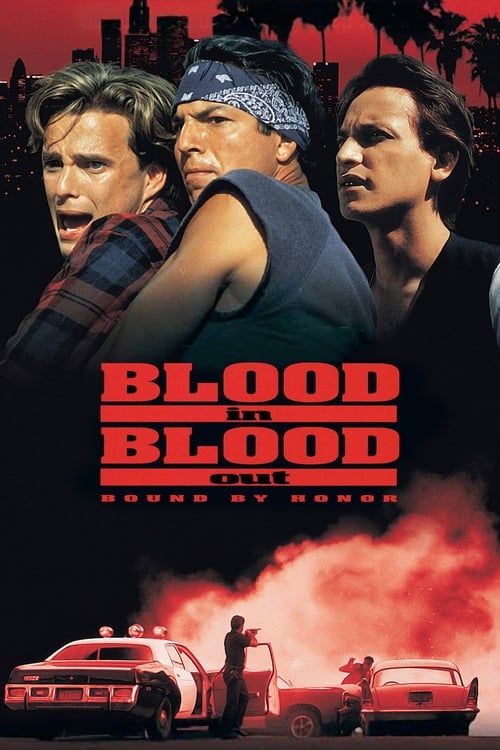
Bound by Honor
1993 · Taylor Hackford
For when you want a big, immersive crime epic with stakes that feel personal — a heavy, gripping commitment, not a casual watch. Ideal when you're in the mood for loyalty, tragedy, and a story with the sweep of years.
What it's about
East L.A., 1972: half-brothers Paco and Cruz and their light-skinned cousin Miklo run with the Vatos Locos street gang until one violent night splits their lives onto three separate tracks. Miklo goes to San Quentin and climbs the brutal hierarchy inside; Cruz, a gifted painter, is pulled under by heroin; Paco ends up an LAPD cop policing his own people. Drawn from the life of poet Jimmy Santiago Baca, it spans a decade of loyalty, betrayal, and blood debts.
The experience
A three-hour epic that earns its length — sprawling, violent, operatic, and completely absorbing, with the prison stretches delivering real menace and the family scenes real ache. It's the kind of saga you sink into for a whole evening and quote afterward.
Performances
Damian Chapa burns as Miklo, whose need to prove he belongs drives the whole tragedy, while Jesse Borrego brings genuine heartbreak to Cruz and a young Benjamin Bratt gives Paco a coiled, conflicted intensity.
The craft
Taylor Hackford shoots East L.A. and San Quentin with documentary-level texture — the murals, the yards, the slang all feel lived-in rather than researched, helped by Jimmy Santiago Baca's hand in the screenplay. The triptych structure lets three fates comment on each other across a decade.
Why it matters
A flop on release, it became one of the most beloved cult films in Chicano culture — endlessly quoted, passed down, and treated as a foundational screen portrait of East L.A.
Snapshot
Bound by Honor — released and now far better known under its original title Blood In Blood Out — is Taylor Hackford's three-hour epic of Chicano gang life, imprisonment, and blood loyalty in East Los Angeles from 1972 into the early 1980s. Structured as a triptych, it follows three young men of the "Vatos Locos" crew whose paths violently diverge: Miklo (Damian Chapa), a light-skinned half-Anglo cousin who must prove his brownness and rises through the prison hierarchy of San Quentin; Cruz (Jesse Borrego), a gifted painter destroyed by heroin; and Paco (Benjamin Bratt), who becomes an LAPD officer and thus his own kin's enemy. Grounded in the life and family history of Chicano poet Jimmy Santiago Baca, who co-wrote the screenplay, the film was a commercial failure on release yet has become one of the most durable cult objects in Latino American cinema — endlessly quoted, memorialized, and re-watched. Its dual-title history is itself a piece of the record: the studio, wary of gang content in the immediate wake of the 1992 Los Angeles uprising, softened the marquee name for the wider release while the harder, community-facing title survived on home video and in the culture.
Industry & production
The film was produced and distributed through Hollywood Pictures, the Walt Disney Company label then positioned for more adult, edgier fare than the Disney or Touchstone brands. That a Disney subsidiary bankrolled a long, subtitled-inflected, largely unknown-cast drama about Chicano prison gangs is the single most surprising fact of its production context, and it goes a long way to explaining what followed: a studio that did not know how to sell it, a title changed to blunt its subject, and a release that stranded a difficult art film in a mainstream distribution system. Hackford, coming off the commercial success of An Officer and a Gentleman (1982) and Against All Odds (1984) and having produced the Chicano-culture hit La Bamba (1987), carried enough clout to mount an expensive, wide-canvas project with an almost entirely Latino ensemble — a rarity for a major studio in the early 1990s.
Portions of the film were shot on location at San Quentin State Prison, lending the incarceration sequences documentary weight. The commercial outcome was poor; the film is widely described in the historical record as a box-office disappointment, and I will not attach specific grosses to it, as reliable figures for its limited theatrical run are not something I can cite with confidence. What is beyond dispute is the second life it found on video and cable, where it became a defining text of Chicano popular culture — a trajectory that inverts the usual studio logic and marks it as a film the industry made almost by accident.
Technology
Bound by Honor is a conventional 35mm photochemical production of its era, made before digital intermediates or nonlinear editing had reshaped mainstream Hollywood workflow. Its technological interest lies not in novel apparatus but in the disciplined deployment of standard early-1990s tools — anamorphic-friendly widescreen framing, location sound and prison-recorded ambience, optical post work — across an unusually long running time. The film's ambition is architectural and durational rather than technical; it uses the ordinary equipment of a studio drama to sustain an epic scale more often associated with the gangster sagas of the prior decade.
Technique
Cinematography
Photographed by Gabriel Beristáin, the film moves across three distinct visual registers keyed to its three strands. The East L.A. barrio of the opening act is rendered in warm, saturated daylight — muralism translated into light, with the neighborhood's painted walls and lowrider chrome treated as a living visual culture rather than backdrop. The San Quentin material shifts to a colder, more confined grammar: hard institutional light, concrete grays, the compressed geometry of tiers and yards. Cruz's world of art and addiction occupies a third register, softer and more interior. Beristáin, a cinematographer with a strong painterly sensibility, treats the recurring motif of Chicano visual art — Cruz's canvases, the barrio murals, prison tattoo work — as a throughline that lets the film argue for image-making itself as a mode of survival.
Editing
The most consequential technical decision is length. In its fullest form the film runs to roughly three hours, and the editing embraces a novelistic, chaptered rhythm rather than the propulsive cutting of a genre thriller. The triptych structure requires the cut to abandon and rejoin each brother across years, and the film accepts long stretches inside a single strand before returning to the others. This is a deliberately unhurried construction that trades momentum for accumulation; the emotional payoffs depend on time literally elapsing on screen. The trade-off is real — the film's pacing was among the qualities that made it a hard theatrical sell — but the durational commitment is inseparable from its epic aims.
Mise-en-scène / staging
Staging is organized around thresholds and territories: the barrio street, the prison yard, the cell, the police precinct. The film is acutely attentive to how space encodes belonging — who may stand where, which body is read as insider or outsider. Miklo's arc is staged almost entirely as a problem of positioning within the racialized geography of the prison, where alliance is spatial before it is verbal. The production design foregrounds Chicano material culture — dress, ink, iconography, religious imagery — not as decoration but as the grammar by which characters assert identity.
Sound
The film leans on period source music and barrio soundscape to fix its early-1970s East L.A. setting, and on the hard institutional ambience of the prison for its central act. I do not want to overstate specifics of the sound design beyond what the film plainly does — anchor place through music and environmental sound — since I cannot verify a detailed technical account of its mix.
Performance
Performance is the film's engine, and it launched or elevated several careers. Damian Chapa's Miklo is the fulcrum: a study in overcompensation, a man whose light skin makes his belonging perpetually provisional and whose response is a hardening into something more absolute than any of his darker-skinned peers. Benjamin Bratt, early in his career, gives Paco a wounded rectitude, and Jesse Borrego makes Cruz's decline genuinely tragic rather than cautionary. The deep ensemble — including Enrique Castillo as the prison mentor figure and a young Danny Trejo in an early role that prefigured his long screen career — gives the incarceration scenes a lived-in authority. The casting of a predominantly Latino ensemble in fully dimensioned roles is itself part of the film's historical significance.
Narrative & dramatic mode
The dominant mode is tragic epic. The film adopts the multi-generational, multi-strand architecture of the great crime sagas and bends it toward a fatalism specific to its milieu: three young men who begin as one crew are sorted, by blood, skin, and circumstance, into incompatible fates. The dramatic irony is structural — Paco the cop and Miklo the gang leader are family, and the film's engine is the impossibility of their reconciliation. Rather than a single protagonist's rise and fall, it offers three braided arcs whose intersections generate its meaning. The mode is unafraid of melodrama in the older, dignified sense: large emotions, moral absolutes tested against circumstance, loyalty elevated to the level of tragic necessity.
Genre & cycle
The film sits at the confluence of the prison drama, the gang film, and the family crime epic. It arrived within the early-1990s cycle of American films centered on urban communities of color and gang life — a moment that also produced Boyz n the Hood (1991), Juice (1992), and American Me (1992), the last especially relevant as another film about Chicano prison gang power. Against that cycle, Bound by Honor is distinguished by its epic length and its explicit lineage from the family-saga gangster tradition; where many contemporaries were tight, contemporary, and neighborhood-scaled, Hackford's film reaches for decades and generations. It is a Chicano crime epic in a register the studios had rarely, if ever, extended to Mexican American subject matter.
Authorship & method
The film is a genuine collaboration between an established Anglo studio director and Chicano source authorship. Taylor Hackford brought the craft of mainstream studio drama — he is a director of large, emotionally direct pictures (An Officer and a Gentleman, later Ray in 2004) and had already engaged Chicano culture as producer of La Bamba. The screenplay carries the authorship of Jimmy Santiago Baca, the poet whose own life and family history — including incarceration — supplied the film's material and its claim to authenticity; he shares screen credit with additional writers, and I will not assign the precise apportionment of story-versus-screenplay credits here, as I cannot verify that breakdown confidently. Cinematographer Gabriel Beristáin supplied the film's painterly command of light and its tri-partite visual scheme. The score is generally credited to Bill Conti, a frequent presence in Hackford's filmography and a composer associated with muscular, emotionally frontal orchestral writing. The editing sustains the film's novelistic length. The essential method is the grafting of insider testimony (Baca) onto studio-scale craft (Hackford and his collaborators) — a hybrid that accounts for both the film's authority and its occasional tension between authenticity and epic convention.
Movement / national cinema
Bound by Honor belongs to Chicano cinema, the current of Mexican American filmmaking that reached wider visibility in the late 1980s and early 1990s through films such as La Bamba and American Me. It is a complicated instance: a Chicano story, cast, and co-authored by a Chicano poet, but directed by a non-Chicano filmmaker and financed by a major studio. That hybridity has made it a recurring subject in discussions of who authors Latino screen representation. Within the broader field of American national cinema it functions as one of the most ambitious mainstream attempts to render Mexican American experience at epic scale, and its afterlife in Chicano communities has effectively claimed it as a community text regardless of its studio provenance.
Era / period
The film is both set in and marked by its moment. Its story spans the early 1970s to the early 1980s — the era of the Chicano Movement's aftermath, of heroin's devastation of urban barrios, and of the entrenchment of the racialized prison-gang system in the California penal complex. Its production moment, 1992–93, is equally legible: it emerged directly into the aftermath of the 1992 Los Angeles uprising, a context that made a studio nervous enough to alter its title and that gave its subject matter an unwelcome topicality. The film thus sits at the hinge between the period it depicts and the anxious early-1990s discourse about race, policing, and urban violence into which it was released.
Themes
The governing theme is loyalty as both salvation and doom — the "blood in, blood out" ethos that admits no exit and that the film treats with tragic seriousness. Braided through it are the film's other preoccupations: the instability of racial identity, dramatized through Miklo's mixed heritage and the way skin color adjudicates belonging on both sides of the prison wall; incarceration as a total social world with its own economy, politics, and racial order; addiction as a private catastrophe set against communal violence, embodied in Cruz; and art as resistance, with Chicano muralism, tattooing, and painting recurring as assertions of dignity against erasure. Family — specifically brotherhood, biological and chosen — is the arena in which all these forces collide, and the film's deepest argument is that the codes meant to protect a community can also consume it.
Reception, canon & influence
Critical reception on release was mixed and the commercial performance weak; the film's length and the studio's uncertainty about how to position it worked against it, and it did not enter the mainstream critical canon of its year. Its influences run backward to the family crime epics of the 1970s and to the immediately preceding cycle of American gang and prison films, American Me foremost among Chicano-specific antecedents. Its true significance is in the forward direction and in the register of culture rather than prestige. Over the following decades, largely through home video and cable, Blood In Blood Out became a cornerstone of Chicano popular culture — its lines quoted, its iconography absorbed, its status as a foundational Latino cult film secure. It helped launch or advance the careers of Benjamin Bratt, Jesse Borrego, and Damian Chapa, and it stands as an early credit in Danny Trejo's now-iconic screen presence. Its legacy is that of a film the industry undersold and a community adopted — a canonical text of Chicano cinema whose authority was conferred not by critics or box office but by the audience whose life it set out to represent. Where the granular record of its reception is thin, that reversal is the essential fact: a studio failure that became a people's classic.
Reception
Dumped into theaters in 1993 after post-LA-riots jitters got it retitled and barely released, it flopped with critics who called it bloated — but three decades on it's a stone-cold cult classic and a cornerstone of Chicano cinema, quoted like scripture in the communities that adopted it.
How Bound by Honor was received, from release to now →
How to watch Bound by Honor: what to notice on a first viewing
- Notice the light change color as each brother's world shifts. Beristain shoots the barrio in warm saturated daylight, the prison in cold institutional grays, and Cruz's world in something softer, so you can tell whose story you're in by color alone. The palette does the work of announcing whose section of the triptych you're watching.
- Watch who is allowed to cross which line or doorway. The film keeps staging scenes around a threshold, the barrio street, the yard, the cell, the precinct desk, where standing on the wrong side marks a body as insider or outsider. Belonging in this film is a matter of where you're allowed to stand, not what you say.
- Notice murals, tattoos, and paintings recurring throughout the film. Barrio murals, prison tattoo work, and Cruz's canvases keep appearing as the film's own throughline of imagery, in three different settings. Image-making itself keeps showing up as something characters do to survive, not just decoration around them.
- Track how long the film stays with one brother's story. Instead of cutting quickly between the three men, the film settles into one strand for long stretches before jumping years ahead to rejoin another. The patience lets each brother's fate build up slowly instead of getting rushed through for momentum.
The whole guide to watching Bound by Honor, with the keys for a rewatch →
Influences: the films it descends from and the films it influenced
- The Godfather Part II (1974) — Supplies the novelistic-length family crime epic with a braided, parallel-strand structure in which blood loyalty is the engine that ultimately fractures the family — the tragic-epic register Beristáin and the editors sustain across the three cousins.
- American Me (1992) — The immediate Chicano-specific antecedent: it codified the racialized prison geography (La Eme / pinta yard politics, cell-block territory) and the Latino pinta ensemble that Bound by Honor restages a year later.
- Once Upon a Time in America (1984) — Model for the durational, decades-spanning crime saga that follows a cohort of boyhood friends into betrayal, tracking time through faces aging inside a deliberately over-long, memory-weighted cut.
- Scarface (1983) — Established the operatic Latino gangster rise-and-fall built on frontal emotional excess and quotable iconography — the maximalist crime-opera mode Conti's muscular orchestral scoring services here.
- La Bamba (1987) — Hackford produced it; it is the direct template for the studio-scale-craft-plus-Chicano-authorship hybrid and for the period-source-music strategy aimed squarely at a Latino audience.
- Zoot Suit (1981) — Foundational Chicano feature whose theatricalized pachuco iconography and staged racialized-identity performance seed the film's East LA barrio self-presentation and mural-adjacent visual code.
- Boulevard Nights (1979) — Early barrio gang film whose two-brothers-on-diverging-paths armature and on-location East LA vato staging are the structural blueprint for Paco, Cruz and Miklo's forking fates.
- I Am Joaquin (1969) — The Chicano Movement's poetry-as-cinema origin point, establishing art-as-resistance and muralist identity assertion — the exact lineage that legitimizes Baca's poet-authorship and Cruz's painter arc.
- Mean Streets (1973) — Bequeaths the ensemble of neighborhood men bound by loyalty and Catholic guilt, scored through diegetic period source music rather than underscore, immersed via street-level staging.
- My Family / Mi Familia (1995) — Extends the multigenerational Chicano family epic in the same saturated, painterly-muralist light and braided generational structure, carrying the East LA tragic-epic mode forward two years later.
- Selena (1997) — Carries the studio-scale, emotionally frontal Latino epic built on period source music and a star-making lead performance, made for and embraced by the same Latino audience that adopted this film.
- Machete (2010) — Built entirely on the Danny Trejo screen persona that Bound by Honor first crystallized, extending its tattooed-convict iconography into leading-man mythology.
- La Mission (2009) — Benjamin Bratt-led barrio drama that inherits the lowrider-and-muralism visual vocabulary and the thresholds-and-territories staging of machismo, advancing a career this film launched.
- Mi Vida Loca (1993) — Contemporaneous Echo Park Chicana gang film sharing the braided multi-strand vignette structure and reliance on a largely nonprofessional Latino ensemble drawn from the neighborhood.
- Ray (2004) — Hackford's own later authorship in the same key: a large, emotionally direct biographical epic organized around period source music and a bravura lead performance sustained over epic length.
- City of God (2002) — Parallel durational crime epic of a marginalized community, using a chaptered/tri-partite braided structure and a nonprofessional local ensemble to give insider testimony epic scale.
Similar films
- Scarface (1983) — influence & lineage
- The Godfather Part II (1974) — influence & lineage
- Mean Streets (1973) — influence & lineage · same viewing thread
- Once Upon a Time in America (1984) — influence & lineage · same viewing thread
- Carlito's Way (1993) — same viewing thread
- Mystic River (2003) — same viewing thread
- A Bronx Tale (1993) — same viewing thread
- The Godfather (1972) — shared sensibility
All the films related to Bound by Honor →
Watch it with: curated runs of related films
- American Crime, Long Memory — A run of mob epics, noir, and neighborhood tragedies that all circle the same wound — loyalty, masculine violence, and the past that never lets go — so watch them close together and let the decades and cities blur into one long American story.